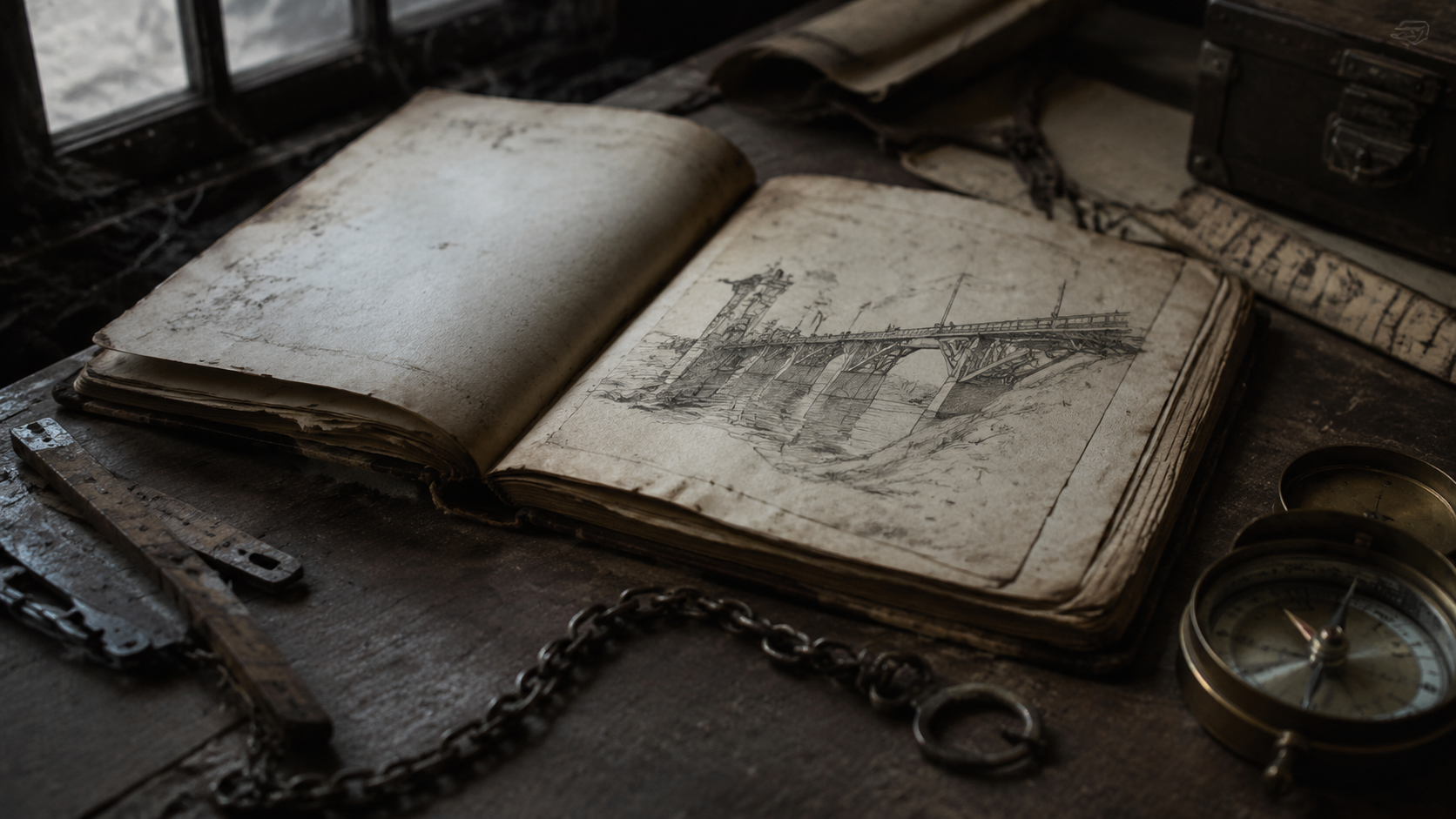
A pencil line in the Ashton Creek survey notebook bends where it should have stayed straight.
At first, it looks like a correction. A draftsman noticed a truss member in the wrong place, pressed harder with the pencil, and circled the flaw so someone else would understand it later.
That is the easy reading. Railway survey books are full of corrections, false starts, and field guesses that were never meant to become mysteries.
What makes this one harder to file away is the date on the cover: October 1886. The bridge it appears to describe was not completed until 1889, and the circled flaw resembles a damage mark recorded only after an accident in 1891.
The Notebook That Should Have Been Boring
The notebook is not dramatic in appearance. It is a narrow field book, the kind survey crews used because it could fit inside a coat pocket and survive rain better than loose paper.
Its pages contain slopes, creek crossings, soil notes, timber estimates, and small sketches made quickly beside the route. Most of it is exactly what a railway historian would expect.
The odd section begins with a creek profile later cataloged as Ashton Creek. The page shows an approach grade, two abutment positions, and a bridge outline drawn with enough confidence to feel less like a proposal than a record.
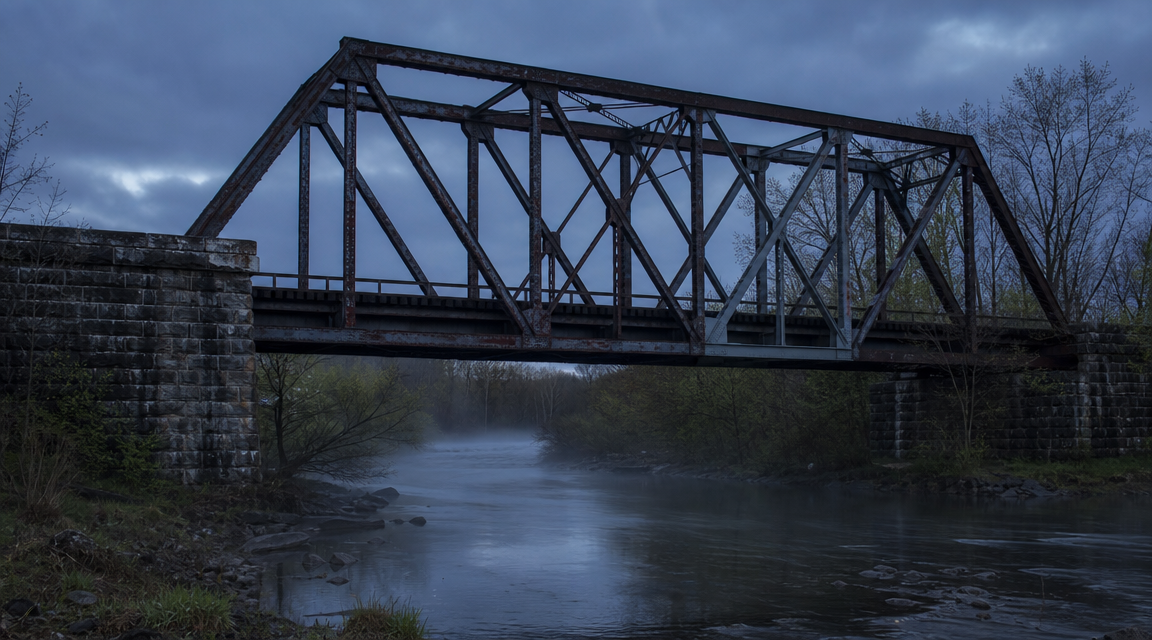
This sketch includes a deck height, a span, and a truss rhythm close to the bridge photographed after completion.
What the Railway Was Trying to Cross
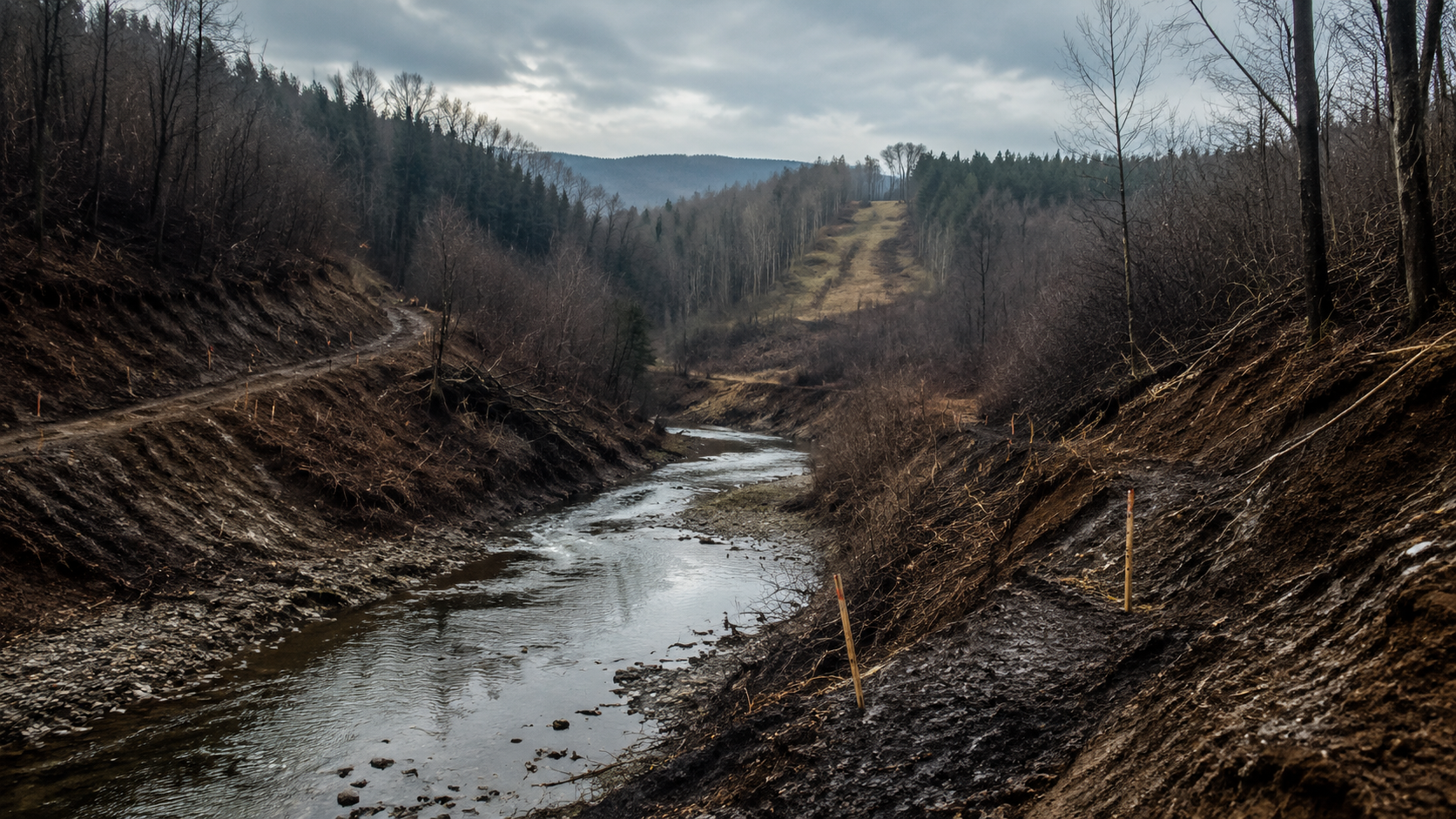
Ashton Creek was not a grand obstacle. It was a narrow, stubborn waterway that cut through a wooded ravine and swelled badly after spring rains.
For railway planners, that kind of crossing could be more troublesome than a famous river. It did not justify monumental engineering, but it still demanded a structure strong enough for freight loads, wet ground, and ice.
The line was surveyed in stages. Crews walked ahead of construction, testing routes and adjusting grades before investors agreed to final expense.
In that setting, an 1886 note about a future bridge would not be strange by itself. Surveyors often anticipated where bridges would go.
The strange part is the level of finish. The page does not simply say a bridge is needed. It seems to know what kind of bridge arrived later, where it would sit, and which section would become important after something went wrong.
The Detail People Return To
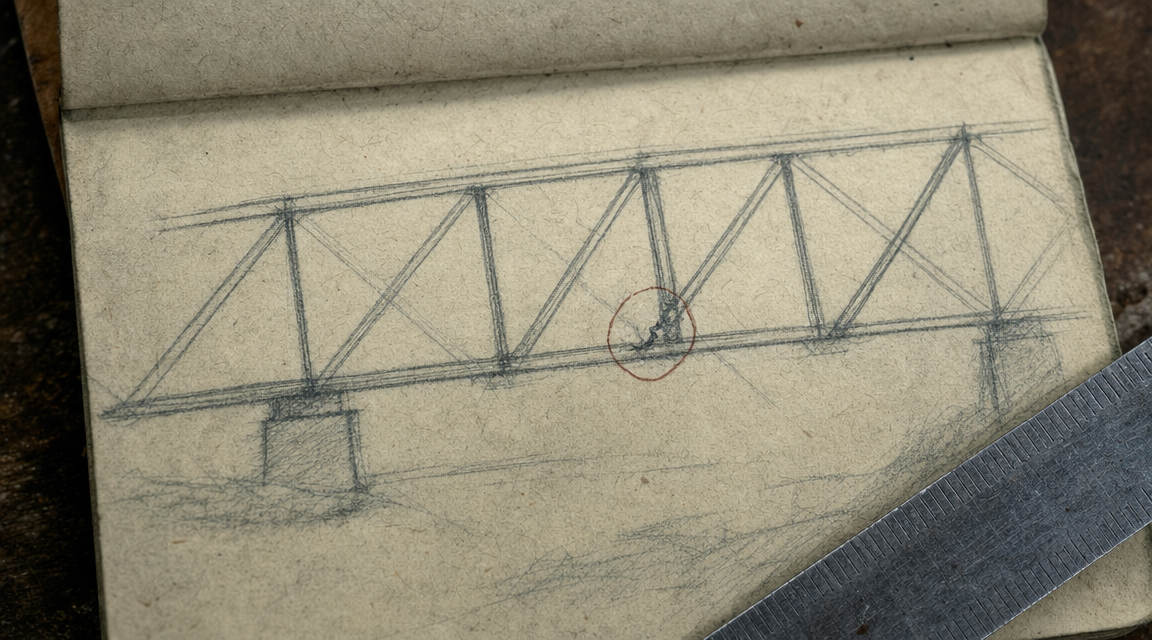
Most discussions of the notebook return to a small mark near the lower chord on the east side of the sketched bridge.
It is easy to miss. The mark is no larger than a fingernail, a short dark stroke surrounded by a faint oval. It could be a smudge, a field notation, or a later reader's emphasis.
But in the bridge maintenance file, an 1891 accident report describes damage to the lower east truss after a loaded freight car jumped the rail during a slow crossing. The report does not describe a collapse. It describes a localized strike, followed by reinforcement and a temporary speed restriction.
The repair location appears to correspond with the circled mark in the 1886 notebook.
That does not prove anything impossible. It does, however, explain why the page has outlived its ordinary purpose. The notebook seems to point not only to the bridge, but to the place where the bridge would later be hurt.
Why the Simple Explanation Is Not Enough
The simplest explanation is that the notebook was misdated.
That would solve much of the problem. If the cover date were wrong, or if pages from different years were bound together later, the bridge sketch might be a post-construction note placed inside an older field book.
Archival collections are rarely clean. Papers are moved, rebound, donated, re-labeled, and sometimes organized by someone who only half understands what they are seeing.
Yet the date problem does not disappear so easily. The paper stock appears consistent through the book. The handwriting in the Ashton Creek section resembles surrounding entries. The sequence of notes before and after the sketch follows the same survey route.
There is also no obvious reason for someone to insert an 1891 or later bridge note into the middle of an 1886 field sequence. Possible, yes. Cleanly satisfying, no.
The Most Reasonable Theory
The most reasonable theory is not time travel, prophecy, or a haunted railway crew. It is a less theatrical possibility: the bridge design may have existed earlier than surviving construction records suggest.
Railway companies often reused standard bridge plans. A surveyor might have copied a planned span from an engineering office, then carried that design into the field years before construction money arrived.
If Ashton Creek had been assigned a standard truss design in 1886, the notebook could accurately show a bridge that would not be built until 1889.
The accident mark is harder, but it may also have a practical explanation. What looks like damage may have indicated a weak point, a stress concern, a joint detail, or a place requiring reinforcement because of the creek alignment.
Later, when the 1891 accident damaged that same area, the old mark gained a more unsettling meaning.
In other words, the notebook may not have predicted the accident. It may have identified the vulnerability that made the accident memorable.
That explanation is sober. It fits the habits of engineers. It also makes the document more interesting, because it suggests the later damage was not entirely random.
The Accident That Changed the Page
The 1891 incident at Ashton Creek was minor by the standards of railway disasters. No dramatic casualty list is attached to it. No famous photograph shows wreckage hanging over the ravine.
A freight movement crossed slowly after heavy rain. One car reportedly shifted or jumped enough to strike part of the truss. Traffic was delayed, inspectors were sent, and repair work followed.
The official language is practical and dry. It treats the bridge as a problem to be measured, fixed, and returned to service.
But once the accident report is read beside the older notebook, the dry language changes. The circled pencil mark begins to look like a warning waiting for a matching event.
That may be a trick of hindsight. Humans are extremely good at making old marks meaningful after new facts appear.
What Could Have Happened in the Archive
There is another grounded possibility: the mark may be later than the sketch.
Someone reviewing the notebook after the 1891 accident could have circled the corresponding part of the drawing. That person might have been an engineer, clerk, investigator, or collector connecting the original design to the damaged section.
If so, the bridge sketch can remain genuinely early while the most mysterious mark becomes a later annotation.
This theory is attractive because it explains the page without requiring the whole book to be misplaced. It also fits how working documents are used.
The difficulty is proving it. Pencil does not always surrender its timeline easily. Pressure, oxidation, smudging, and paper wear can hint at sequence, but they rarely give a clean date.
Unless a conservation study identifies the circled mark as a later addition, the notebook remains suspended between two ordinary explanations.
Either the mark came before the accident as a design concern, or it came after as an investigative note.
Both are plausible. Neither feels completely complete.
How the Story Became Stranger Than the Evidence
The Ashton Creek notebook likely spent decades as a quiet archival object before anyone treated it as unusual.
That is common with historical mysteries. The object does not change. The questions around it do.
A railway enthusiast notices a date. A local historian compares a sketch to a later photograph. Someone else reads an accident report and recognizes the marked section. The pieces begin to gather around one another.
By the time the story is retold, the careful version can become too neat: a notebook predicted a bridge and marked its future wound.
That phrasing is memorable, but it is also too certain. The actual evidence is more delicate. It suggests, resembles, corresponds, and raises questions. It does not speak in thunder.
The better mystery is quieter. It asks how much future can appear inside planning, maintenance, and hindsight before we mistake preparation for prediction.
The Part That Still Feels Unresolved
If the notebook only described a planned bridge, it would be a useful historical record. If the accident mark was added later, it would be a sensible engineering annotation.
The unresolved feeling comes from the combination.
The page looks like a field note, a plan, a memory, and a warning at the same time. Each explanation accounts for one layer while leaving another slightly exposed.
That is why the Ashton Creek notebook belongs in Unexplained History rather than outright folklore. Nothing about it requires a supernatural answer. Its unease comes from paperwork doing something paperwork is not supposed to do.
A routine notebook seems to know too much, or at least to invite that suspicion.
In the end, the most honest reading may be that the page records a vulnerability before it became an incident.
That would make the notebook less impossible, but not less haunting. It would mean the future was not predicted. It was engineered into place, sketched in pencil, crossed by heavy wheels, and only recognized after the damage appeared.
Reader Context
This Weird Witnessed story is an editorial reconstruction, written as eerie visual storytelling rather than a verified report. For more context, see How to Read Weird Witnessed Stories and How WeirdWitnessed Creates Reconstructed Horror Stories.