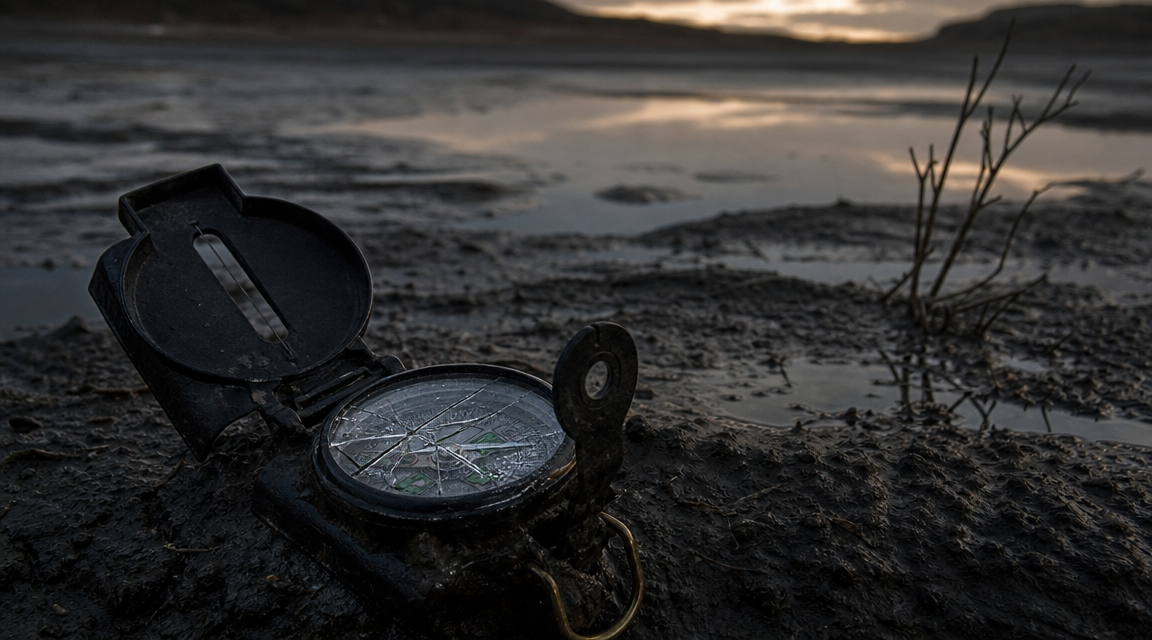
A cracked black field compass should not have been the strangest thing found in the mud.
When the reservoir was drawn down for repairs, the exposed basin produced the usual inventory of lost and abandoned objects: bottles, fence wire, rusted cans, a few tools, and pieces of road surface that had not seen open air in decades.
The compass looked ordinary at first. Its lid was missing, its glass was split across the face, and the black paint had worn thin at the edges.
What made people keep talking about it was not that it pointed somewhere strange once. It was that, in the recreated version, it pointed toward the same vanished road only at dusk, as if the last useful direction it remembered was not north but a place erased by water.
The First Version of the Find
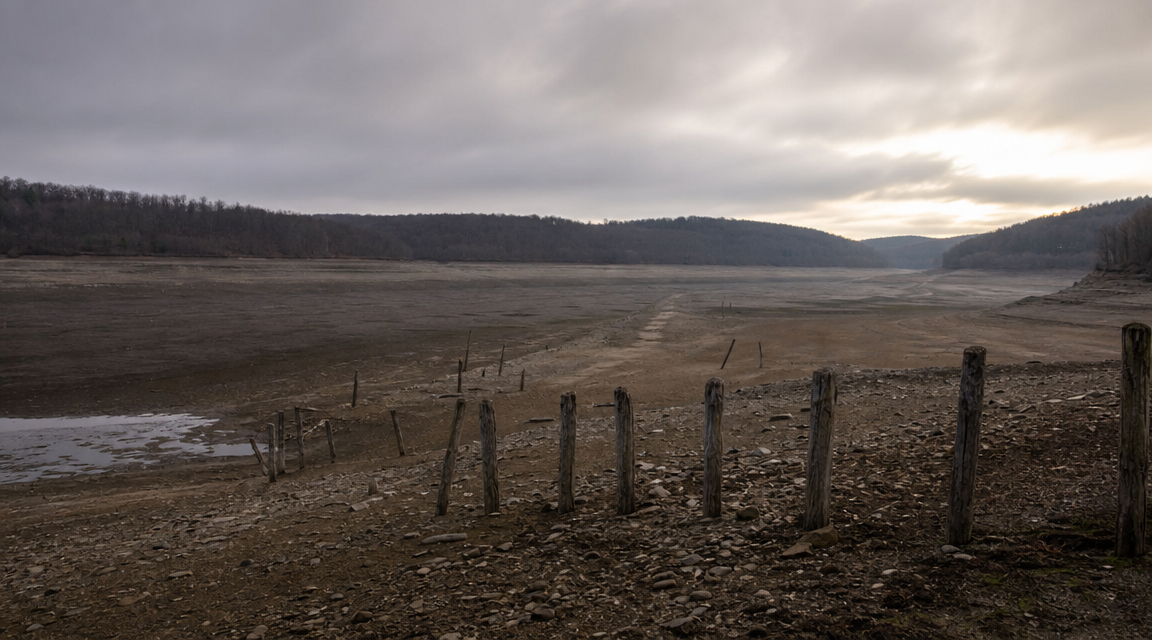
The story usually begins with a maintenance drawdown at a rural reservoir, the kind that briefly turns a lake back into a valley.
Workers and locals walked the exposed margins because people always do when hidden ground appears. Mud holds a particular invitation. It promises that ordinary things may have been waiting in silence.
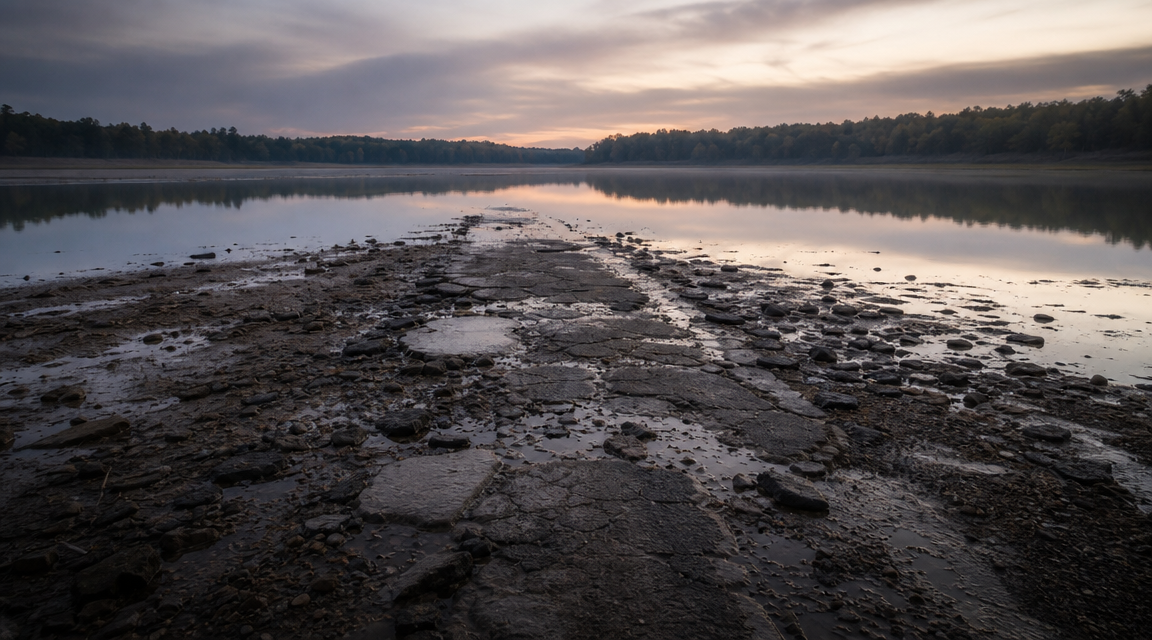
The compass was reportedly found near a line of broken aggregate and dark stones that older residents identified as part of the pre-reservoir road.
No dramatic discovery followed. There was no sealed box, no inscription, no body, and no obvious historical marker attached to it.
That plainness is part of why the account has lasted. A strange object that arrives without ceremony is often harder to dismiss than one wrapped in legend.
A Road Removed From the Map
Before the reservoir, the basin was crossed by a narrow service road or country lane, depending on which version of the account is told.
It connected farms, cut along a low ridge, and then dipped toward a bridge or culvert that disappeared when the valley was flooded.
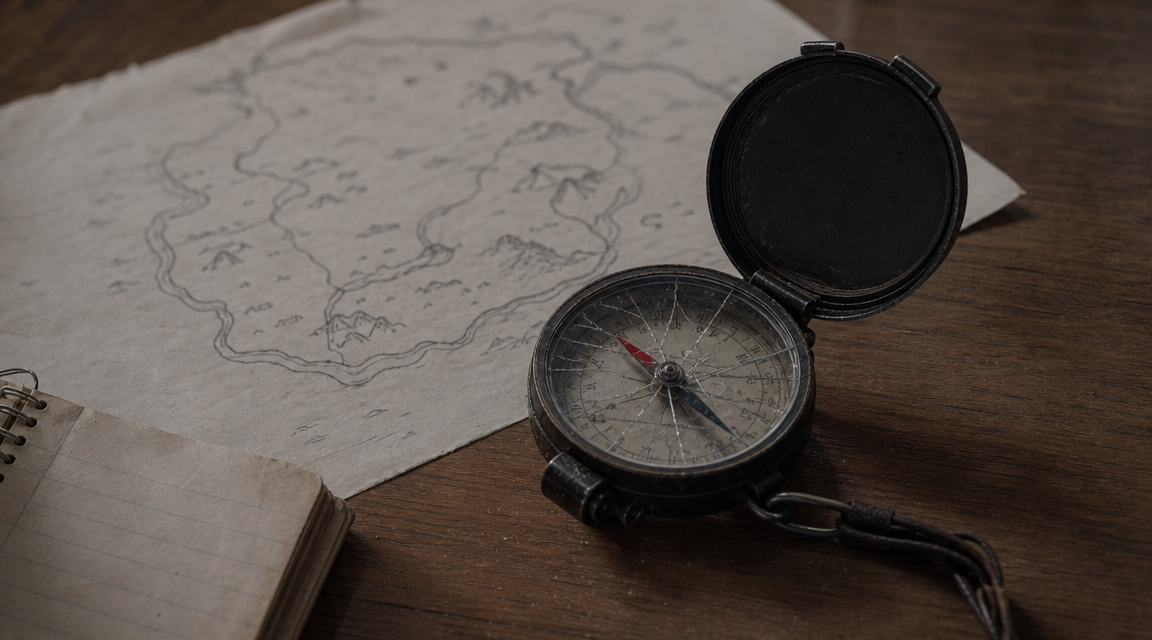
Old maps apparently showed a thin line where current maps show only water. That detail matters because it gives the compass story a physical target.
It was not said to point toward a vague memory or a spiritual north. It pointed, witnesses claimed, toward a specific alignment in the mud.
When the reservoir filled again, that alignment vanished under the surface, leaving the compass as the only portable part of the story.
What the Compass Was Said to Do
By day, the compass behaved badly but not impossibly.
A cracked housing, water damage, grit in the pivot, or a weakened magnet can make a needle sluggish or unreliable. Nobody needed a paranormal explanation for a surplus compass that had spent years underwater.
The odd behavior was said to appear around dusk.
As the light flattened and the basin cooled, the needle would hesitate, drift, and then settle away from north. According to the strongest version of the account, it pointed toward the drowned roadbed with enough consistency that several people tried moving the compass to test it.
The most cautious reports do not say it snapped violently or spun like a prop in a ghost story.
They say it turned slowly, as if choosing the wrong answer with confidence.
The Most Reasonable Explanations
The practical explanations come first, and they are strong.
A submerged compass may contain corrosion products, mineral residue, or trapped particles that interfere with the needle. If the housing warped, the pivot could bind at certain angles. If the needle was remagnetized by scrap metal, machinery, or electrical equipment, it might no longer point accurately.
The reservoir itself could also matter.
Drained basins are full of hidden metal: fence wire, nails, culvert fragments, dumped appliances, reinforcement bar, and lost tools. A compass placed near any of these could give strange readings.
Temperature changes at dusk might affect moisture inside the case or a sticky pivot.
There is nothing impossible about a damaged compass changing as the air cools.
The question is whether those explanations account for the repeated direction toward the old road rather than simply random error.
The Dusk Detail That Keeps Returning
Many strange-object accounts lean on timing because timing gives coincidence a shape.
In this case, dusk matters because it is both ordinary and suggestive. It is when workers pack up, when shadows simplify the landscape, and when exposed mud stops looking like a worksite.
If the compass had pointed toward the road all day, people might have blamed a buried pipe or wire under that alignment.
If it had spun randomly at night, the account would feel easier to file under exaggeration.
Only at dusk sits in a stranger middle ground. It suggests a condition rather than a performance.
Maybe the temperature shifted. Maybe the viewer's patience changed. Maybe the low light made a minor deflection seem meaningful. Or maybe the object had a repeatable fault no one properly documented.
The cautious answer is not that dusk proves anything. It is that dusk gave the story its pattern.
What Witnesses Could Have Misread
The vanished road itself complicates the account.
Once people knew where it had been, they may have unconsciously aligned the compass with the story. A needle that sat slightly off north could become more impressive when placed beside a remembered route.
Human perception is not dishonest by default. It is hungry for pattern.
A local who grew up hearing about the drowned road might see direction where an outsider would see malfunction. A worker who found the object near the roadbed might remember later tests as more precise than they were.
There is also the problem of maps.
Old roads rarely run as straight in reality as they do in memory. If the road curved, dipped, or crossed the basin at an angle, then saying the compass pointed toward it may mean several different things.
This is where the story becomes less certain, but also more interesting.
The compass may not reveal a hidden force. It may reveal how quickly a place can return to the imagination once water withdraws.
The Part That Remains Unresolved
The unresolved part is not whether a compass can be broken. Of course it can.
The unresolved part is why the account kept narrowing around one direction, one time of day, and one lost piece of geography.
If the object had simply failed, the story would have ended in a drawer. Instead, people reportedly tested it because it behaved just well enough to be worth watching.
That is the uncomfortable category where many strange objects live.
They are not convincing a detail people read as anything large. They are not clean enough to become science, and not theatrical enough to become folklore immediately.
They persist because they leave a small practical question unanswered.
What, exactly, was the compass responding to?
How the Story Changed After the Water Returned
Once the reservoir refilled, the setting became harder to check.
The roadbed disappeared again. The mud line vanished. Any buried metal that may have influenced the needle returned beneath water and silt.
The compass, meanwhile, became easier to mythologize because it was no longer surrounded by the conditions that might explain it.
Some versions say it was kept in a workshop. Others place it in a local collection, a tackle room, or a box of objects recovered during the drawdown.
The details shift, which is a warning sign for anyone trying to treat the story as evidence.
But the central image remains stable: a black cracked compass, a drowned road, and the falling light in which north stopped being the answer.
That image is probably why the account travels better than a technical explanation ever could.
Why the Compass Still Matters
The reservoir compass is valuable as a mystery because it does not need to be exaggerated.
It asks a small question in a precise setting. It does not require a ghost on the shore, a voice from the water, or a curse attached to the object.
Its unease comes from the way places remember what maps forget.
A road can be removed, flooded, and renamed as part of a lake, but the ground beneath it does not become abstract. It stays lined, graded, compacted, and interrupted by whatever people left behind.
A compass that points toward such a road may be malfunctioning. It may be reacting to hidden metal. It may be following damage inside its own cracked case.
Still, the story lingers because the wrong direction was also a meaningful one.
That is the difference between error and mystery.
An error points nowhere. This one, if the witnesses remembered it correctly, pointed toward a road that had vanished but had not quite stopped being there.
Reader Context
This Weird Witnessed story is an editorial reconstruction, written as eerie visual storytelling rather than a verified report. For more context, see How to Read Weird Witnessed Stories and How WeirdWitnessed Creates Reconstructed Horror Stories.