The Shower That Looked Too Narrow
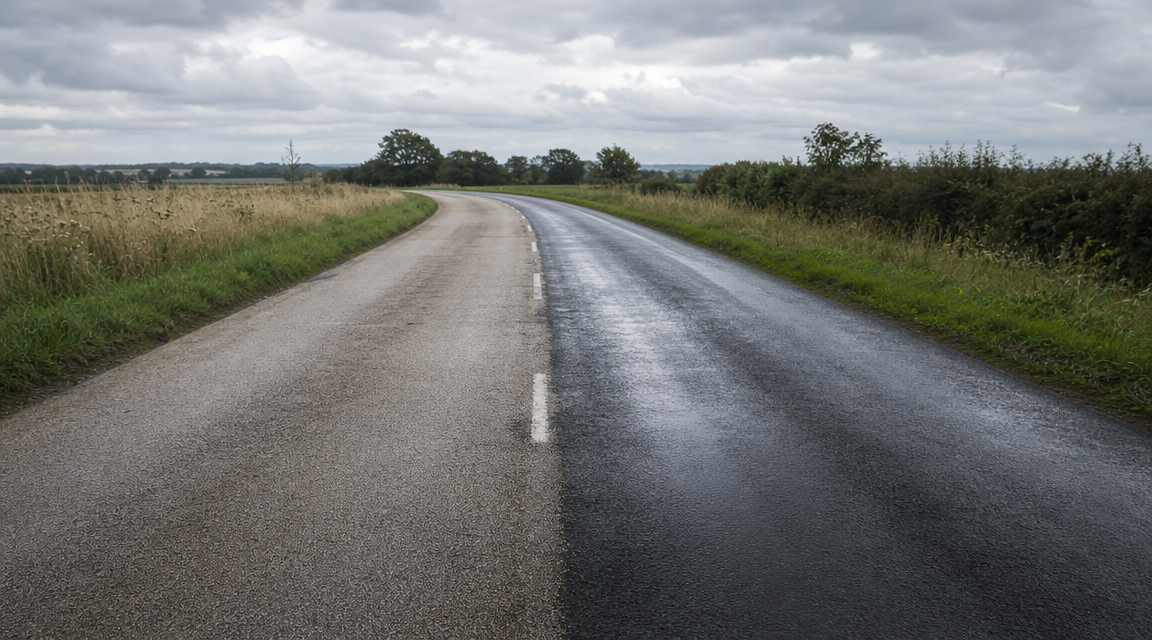
The Ashford rain was not remembered because it was violent, beautiful, or especially long. It was remembered because, according to the people who saw it, it behaved as if the road had been divided by an invisible ruler.
The account concerns a rural two-lane road outside Ashford, where drivers and at least one nearby resident later described rain falling on only one lane for several minutes. The opposite lane, the painted center markings, and both shoulders were said to have remained dry.
That claim sounds simple until someone tries to explain it cleanly. Rain can be patchy. Showers can pass in thin curtains. But a lane is a human measurement, not a weather pattern.
The oddness rested in the neatness. Witnesses did not report a general drizzle tapering off across a field. They described a narrow falling sheet that followed the road surface closely enough to leave a single dark stripe behind.
What Witnesses Said They Saw
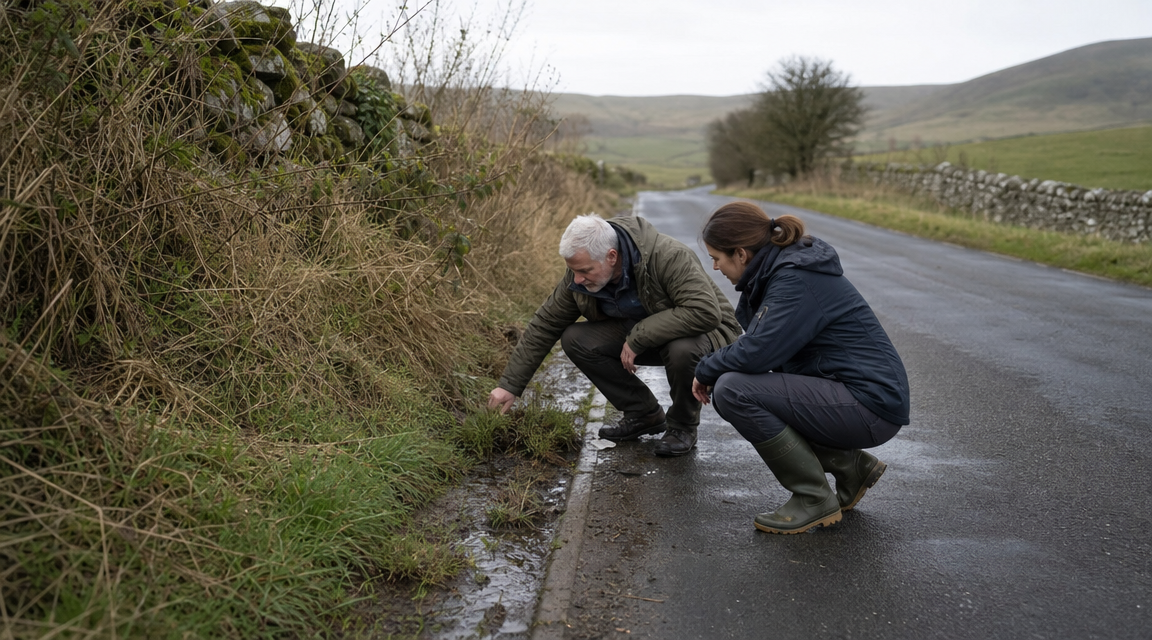
The first driver reportedly noticed it while approaching a slight bend. Ahead, the left-hand lane looked freshly soaked, darker than the rest of the road, but there was no general rainfall on the windscreen.
As the car entered the patch, drops began striking the glass and roof. The sound lasted only while the vehicle occupied that lane. When the driver moved beyond the wet section, the rainfall stopped as abruptly as it had begun.
Another witness, coming from the opposite direction, gave the detail that made the story linger: the rain seemed to be falling beside them, not on them. Their lane stayed dry while the adjacent lane showed active splashes.
A person near a field entrance later described seeing a thin vertical shimmer in the air over one side of the road. It was not a wall, exactly, and not a mist cloud. It was more like ordinary rain compressed into a strangely narrow place.
None of these descriptions prove the event happened exactly as remembered. They do show that the lane-specific detail was not added as a vague afterthought. It was the center of the story from the beginning.
The Stripe Left Behind
The most practical evidence was the pavement afterward. People who returned or stopped nearby reported a clean wet stripe in one lane, running for a short distance along the road.
The shoulders were reportedly dry enough to show dust and pale grit. The opposite lane did not have the same darkened sheen. Where tires had crossed the wet stripe, they carried water briefly into drier areas, leaving ordinary tracks.
That matters because it separates the account from a purely aerial impression. If the witnesses had only seen rain from a distance, perspective could have done much of the work. The pavement gave the story a second stage.
The stripe was not described as a puddle, overflow, or spill pooling downhill. It was described as a wetted surface, as if rain had fallen directly onto that portion and stopped at a boundary.
The clean edge was never perfect in a laboratory sense. Roads are rough, cambers vary, and tires smear water. Still, several descriptions emphasized the contrast between one side and the other.

The First Suspects: Sprinklers and Tankers
The easiest explanation was a hidden human source. A roadside sprinkler, agricultural sprayer, leaking irrigation line, or passing tanker can create a wet lane and fool a witness who arrives moments later.
That possibility was apparently checked first. The roadside verge showed no obvious sprinkler head, burst hose, or active irrigation pipe. There was no visible spray drifting from a field, and no machinery nearby when people inspected the area.
A tanker explanation also had problems. A leaking water truck can leave a long wet trail, especially if a valve is faulty or a load is sloshing. But such a trail usually follows tire movement and often shows splashing near bends, junctions, or braking points.
The Ashford stripe, as described, did not look like a vehicle leak centered between wheels. It occupied a lane rather than a narrow track. No one reported seeing a water lorry pass immediately before the incident.
Absence of evidence is not evidence of absence, especially on a country road. A vehicle could have passed minutes earlier. A temporary hose could have been removed. But the usual suspects did not satisfy the people who looked.
Could Weather Really Do That?
Weather is stranger at small scales than most people expect. Rain does not always fall as a broad, even sheet. Showers can have sharp edges, and convective clouds can release pockets of precipitation with surprising boundaries.
A narrow rain shaft can pass over one side of a road while sparing the other, especially when wind shear, uneven terrain, and localized uplift are involved. From the ground, such edges can look theatrical.
There are also phenomena called virga and microbursts, though neither fits perfectly. Virga evaporates before reaching the ground, and microbursts are usually gusty, forceful downdrafts rather than polite lane-sized showers.
A more modest explanation is a tiny shower cell drifting across the road at just the right angle. If it moved parallel to the lane for a few minutes, it could create the impression that rain was obeying the road.
The difficulty is scale. A traffic lane is roughly three meters wide. Natural rain boundaries can be sharp, but keeping one aligned with a lane long enough for multiple observers to notice is a rare bit of geometry.
The Road Surface Problem
Another possibility is that the rain was less selective than the pavement made it appear. Different road surfaces can darken differently depending on age, aggregate, oil residue, repairs, and texture.
If one lane had been recently resurfaced, sealed, or contaminated with fine dust, it might show moisture more dramatically than the other. A light shower across the whole road could then be remembered as rain on one side only.
Camber also matters. Roads are built to shed water. A subtle slope can carry moisture toward one lane, making it look as though only that side received the rainfall.
But this theory has to handle the reports of active drops. Drivers said they heard and saw rain while passing through the affected lane. That does not disappear just because asphalt absorbs water unevenly.
Still, surface effects may have sharpened the mystery. A normal narrow shower plus a road that displayed wetness unevenly could produce a cleaner stripe than the sky actually delivered.
Memory, Angles, and the Urge for a Boundary
Human memory likes edges. When something odd happens quickly, the mind often organizes it into a clearer shape after the fact. A patch of rain becomes a strip. A strip becomes a lane.
The witnesses were moving, too. Drivers saw the scene through glass, in changing light, with reflections, road markings, hedges, and approaching traffic all competing for attention. A few seconds of perception can harden into a precise memory later.
There is also the social life of an odd event. Once one person says, “It was only in that lane,” others may compare their memories against that frame. Matching details grow stronger. Complications fade.
That does not mean the witnesses were dishonest. It means the cleanest version of a strange experience is not always the first version the world supplied.
The Ashford account remains interesting because even skeptical explanations preserve something odd. Whether the boundary was in the sky, on the road, or in memory, the event produced a remarkably consistent image.
Why the Single-Lane Detail Stayed
Most brief weather oddities vanish from conversation. A sudden burst of rain, a dry patch under a tree line, or a sunlit shower across a field becomes a small remark and then nothing.
This one survived because it borrowed the language of traffic. Everyone understands a lane. It is painted, regulated, and ordinary. Saying rain fell in one lane makes the sky sound as if it recognized road rules.
That is why the detail is so hard to shake. A roadside shower is meteorology. A lane-only shower feels like a mistake in the agreement between natural and human order.
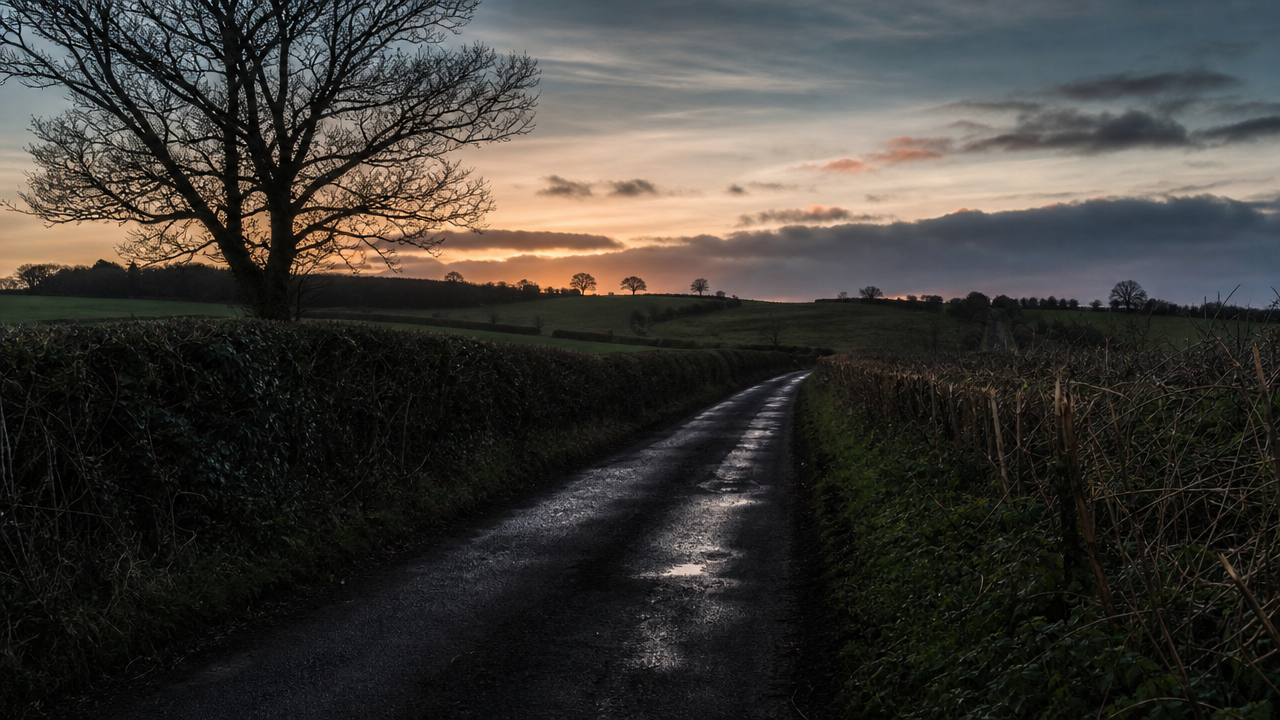
It also left behind a scene simple enough to picture: two lanes, one wet and one dry, a dividing line, and people standing around looking for a pipe that was not there.
The best explanation may be a combination rather than a single dramatic answer. A narrow shower, wind direction, surface differences, road camber, and witness framing could all have contributed to the impression.
What Can Be Said Safely
There is no need to turn the Ashford rain into a supernatural event. Nothing in the account requires impossible physics, and small-scale weather can be deeply unintuitive.
There is also no need to flatten it into nothing. The reported inspection found no obvious sprinkler line, no passing tanker, and no simple roadside mechanism. The witnesses had a reason to keep talking.
The case sits in the uncomfortable middle where many good weird events live. It is not a detail people read as anything grand. It is a moment when ordinary explanations are available but none feels fully satisfying.
If the rain did fall exactly as described, it was likely an accidental alignment of weather and road, brief enough to happen and vanish before instruments could care. If it did not, then the story still reveals how strongly people respond to sharp boundaries in the everyday world.
Either way, the image remains: a country road near Ashford, one lane dark with fresh rain, the other pale and dry, and a few witnesses wondering why the weather seemed to know where the line was.
Reader Context
This Weird Witnessed story is an editorial reconstruction, written as eerie visual storytelling rather than a verified report. For more context, see Camera Anomalies and Strange Images Guide and How WeirdWitnessed Creates Reconstructed Horror Stories.