The Object That Should Not Have Been There
Most trail camera mysteries ask us to look for something hiding in the dark. A face between branches. A pale animal that might not be an animal. A person standing too far from any road.
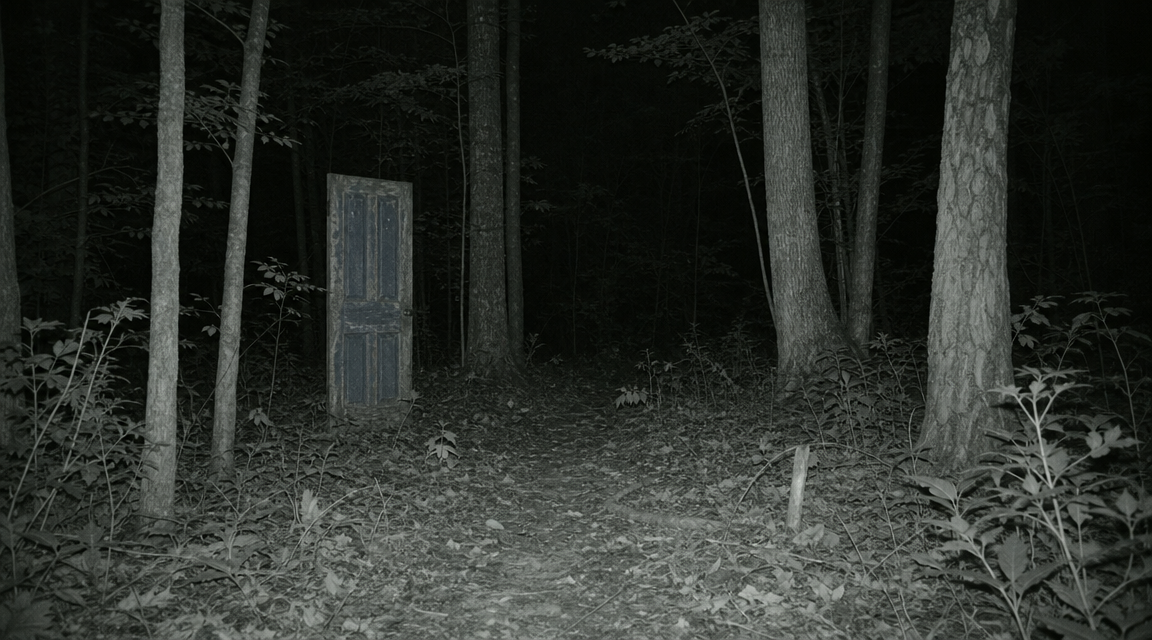
The blue door photo is different because it does not hide. It is right there in the frame, rectangular and obvious, standing upright in woodland as if the forest had briefly decided to include a room.
The story attached to the image is simple. A wildlife trail camera set along a wooded game path reportedly captured a weathered blue interior door during one night of camera record. It appeared in multiple frames, remained upright among the trees, and was gone after dawn.
No cabin was found nearby. No obvious drag marks showed how it had been brought in. The timestamps, according to the account, were normal and continuous.
That is why the image still bothers people. It is not theatrical. It is just an ordinary household object in a place where ordinary rules make it feel wrong.
What the Camera Reportedly Showed
The camera was said to be a standard motion-triggered wildlife unit, the kind used by hunters, landowners, researchers, and people curious about what crosses their property after dark.
The setting was not described as an abandoned lot or the edge of a rural dump. It was woodland: trunks, undergrowth, fallen leaves, and a narrow natural corridor where animals might pass.
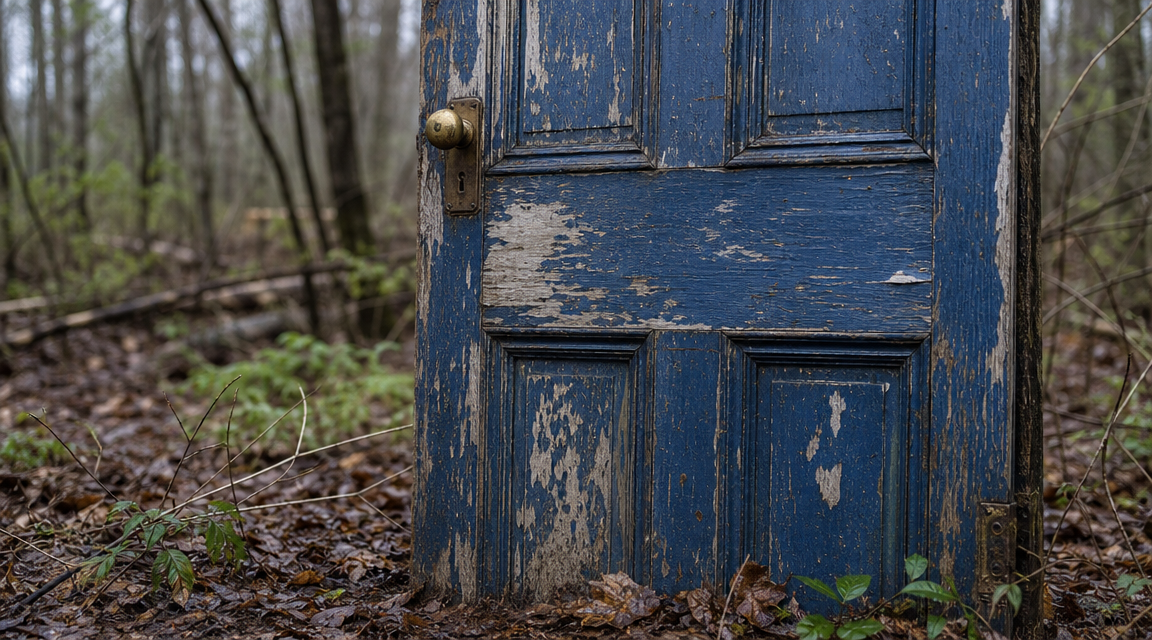
In the strange sequence, the door stands a short distance from the camera. It appears to be an interior door, not a heavy exterior slab or farm gate. The paint is faded blue, worn enough to look old, but not so ruined that it blends into the ground.
The object has the unnerving clarity that trail cameras sometimes produce. The background is flat from infrared light, but the shape is too clean to dismiss as a stump or shadow.
There are no visible hands holding it. No person is captured walking away. No vehicle lights appear between the trees. Nothing in the frame explains why a door would be standing there.
The One-Night Detail
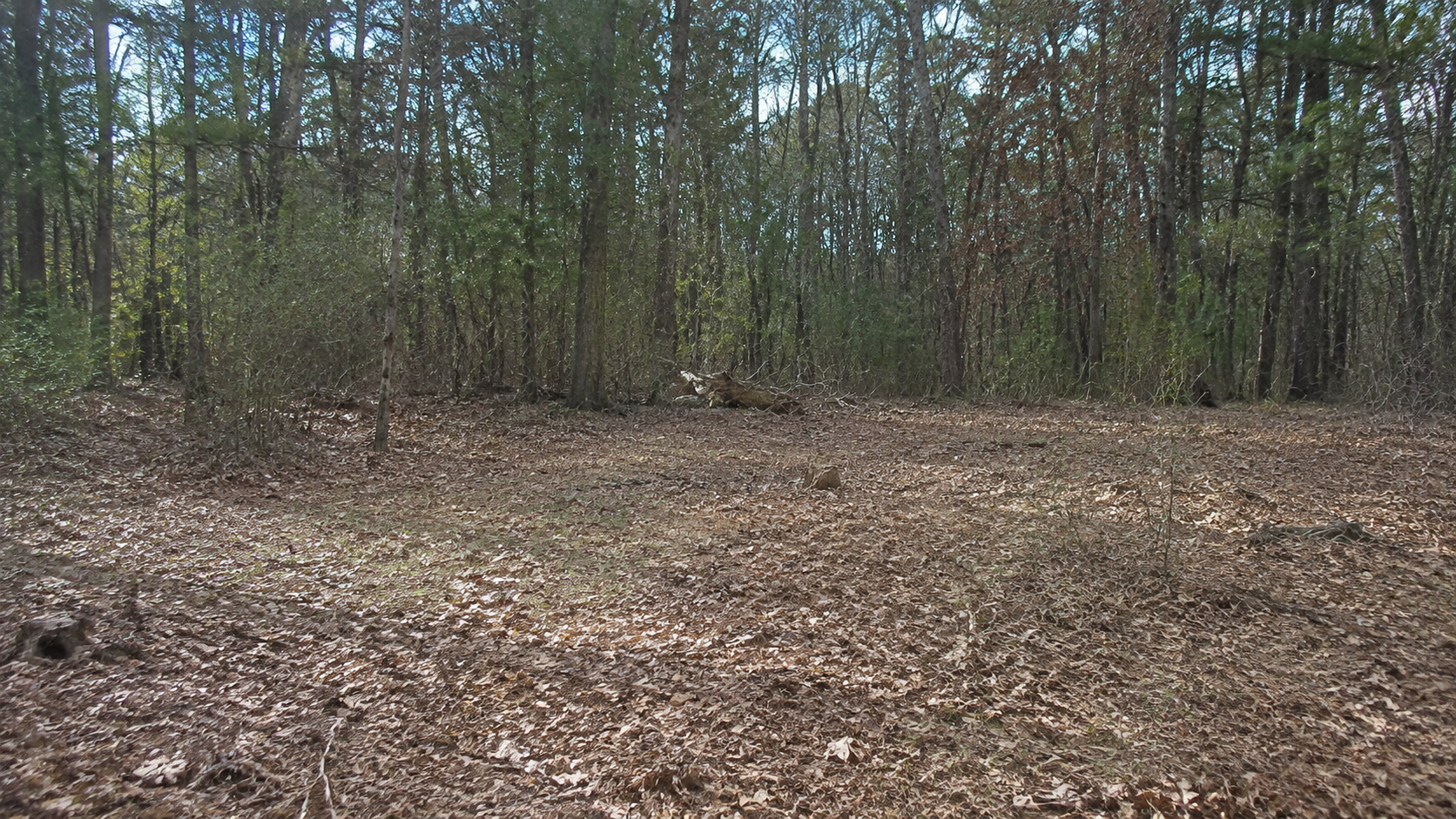
The most repeated part of the account is that the door was present for one night only. Earlier images reportedly showed the clearing as it usually was. Later images showed it empty again.
That matters because a single odd frame can be blamed on blur, corruption, or a momentary illusion. A repeated object across several frames is harder to reduce to a glitch.
At the same time, a one-night appearance is exactly the kind of detail that makes cautious readers hesitate. If someone carried a door into the woods as a prank, one night would be enough. If someone was dumping old materials, a door could come and go quickly.
But the weirdness does not come from the door existing. Doors are common objects. The weirdness comes from the clean absence of context around it.
A door in the woods usually belongs to a story: an old homestead, a shed foundation, storm debris, a campsite, an art project, or illegal dumping. In the circulated version, none of those explanations came with the photo.
Why No Cabin Matters
When people first hear about a door in the forest, the natural assumption is that a structure must be nearby. An abandoned cabin can disappear into brush faster than expected, especially if only a few walls remain.
Searchers in the story reportedly found no cabin, no ruins, and no obvious frame or foundation that would explain a loose interior door standing in that specific clearing.
This does not prove anything supernatural. Rural land often contains forgotten debris far from where it began. Previous owners, storms, campers, teenagers, and cleanup projects can all move objects into unlikely places.
Still, the lack of a nearby building is what turns the photo from odd to memorable. A door implies a threshold. A threshold implies a room. The woods offered no room.
That mismatch is what viewers respond to. The camera seems to have photographed the punchline of a missing structure, as if the rest of the house had been carefully erased.
The Ground Did Not Help
The other practical detail people mention is the ground. If a full door had been hauled through leaves and soil, viewers expected to see scuffs, flattened plants, or a clear drag trail.
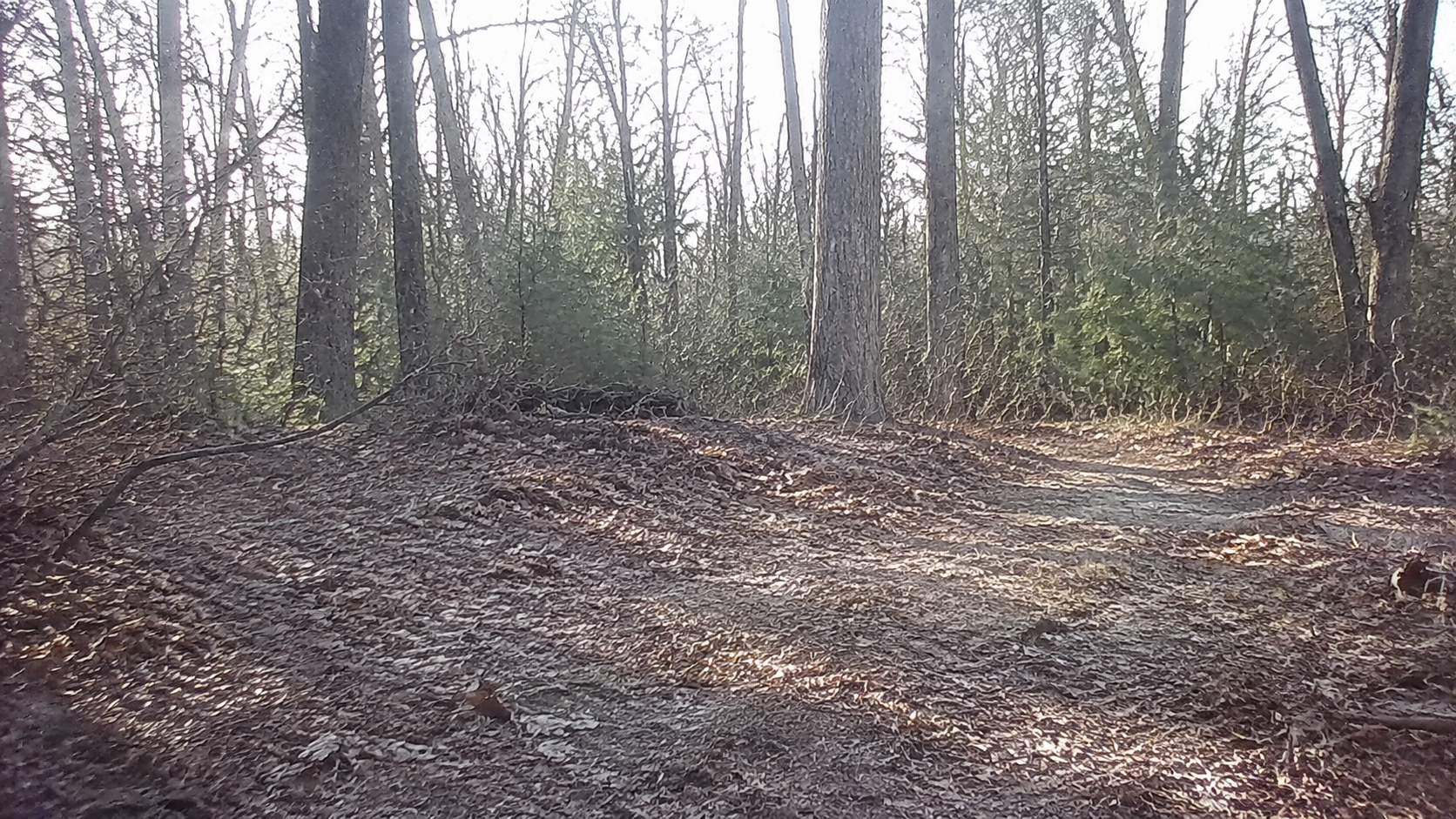
According to the account, there were no obvious marks leading to or from the object. The clearing looked mostly normal before and after.
This is interesting, but it should be handled carefully. Trail camera images are not forensic surveys. Infrared flash flattens texture. Leaves can spring back. A person carrying a hollow interior door might not leave much evidence at all.
A lightweight door could be moved by two people without dragging. One determined person could carry it overhead or under one arm for a short distance, especially if the terrain was manageable.
So the missing marks do not make the event impossible. They make it annoying. They remove the easiest visual clue, leaving the door standing there without a visible route.
Why a Door Feels Worse Than a Figure
Many eerie photographs rely on the possibility of a person or creature watching from the edge of the frame. The blue door image creates a different kind of unease.
A figure has motives, even if we do not understand them. It can be lost, hiding, trespassing, hunting, or simply misidentified. A door has no motive. It is an object that belongs to architecture, privacy, and transition.
Placed upright in a forest, it looks like an invitation without a host. It suggests entry, but offers nowhere to enter. It suggests an inside, but stands in open air.
That contradiction is why the photo works so well as a weird image. It does not need eyes. It does not need motion. It becomes strange by being too normal.
There is also a familiar dream quality to it. Many people have imagined doors appearing in landscapes where they should not be. Seeing that arrangement in a camera trap image gives the scene a borrowed feeling of memory.
The Hoax Problem
The most grounded explanation is also the least satisfying: someone placed the door there. That could mean a prank, a staged internet mystery, an art project, or a private joke never intended to travel widely.
A blue door is not hard to find. Old doors are often removed during renovations and left in barns, sheds, or scrap piles. Putting one in front of a trail camera would be simple if the person knew the camera was there.
The image's strength is also its weakness. Because the object is ordinary and the scene is static, it would not require advanced editing or elaborate construction. It would require only a door, a wooded spot, and timing.
Other explanations remain possible. Someone may have used it as a temporary blind, carried it as scrap, or moved it through a nearby property project. If the camera was closer to a path or boundary than viewers assume, the event becomes less impossible and more eccentric.
None of this confirms the photo is fake. It only means the photo does not need a paranormal explanation to exist. Caution is part of the story.
Why It Still Circulates
The blue door photo persists because it offers a perfect little rupture in normal scenery. It is specific enough to remember and plain enough to believe someone might actually have seen it.
It also reverses the usual caught-on-camera formula. Instead of asking whether an object in the woods is alive, it asks why a dead household object looks so purposeful.
The door faces the camera like it has been placed for inspection. It is not lying flat or broken against a tree. It stands with a kind of patient, wrong dignity.
That posture is doing much of the work. A door on the ground is trash. A door upright is architecture. Architecture in the middle of trees becomes a question.
Even skeptics can enjoy that question without accepting anything supernatural. The mystery does not require a ghost to be effective. It only requires a human mind to notice that a threshold has appeared where no threshold belongs.
The safest conclusion is that the blue door was most likely placed there by a person, whether as a prank, a temporary prop, or an act of dumping that happened to be caught by a wildlife camera.
The less safe conclusion, and the reason people keep returning to the image, is that the explanation is absent from the frame. We see the result, not the action. We see the object, not the carrier.
Trail cameras are good at creating that gap. They do not record continuously like a film crew. They wake when something moves, capture fragments, and leave us to imagine the missing minutes.
In those missing minutes, a perfectly ordinary blue door becomes strange. It may have been carried by muddy hands. It may have been staged. It may have been a joke that outlived the joker.
But the photograph still has its grip because it shows a piece of an interior world standing alone outside. For one night, in one wooded clearing, the camera caught a door with no house, no hallway, and no visible reason to be there.
That is enough. Not every weird image needs a monster. Sometimes the most unsettling thing in the forest is an object that knows exactly what it is, while we have no idea how it arrived.
Reader Context
This Weird Witnessed story is an editorial reconstruction, written as eerie visual storytelling rather than a verified report. For more context, see Camera Anomalies and Strange Images Guide and How WeirdWitnessed Creates Reconstructed Horror Stories.