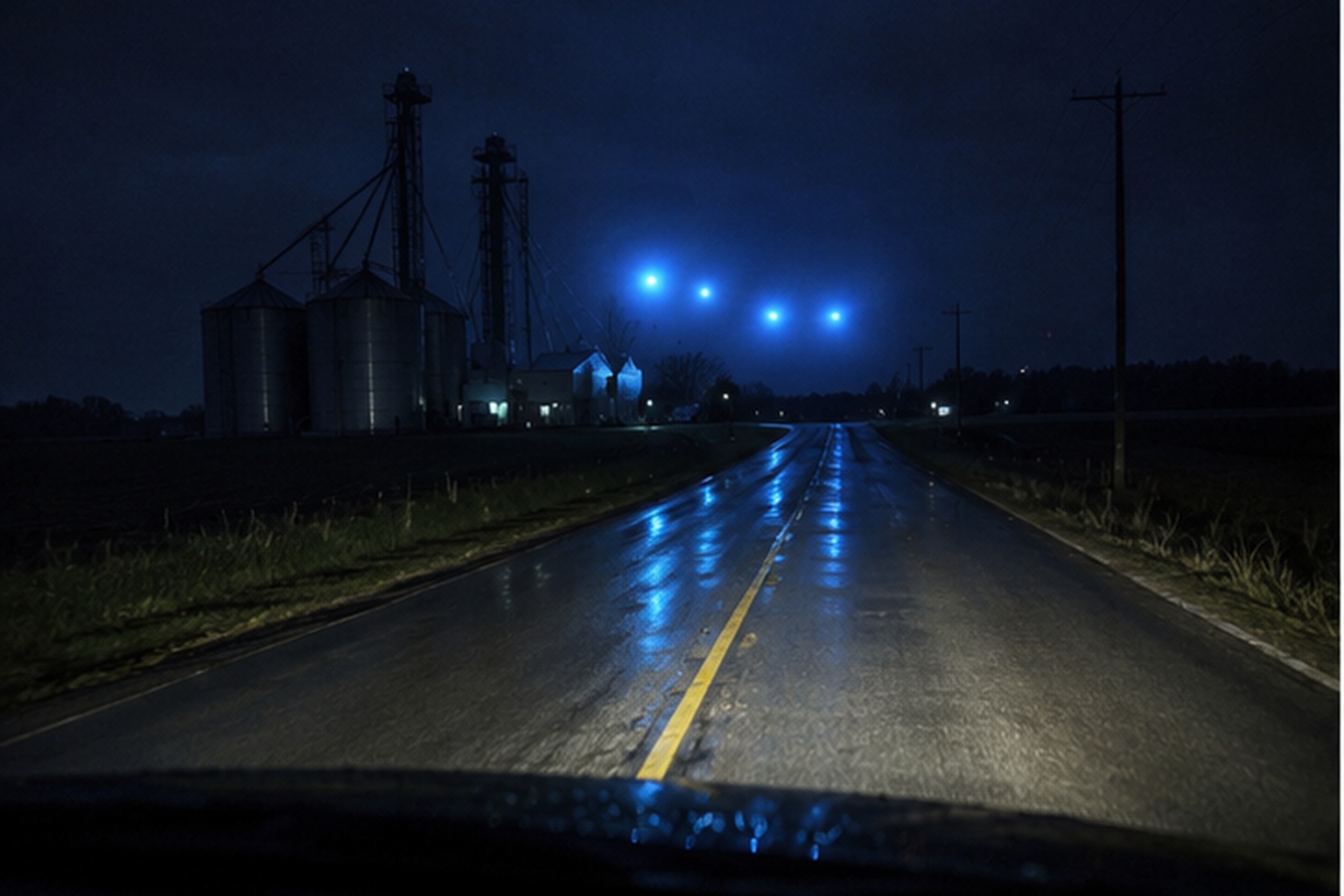
The driver noticed the road turning blue before he noticed the sky.
That is the detail that stayed with him. Not a shape descending through clouds. Not a dramatic flash over the fields. Just the wet pavement ahead changing color in the dashcam view, as if someone had lowered an electric sign over Silo Road and switched it on behind the windshield.
He was running the night mail route between two small distribution stops, a contract run that started after most houses had gone dark and ended before farm traffic woke up. The route was repetitive by design: county highway, gravel shoulder, long straight stretch past the grain bins, left at the old co-op sign, then twelve miles of blacktop to the next town.
On rainy nights, the dashcam saw more than the driver did. It caught mailbox posts, deer eyes, reflective road markers, and the hard white flare of oncoming headlights. It also caught the blue lights over Silo Road.
The driver later said he first assumed the glow came from a farm truck parked near the bins. Blue LEDs are everywhere now: tow trucks, security systems, cheap light bars, equipment panels. A strange reflection on wet asphalt does not have to mean anything strange in the sky.
Then the road ahead brightened in three separate patches.
The dashcam showed them first as smears in the puddles: cobalt, almost neon, trembling with the vibration of the van. A second later, the source appeared above the road beyond the mailboxes. Several blue points hung in a loose arc over the silo complex, too low for stars and too steady for lightning. They did not sweep like searchlights. They did not blink like normal aircraft markers. They held.
The driver took his foot off the accelerator.
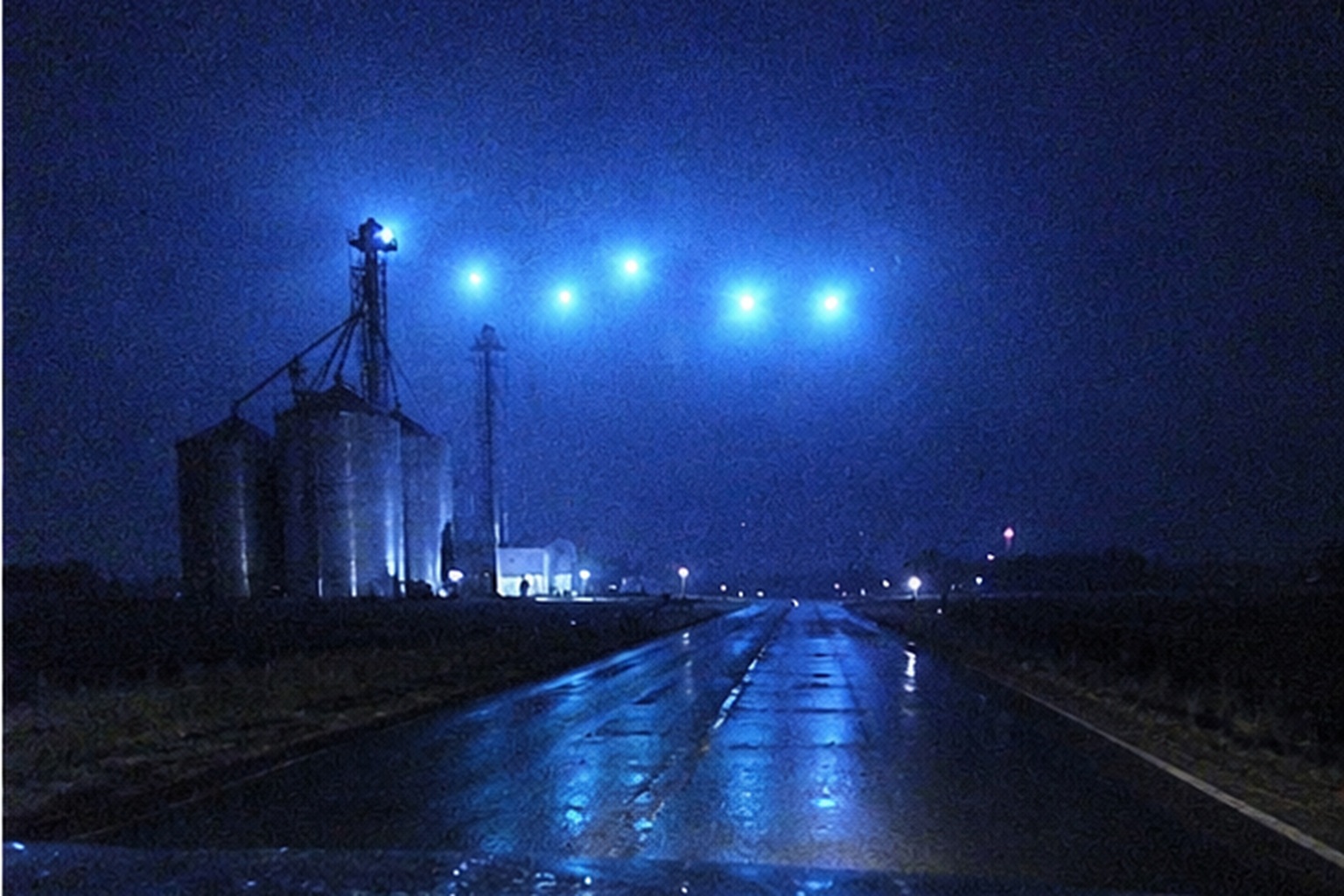
That small action became visible in the video because the engine sound dropped and the reflected lane line slowed beneath the camera. The van rolled forward at a crawl while rain ticked against the windshield. The wipers dragged across the glass, and each pass briefly sharpened the scene: silos, power lines, wet road, blue points in the sky.
There were no figures on the ground. No strange person at the roadside. No creature stepping from the ditch. The whole account stays with lights and their reflections, which may be why it feels more unsettling rather than less. The road remained ordinary, but the light on it did not belong to any ordinary source the driver recognized.
At first, the lights formed a shallow triangle with two dimmer points trailing to the right. Then the formation compressed, not quickly, but with the smoothness of objects moving together or one larger object changing angle. The reflections in the road did the same. Blue streaks that had been separated in the puddles drew closer until they looked like one long luminous bruise across the blacktop.
The driver pulled to the shoulder near a row of mailboxes. He did not get out. He stayed belted in, one hand on the wheel, one hand near the radio, watching through glass while the van idled.
The radio produced static when he tried to call the next stop.
Rural routes have dead zones, and rain can make weak reception worse. Still, on the recording, the attempt adds a human sound to the clip: a brief burst of hiss, the driver saying the road name, then silence except for wipers and engine.
The blue lights lowered, or seemed to.
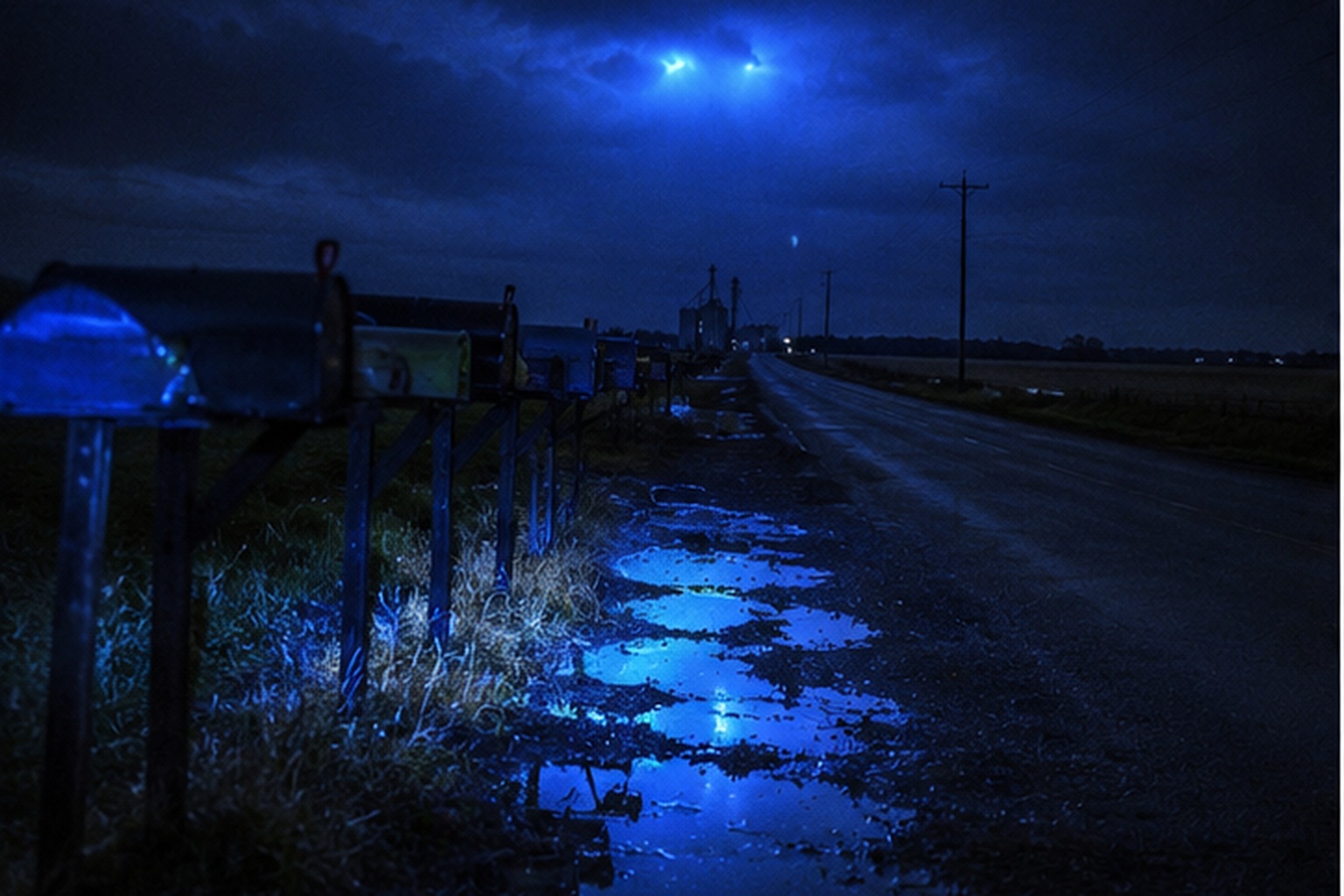
That is the cautious phrasing because judging height at night is difficult. There were no clear clouds to measure against, and the silos could trick the eye. But in the dashcam frame, the lights appeared to sink closer to the line of the grain bins. The tops of the silos caught a faint blue rim. The side of the equipment shed flashed with a watery glow. Puddles beside the mailboxes brightened as if lit from above.
A plane would have moved on. A tower beacon would have stayed fixed to its tower.
A drone might have hovered, but the spacing and brightness seemed wrong to the people who later watched the footage. There was also the silence. The van engine and rain made it impossible to know what the outside air sounded like, yet the driver remembered no rotor buzz, no small motor whine, no passing aircraft rumble. He remembered only the feeling that the road ahead had become a stage lit for something he could not see.
For nearly forty seconds, the lights held over Silo Road.
That is longer than it sounds when you are stopped in the dark with no other traffic. Long enough to think of practical explanations and reject them, then accept them again because the alternatives are worse. Long enough to check mirrors. Long enough to wonder if the blue glow is behind you too.
The dashcam's most discussed moment came near the end. The lights, which had been steady, pulsed once in unison. Not a flash in sequence. Not lightning. One clean brightening across the whole cluster, mirrored instantly in the wet road. For a single frame, the foreground puddles looked like blue glass.
Then everything cut out.
The sky went black. The silos returned to silhouette. The road became just a rain-dark county road again, reflecting only the van's headlights. There was no visible streak upward, no object racing away, no explosion of speed. The lights simply stopped being there.
The driver sat for several seconds before moving.
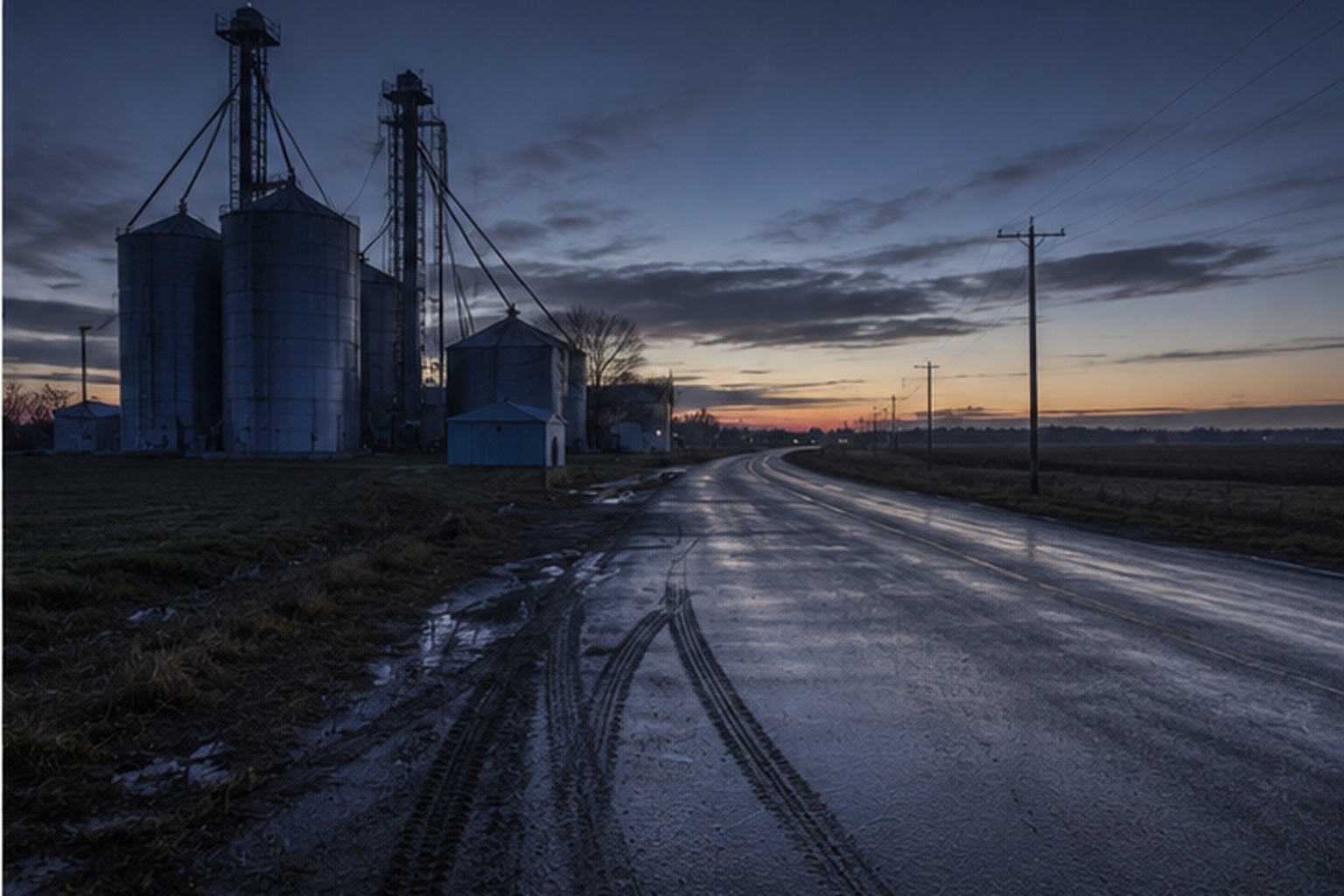
When he finally pulled back onto the road, the van passed the grain bins without incident. The dashcam showed no people, no vehicles, no portable towers, and no obvious equipment left behind. The mailboxes were ordinary. The ditch water ran brown. The co-op sign creaked in the wind.
At the next stop, he mentioned the lights to the clerk on duty and replayed the clip on the tiny dashcam screen. Small screens make everything easier to dismiss. Glare becomes artifacts. Distant lights become reflections. Fear becomes embarrassment. The clerk reportedly told him it was probably a crop duster, though no one could explain why a crop duster would hover blue and silent over wet silos at that hour.
By morning, the story had become a group viewing on a larger monitor.
That was when the reflection became important. The camera did not only capture points in the sky. It captured the road responding to them. Blue light appeared in puddles at different distances, along the hood edge, on the mailbox doors, and on the curved metal of the silo tops. Whatever the source was, it had been bright enough and positioned high enough to paint the whole scene.
People suggested utility work, law enforcement, drones, transformers, weather effects, and prank lighting from the silo property. Those are all reasonable places to start. No careful witness account should leap past them. But the owner of the bins reportedly knew of no equipment running that night. There had been no outage logged in the immediate area. No storm lightning appeared on nearby security clips at the same time.
The dashcam did not solve the question. It preserved it.
That may be why the Silo Road clip stayed with people who saw it. It did not show a saucer landing in a field. It did not show beings at the fence. It showed a working driver on a wet rural road, slowing because the world ahead had turned the wrong color.
On later runs, the driver reportedly watched the silo stretch more closely. He noticed every tower light, every reflective sign, every farm truck parked near the bins. Nothing repeated. Silo Road went back to being Silo Road: damp pavement, fields, mailboxes, and grain bins waiting for harvest.
But the dashcam kept the blue version of it.
In that version, the van slows. The wipers sweep. The road glows ahead in impossible color. Above the silos, several blue lights hold their place in the rain-dark sky, steady enough to reflect in every puddle, strange enough that the driver does not want to drive beneath them, and quiet enough that the moment after they vanish feels louder than any sound they could have made.