The community pool had already done the little evening rituals that make a public place stop feeling public. Lane ropes had been stacked. Wet-floor signs waited near the showers. Somewhere beyond the locker room wall, the pool water still held that flat blue glow that never looks natural after closing.
By then, the building should have belonged only to machines.
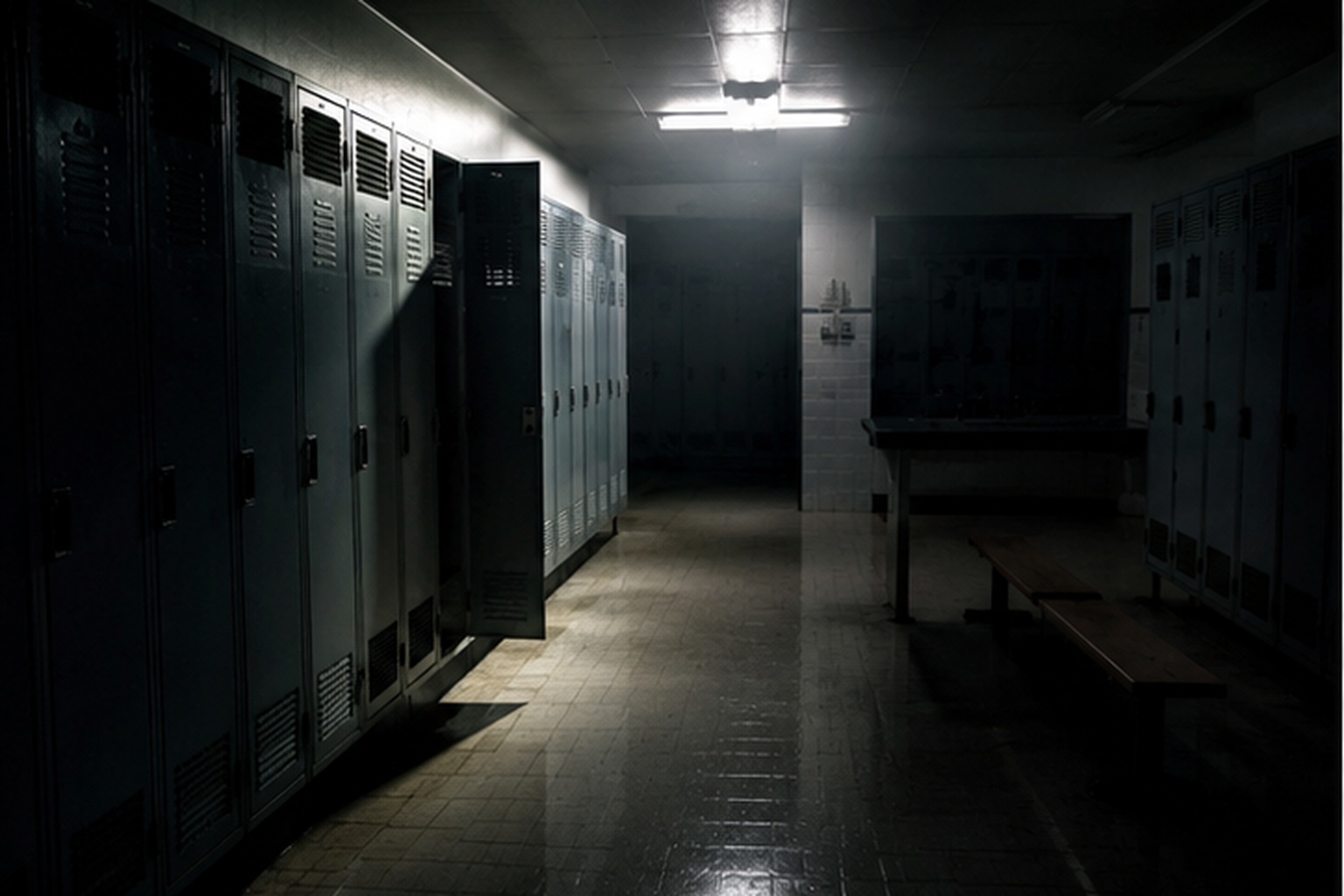
A security camera watched one aisle from a high corner. It saw rows of metal lockers, a bench down the center, a trash can near the sinks, and patches of damp tile reflecting the fluorescent lights. Nothing about the first seconds looks haunted.
Then the last cleaning lights go out.
The room does not become fully black. A weak spill from the pool deck leaks through the entrance, and emergency lighting leaves the lockers visible. The camera adjusts. The bright tile sinks into gray. The far aisle becomes a soft block of shadow.
For a moment, the locker room holds still. Then one locker door on the right side opens.
After Closing, The Building Changed Shape
Anyone who has ever left a pool late knows the change. During the day, a locker room is loud enough to erase itself: doors slamming, children shouting, hair dryers whining, sandals slapping tile, water running in the showers.
After closing, all of that noise vanishes, and the same room feels too large.
The camera catches that version of the place. The benches are empty. The hooks have no towels. The sinks hold no movement. There is no janitor crossing the frame, no swimmer coming back for a forgotten bag, no obvious person near the locker that moves.
That emptiness matters because the scene asks the viewer to accept a simple fact before anything strange happens: there should not be anyone there.
It is not a ruined hospital or a cemetery road. It is a community pool locker room, which somehow makes it worse.
The Lights Go First
The timing is the part people tend to remember. The locker does not move while the cleaning lights are still bright. It waits until after the room drops into that low, greenish dark that public buildings have when the main switches are off but the safety lights remain.
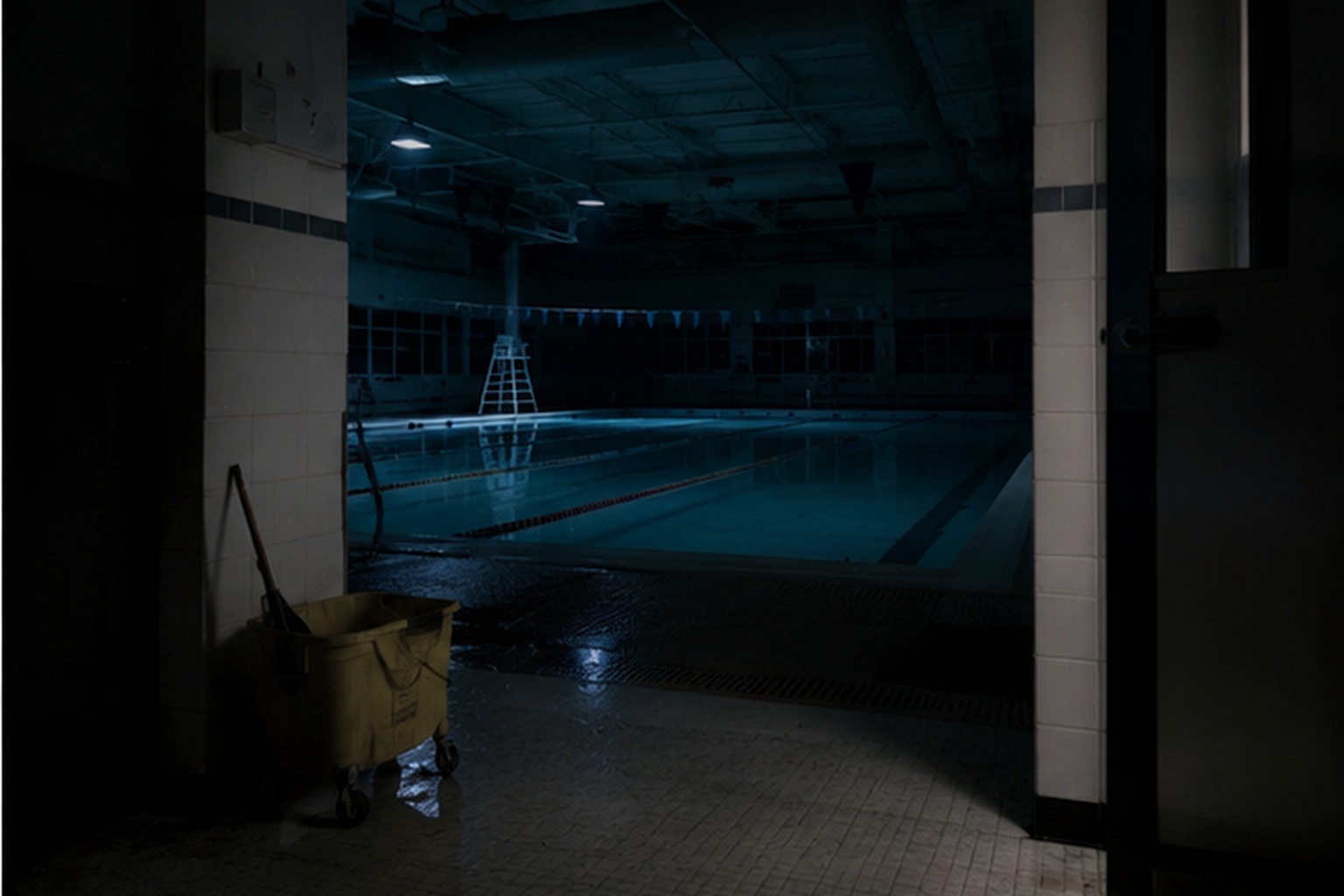
A practical explanation may start there. The lights could be on a timer. A staff member might have switched them off from a hallway. The electrical change might have coincided with a vent cycle or a pressure shift from a door closing elsewhere.
Still, the room seems to pause after the lights fail. If the locker had swung open at the exact second the lights clicked off, it would be easy to file away as vibration or air movement. Instead, the darkness settles first.
The viewer has enough time to think, all right, it is empty. Then the door begins.
One Door Moves With Too Much Patience
The locker door does not appear to burst open. It does not rattle like something struck it from inside. It moves in a slow, careful arc, the kind of motion that feels less like a failure of metal and more like a decision. That is unfair to the hinge, probably.
Old lockers do strange things. Latches wear down. Doors bend out of square. A locker that looks closed can sit barely caught for hours before gravity, moisture, or a tremor makes it give up. In a pool locker room, humidity works on everything. Screws loosen. Hinges drag. Metal sticks, then releases.
A slow swing can be perfectly ordinary. But ordinary motion usually looks accidental. It wobbles. It snaps. It overshoots. This one seems to open just enough, and slowly enough, for the black gap inside to become the center of the frame.
The eye keeps waiting for a hand. No hand appears.
The Far Aisle Has Someone-Shaped Darkness
The locker door would be easier to dismiss if the rest of the aisle stayed blank.
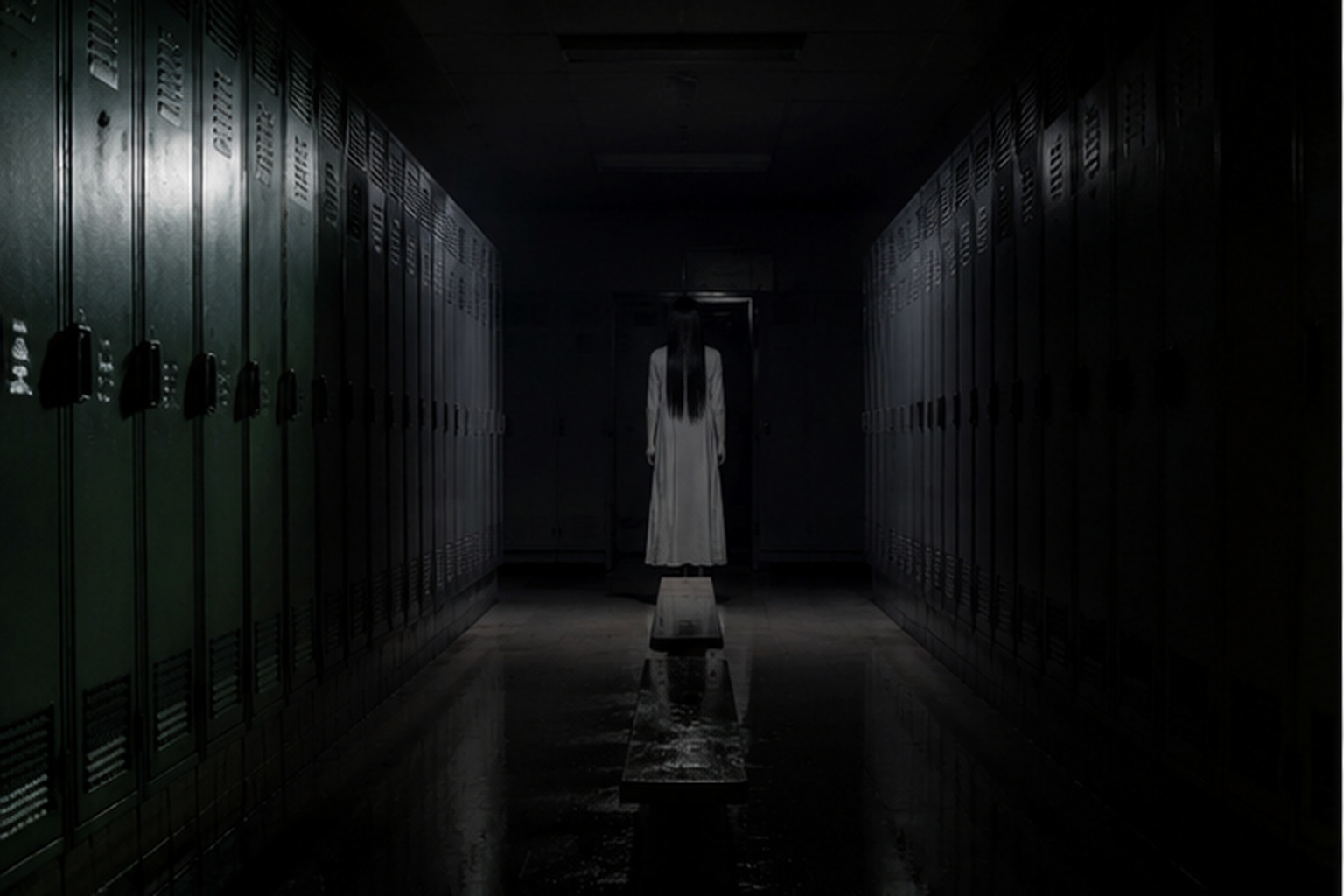
At the far end, where the camera loses detail, there is a pale vertical shape. It is not sharp enough to call a person. It is not close enough to show a face. The shape is mainly brightness against a darker background, with long shadow around the top and a white drop of material below.
That is all the mind needs. The common description turns it into a woman-like form: pale, long-haired, dressed in white, standing still at the end of the row. The camera itself gives no clean answer. Low light makes bodies out of towels, signs, cleaning cloths, and reflections from wet tile.
The pool area nearby could have thrown a strip of blue-white light into the locker room. A hanging item could have become taller in the lens after the exposure shifted. A reflection might have doubled itself on the floor and suggested the lower half of a figure.
Those are better explanations than a stranger waiting in the dark. The problem is placement. The shape is not beside the moving locker, where it would solve the scene. It is waiting beyond it, uncertain but close enough to feel intentional.
The Room Offers A Sensible Answer
If this were being reviewed as a building issue, the report would probably be boring.
A locker did not latch. The lights changed on schedule. The camera adjusted to the darker room. A pale object near the far aisle became more noticeable after the exposure shifted. The security system recorded those unrelated details in the same frame, and the human brain stitched them together.
That explanation is not just possible. It is likely. Public pools are full of things that make cameras misbehave. Wet floors reflect light from odd angles. Metal locker faces create repeating patterns that hide depth. Mirrors, glass doors, drains, vents, and white tile bounce brightness around. Automatic cameras correct darkness by brightening whatever they can find, turning a towel into a shoulder or a sign into a dress.
Even the opening door has ordinary suspects. Air pressure can change when exterior doors seal. HVAC systems can push a loose panel. Plumbing can thump in walls.
The mundane answer is strong. It just does not calm the image.
Why The Explanation Does Not Settle It
The trouble is that fear does not only respond to likelihood. It responds to arrangement.
Here, every ordinary piece lands in the wrong order. The bright room becomes dim. The empty aisle sits still. The door opens slowly. The pale shape remains at the end, neither approaching nor leaving.
A rational viewer can explain each part separately. Together, they still feel staged by something with patience.
That does not mean the scene shows anything paranormal. It means the scene uses the grammar of a haunting while remaining made of everyday parts. A loose hinge becomes a signal. A reflection becomes a witness. A closed locker room becomes a corridor that seems to know when it is not being watched by people, only by a camera.
There is also the discomfort of distance. If the pale shape were closer, it might resolve into a bucket, towel, or sign. If it were farther away, it might vanish into noise. Instead, it stays in the worst possible zone, where recognition almost happens and then fails. That almost is where the unease lives.
The Stillness Makes It Worse
Nothing rushes the lens. No alarm sounds. No staff member walks in. The pale shape does not lunge. The locker door reaches its angle and stays there, open enough to expose darkness but not open enough to reveal anything useful.
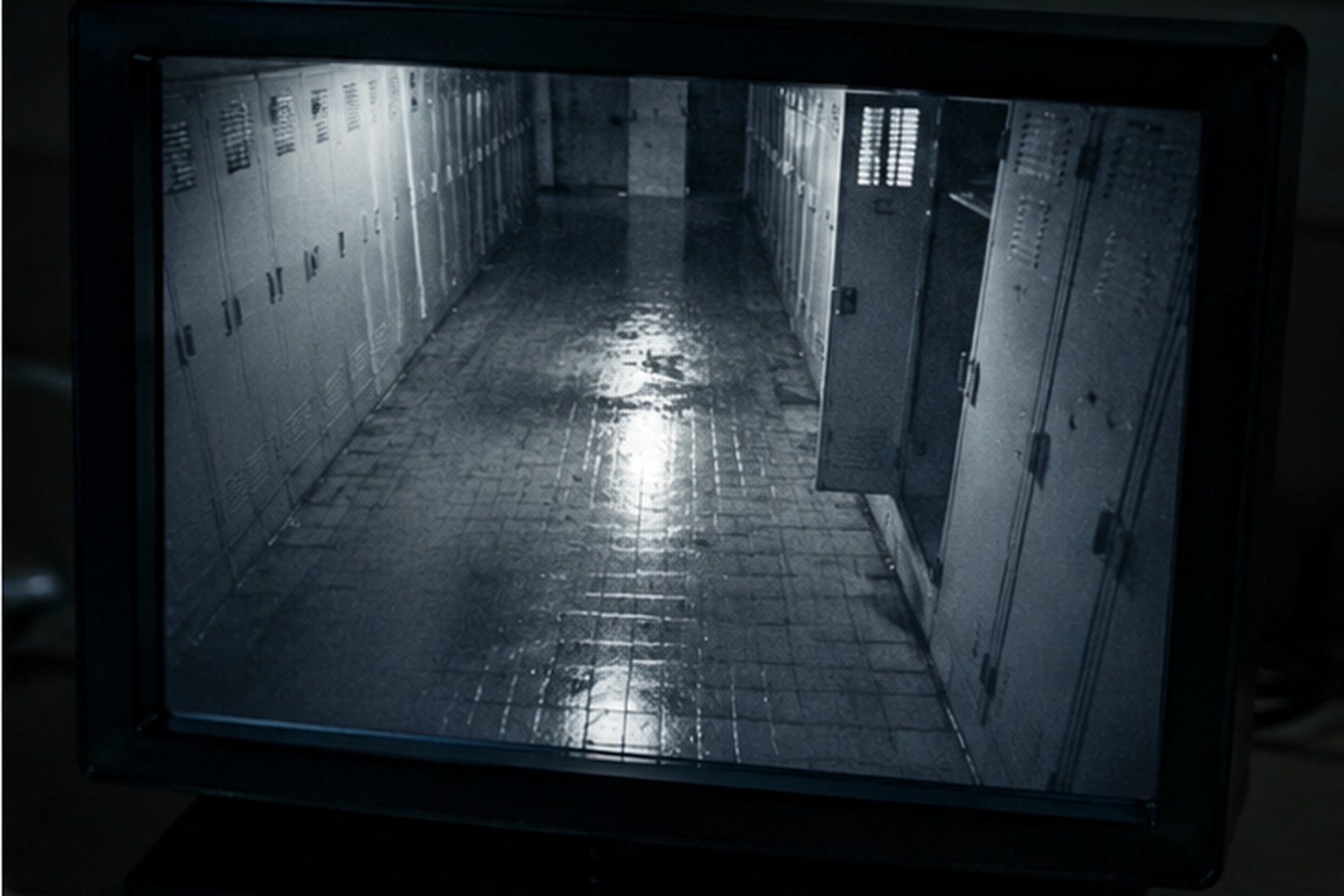
The lack of action makes the scene feel private. It is not trying to scare anyone in the room because there is no one in the room to scare. The camera seems to have arrived late to a quiet exchange between the building and whatever waited at the end of the aisle.
That may be why the story travels better as a single remembered image than as a mystery to solve.
A closed community pool. Cleaning lights gone. Wet tile holding weak reflections. One locker door no longer shut. Something pale at the far end, hair-dark at the top, white below, still enough to become part of the architecture. People can argue about what it is, but they tend to remember where it stands.
The Last Image Is The One That Stays
The safest reading remains ordinary: bad latch, old hinge, low light, reflective surfaces, and a camera doing its best in a room designed to confuse it.
That answer should come first. A vague after-hours scene is not enough to name an intruder, a haunting, or anything beyond a strange alignment of common details. Public buildings make noises after closing. Doors move. Lights change. Cameras flatten space into lies.
Still, the final image refuses to become completely boring.
Outside the frame, the pool water sits under its night glow, smooth and chemical-blue. The lobby is locked. The office is dark. The cleaning cart has already been rolled away.
In the locker room, the aisle remains dim. At one side, the open locker holds its black rectangle.
At the far end, the pale shape waits in the place where the camera cannot decide what it is.
And because nobody walks in to close the door, the room is left exactly like that: quiet, damp, and unfinished.