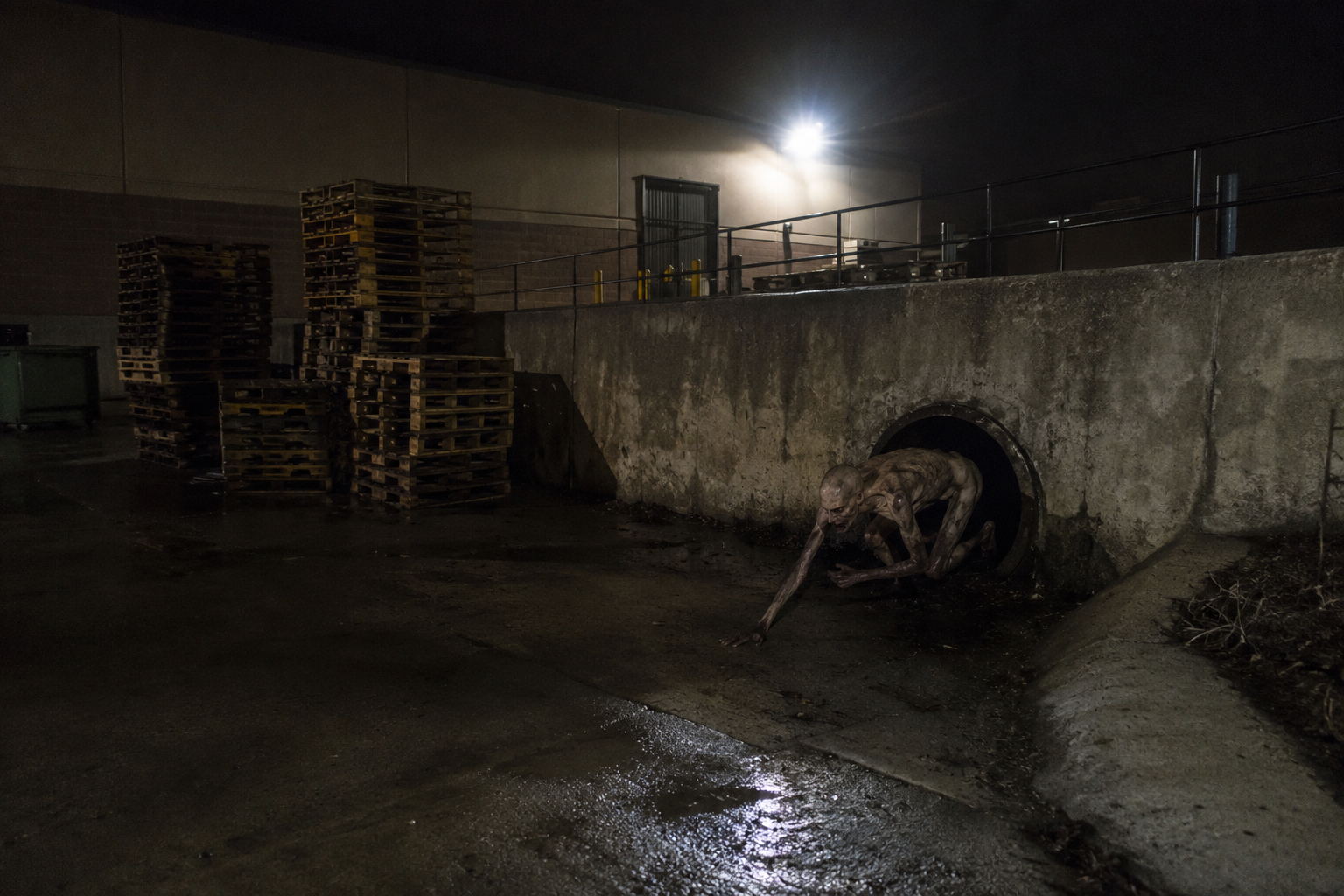
The rear of the supermarket was never meant to be interesting. Customers saw bright doors, polished floors, fruit displays, and checkout lights. Employees saw the back: dented loading bays, a humming compactor, broken pallets stacked too high, and a drainage culvert set into the retaining wall beyond Bay Three.
The culvert was just a black concrete circle at ground level. Rainwater from the parking lot ran through it, carrying leaves, cigarette butts, and the sour smell of the gutter. It sat partly hidden behind weeds and a leaning column of empty pallets.
The camera above the dock watched it by accident.
It had been installed because pallets kept disappearing after closing. The manager wanted license plates and trespassers. Instead, on a humid weeknight after the last truck left, the camera recorded something that looked as if it had been folded inside the drainage pipe and was slowly unfolding itself onto the wet concrete.
The First Reach From The Pipe
The store closed at eleven. By 12:43 a.m., the back lot was empty except for the buzz of the security light and the refrigeration units along the wall. Earlier rain had left the concrete shining. Water dripped from the culvert lip in slow silver threads.
The motion sensor triggered without headlights, a person, or an animal crossing the open lot.
At first, the frame looked empty. Then a pale limb slid out of the black pipe.
It did not step. It reached.
The limb was thin as a broom handle, jointed sharply, and too long for the small space it emerged from. Its end widened into something like a narrow hand or splayed foot, with dark tips that pressed against the wet ground. It held there, testing. A second limb followed, lower and crooked, dragging water behind it.
Then the body came forward one section at a time.
The Thing Behind The Pallets
The creature did not move like a stray dog, a coyote, or anything built to trot across asphalt. It crawled in careful pieces, planting one bent limb, pausing, and pulling its narrow torso after it. Every joint seemed to work late, as though the body had to remember how to use itself.
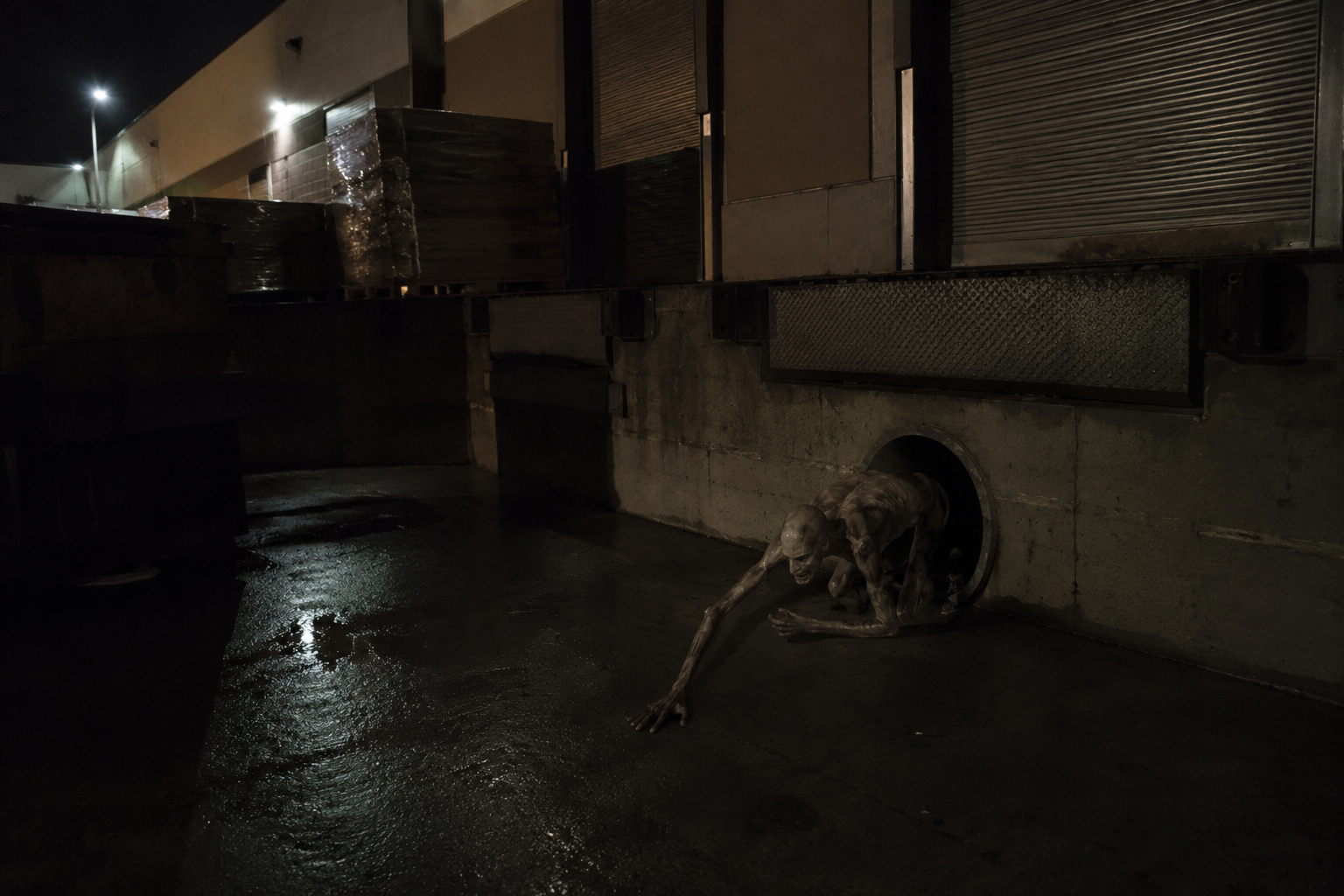
When the loading-dock light caught its shoulder, it looked mostly hairless. Its skin was pale gray, mottled darker along the ribs and spine. Sparse clumps of blackish hair or bristle clung to the back of its neck and one hip, not enough to make it furry, only enough to make it look patchy and wrong.
It was terribly thin. The ribs showed as bars in the grainy frame. The hips rose high and sharp. The forelimbs were long and sticklike, folding at elbows that seemed placed too far down. It moved on all fours, but not like an ordinary animal. It looked more like a tall, gaunt thing forced low beneath a ceiling.
For several seconds, the stacked pallets cut it into pieces: one pale curve of back, one angled forearm, one narrow head lowered near the concrete. The head was small compared with the limbs, almost hairless around the face, with a tight muzzle or chin that never turned fully toward the camera.
There was no collar, no tail, and no familiar rhythm that let anyone watching later say stray and relax.
The Sound At Bay Three
The overnight clerk stocking frozen foods did not see the camera feed live. The monitor was in the receiving office, and nobody watched it all night. But around the same time, he heard something through the rear wall.
He described it as wood being dragged over concrete.
At first, he blamed the compactor or a loose pallet shifting outside. Then the scrape came again, slower, followed by a light clatter. He walked toward the receiving doors and stopped in the dark hall, where the red exit sign glowed above the dock.
The sound was outside near Bay Three.
There was also a smell. Not the usual dumpster stink, but something wetter and sharper, like creek mud mixed with old meat. It seeped through the weather stripping, hung there for a few seconds, and faded.
The clerk did not open the door. He told himself it was a raccoon under the pallets and went back to work. By morning, after seeing the stills, he was grateful in a way he did not enjoy explaining.
The Frame They Kept Pausing
The assistant manager reviewed the motion alerts the next morning. She expected kids taking pallets or someone cutting through the rear gate. Instead she saw the pale arm emerge from the culvert and called two employees into the office.
They replayed the camera file repeatedly.
The frame they kept pausing showed the creature fully outside the pipe but not yet away from it. Its front limbs were planted on the concrete. Its back limbs were tucked near the culvert mouth, bent outward at harsh angles. The torso hung low, almost touching the ground, while the head lifted just enough to show a dark hollow where an eye should have reflected the dock light.
Behind it, the pallets leaned over the scene like a crooked fence. In front of it, a wet trail ran toward the dock drain.
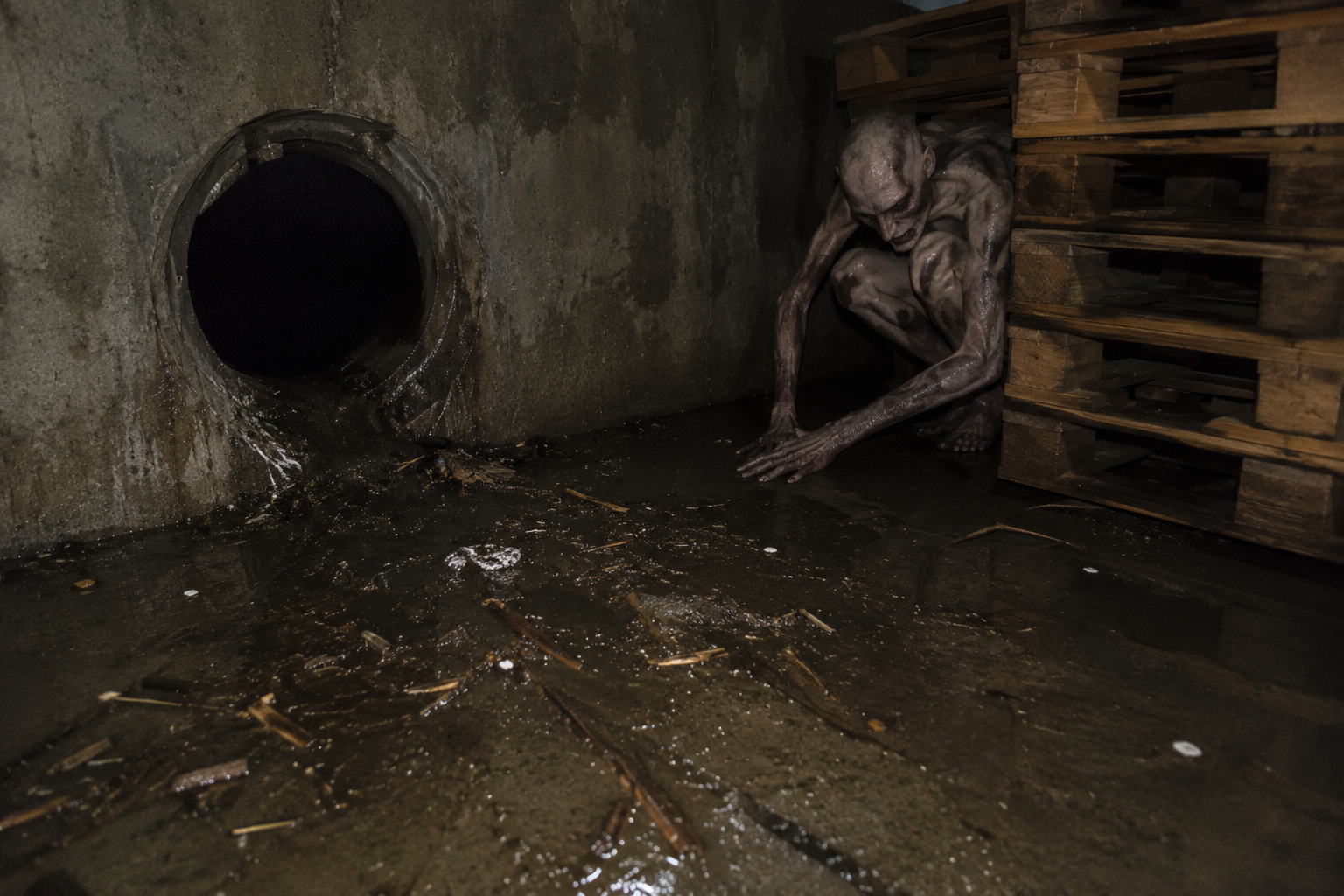
The skin did not look smooth. It looked blotched, with one bare gray shoulder and a darker ragged patch along the opposite hip. Small knobs down the spine caught the light for a moment before the creature shifted.
Then it crawled sideways between the pallets and the retaining wall.
That sideways motion bothered everyone. It was not a run or a scamper. It pulled itself along with long limbs folding under it, like a spider trying to imitate a starving person.
What Was Left In The Morning
After sunrise, three employees went outside together. The loading area looked normal in the cruel way ordinary places do after something has made them feel unsafe. The culvert was only a pipe again. The dumpsters smelled like dumpsters. The first delivery truck had not arrived.
But the pallets had shifted.
They were not knocked down, only nudged out of line. Several bottom boards were wet and streaked with muddy gray residue. One splintered plank held a dark smear no one wanted to touch. Near the culvert, the rain film on the concrete showed thin marks where narrow points had pressed and slid.
They were not paw prints. They were not shoe prints. They looked like four or five long digits had dragged over the surface while the body pulled itself forward.
The trail ran from the culvert to the pallets, then vanished under the dry strip beneath the dock overhang.
There was no trapped animal, no body, and no hole in the rear fence. The only obvious route was the drainage pipe. Nobody volunteered to crawl in and check where it led.
The Drain With A Grate
People tried to name what was in the camera record because naming it made it smaller. A sick dog. A mangy coyote. A raccoon distorted by bad light. A fox soaked by runoff and caught at the worst angle.
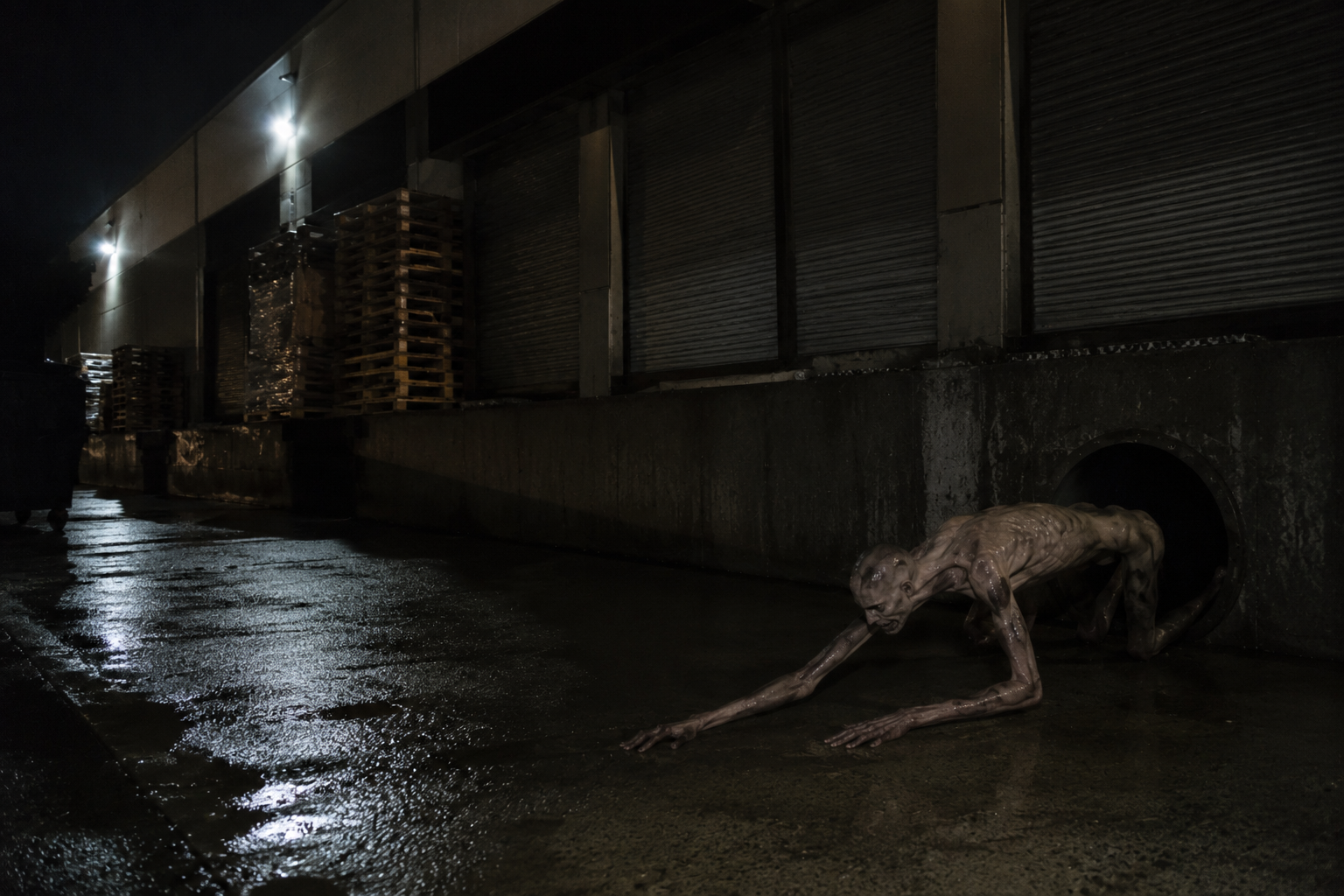
But the shape kept resisting those answers. A dog or coyote would still carry its head, shoulders, hips, and spine in a familiar pattern. A raccoon would be rounder, quicker, and lower to the ground. This thing was all angles: stick limbs, high hips, a narrow ribbed body, patchy hair in the wrong places, and joints that made each movement feel borrowed.
Night cameras lie. Wet wood becomes faces. Trash bags breathe in wind. A poor lens can flatten depth until a normal animal looks monstrous.
Still, the camera record had motion before it had shape, and the motion was what stayed with them: the reach from the pipe, the pause, the pull, the careful lift of those bent limbs onto the concrete.
Management saved the camera file and called maintenance. Within a week, a heavy grate was bolted over the culvert. The official reason was pest control and loss prevention. Nobody wanted shoppers hearing that something pale and jointed had crawled out behind the grocery store.
After that, workers stacked pallets in pairs after dark. The overnight clerk stopped smoking by the dock. The assistant manager stopped parking near the rear gate.
Most nights, the camera recorded only rain, moths, and trucks backing into place before dawn. The new grate made the culvert look less like a drain and more like a cage door.
Why The Ordinary Answer Did Not Settle It
Maybe the frame showed a sick animal made strange by shadow, hunger, and a bad angle. That was the cleanest explanation, and it was the one management preferred. But ordinary animals leave people arguing about species, not about where the elbows should be.
Maybe something from the buried runoff channels under the parking lot came up by accident and found the supermarket light. Or maybe it had always known that route, moving through culverts and service alleys only when the trucks were gone.
By opening time, the store looked clean and ordinary again.
Out back, the wet marks dried.
Behind the grate, the culvert held its black circle perfectly still.