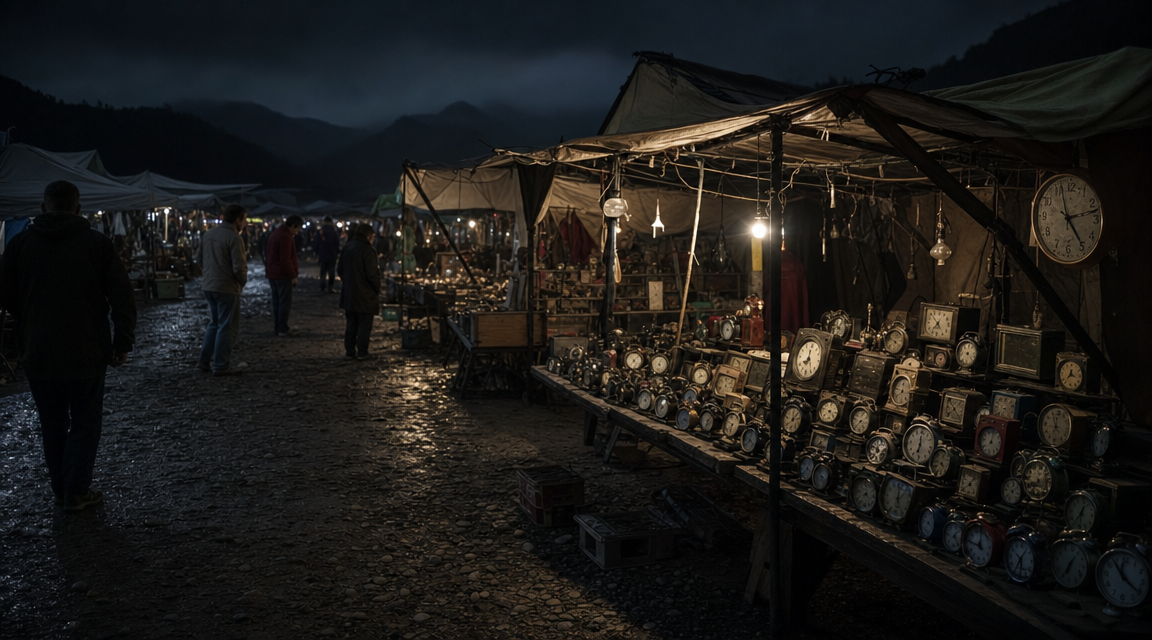
At first, the oddest thing on the stall was not the time itself. It was the silence of so many small clocks that should have been ticking over one another.
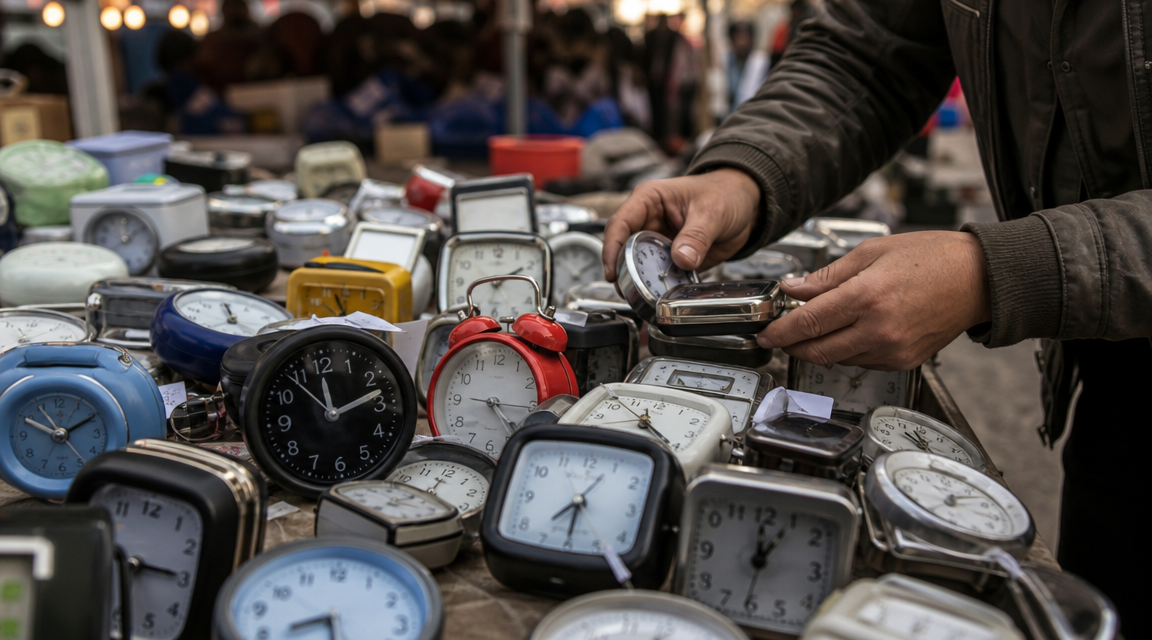
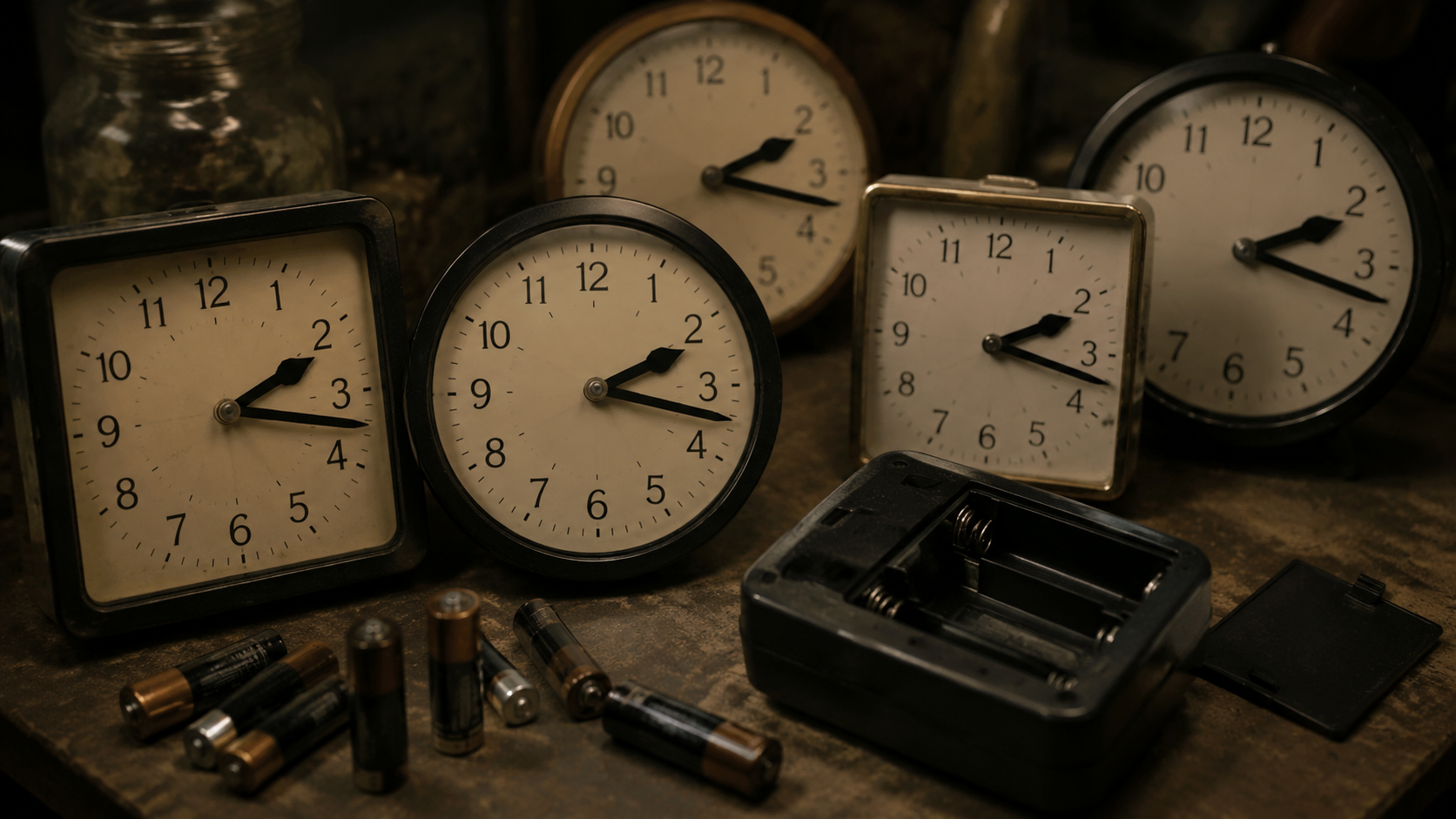
The table belonged to a vendor who sold house-clearance items: chipped mugs, extension cords, old paperback boxes, and a wide spread of cheap battery-powered clocks. By the end of the rural night market, every working clock on that one table was said to be showing 2:17.
Stories like this usually get filed under coincidence. Batteries fail, hands slip, shoppers wind knobs, and people notice patterns after the fact.
But the part that keeps the account alive is how narrow it was. The rest of the town did not seem to lose power, lose signal, or lose time. Only one stall, in one field, appeared to have paused.
The First Version Was Almost Too Small To Notice
The market took place on the edge of a farming village, where the weekly night market was less a spectacle than a habit. People came for vegetables, tools, secondhand toys, and food trucks.
According to the version repeated afterward, nothing dramatic happened at 2:17. No flash was reported. No burst of sound moved through the field. No one claimed to see the sky open.
That absence matters. The story is not built around a theatrical moment. It is built around a vendor noticing, sometime later, that the clocks had stopped agreeing with the world.
The first clock was dismissed as dead stock. The second was annoying. By the fourth or fifth, the stallholder reportedly started turning them over and asking nearby sellers whether their card readers or phones had glitched.
They had not.
A Market That Kept Moving Around One Still Table
The setting makes the report stranger because it was not isolated in the usual way. There were generators, rechargeable lanterns, phone screens, kitchen timers, payment devices, and vehicle dashboards nearby.
If there had been a broad electrical disturbance, people would have remembered it. Vendors depend on little machines. A failed card reader can matter more than a flicker in the sky.
Instead, the accounts describe ordinary inconvenience: muddy ground, tired shoppers, someone searching for change, the smell of fried onions drifting over the produce row. The town church clock was later said to have stayed on time. So were phones checked after closing.
That does not prove anything impossible happened. It only narrows the room available for a simple power-failure explanation.
The objects were not plugged into the same circuit. They were battery clocks, scattered across one stall, supposedly collected from different houses and boxes.
The Detail Witnesses Kept Repeating
The detail people remembered was not simply that clocks stopped. It was that they stopped together, or appeared to.
Several were small alarm clocks. A few were plastic wall clocks leaning against crates. One was described as a travel clock in a folding case. Some had second hands. Some had digital displays.
The account becomes harder to handle when those types are mixed together. Analog hands can slip. Digital displays can freeze when voltage drops. But varied devices showing the same minute suggest either a very ordinary setup nobody reconstructed later, or an unusually neat coincidence.
The stallholder reportedly replaced batteries in two of the clocks. One resumed after being handled. Another did not. That inconsistency is important because it makes the story less polished.
A hoax version would likely have every device behave perfectly. Real incidents, even mistaken ones, are usually messier.
The most quoted question was practical: “Why this minute?” Not midnight, not three in the morning, but 2:17, a time with no obvious folklore attached to the village.
Why Battery Failure Does Not Fully Close The Case
The most reasonable explanation begins with batteries. Secondhand stalls are full of old cells, mismatched devices, and items that were never tested properly.
Cold damp air can weaken batteries. Corrosion can break contact. A weak spring in a battery compartment can fail after the table is bumped.
There is also the human factor. Once one stopped clock is noticed, a person begins searching for others. The mind is excellent at making a pattern out of scattered failures, especially at the end of a long night.
Still, the battery explanation has one rough edge. It explains why clocks might stop, but not easily why so many would seem to stop at the same displayed minute.
That does not make the event paranormal. It means the ordinary answer needs more shape. Were the clocks all set by the vendor earlier in the day? Did someone adjust them as a joke? Were the digital clocks reset after batteries were inserted, then abandoned when they failed?
Any of those could produce the appearance of a synchronized stop. None require anything supernatural. Without the inventory, battery types, and timeline, they remain explanations in outline rather than a closed case.
The Most Plausible Theory Is Also The Least Dramatic
The least dramatic theory may be the best one: the clocks were unintentionally synchronized before the market ever opened.
A vendor preparing a stall might insert batteries into several clocks to show they worked. If that happened around 2:17 in the afternoon, or if the clocks were set quickly to a convenient display time, weak batteries could later make them fail in a way that looked mysterious.
Another possibility is handling. Shoppers pick up clocks, press buttons, pull crowns, test alarms, and put items down carelessly. On a crowded table, one person’s fiddling can become several devices showing similar times by accident.
There is also memory compression. People may not have seen every clock at 2:17 at the same moment. The story may have tightened as it traveled from stall to stall, then from the market to social media.
That happens often with strange events. A confusing detail becomes cleaner in retelling, not always because someone lies, but because clean stories are easier to carry.
The Rest Of Town Became The Control Group
What makes the account stronger than a private household story is the accidental control group around it.
A night market is full of timekeeping. Food vendors watch closing permits. Drivers check dashboards. Parents check phones. Volunteers know when the last generator should be shut down.
If everyone in the village had discovered lost minutes, the story would become broader but less testable. Instead, the claim is small: normal time everywhere else, stopped time on one table.
Small claims are not automatically true, but they can be more interesting. They give skeptics something specific to push against.
No reliable record appears to show a town-wide outage. No report suggests emergency calls, traffic lights failing, or alarm systems resetting. That makes the clock stall feel less like a disaster and more like a pocket of disorder.
In folklore, small pockets matter. They are how people talk about places that do not seem cursed, exactly, but briefly wrong.
The Part That Remains Unresolved
The unresolved part is not whether clocks can fail. They can, constantly.
The unresolved part is documentation. By the time anyone thought the incident might be worth preserving, the evidence was already being handled. Batteries were removed. Clocks were shaken, opened, and tested. Some were sold later, according to one version, while others went back into boxes.
That is how many minor weird events vanish. The first instinct is not to build a case file. It is to fix the thing, finish the night, and get home.
The most useful evidence would have been boring: photos of every clock, battery labels, receipts, weather conditions, a list of which devices restarted, and the exact moment someone first noticed the match.
Instead, what remains is a story shaped by tired witnesses and practical questions. It is not enough to prove an anomaly. It is enough to explain why the market kept being mentioned.
There is a difference between evidence and residue. This incident has little of the first, but more of the second than expected.
Why A Small Clock Story Still Matters
The rural night market clocks are not important because they prove hidden forces at work. They do not.
They matter because they show how little an event needs in order to become unsettling. No apparition is required. No locked room. No impossible object falling from the sky.
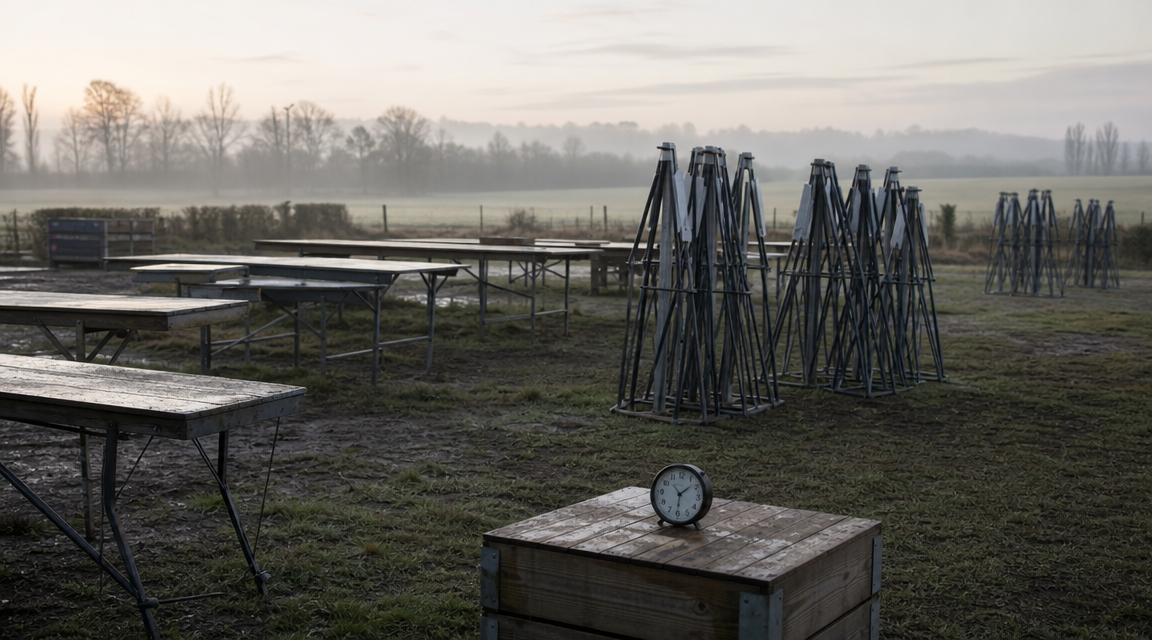
A table, some batteries, a minute on a dial, and a normal town continuing around it can be enough.
The strongest weird events are sometimes the ones that stay close to ordinary life. They borrow the shape of something we already understand, then bend one part just slightly out of place.
If the clocks had all stopped at midnight, the story might feel too neat. If the whole town had gone dark, it would become an outage report. But 2:17 on one stall is awkward, specific, and hard to turn into a clean lesson.
Maybe the clocks were weak. Maybe they were set together. Maybe the memory improved the pattern after the market ended. Maybe someone played a quiet joke and never admitted it.
Or maybe, for reasons no one documented in time, one table at a rural night market briefly became the place where every cheap clock agreed to stop.
The rest of the town moved on. That may be the strangest part.
Reader Context
This Weird Witnessed story is an editorial reconstruction, written as eerie visual storytelling rather than a verified report. For more context, see Camera Anomalies and Strange Images Guide and How WeirdWitnessed Creates Reconstructed Horror Stories.