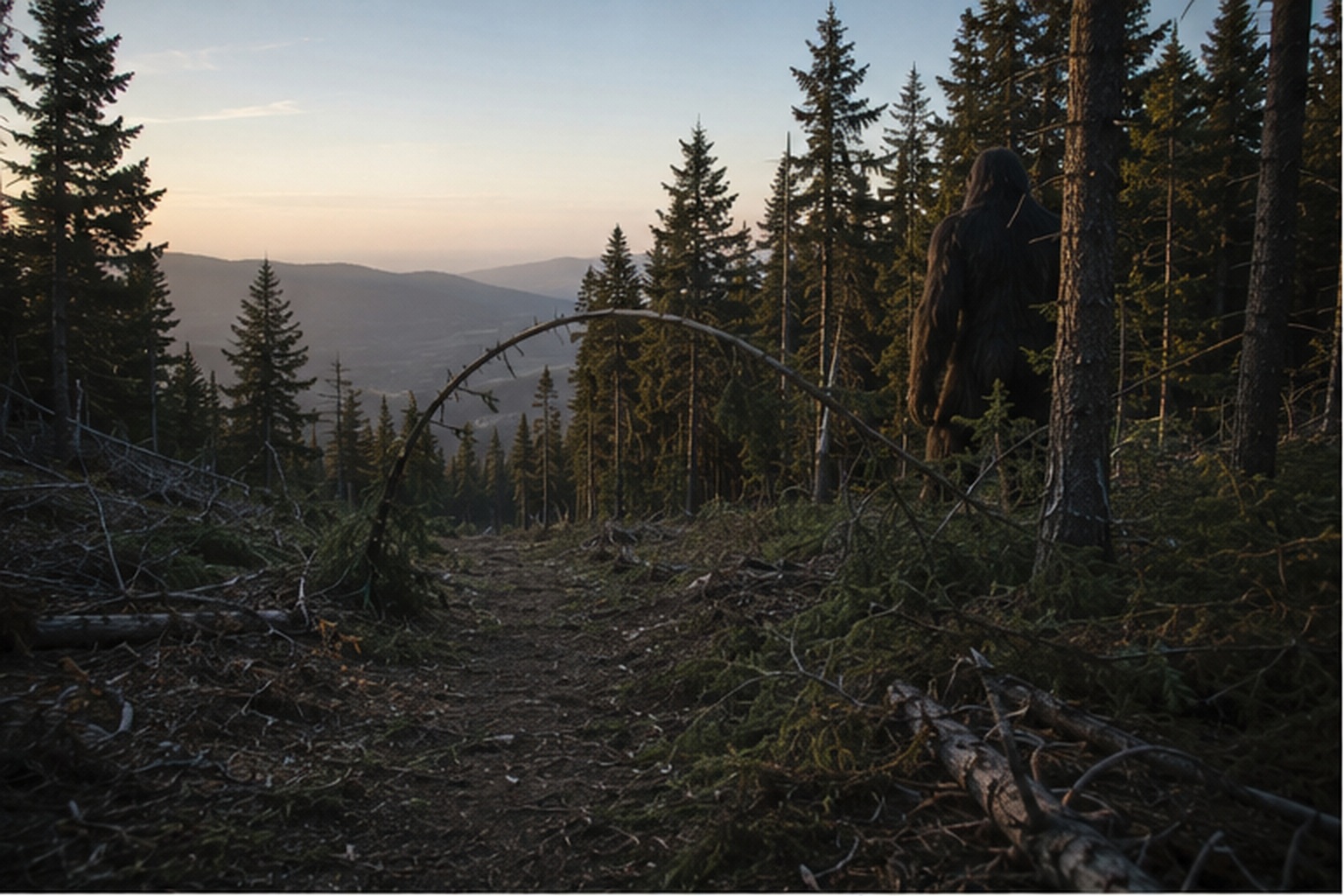
The sapling was not broken. That was the first thing the forestry crew noticed.
It had been bent cleanly into an arch over the firebreak trail, its thin trunk curved from one side of the clearing to the other like somebody had drawn a doorway out of living wood. The top still held green needles. The base was still rooted. The far end had been tucked under a deadfall and pinned with enough pressure to keep the curve tight.
No one on the crew remembered seeing it the day before.
The mountain firebreak was not near a campground, road, berry patch, or hiking loop. It crossed a steep shoulder of fir and hemlock where a line had been cut years earlier to slow any wildfire coming up from the canyon. Most people never went there unless they were paid to do it.
A trail camera had been strapped to a fir to monitor elk movement and unauthorized ATV use. By morning, it had recorded the arch. It had also recorded something standing behind the trees.
The Firebreak Above The Canyon
The firebreak ran across the mountain like a scar, ten to fifteen feet wide in most places, wider where crews had cleared brush around old stumps. On one side, the slope climbed into tight fir. On the other, it fell through rock, salal, and wind-thrown timber toward a creek that could be heard but not seen.
It was not an easy place to wander by accident. The nearest drivable road ended more than two miles below, and the old spur beyond it had washed out so badly that even service vehicles stayed away unless absolutely necessary.
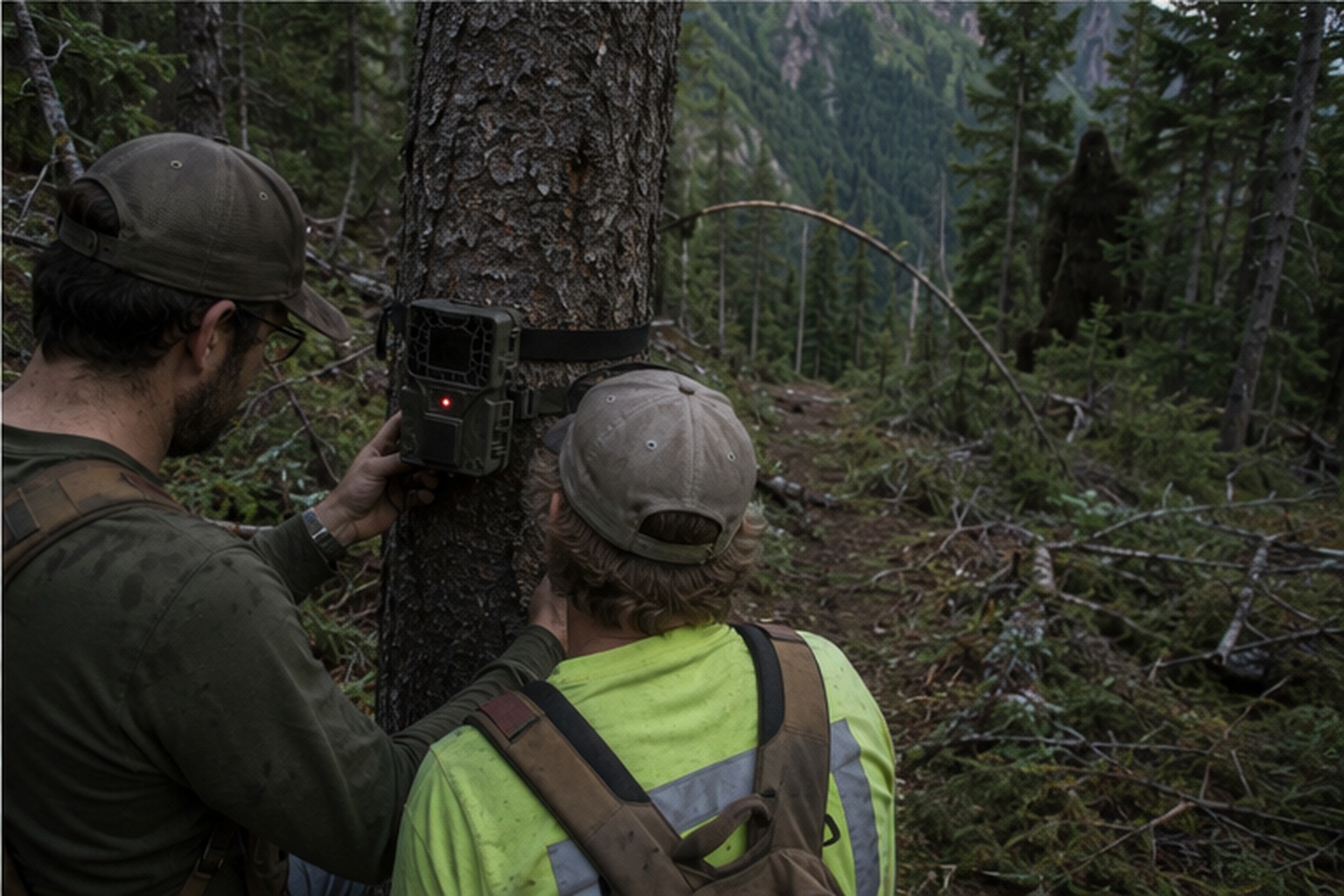
The camera was installed after crews found fresh cuts in the brush and one odd depression where something heavy had pushed through the duff. They thought it might be elk bedding near the clearing or a bear using the firebreak as a travel lane.
The camera faced down the trail, with fir trunks staggered in the background and a narrow slice of open sky above.
For three nights, it recorded nothing stranger than moths and fog.
The Arch In The Morning
When the crew returned, the bent sapling was impossible to miss.
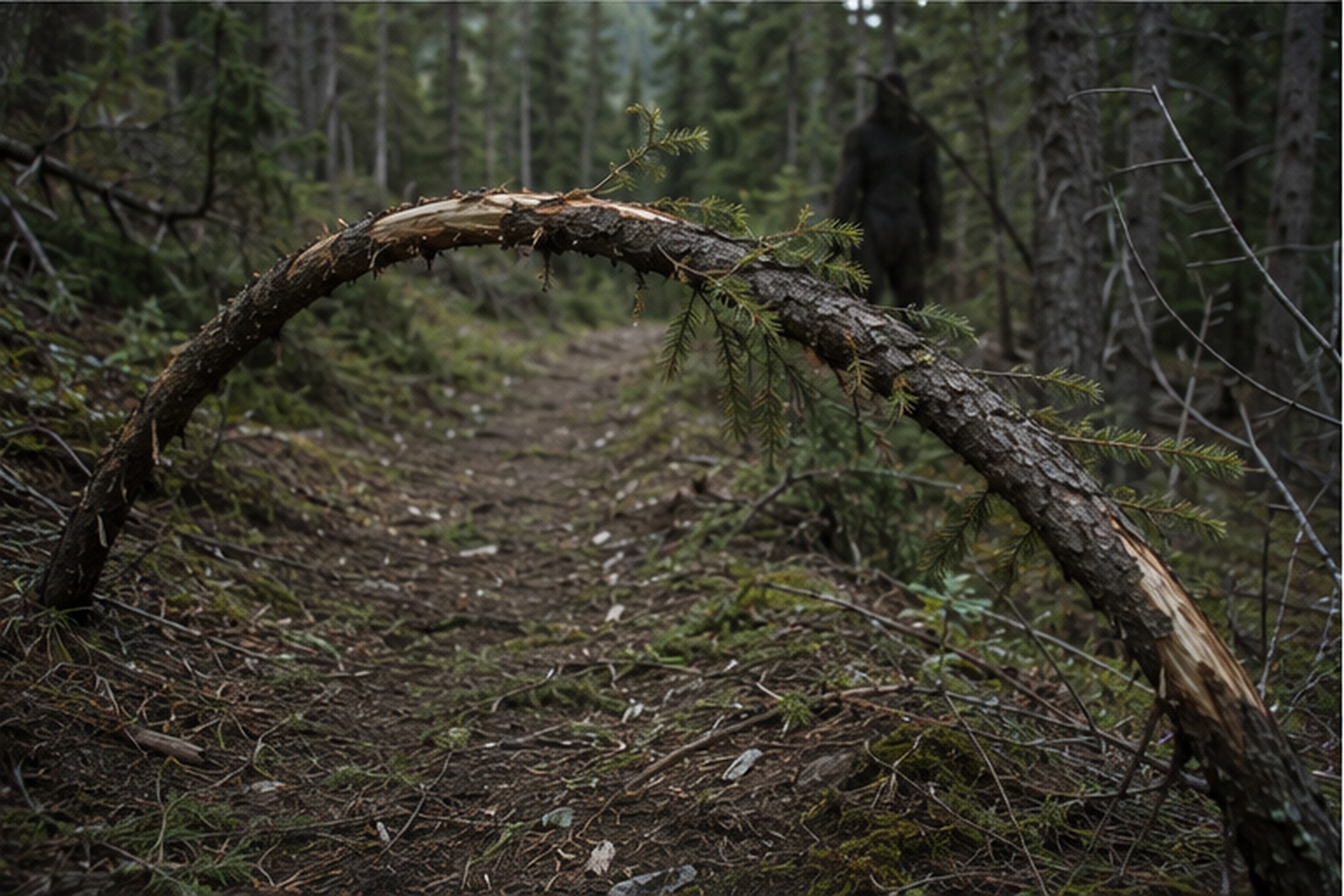
It crossed the firebreak at chest height for a tall person, bowed smoothly, with no snapped fibers showing. The top had been drawn down and wedged under a fallen limb on the opposite side of the path. Someone or something had applied steady force instead of a quick break.
The ground around it was messy but not readable. Elk tracks cut through the softer soil. Boot marks from the crew overlapped older impressions. Fir needles, cones, and rotten bark covered whatever might have been useful.
Still, the arch felt deliberate.
Foresters know what weather does to young trees. Snow bends them. Ice loads them. Wind leans them. Falling limbs crush them. This one looked less like damage and more like placement, as though the trail had been marked overnight.
That would have been strange enough. Then someone pulled the camera card.
The Frame Behind The Firs
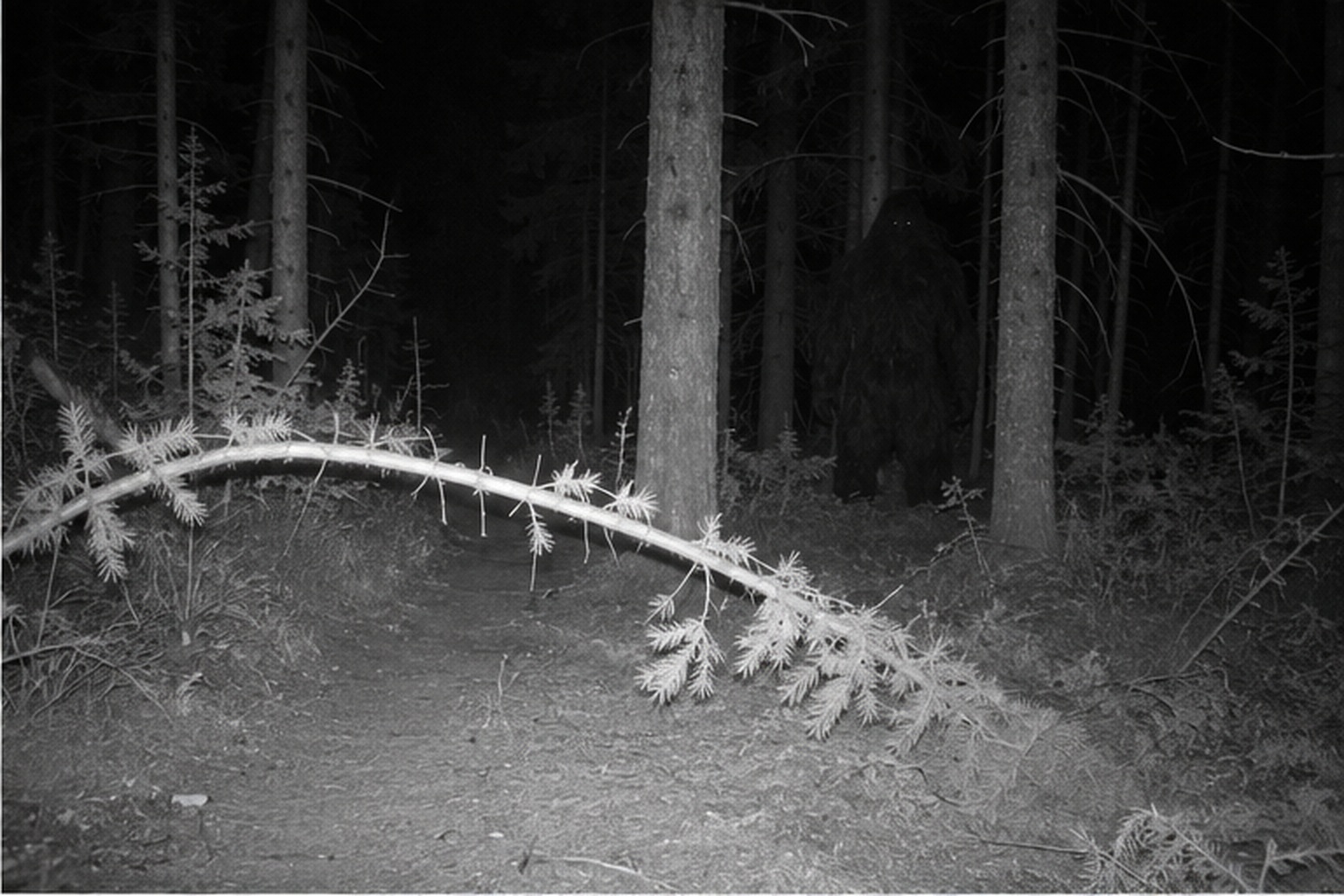
The troubling image came from just after two in the morning.
The camera view is grainy and flat, the way night forest images often are. The firebreak runs pale through the center. The sapling arch is visible in the foreground, curving across the trail where it had not been in the earlier evening frames.
Behind it, at the right edge of the cleared line, stands a dark mass between two fir trunks.
It is not a mist or a gap in the brush. The shape appears solid, blacker than the surrounding woods, with a broad upper body and a head set low between heavy shoulders. Only part of it can be seen because the firs hide the rest. One side blends into the trunk. The other side drops into brush where an arm might hang.
There is no face. No eye shine. No clean outline. That makes it worse. The form seems to be using the trees the way a person might use a doorway, close enough to look out while staying mostly concealed.
Far From The Usual Excuses
The location made the image harder to shrug off.
Many strange forest photos come from places where humans, animals, and messy expectations overlap. Campgrounds produce shadows around tents. Orchards produce bears standing under fruit trees. Berry fields produce dark shapes where hungry animals gather and people watch for them.
This was not that. There were no berry rows, no cabins, no trash barrels, and no easy road. The firebreak offered no reason for a prankster to carry a costume into the high timber at night. It offered no reason for a casual hiker to be there after midnight. Even hunters avoided that slope outside season because retrieving anything from it would be miserable.
The camera had been set for practical forestry work, not for a monster hunt.
That is why the crew stared at the frame longer than they expected to. The place looked too remote for theater, and the shape looked too upright for comfort.
The Size Problem
Nobody could measure the figure perfectly from the photo, but the nearby trees gave people something to argue with.
The fir trunks behind the firebreak were known markers. One had a broken branch at about six feet from the ground. Another showed a pale bark scar where equipment had scraped it during an old clearing job. In the image, the dark shoulder mass rose near those points even though the figure stood farther back from the camera.
If it was a person, it was either unusually large or positioned in a way that fooled the lens completely.
A bear could appear tall if it stood on its hind legs. Bears also bend saplings, push through brush, and investigate clearings. That explanation stayed on the table because it belonged there.
But the crew had seen bears on cameras before. They usually showed a muzzle, a rounded back, or eye shine. This frame showed a vertical mass half hidden behind fir trunks, with the visible side dropping straight down like a hanging arm.
It looked less like an animal crossing the trail than something watching the trail after altering it.
The Mundane Possibilities
There are sensible explanations for both parts of the story.
A snow-loaded sapling can remain bent after weather shifts, especially if its tip becomes trapped under deadfall. The crew may have overlooked it the previous day, or it may have sprung into a more obvious position as moisture, wind, or gravity changed the tension overnight.
A bear might have pushed the sapling down while moving through the brush, then left it pinned by accident. An elk could have shoved through at the wrong angle. Even a falling branch could have levered the young tree into that arch without any intention at all.
The dark figure could be a stump, a cluster of wet branches, or a bear partly hidden by trunks. Trail cameras compress space. Infrared shadows turn ordinary forest shapes into heavy silhouettes. Once a viewer sees shoulders and a head, the mind starts building the rest.
None of that is impossible. But none of it fully quiets the frame, either.
What Happened After
The crew reset the sapling to test how much force it took. One worker could bend it partway, but holding the curve while pinning the top under the deadfall was awkward. Two workers managed it more easily, though the trunk fought back with a springy pressure that made the movement noisy.
That detail bothered them. The camera had recorded no clear image of a person entering the frame to work on the tree. Earlier images showed the firebreak open and empty. Then the arch was present. Then the dark shape appeared behind the firs.
A second camera was added higher on the slope. Brush was trimmed around the first camera to reduce false triggers. The arch was left in place for a week, then released. The sapling slowly rose but never returned fully straight.
No similar figure appeared again. That did not make the original record less strange. It made it feel more like a brief visit to a place that usually keeps its traffic hidden.
The Doorway In The Trees
People who hear the story often focus on the arch. They ask whether Sasquatch are supposed to bend trees as markers, warnings, or signs to each other. The truth is that no one looking at a single bent sapling can responsibly answer that.
What matters in this story is the combination: a remote firebreak, a camera placed for ordinary work, a fresh arch where none was remembered, and a massive dark shape standing half concealed in the firs after it appeared.
Maybe it was a bear and a bent tree. Maybe it was wind, deadfall, and a stump arranged by bad luck into a mountain nightmare. Maybe someone climbed miles through steep timber to stage a scene for a camera they were not supposed to know about.
Or maybe something large used the firebreak that night, bent the sapling down as it passed, then stopped behind the trees when the camera blinked awake.
The photo does not answer the question. It leaves the arch hanging over the trail like a threshold, and the dark figure waiting just beyond it, solid enough to block the forest behind its shoulders.
By sunrise, the mountain was quiet again. The sapling still held its curve. The firs behind it looked empty, which somehow felt less reassuring than before.