The strange part of the Halloway Clinic camera images is not that something appears in it.
Security cameras create ghosts all the time. Compression blocks become faces. Reflections detach from glass. A person moving too quickly through poor light can look less like a person than a stain.
What bothered staff at Halloway was the sequence. A freight elevator arrived at a locked supply floor after hours. Its doors opened. A dark, patient-shaped figure stepped out and moved beyond the frame.
Then the records were checked, and the ordinary explanation became harder to hold. The access logs showed no badge use for that floor, and the cleaning crew remembered hearing the elevator arrive before anyone had called it.

The Clinic Was Not the Kind of Place That Invited Legends
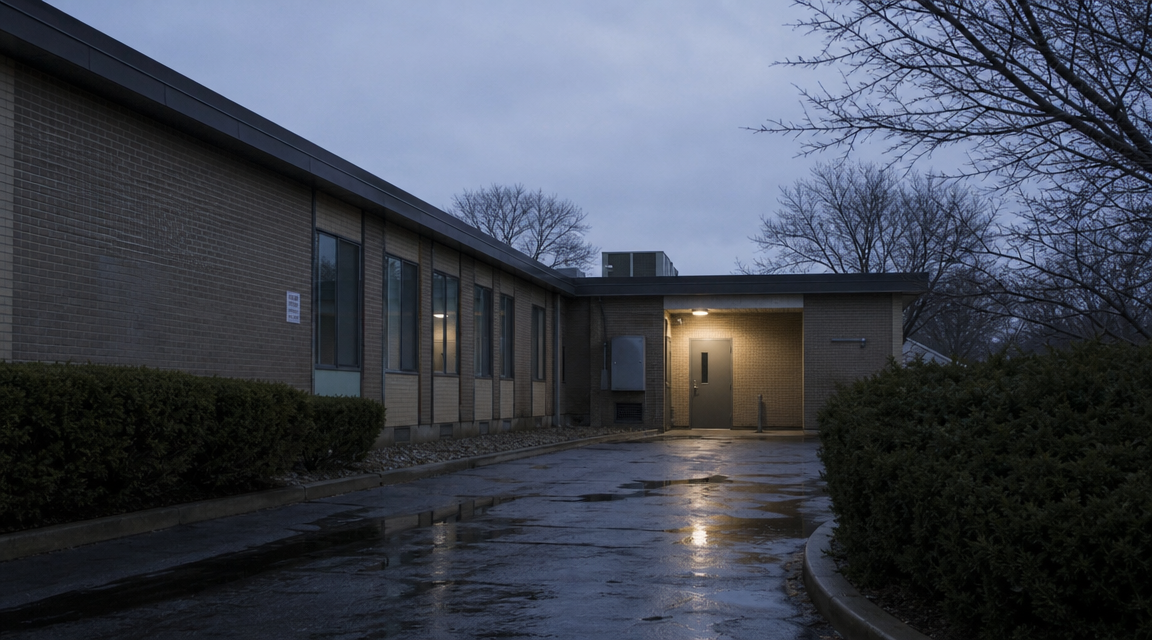
Halloway Clinic was a modest outpatient center, the sort of building most people pass without noticing. It handled appointments, tests, follow-ups, and the steady weekday traffic of a small medical practice.
There were no long-term wards, no old operating theater, and no empty patient rooms left waiting in the dark. By reputation, it was efficient rather than atmospheric.
The freight elevator sat near the rear service hall. Staff used it for boxed supplies, equipment deliveries, waste containers, and linen carts. Patients were not supposed to use it, and most never saw the hallway that led to it.
The floor involved was used mainly for overflow supplies and archived office material. After closing, it was locked by badge access at the stairwell and elevator controls.
That is why the camera images spread quietly among employees before it became a scary reconstructed moment. It was not filmed in a creepy place. It was filmed in a practical one.
What the Camera Appeared to Record
The camera still reportedly came from a fixed camera mounted high in the supply floor elevator lobby. Its view was plain: elevator doors, part of the corridor, and polished floor tile.
Shortly after the clinic closed, the freight elevator arrived. The doors opened without anyone visible inside at first. For a second, the cab looked empty.
Then a dark figure moved forward from the rear of the elevator.
Witnesses described it carefully. They did not mention glowing eyes or a distorted body. They said it resembled a patient in posture: narrow shoulders, slow gait, head slightly lowered.
The problem was the darkness. It looked less like a person in dark clothing than a person-shaped absence in the light. It crossed the threshold, turned toward the supply corridor, and left view.
No one appears after it. The elevator doors remain open for several seconds, then close.
The Locked Floor Is the Detail That Changed the Story
If the camera had been pointed at a public hallway, the camera still might have been dismissed within minutes. Clinics are busy, and someone is always where they should not be.
But the supply floor was not public. Staff entering from the stairwell had to badge in. The freight elevator also required authorized use for that level during closed hours.
When a supervisor reviewed the system, there was reportedly no badge event matching the elevator arrival. No staff member registered at the stair door. No vendor or delivery was logged.
That does not prove the figure was impossible. Security systems fail. Doors can be propped. Permissions can be misconfigured. A badge reader can miss an event or record it under a confusing code.
Still, the absence removed the easiest explanation. There was no clean paper trail for an employee, contractor, or patient wandering into the wrong place.
For a medical building built around tracking access, the blank space in the log was almost as unsettling as the shape on the screen.

The Cleaners Heard the Elevator First
The most repeated witness detail came from the cleaning staff working one floor below.
According to the account, two cleaners were near the rear corridor when they heard the freight elevator move. That was not unusual by itself. The elevator had a heavy mechanical sound, and its arrival could be heard through the service shaft.
What made them notice was that neither had called it.
They were preparing to move bags later in the shift, but had not pressed the call button. One cleaner reportedly joked that someone had saved them a trip. The elevator was not on their floor.
That small memory may be imperfect. People reconstruct timing after the fact. A sound that seemed important later may not have been clear in the moment.
But the cleaners’ account gives the camera images its second anchor. The event was not only seen later on a screen. It had been heard in the building as it happened.
Why the Figure Looks Wrong Without Doing Much
The Halloway camera still is not famous because of movement. The figure does very little. It exits an elevator and turns out of view.
That restraint is why some viewers found it convincing and others found it frustrating. There is no vanish, no thrown object, no impossible bending of limbs.
Instead, the wrongness sits in proportion and contrast. The figure has the outline of a patient but no readable surface. It appears where a person should not be, emerging from an elevator no one admits calling.
camera images like that depends heavily on context. Without the log issue and the cleaning staff statement, it is just another dark blur in institutional lighting.
With those details attached, it becomes harder to file away. It suggests either mundane failures stacked neatly together, or something using the clinic’s routines without leaving the usual marks.
A cautious viewer should not ignore either possibility.
The Sensible Explanations Are Still on the Table
There are several non-paranormal explanations, and none should be dismissed just because the story feels eerie.
A staff member may have used an unlogged route. Someone could have held a door open earlier. A vendor or employee in dark clothing may have been distorted by compression.
The elevator record could also be incomplete. Access software, elevator controls, and camera timestamps do not always agree perfectly.
The dark appearance may be a camera problem. Low light, reflective flooring, exposure changes, and artifacts can turn ordinary clothing into a flat silhouette.
The cleaners’ memory could have attached itself to the camera images once staff began discussing it.
Taken together, they make a practical case: an after-hours access mistake, captured poorly, remembered nervously.
That may be the truth.
Why Staff Did Not Treat It Like a Joke
What keeps the Halloway account alive is how quietly it seems to have circulated.
Employees were not describing a monster. They were talking about a security concern that happened to look like an apparition. That difference matters.
In medical spaces, locked areas are locked for reasons. Supplies, records, equipment, and patient privacy depend on controlled access. A figure entering without a badge is a problem before it is a ghost story.
The camera still reportedly prompted checks of doors, elevator permissions, and camera timing. Staff compared logs. Cleaning workers were asked what they heard.
Only after no simple answer settled the matter did the stranger interpretation grow. The eerie reading was not the first response. It was what remained after the normal response failed to satisfy everyone.

The One Patient-Shaped Detail
The phrase that followed the camera still was not “shadow person” at first. It was “patient-shaped.”
That wording is oddly specific. It does not mean staff recognized a patient. It means the figure moved with the subdued posture people associate with clinics: slow, contained, slightly bent inward.
One employee later said the figure looked like someone leaving an appointment they had not actually attended. That is not evidence, but it explains why the camera still unsettled people who worked there.
Clinics are full of temporary vulnerability. People arrive worried, tired, or in pain. A human outline there already carries a story before anyone adds the supernatural.
The dark figure seemed to borrow that familiarity without becoming identifiable. It was close enough to read as a person and blank enough to resist being one.
That is a narrow space for a mystery to occupy, but it is where the Halloway camera images lives.
What Still Feels Unresolved
The Halloway Clinic camera images has the weaknesses common to most modern security mysteries. We do not have a public chain of custody, raw system files, or a full technical audit.
Without those things, certainty would be dishonest.
But the account remains effective because it is built from plain details: a clinic after closing, a freight elevator arriving, a locked floor, a missing badge record, and cleaners who heard machinery move uncalled.
Nothing in the story needs thunder or spectacle. Its unease comes from administrative failure wearing the shape of a person.
Maybe someone slipped through a service route and a bad camera made them darker than they were. Maybe the access system missed what it should have caught. Maybe the cleaners remembered the timing wrong.
Those are responsible answers, and they may be enough.
Still, the camera images lingers for one reason. The elevator doors opened onto a floor that was supposed to be empty, and something shaped like a patient stepped out as if it had every right to be there.
Reader Context
This Weird Witnessed story is an editorial reconstruction, written as eerie visual storytelling rather than a verified report. For more context, see Camera Anomalies and Strange Images Guide and How WeirdWitnessed Creates Reconstructed Horror Stories.