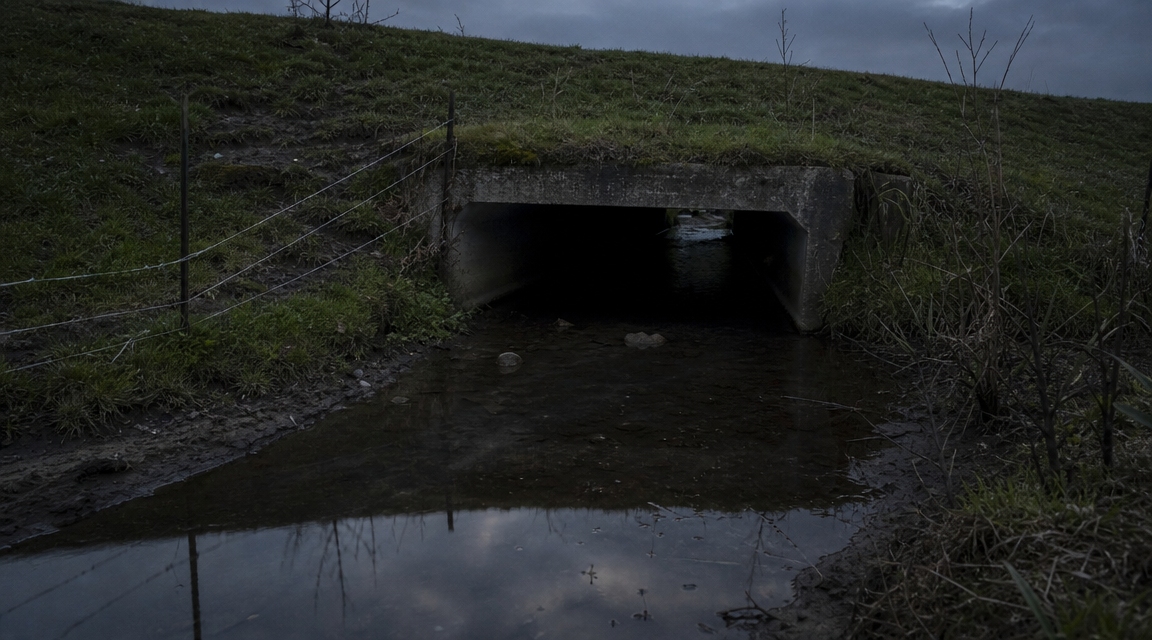
The Bellmoor Creek report is unsettling because it does not try to be large.
There is no sharp photograph, no towering silhouette framed by headlights, and no clean line of footprints pressed into perfect mud. The account turns on a culvert, a few hollow knocks in the dark, a low shape crossing shallow water, and one long coarse hair caught on rusted fence wire.
That is a narrow foundation for any claim. It is also the kind of foundation field investigators tend to take seriously, because physical traces are easier to examine than fear, memory, or a story improved over many retellings.
The Bellmoor Creek hair snag is not a detail people read as Bigfoot. It is a small piece of possible evidence in a setting where the witness details line up just enough to deserve a careful look.
A Quiet Culvert With an Ordinary Problem
Bellmoor Creek was not known locally as a monster place. It was a drainage line running through brush, pasture edges, and a two-lane road where water passed under a concrete culvert.
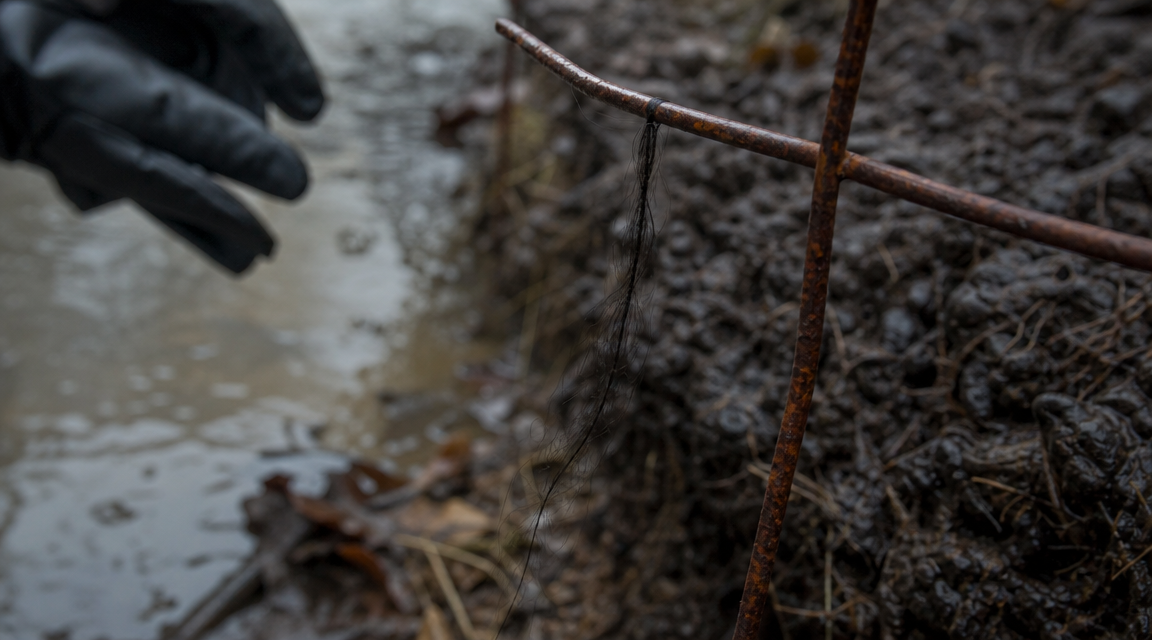
The fence wire along the creek bank was old and practical. It leaned between weathered posts, rusted in places, and dipped low where animals had pushed through over the years.
That detail matters. A fence like that is a collecting surface. It can catch deer hair, horsehair, cattle hair, shed dog fur, feathers, and the occasional human thread from a jacket sleeve.
What made this one different was when and where it appeared.
The Knocks Before the Sighting
The first oddity came after dark.
According to the reported sequence, two witnesses had parked near the culvert after hearing what they first thought was someone working late in the timber. The sound was described as a hollow knock, then another, separated by several seconds.
It did not sound metallic or like a loose gate tapping in wind. One witness compared it to a heavy limb being struck against a standing trunk.
Wood knocking is familiar in Bigfoot reports, but it is easy to overread. Sound carries strangely along creek channels. A distant axe, a truck tailgate, a beaver slap, or a shifting branch can become mysterious once the listener is alert.
Still, the witnesses did not report whoops, screams, or dramatic pursuit. They reported listening, becoming uncomfortable, and then hearing movement down near the water.
That restraint gives the account some weight.
The Low Shape in the Water
The sighting itself was brief and poor.
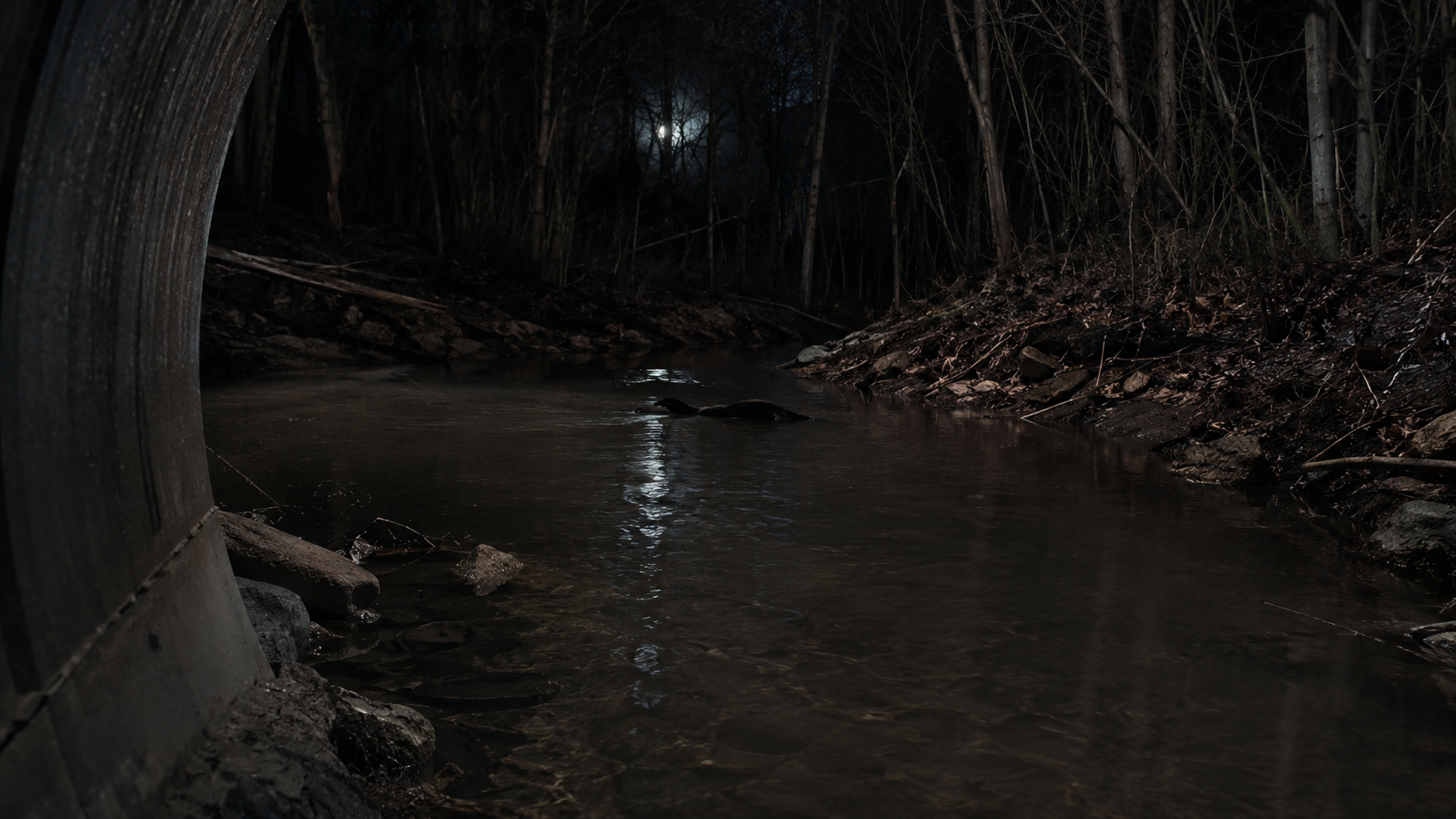
In the dim light near the culvert, the witnesses saw a dark, low shape move across the creek. It was not described as a tall upright figure striding between trees. It was broad, hunched, and close to the water, crossing from the culvert side toward the fence line.
The creek was shallow there, with slick stones and a narrow run of moving water.
One witness remembered hearing water rather than seeing feet. The other remembered the shape rising slightly near the opposite bank, as if climbing from the channel.
Neither could offer a confident height estimate. That is important. Many questionable Bigfoot accounts become weaker when witnesses insist on exact measurements from terrible conditions. Here, the uncertainty is part of the report.
They saw something dark and animal-sized or larger. They did not know what it was.
The Wire Where the Hair Was Found
The next morning, curiosity brought one witness back to the culvert.
Daylight made the scene ordinary again. The creek was narrow. The fence was rusty. The mud held partial animal sign, tire ruts near the pull-off, and broken grass where the bank had been used before.
On a strand of rusted wire at about hip height for an adult human, a long dark hair was caught where the fence dipped toward the creek.
It was reportedly longer and coarser than expected for deer. It did not look like the soft underfur of a domestic dog. It was described as dark brown to black, slightly wavy, and thicker than a human head hair.
Those descriptions are interesting but not decisive. Visual hair identification is notoriously unreliable. Lighting, moisture, and expectation can change how a sample appears.
The strongest point is location. The hair was found on the same side of the creek where the shape seemed to leave the water, on a wire that could have scraped a shoulder, flank, or back.
Why One Hair Is Not Enough
A single hair cannot carry a Bigfoot case by itself.
For evidence value, investigators need chain of custody, clean collection methods, comparison samples, and a lab willing to examine morphology or DNA without turning the process into entertainment.
The Bellmoor Creek sample, as described, falls short of that standard. It was not discovered by a trained forensic collector, and it was found outdoors on a contaminated surface.
Even if the hair was unusual, unusual does not mean unknown. Regional wildlife can surprise people. Black bear guard hairs can be long and coarse. Horses and cattle shed along fences. A dog with a rough coat could leave convincing strands.
There is also the mundane possibility that the hair was already there before the knocks were heard.
Good evidence survives skeptical questions. This sample survives some, but not all of them.
What Still Makes It Interesting
The Bellmoor Creek report remains interesting because its pieces are modest and connected.
The knocks came first. Then came movement near the culvert. Then came a low dark shape crossing shallow water. Then, in daylight, a hair was found on the wire along that apparent route.
None of those facts, taken separately, is extraordinary. Together, they form a pattern investigators can at least map.
The setting also fits a practical wildlife corridor. Creeks create cover, water access, and travel lanes through land divided by roads and fences. If a large wary animal wanted to move without using the open road, the culvert and creek bed would make sense.
That does not make the animal Sasquatch. It means the place itself is not absurd.
A hoaxer could have planted a hair, but the account lacks the usual showmanship. There was no immediate media push, no dramatic cast, and no clear attempt to monetize the story.
The Better Tests to Ask For
If the Bellmoor Creek hair still exists, the best next step is not another night vigil. It is documentation.
The sample should be photographed with scale, stored dry in paper rather than plastic if moisture is present, and handled with gloves. The collection point should be mapped. The wire height, distance from the water, and likely crossing line should be recorded.
A comparison search should also be done. Fence lines nearby may hold known deer, horse, cattle, bear, coyote, and dog hairs. Without those comparisons, the unusual sample has no local baseline.
Microscopic examination could show medulla pattern, scale structure, pigment distribution, and whether the hair resembles known species. DNA testing may fail if the root is absent or the sample is degraded, but even a failed test can be useful if documented honestly.
The point is not to force an answer. The point is to reduce the number of bad answers.

A Case Built From Edges
The most persuasive part of the Bellmoor Creek account is also the easiest to overlook.
Everything happens at an edge. Road edge, creek edge, fence edge, dark edge, and the thin line between witness memory and physical trace.
Bigfoot evidence often fails when it tries to be cinematic. The Bellmoor Creek hair snag does the opposite. It asks whether a small, dirty, easily contaminated object can still matter when it appears in the right place after the right kind of disturbance.
The cautious answer is yes, but only a little.
It matters enough to document. It does not matter enough to declare a discovery.
That balance is where many of the better Sasquatch reports live. Not in certainty, but in the uncomfortable space where a witness saw too little to be sure and found just enough to keep asking.
What the Bellmoor Creek Hair Leaves Behind
In the end, the Bellmoor Creek culvert gives us a grounded mystery rather than a conclusion.
A dark shape crossed shallow water. A fence wire held one long coarse hair. The witnesses connected the two because the place, timing, and movement seemed to match.
Skeptics have fair alternatives. The hair may belong to a known animal. The shape may have been a bear, dog, deer, or human misread in poor light. The knocks may have come from ordinary sources distorted by the creek channel.
Believers have fair reasons to pause. The behavior was quiet. The route made sense. The trace was found where a body might have brushed the wire.
That is why the Bellmoor Creek hair snag remains a useful Bigfoot evidence story. It does not prove what crossed the water. It preserves the question in a form that could, at least in theory, be tested.
For a field built on shadows, that is something.
Reader Context
This Weird Witnessed story is an editorial reconstruction, written as eerie visual storytelling rather than a verified report. For more context, see Bigfoot and Sasquatch Stories Guide and How WeirdWitnessed Creates Reconstructed Horror Stories.