The strongest unknown visitor stories are not always the ones with a craft in the sky.
Sometimes the center of the account is a dull line of equipment, a dry canal, and a field so empty that it gives the mind nowhere dramatic to hide.
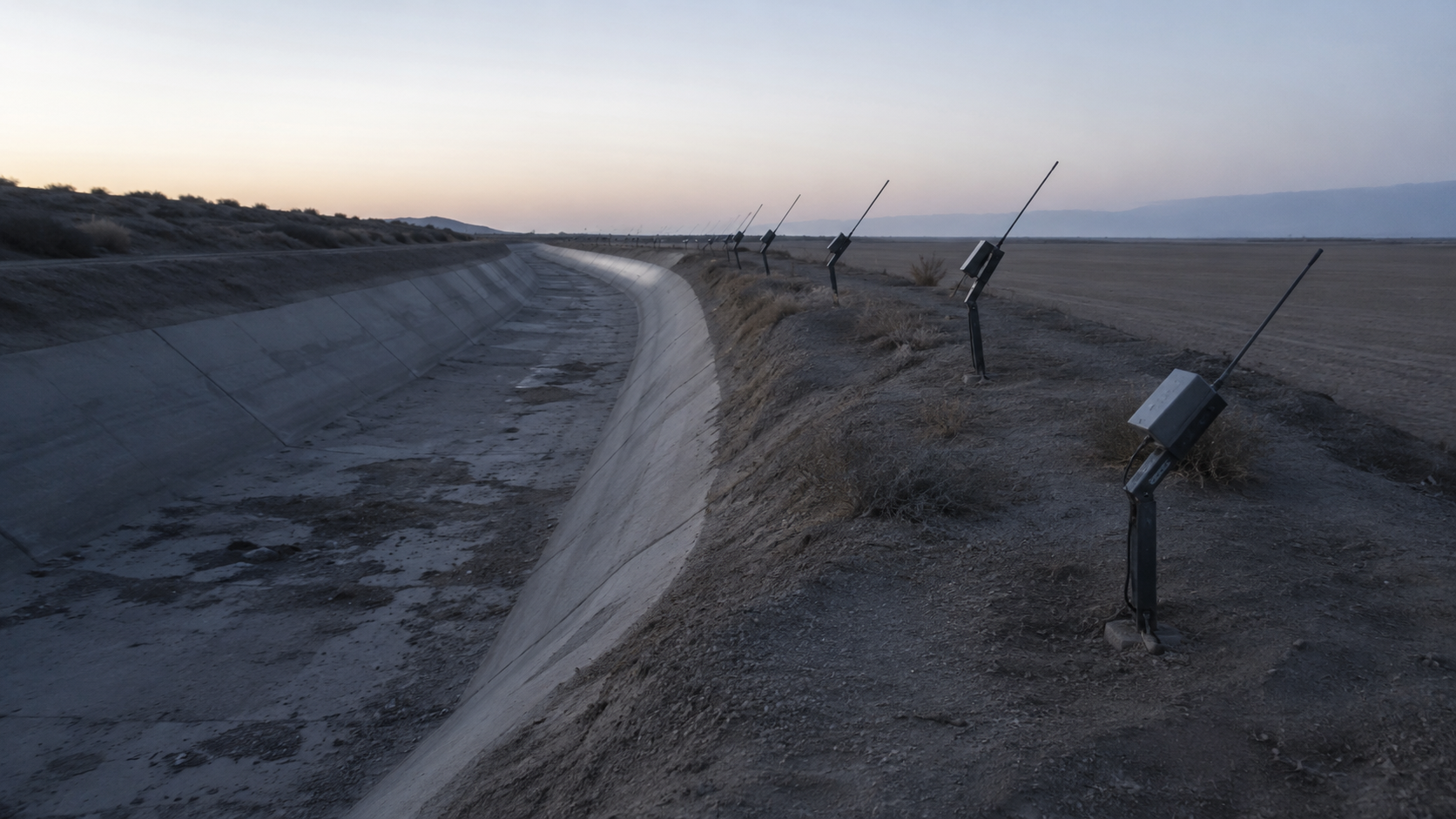
This report concerns battery-powered radio poles placed along an irrigation canal during a local signal check. They were temporary devices: short poles, small antennas, sealed battery boxes, and brackets set into hard ground beside the channel.
Then came a silent green-white pulse after dark.
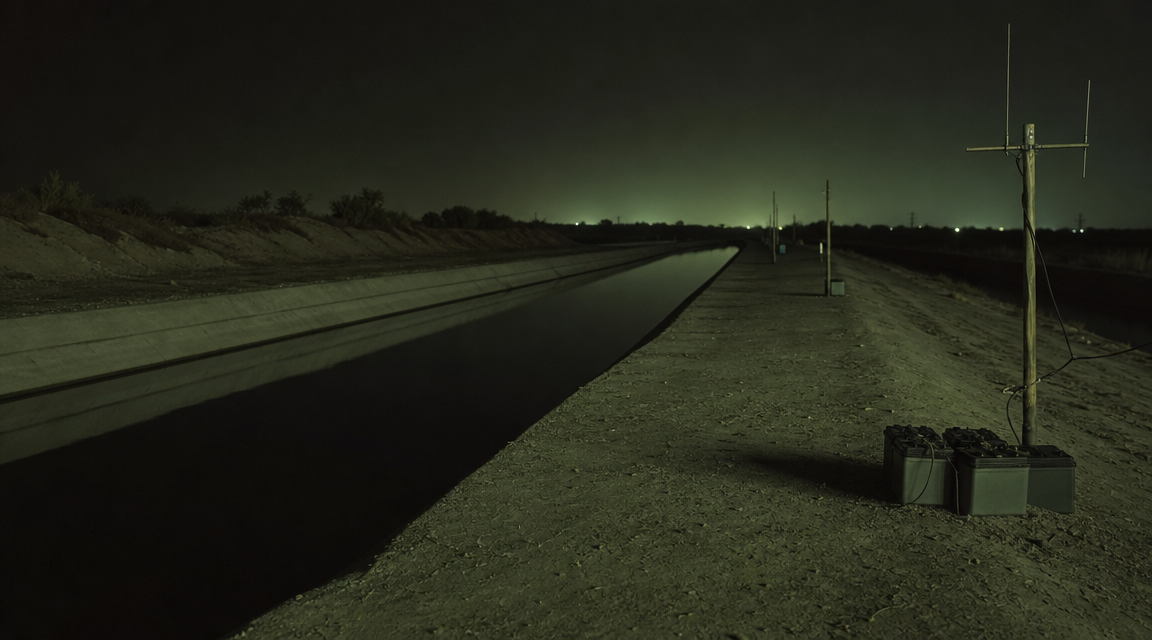
By morning, the poles reportedly faced one direction. Not north, not the nearest road, and not the expected relay point. Every one had turned toward the same blank field. In the pale dust around the equipment, witnesses said there were no footprints.
A Dry Canal Built for Ordinary Work
The setting matters because it strips the story of most decorative mystery.
This was not a famous desert test range or an abandoned observatory. It was a working agricultural corridor in a dry season, when the irrigation canal had been shut down and left as a concrete trench with powdery silt gathered along the shoulders.
A small crew had placed the radio poles for a short-range reception survey. They wanted to know how a low-power signal behaved along the canal cut, where banks, road, and fields could interfere with line of sight.
The poles were closer to survey stakes with antennas than towers. The batteries were field gear, not secret machinery. That simplicity is important. If the account is accurate, whatever happened did not require a complex target.
It touched the most basic part of the setup: direction.
The Pulse Nobody Heard
The first oddity was not movement. It was light.
According to the account, two people near the canal after sunset saw a green-white pulse spread across the dry channel and the field beyond it. They did not describe a beam or descending object. They described a broad, silent brightening, like heat lightning without thunder, except the color was wrong.
It appeared, peaked, and vanished.
No boom followed. No engine sound approached. The canal returned to darkness quickly enough that one witness reportedly wondered whether the flash had happened behind their eyes rather than in the field.
That uncertainty feels honest. Many strange-light reports grow more confident with retelling. This one begins with people trying to decide whether they had seen a real event, an electrical fault, or a trick of night vision.
The Morning Alignment
The next morning made the pulse harder to dismiss.
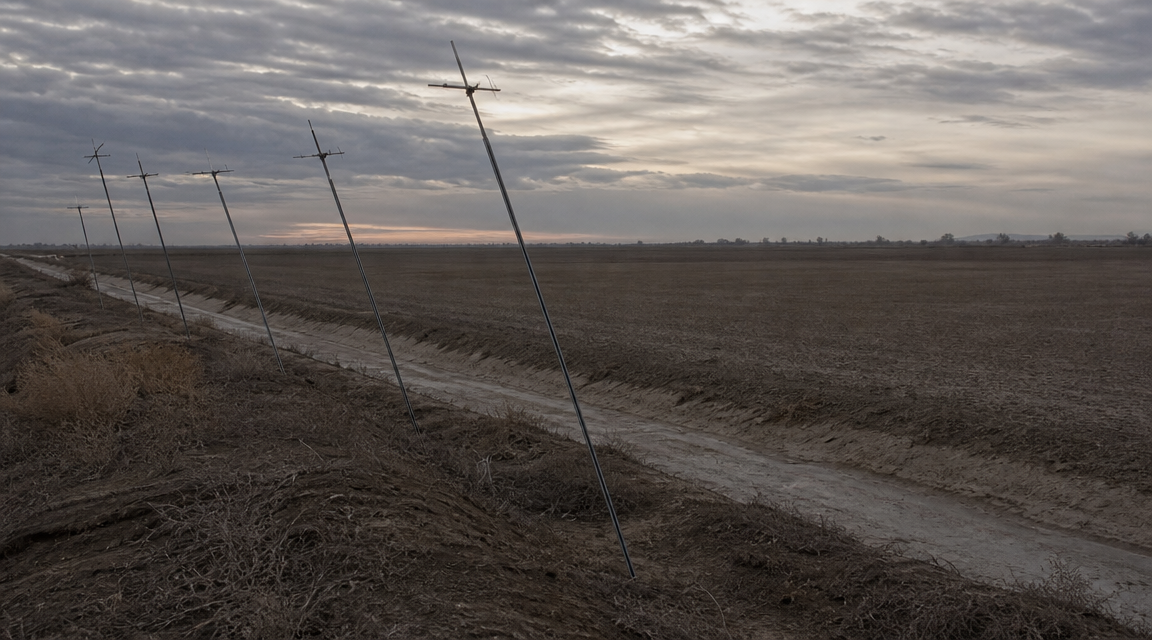
When the crew returned to check the equipment, the radio poles were no longer in the positions they remembered. Each antenna assembly had been rotated or angled toward the same open field on the far side of the canal.
The change was subtle from a distance and obvious up close. These were not poles thrown down by wind or broken by vandals. The story says they remained upright and functional. Battery cases were still closed. Cables had not been torn out.
The alignment was the unsettling part. Temporary field equipment is often messy, with each unit leaning according to soil, bracket, and human impatience. Here, witnesses claimed the pieces shared a new intention. They all indicated the same quiet patch of ground.
A blank field is a difficult destination for a mystery. It offers no monument, no visible landing mark, and no convenient object to blame. The emptiness becomes the evidence because the equipment appears to have selected it anyway.
No Footprints in the Dust
The missing footprints are why this story belongs in the evidence category rather than the strange-light category alone.
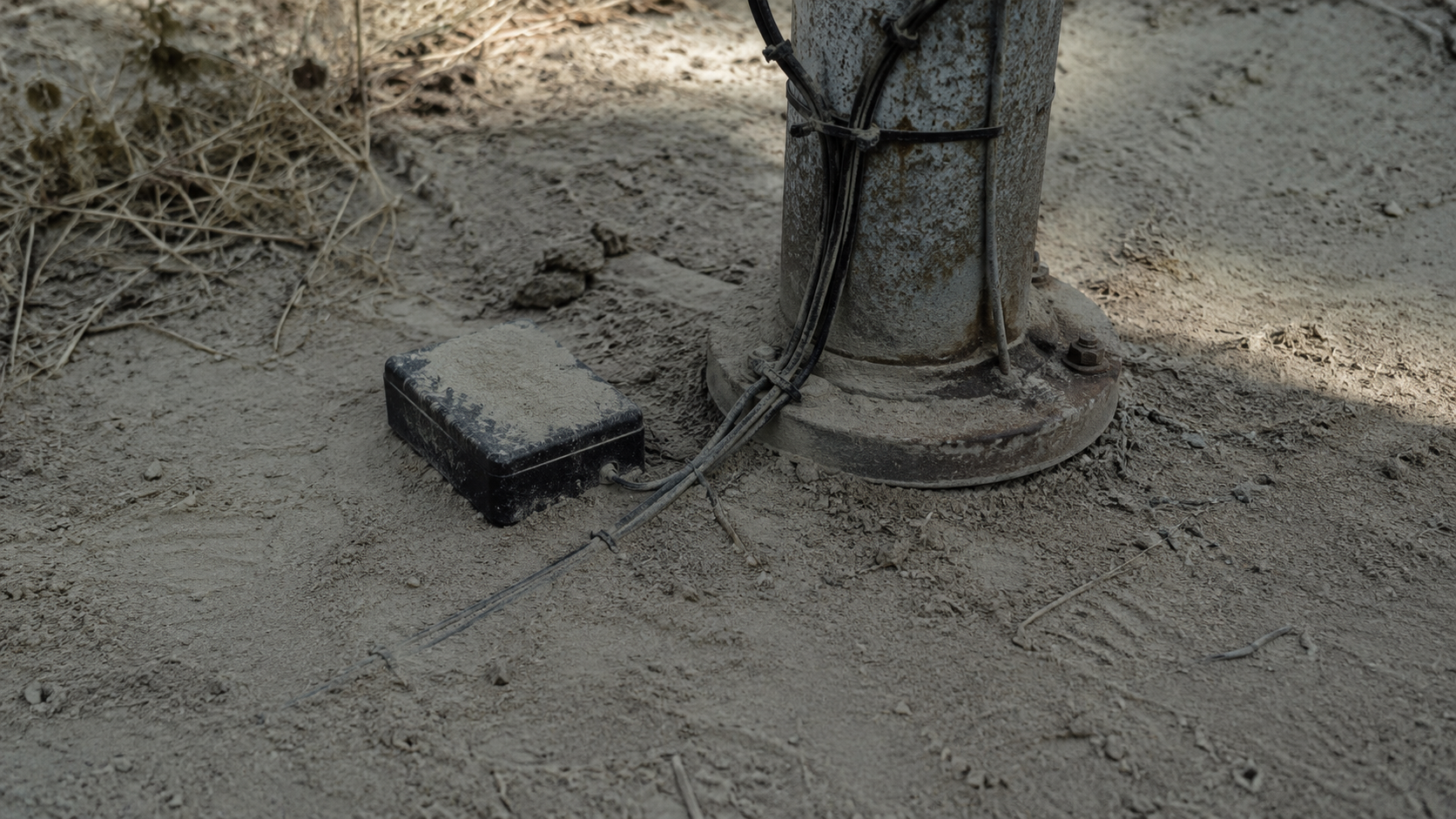
The canal shoulders were said to be coated in fine dust and silt. Anyone walking from pole to pole would have left marks, especially near the battery boxes.
The crew reportedly saw old tracks from the original installation, tire marks on the access path, and small disturbances from weeds and animal movement.
But around the bases of the moved poles, the fresh disturbance they expected was absent.
That does not prove an unknown visitor. Dust can crust. Wind can erase. People can step carefully on existing marks. A prankster could use boards or reach from the concrete edge. Still, the report becomes harder to flatten when the physical environment should have recorded ordinary interference and apparently did not.
In grounded terms, the dust is more important than the color of the light.
What the Equipment Could and Could Not Do
A useful version of this account has to ask whether the poles might have turned themselves.
Small field antennas can shift under wind load if their mounts are loose. Thermal contraction can change tension in brackets or cable ties. Animals can rub against equipment. A passing vehicle can create vibration along hard ground.
Those explanations deserve attention.
The difficulty is the shared orientation toward one field. Wind would push exposed surfaces according to gust direction, but canal geometry, pole placement, and individual mounting angles would introduce variation. Loose brackets would not normally choose a common target unless the starting conditions already favored it.
The batteries also matter. If the units contained small motors or tracking heads, the mystery would shrink. In the usual telling, they did not. They were passive poles with radio components.
So the mechanical question remains narrow: could ordinary forces rotate simple equipment in a coordinated way without leaving obvious disturbance around the bases?
Possibly. But not comfortably.
Why the Field Became the Focus
The field across the canal was described as blank, but blank does not mean irrelevant.
Open agricultural land can hide buried pipe, old fence lines, abandoned cables, mineral differences, wet patches below dry crust, or metal debris from decades of work.
If the survey produced odd readings from that direction before the pulse, the crew might have noticed the field already. If the poles were later found facing it, memory could bind the details into a single pattern.
That is not an accusation of invention. It is how witnesses work. Still, the field’s emptiness keeps the story alive. Nobody reported a figure standing there, machinery parked there, or a glowing object lifting away.
The alleged visitor, if there was one, left only orientation behind.
The Unknown Visitor Reading
Within Alien / Unknown Visitor Evidence, this case is interesting because it avoids the usual spectacle.
There is no claim of a saucer, no doorway of light, no message, no creature at a window. The evidence is behavioral and indirect. Something appeared to affect human tools, or to leave human tools arranged as if they had reacted to its presence.
The green-white pulse supplies the visitor-like element. The aligned poles supply the aftereffect. The undisturbed dust supplies the challenge.
Taken together, they create a pattern seen in durable close-range unknown reports: a brief light event, a localized equipment anomaly, and a physical scene that does not quite match normal access.
That does not make the unknown visitor explanation the most likely. It makes the account eligible for that shelf because the story is not simply, “we saw a light.” It is, “something changed after the light, and the ground did not show how.”
A skeptical reconstruction can still be built without insulting the witnesses. The pulse may have been distant electrical activity, a transformer flash, a meteor fragment, a vehicle light reflected strangely by dust, or a momentary optical effect amplified by expectation. The pole alignment may have resulted from loose mounts, wind, vibration, or imperfect memory of their original positions.
The footprint issue may be less solid than it sounds. Morning light can hide shallow marks. Dust near hardware can look undisturbed unless photographed before and after. A person checking equipment may avoid stepping close without realizing it.
This may be the correct reading. But it handles the pieces separately, while the account asks to be considered as a sequence: first the silent pulse, then the shared direction, then the missing tracks.
What Would Make It Stronger
The difference between a compelling story and strong evidence is documentation. The strongest version would include dated before-and-after photographs, close images of the dust, notes on wind conditions, a map of the field, and logs from the radio survey.
Battery voltage readings would matter. So would bracket photographs, soil texture, and the exact distance from the canal edge to each pole. Nearby cameras, irrigation monitors, power company records, or weather data could shrink the mystery or sharpen it.
Without that material, the story remains an account rather than a case file. Even so, it has the shape of something worth preserving: ordinary equipment, a brief environmental anomaly, a physical change, and a gap where human footprints should be.
What stays with me is not the flash. Strange lights are common, and many become less strange once their context is known.
What stays is the morning scene: a dry canal, small radio poles, closed battery boxes, and every antenna turned toward a field that offered no explanation back.
If a person did it, they left an unusually clean scene. If weather did it, it behaved with unusual precision. If memory reshaped the setup, it did so around a pulse that witnesses already found difficult to place.
The unknown visitor reading should be held carefully, not preached as a conclusion. The best WeirdWitnessed cases stay open to wonder, resistant to exaggeration, and honest about what the evidence can bear.
Here, the evidence is modest but stubborn.
A line of simple radio poles faced an empty field after a silent green-white pulse, and the dust around them reportedly kept its mouth shut.
Reader Context
This Weird Witnessed story is an editorial reconstruction, written as eerie visual storytelling rather than a verified report. For more context, see UFOs and Unknown Visitors Guide and How WeirdWitnessed Creates Reconstructed Horror Stories.