The Northgate car wash camera did not record a ghost walking through mist or a face pressed against glass.
It recorded a reflection.
That is what made the camera still easy to dismiss at first and harder to forget later. Reflections are unreliable witnesses. They bend space, borrow light, and turn ordinary objects into people if the angle is poor enough. But the shape in the Northgate camera images had the settled posture of someone sitting in a passenger seat.
The problem was that no customer used the lane that night.
A Closed Lane Under White Lights
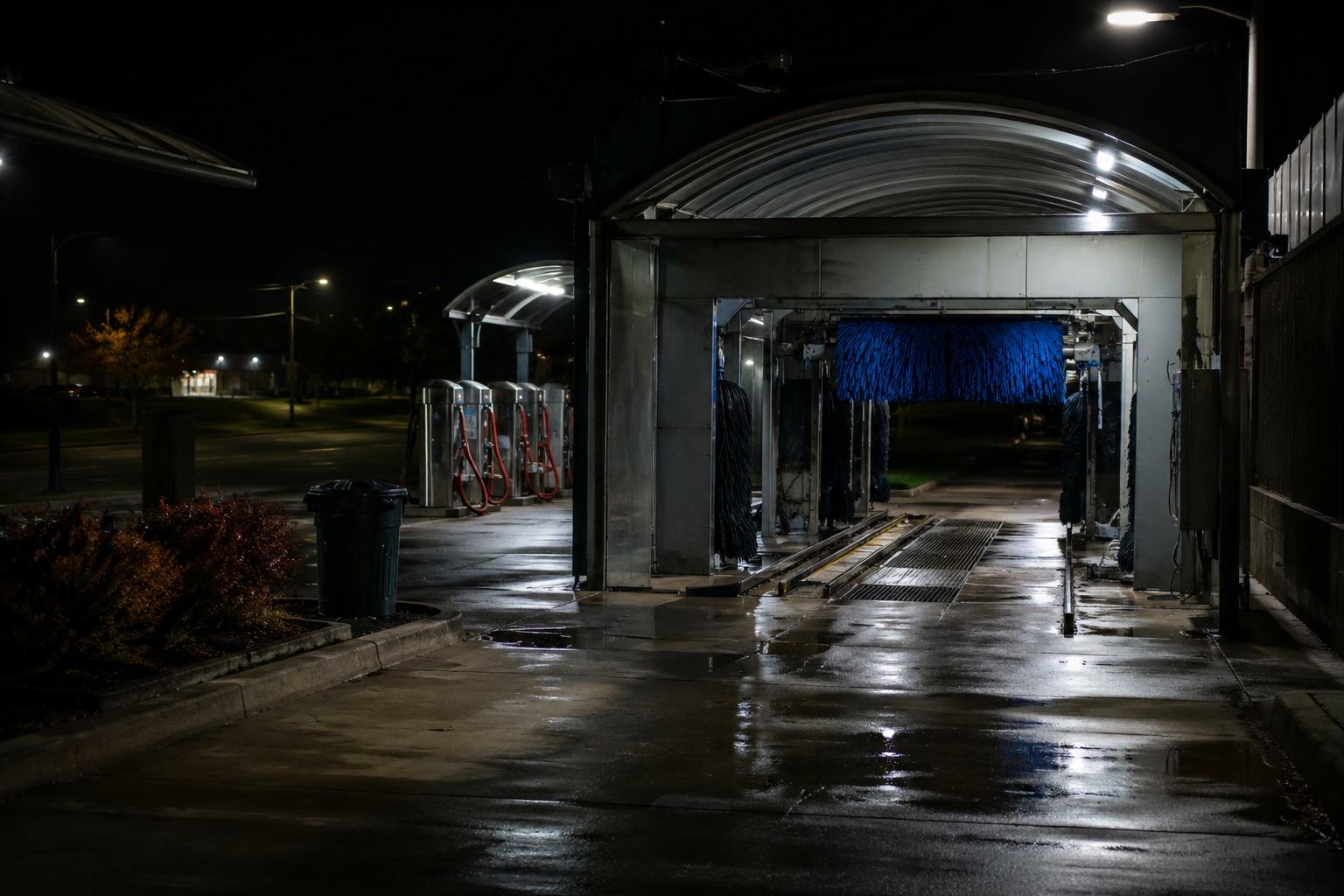
Northgate Automatic Wash sat beside a small service road, the kind of place drivers noticed only when they needed salt rinsed from a car or dust blasted from wheel wells.
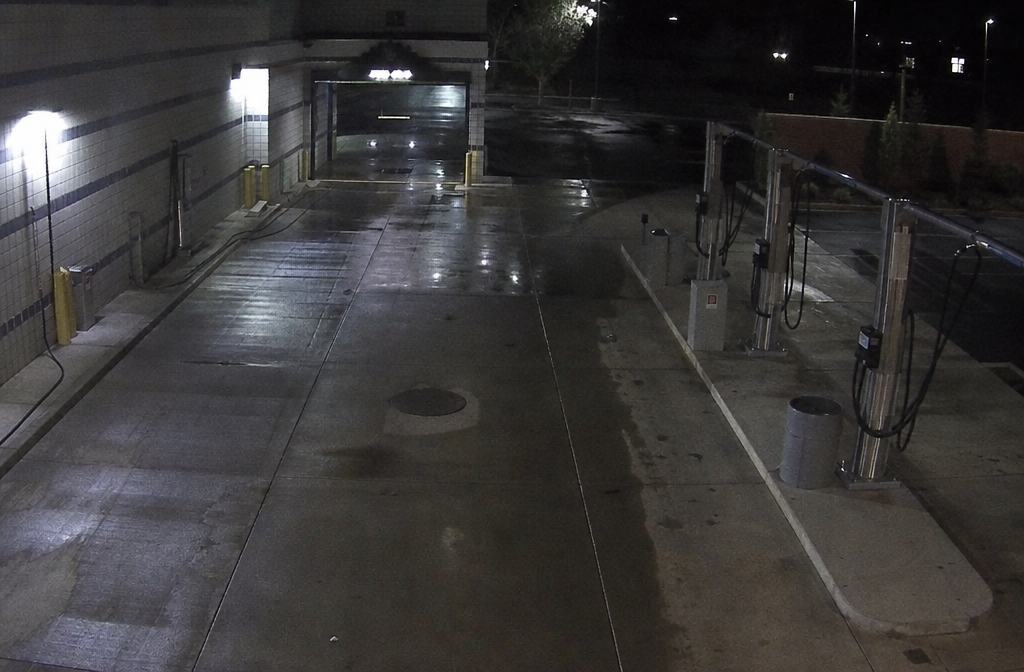
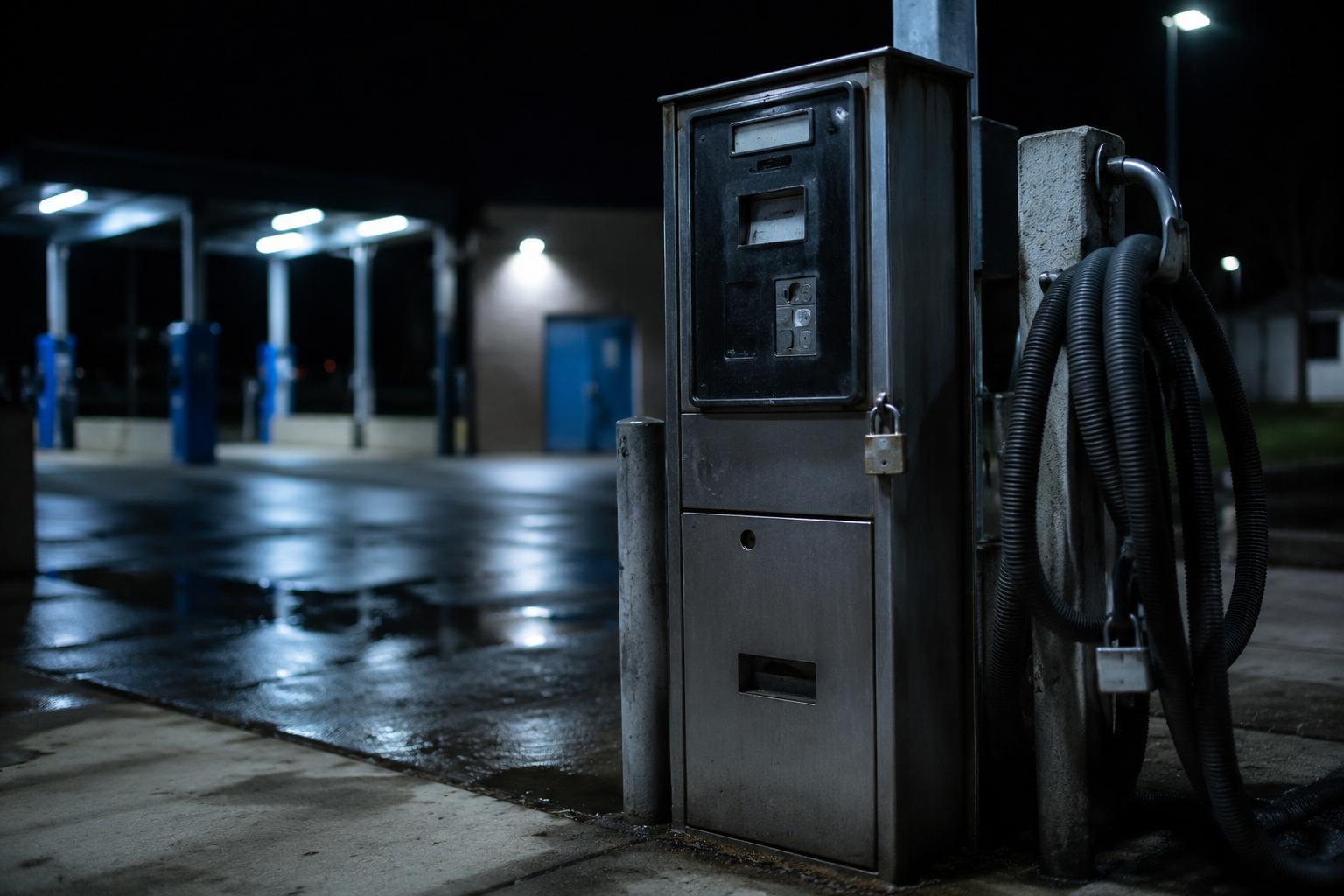
It had one enclosed wash tunnel, a short entry lane, a pay kiosk, and a row of vacuums facing the side wall. After hours, the system locked out new purchases. Cameras watched the kiosk, the tunnel mouth, the vacuum stalls, and the side apron where employees emptied bins.
The camera still came from an overnight security review after a minor maintenance alert. A manager expected to see windblown debris, a raccoon, or a false motion trigger from passing headlights.
Instead, the camera images showed an empty bay and, a few seconds later, a dark seated outline appearing in a reflection near the vacuum area.
The Camera Saw Almost Nothing Happen
Most strange camera images becomes less strange when viewed in sequence. A door opens. A person enters. A shadow crosses from an obvious source. Context removes the mystery.
The Northgate camera still moved in the opposite direction.
The wash lane was visible before the figure appeared. No car pulled in. The pay kiosk remained dark except for its standby glow. The vacuum hoses hung still. The pavement was wet from an earlier rinse cycle, but there was no spray, no moving brush, no employee walking through frame.
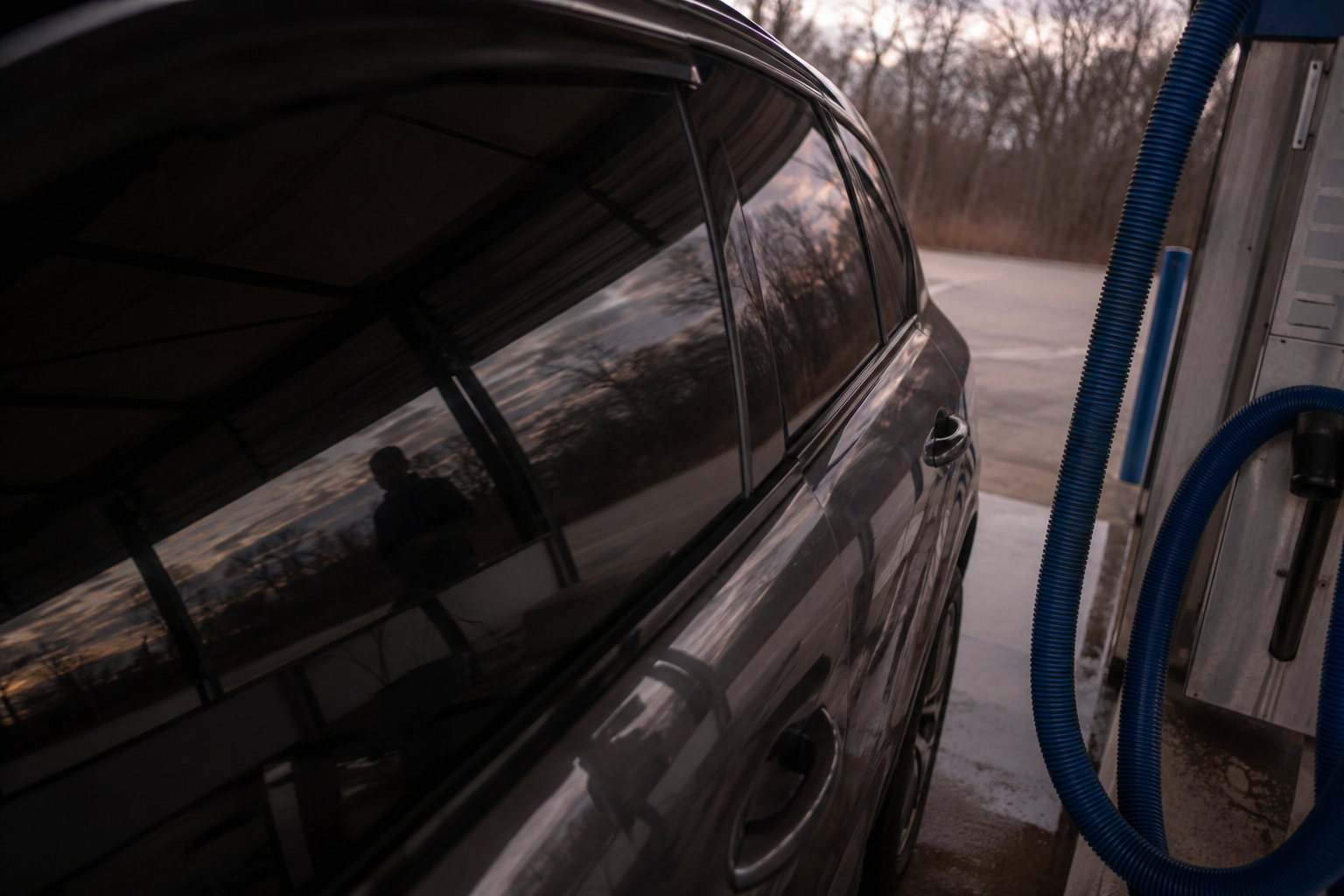
Then a side window or glossy panel near the vacuum area caught a shape. It looked like the right half of a car interior reflected from an angle: a dark shoulder, a rounded head, and the suggestion of a passenger sitting upright.
The image held for several seconds. Then it faded as if whatever supplied the reflection had moved or the camera exposure had changed.
The Passenger Shape
Witnesses who saw the exported still tended to describe the figure before describing the scene.
That is a warning sign. Human perception is hungry for bodies. Once someone says passenger, the mind organizes the dark patch into a passenger. Still, the outline is what carried the story beyond a routine security oddity.
The shape was not standing in the bay. It did not seem to be outside the building. It appeared within the reflected geometry of a side window, as though a car just outside the camera’s view contained someone in the front passenger seat.
There was a head turned slightly toward the wash entrance. A shoulder line dropped toward where a door would be. The lower portion disappeared into blackness, which strengthened the seated impression.
No face, clothing, or hands could be seen. It was only posture, but posture can be deeply persuasive.
The Access Logs Did Not Help
The manager checked the access records because the most obvious explanation was a late customer.
The wash system kept transaction times, kiosk activity, service overrides, and maintenance door openings. The vacuum area had its own power schedule. If a driver had entered through the normal lane, the sensors should have logged a vehicle. If an employee had used an override, the maintenance panel should have recorded it.
There was no matching entry.
The last paid wash occurred before closing. The final employee lockup had been logged. The system remained in closed mode through the time of the camera still. No gate alarm sounded, and no vehicle sensor registered weight or motion in the bay.
That did not make the passenger impossible. Cars can idle outside camera coverage. Logs can miss things. Small businesses run on imperfect equipment.
But it did mean the simplest story left no footprint where it should have.
Reflections Make Bad Evidence
Any careful reading of the Northgate camera still has to begin with a confession: reflections can lie.
A reflective panel can capture something from far outside the frame. A passing vehicle on the service road might appear to sit inside the car wash geometry. A headrest, trash bin, vacuum post, or wet pavement highlight could combine into a human form. Low-light cameras smear edges and flatten depth.
The passenger might have been a driver waiting at the intersection beyond the property, reflected through multiple surfaces at an angle nobody reconstructed. It might have been the camera seeing a familiar pattern in dark plastic and glass.
This is the responsible explanation, and it deserves weight.
Yet the oddity is not that a reflection looked human. The oddity is that it looked human in the one configuration the closed site could not account for: someone seated inside a vehicle at a time when no vehicle was recorded.
The Empty Bay Before and After
The seconds around the appearance are the reason the camera images kept circulating among employees.
Before the silhouette, the bay is empty in the flat, unromantic way of security camera file. No headlights approach. No tire shine moves across the floor. The equipment is still.
After the silhouette fades, the same emptiness remains.
If a passing car caused the reflection, it did not produce a clear sweep of light before or after. If a person walked near the vacuum area, they never appeared directly in the camera view. If the shape was part of the environment, it was strangely absent from adjacent frames.
The camera still was not long enough to solve itself. It offered a narrow window of ambiguity, then closed.
That is often how caught-on-camera mysteries survive: not by showing too much, but by refusing to show the ordinary cause arriving or leaving.
Why Northgate Became a Creepy Moment
Car washes are not usually haunted in the traditional imagination. They are bright, noisy, temporary places. Cars enter dirty and leave wet. People do not linger.
After closing, however, a car wash can feel unexpectedly vacant. The machines are built for motion, so stillness seems unnatural. Hanging hoses resemble slack limbs. Brushes wait in rows. Water continues to drip long after the last customer is gone.
Employees at Northgate already disliked late-night maintenance checks. They joked about hearing tires on wet concrete when the lane was empty and about the tunnel lights flickering on without a car at the sensor. Those stories were probably equipment behavior turned into folklore.
The passenger image gave the jokes a fixed point. It suggested not a monster in the tunnel, but a customer who had somehow arrived without a car, a transaction, or an entrance.
The Best Skeptical Reconstruction
The strongest skeptical reconstruction involves an off-site vehicle.
A car could have passed along the service road at the right angle, its passenger briefly reflected in the wet side panel or window near the vacuum stalls. Because the camera did not face the road directly, the vehicle itself would remain unseen. The passenger shape would appear detached from its source.
This explains the seated posture and the short duration. It also explains why no access log recorded a customer.
There are weaknesses. The road was not especially busy at that hour. The camera still reportedly lacks the sweeping headlights expected from a passing vehicle. The reflection appeared darker than the surrounding panel rather than brighter, which complicates a simple headlight reflection.
Still, this version is plausible. It does not require ghosts, hidden visitors, or broken logs. It requires only glass, distance, and timing.
A good mystery should survive its best mundane answer, not ignore it. Northgate survives by remaining just slightly misaligned with that answer.
What the Camera Could Not Tell Us
The camera could not prove whether the silhouette belonged to a person, an object, or a trick of reflected night.
It could not identify a face. It could not show the source angle. It could not confirm that an unseen car was absent from every possible position outside the frame. Security systems are built to discourage theft, not to solve metaphysical questions.
What it did show was a closed property behaving as if it had briefly contained an unseen passenger.
That is the entire claim, and it is enough. The camera images is not spectacular. It is not clean. It lives in the frustrating borderland between technical artifact and witnessable event.
Maybe the Northgate passenger was only a reflection from the service road, shaped by glass and wet concrete into something human. Maybe the logs missed a vehicle, the camera missed its approach, and the mystery is just several small failures stacked together.
Or maybe the strangest thing about the camera still is how ordinary the figure looks.
Not threatening. Not theatrical. Just seated, waiting, and gone before anyone on site knew it had been there.
Reader Context
This Weird Witnessed story is an editorial reconstruction, written as eerie visual storytelling rather than a verified report. For more context, see Camera Anomalies and Strange Images Guide and How WeirdWitnessed Creates Reconstructed Horror Stories.