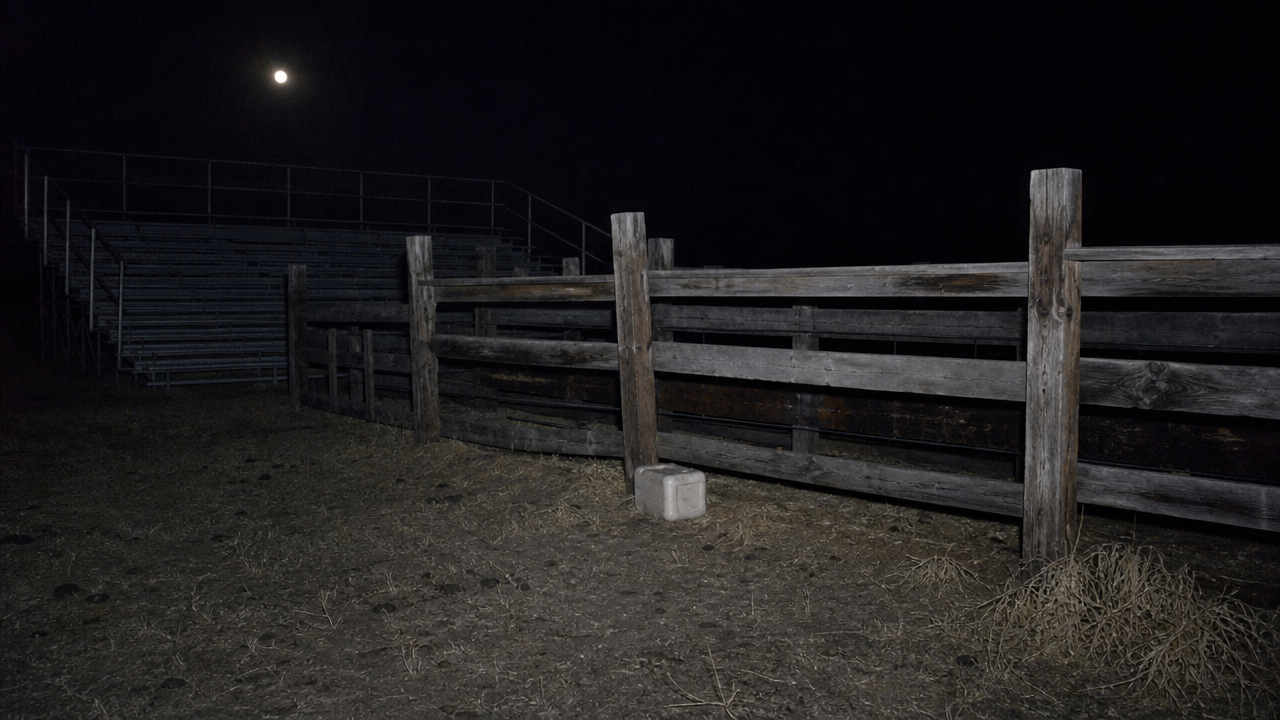
The strongest part of the fairground salt-lick photos is not the dark shape behind the bleachers. It is what happened before it appeared. A salt block that should have stayed near a post was found about three feet away. Deer that had used the pen nightly stopped crossing the rail gap. One fence rail bowed outward. Then the camera caught a broad, solid, upright form partly hidden by rail shadows behind the empty seats.
That combination is why the images still get discussed.
These are not clean a detail people read as Bigfoot, but they are not easy to dismiss as one blurry animal doing one ordinary thing.
WHAT THE PHOTOS SHOW:
The camera was placed at a rural, abandoned county fairground cattle pen where a livestock salt block had been left to draw deer. The pen sat beside empty bleachers, with old boards, patchy grass, and a dirt lane behind the rails.
The sequence reportedly shows:
- deer using the salt block for several nights
- deer suddenly avoiding the pen
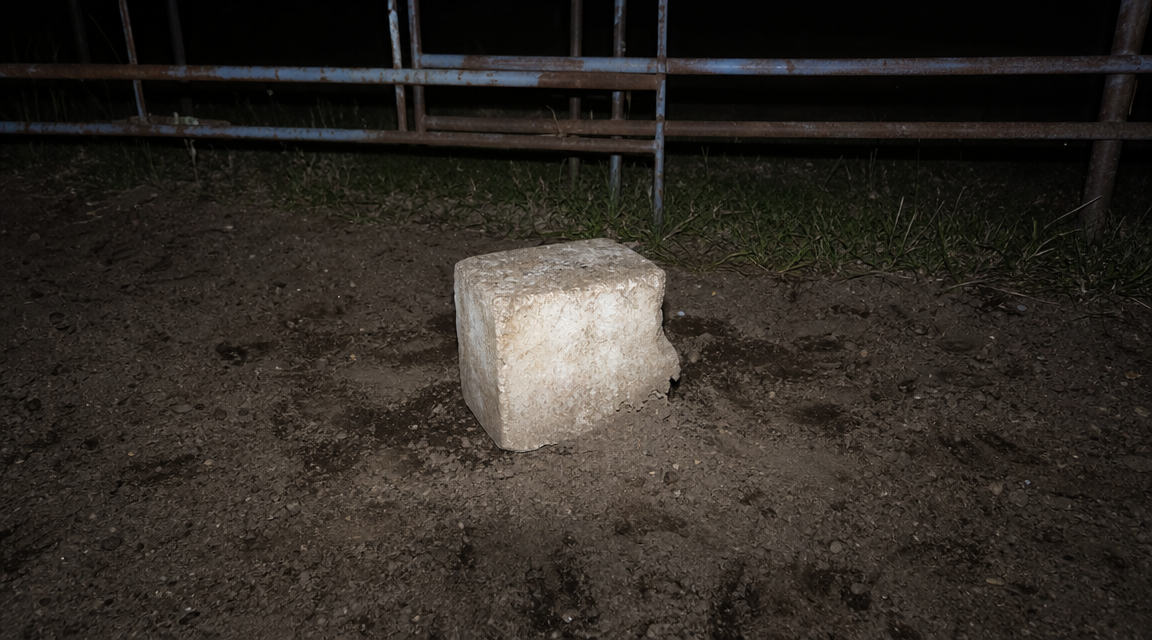
- the salt block shifted about three feet overnight
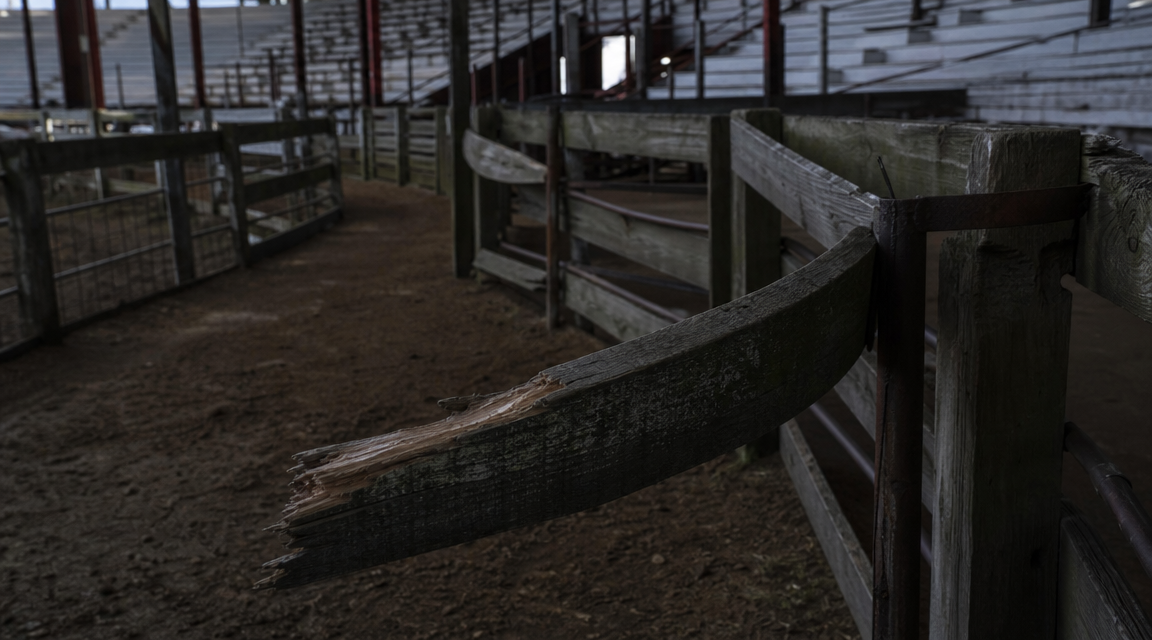
- one fence rail bent outward toward the lane
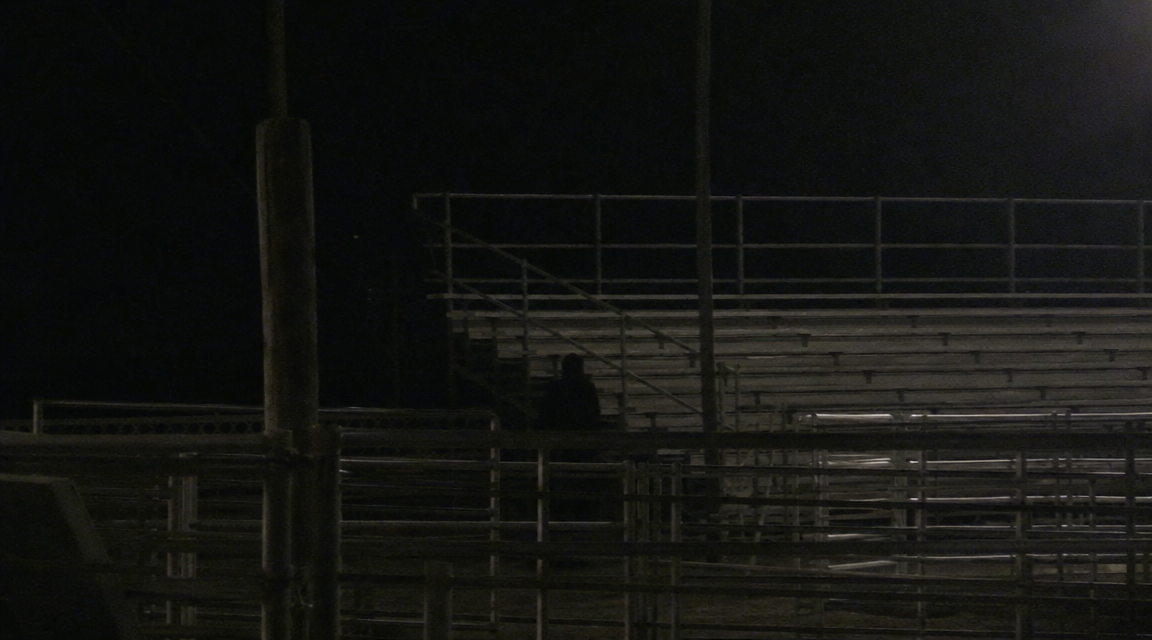
- one low-light image with a broad dark upright shape behind the bleachers
None of that proves a Sasquatch was there. Together, though, the details create a problem: the scene changed in ways that do not point neatly to deer, raccoon, coyote, or wind.
1. The Salt Block Was Not Just Nudged
A livestock salt block can move. Deer can lick it. Raccoons can climb over it. Rain can soften the dirt around it. None of that is mysterious by itself.
The odd detail is distance and direction.
The block reportedly started near a fence post, placed where the camera could see it. By morning, it was roughly three feet away, farther inside the pen. There was no active livestock there, and the dirt did not show the churned mess expected from a herd.
A deer could bump a block. A person could pick one up. But the camera did not show a person entering, and the block did not move along the normal deer approach line.
2. The Deer Changed Their Pattern First
The deer behavior may be the most useful clue because it appears before the dramatic frame.
For several nights, deer entered through the same low gap, lowered their heads to the block, and stayed for multiple photos. Their body language looked normal: heads down, ears rotating, occasional glances toward the bleachers.
Then the pattern breaks.
Instead of entering the pen, deer appear near the edge of the camera range and stop. Some face the pen without crossing in. Others angle away, leaving the salt untouched. Deer spook easily, so this could mean coyotes, human scent, loose dogs, or a new object.
Still, the timing matters. The avoidance starts before the moved block and before the upright shape.
3. The Fence Rail Bent the Wrong Way
The bent rail sounds minor until you picture the pen.
If a deer panicked inside and hit the fence, the rail would likely bow inward. If a person climbed over it, the stress might be downward. In the photos, the rail is described as bowed outward toward the lane behind the pen.
Old fairground rails rot. Moisture weakens boards. A large animal or person on the lane side could bend one.
But paired with the salt block movement, the rail suggests contact from outside the pen, not just a deer bumping around inside it.
4. The Shape Is Broad, Upright, and Too Solid to Ignore
The famous image is low-light and partly blocked by rail shadows. It should not be oversold.
What can be said cautiously is that a dark, upright shape appears behind the empty bleachers. It is broad through the body area and does not have the clean outline of a standing deer. It also does not look like a coyote, raccoon, or small animal in a normal posture.
Could it be a person? Yes. That is one of the strongest ordinary explanations.
A person in dark clothing behind the bleachers could produce a similar silhouette. Empty rural fairgrounds can attract trespassers, hunters, or teenagers looking for a hidden place.
But no flashlight beam, vehicle light, reflective clothing, or second human shape is visible in the described frame. The form also looks wider and less separated at the neck and shoulders than a typical person.
5. The Bleachers Can Explain Some Shadows, Not Everything
Skeptics are right to focus on the bleachers. Low-light cameras can turn normal backgrounds into false bodies. Horizontal rails stack shadows. Bleacher supports create vertical patches. A slight exposure change can make a dark gap look alive.
That may be part of this image.
However, the shape reads as one solid mass behind the rail pattern, not only a random shadow line. The rails hide parts of it, which makes judgment harder. It is not clear enough to confirm anything, but viewers keep seeing a body-like form.
A camera artifact could explain one frame. It does not explain the deer avoidance, shifted salt block, and outward rail bend unless those are coincidences.
6. The Camera Was Aimed at the Wrong Mystery
The camera was set to watch the salt block, not the bleachers. That sensible choice weakens the evidence.
The most interesting area sits in the background, partly outside the strongest illumination. The fence rails cut across it. The bleachers add repeating lines and dark gaps. A second camera on the lane might have shown a person walking in, a deer dragging the block, or a large animal passing behind the boards.
Instead, the best evidence appears in the worst part of the frame.
7. Normal Explanations Each Leave Something Out
The safest approach is to test ordinary answers first.
A deer could explain some activity around the salt. It does not easily explain a broad upright shape behind the bleachers.
A person could move the block, bend the rail, and stand in the background. But the lack of lights, tools, or clear entry behavior leaves the sequence incomplete.
A bear could move the block and damage a rail in some regions, but the silhouette does not clearly show a bear body.
Wind could not move a salt block three feet. Shadows could create a figure-like patch, but shadows do not change deer behavior.
None of this confirms Bigfoot. It only shows why the photos remain open instead of neatly closed.
8. Why This Fits the Better Sasquatch Evidence Pattern
The more interesting Bigfoot reports often involve behavior before they involve a clear body.
Animals go quiet. Deer avoid a normal feeding spot. Something heavy moves an object. A fence, gate, or tree line shows disturbance. Then, sometimes, a camera catches a partial shape at the edge of the scene.
That pattern does not make every case true. It does explain why this one draws attention.
The fairground sequence is not built on one dramatic claim. It is built on several modest details arriving in an uncomfortable order: deer avoidance, moved salt block, outward-bent rail, and then the dark upright form.
9. What Would Make the Photos Stronger
The case would be stronger with measurements and follow-up photos.
Investigators would want the salt block weight, the exact distance moved, and close images of any drag marks. They would want rail height, rail damage, and a daytime recreation from the same angle. They would want to know whether bears, trespassers, or loose livestock had been nearby.
Most importantly, they would want a comparison photo of a person standing behind the bleachers in the same spot. That would show whether the dark shape is human-sized, larger than human, or simply a shadow pocket made by the rails.
The detail that still bothers me is not just the shape.
The dark shape is the easiest part to argue about. People see bodies in shadows all the time.
The harder part is the sequence around it. Deer had a reason to enter the pen and then stopped. The salt block moved farther than a casual bump. The rail bent outward. The camera caught something upright in the one place the animals seemed unwilling to approach.
Maybe it was a person trespassing at an abandoned fairground. Maybe a large animal passed through and the camera made the background look stranger than it was. Maybe the shape is only shadow and the physical changes have separate causes.
But if you were reviewing these frames without trying to win an argument, which detail would you explain first: the moved salt block, the avoiding deer, the bent rail, or the dark upright shape behind the empty bleachers?
Reader Context
This Weird Witnessed story is an editorial reconstruction, written as eerie visual storytelling rather than a verified report. For more context, see Bigfoot and Sasquatch Stories Guide and How WeirdWitnessed Creates Reconstructed Horror Stories.