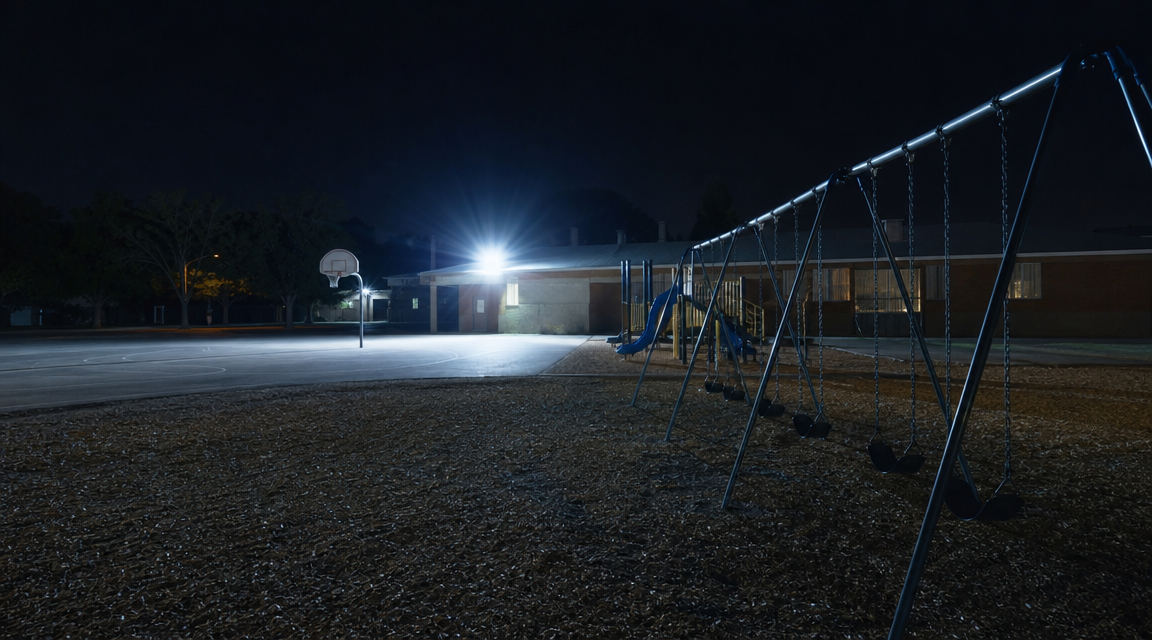
Most strange schoolyard camera images becomes less strange when someone checks the obvious: kids sneaking in, a loose gate, an insect on the lens, a compression glitch, a flashlight passing across the camera. This case is uncomfortable because the obvious checks did not cleanly remove it. At 3:09 a.m., during summer closure, one exterior camera recorded a single blue-white frame. In that frame, the swings were still, one chain was pulled sideways, a narrow figure stood near the basketball hoop shadow, and the magnetic gate sensor logged open and closed without the latch moving.
That combination is why the frame kept circulating among staff instead of disappearing as another camera hiccup.
What the Camera Shows Before Anyone Interprets It
The useful details are simple enough to list before theories get involved:
- The elementary school was closed for summer break.
- The timestamp on the odd frame was 3:09 a.m.
- The yard lights were operating in their normal overnight mode.
- One frame turned blue-white, brighter than the frames before and after it.
- The playground swings appeared still.
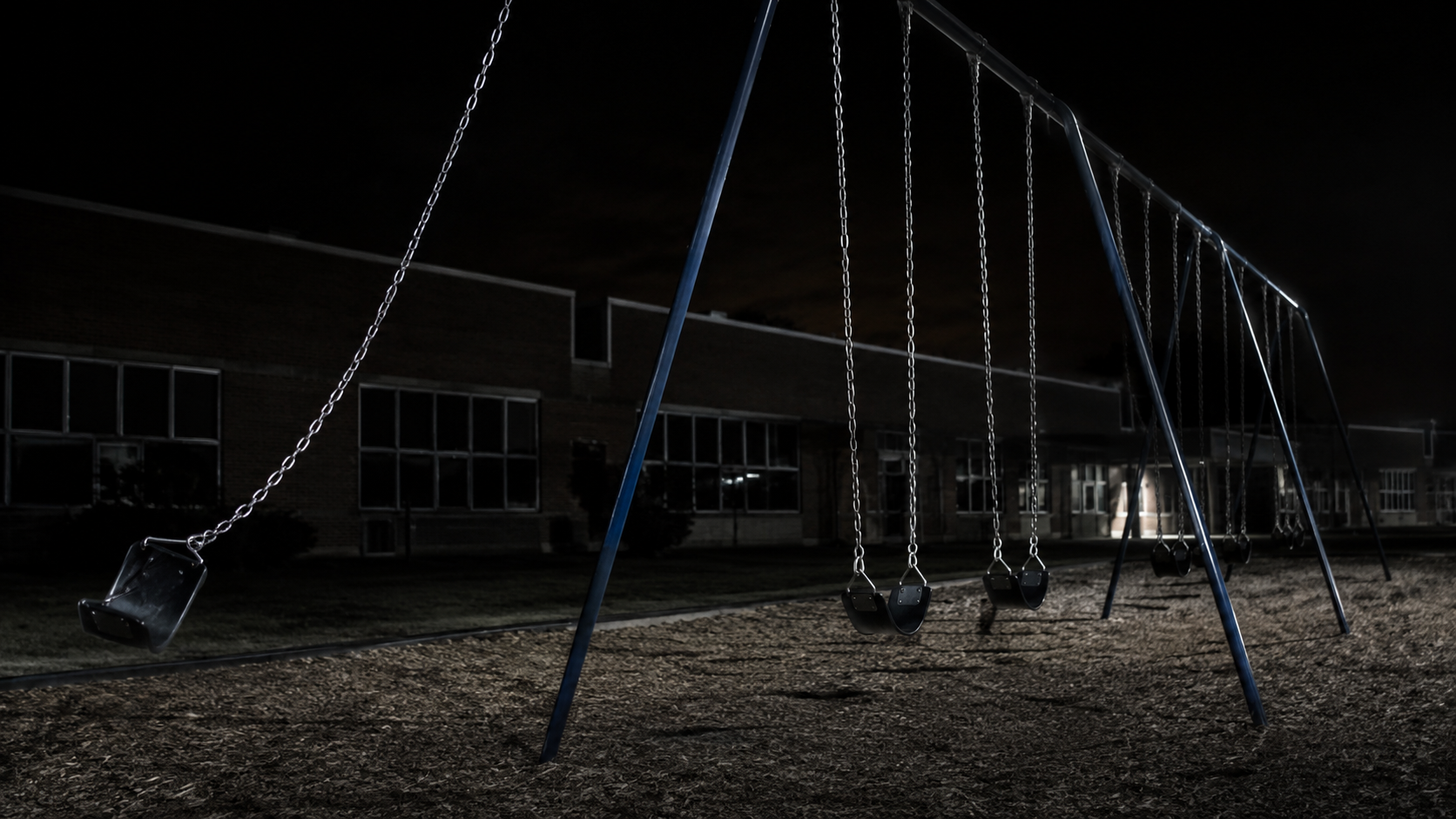
- One swing chain was stretched sideways, not blurred by ordinary motion.
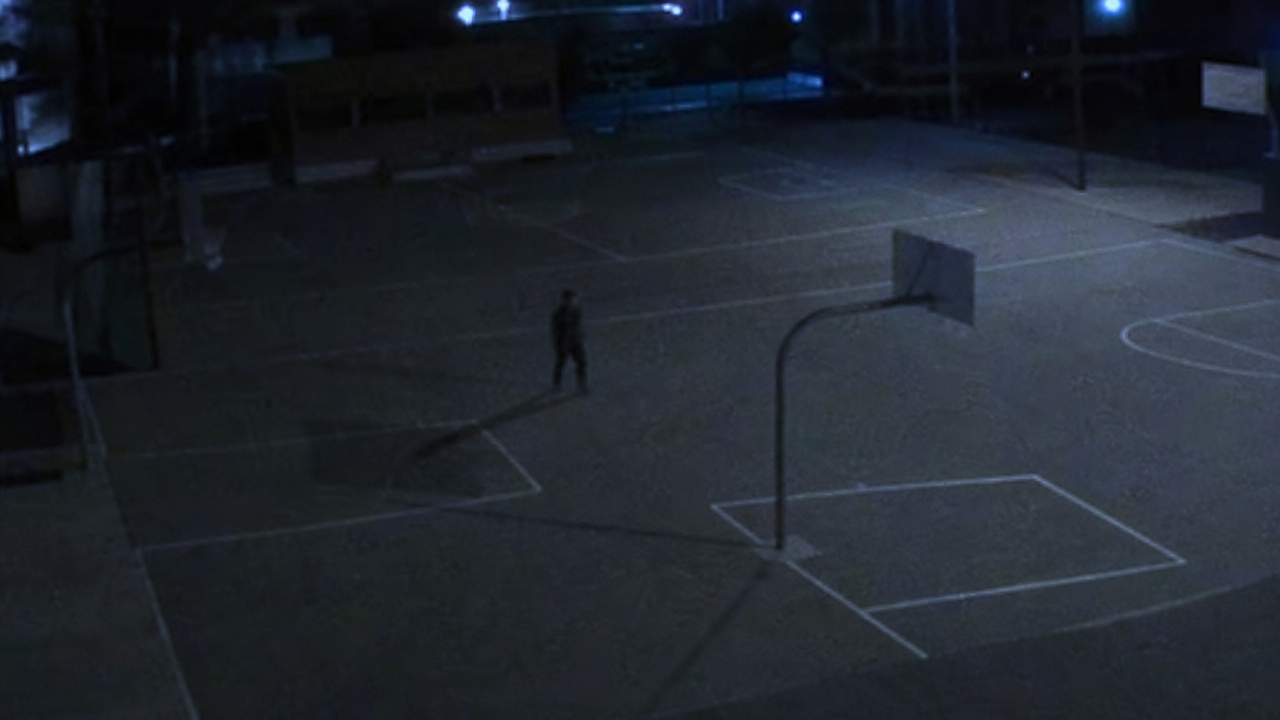
- A narrow, upright shape appeared near the basketball hoop shadow.
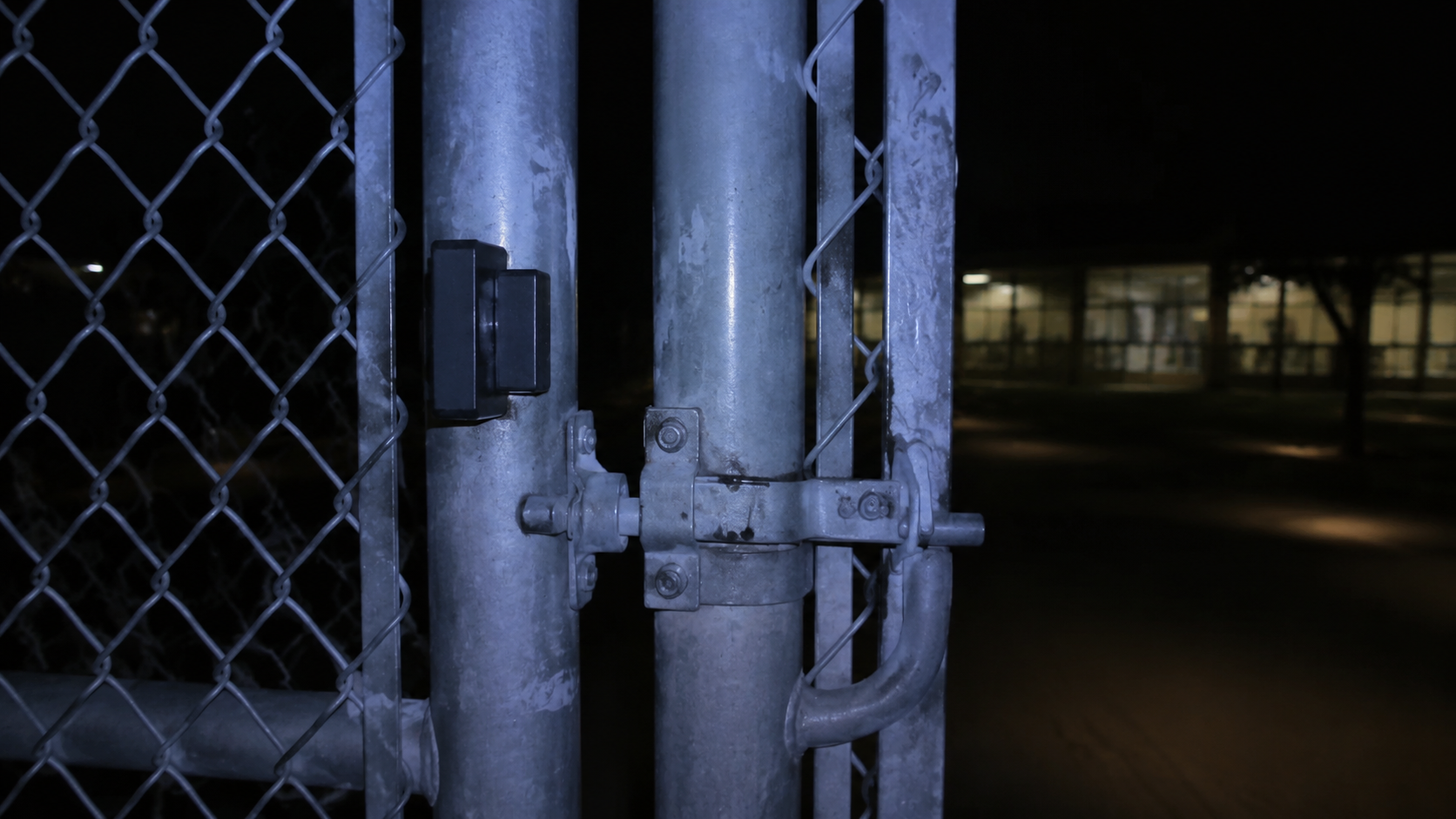
- The magnetic gate sensor logged an open and closed event.
- A later latch check reportedly showed no matching movement on the gate hardware.
None of those points proves a visitor. Together, they create a sequence that is harder to file under one easy explanation.
The Summer Closure Matters More Than It Sounds
Schools are rarely silent places, even at night. There are custodians, late meetings, deliveries, sports groups, and weekend events. Summer closure reduces that background noise. According to the account attached to the frame, this part of the campus had no scheduled staff activity overnight and no summer program using the yard.
That matters because the shape is not being compared against a normal stream of people crossing the camera. It appears in a period when the yard should have been boring. Security camera images is usually most useful when nothing happens, because any interruption has fewer innocent candidates.
A student prank is still possible. So is someone cutting through the property. But the blue-white frame, the swing chain, and the gate record would all have to line up with that person in a way the camera does not clearly show.
The Blue-White Frame Is Not Just a Color Shift
Security cameras can change color at night. Infrared filters click over. Auto-exposure overreacts. Compression can smear a headlight or flashlight into a strange wash. Nobody should treat a blue-white tint as paranormal by itself.
The reason this frame gets attention is that the color shift is isolated. The surrounding camera images reportedly returns to its normal dull night view. The schoolyard does not gradually brighten as a vehicle approaches. There is no obvious beam sweeping across the ground. The frame looks less like a light source moving through the yard and more like the camera caught a brief condition it could not balance.
That does not mean the condition was non-human. It means the image artifact is tied to the same instant as the physical-looking anomalies. A glitch alone would be easy. A glitch with a sideways chain and a sensor event becomes harder to wave away.
The Swings Are Still Except for One Chain
The swing set is the first detail many viewers miss. In the frame, the seats do not appear to be in a wide arc. There is no obvious blur from children or wind-driven movement. The chains hang in the expected vertical lines, except one chain that appears drawn sideways, almost as if something just outside the frame has pulled it taut.
Wind is the cleanest explanation, but wind usually gives itself away. It moves multiple chains, lifts seats, or creates blur across the set. Here the oddity is too selective to be satisfying. One chain appears affected while the rest of the playground reads as still.
A camera artifact could bend a line, especially in a low-light frame. But the chain does not look melted or doubled like ordinary compression smear. It looks misplaced.
The Shape Near the Hoop Is Narrow, Not Dramatic
The figure by the basketball hoop shadow is not a movie monster. That is part of why the frame is unsettling. It is narrow, upright, and easy to dismiss in a casual glance as a post, a shadow, or a person caught at a bad angle.
But the court geometry complicates that dismissal. The shape appears close to the dark line cast by the hoop structure, yet it does not simply match the hoop’s expected shadow. It has a separate vertical presence. It looks like something standing where nothing permanent should stand.
The cautious description is “visitor-like,” not alien, not creature, not intruder. The frame does not provide enough detail for that. What it does provide is a body-like interruption in an otherwise empty court, appearing at the same moment the camera color changes and the gate sensor records activity.
The Gate Sensor Log Is the Hardest Detail to Ignore
The magnetic gate sensor is the least spooky part of the story and possibly the most important. Cameras can lie through bad exposure. Shadows can imitate figures. A chain can look wrong for one frame. A sensor log is not visual, so it creates a separate stream of evidence.
At roughly the same event window, the gate sensor reportedly recorded an open and closed cycle. That should mean the magnet and contact separated, then returned. In ordinary terms, the gate opened and closed.
The problem is the latch. When the camera images and hardware were reviewed, the latch did not show the kind of movement expected from a real gate opening. No obvious person entered through it. No normal swing of the gate matched the log. If the sensor was faulty, the mystery becomes technical. But if it was functioning normally before and after, the open/closed record becomes a second witness.
That is the detail that keeps the case from resting only on a spooky silhouette. A person, animal, or vibration could still be responsible, but the reported sequence asks for an explanation that covers both the image and the hardware.
Why a Simple Intruder Theory Does Not Fit Cleanly
The plainest explanation is still an intruder. Someone enters the closed schoolyard, crosses near the basketball court, pulls or bumps a swing chain, triggers the gate sensor, and leaves. That would account for the human-like form and some physical disturbance.
The trouble is visibility. A real person should create more than one useful frame, especially in an open yard. They should appear approaching, crossing, or leaving. The gate should move if the sensor event is caused by entry. The swing should show ordinary motion, not one chain held sideways while the rest of the set stays quiet.
None of these objections disproves an intruder. They only make the intruder explanation less neat. The case sits in that frustrating middle ground where the normal answer is plausible but incomplete.
Why the Frame Still Gets Called Visitor Evidence
“Evidence” does not always mean proof. In unknown visitor cases, it often means a documented cluster that deserves preservation before people rewrite it into something simpler. This schoolyard frame has that quality. It is not just a shape. It is a shape plus timing, environment, object behavior, and an independent sensor record.
The strongest cautious version is this: during a closed period, the schoolyard system captured one brief event that looked visual and physical at the same time. The visitor-like form could be a person, shadow, or artifact. The chain could be wind or compression. The sensor could be a fault. But all three appearing together at 3:09 a.m. is why the blue frame is difficult to dismiss.
Why the Ending Still Feels Too Abrupt to Call Solved
The easiest way to close the case would be to choose one weak explanation and let it carry the whole frame. A loose chain could explain the swing. A camera flare could explain the blue flash. A sensor fault could explain the gate entry. A distant person could explain the thin shape near the hoop.
The problem is that each answer works best when it is separated from the others. Put them back into the same minute, on the same closed property, with the same camera record, and the event becomes harder to flatten into one neat mistake.
That does not prove a visitor was standing in the schoolyard. It only explains why the staff who saw the frame did not treat it like a routine glitch. The camera images leaves behind a sequence, not a clean conclusion.
If you saw this in your own school’s camera archive, would you label it a glitch, an intruder, or something that needed a much closer look?
Reader Context
This Weird Witnessed story is an editorial reconstruction, written as eerie visual storytelling rather than a verified report. For more context, see UFOs and Unknown Visitors Guide and How WeirdWitnessed Creates Reconstructed Horror Stories.