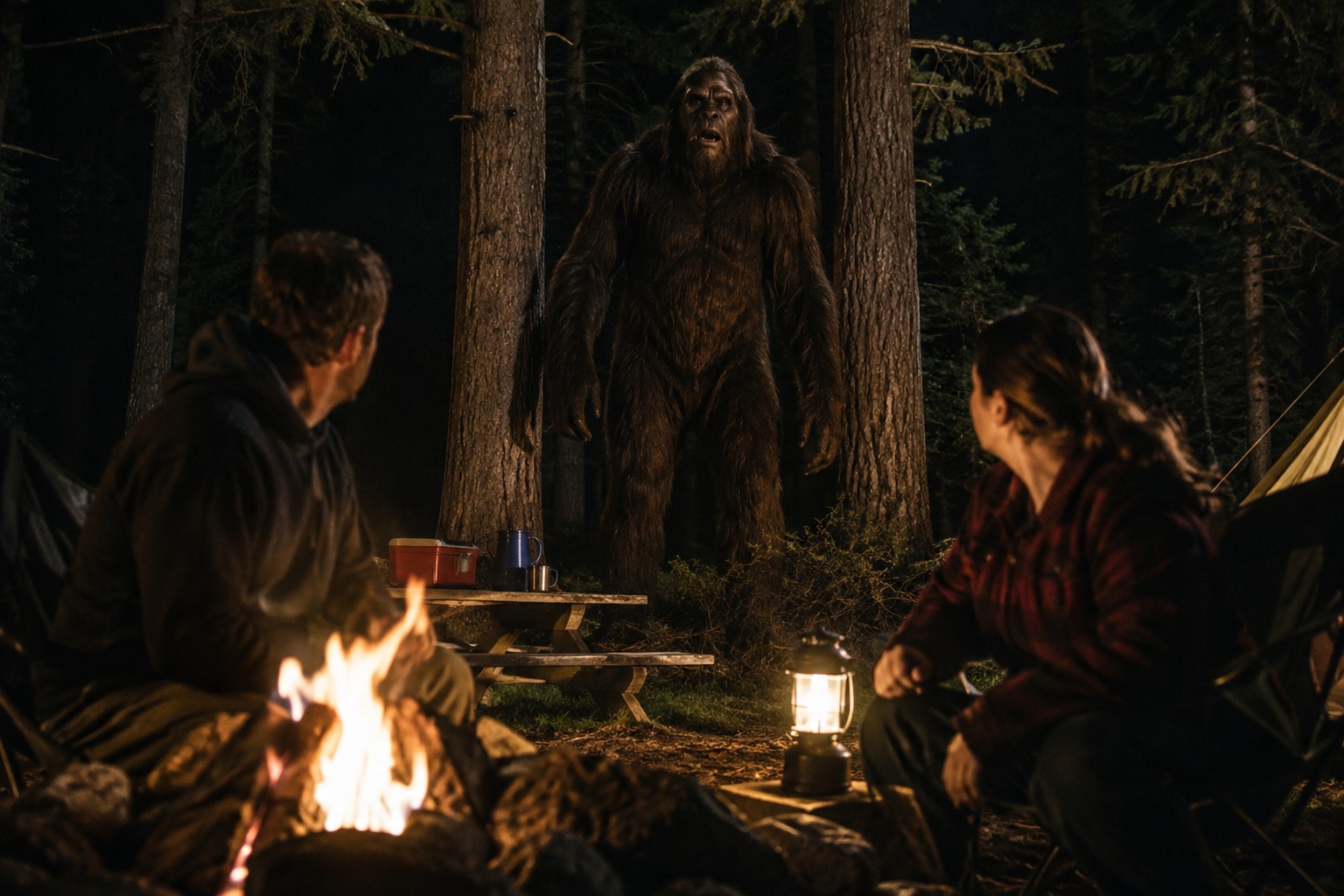
What Makes A Bigfoot Voice From The Treeline Sound Almost Human? The voice used his name. Not a scream. Not a howl. Just two rough syllables coming from the dark trees beyond the campsite, spoken slowly enough that he first assumed another camper was trying to get his attention.
He turned toward the treeline. His flashlight reached the first trunks, a picnic table, and the lower branches of a pine. Nobody stepped out. Then the voice called again. This time the strange part was easier to hear. The sound had the rhythm of a person speaking, but the second syllable dropped into a deep, breathy note that seemed too low for the voice that had started it. His friend stopped unpacking the truck and stared toward the same patch of woods.
A branch shifted about eight feet above the ground. For a moment, something enormous stood between two trees. Broad shoulders. Long dark hair. One arm hanging unusually low beside its body. Then it moved backward and disappeared without another word. Stories about Bigfoot often focus on footprints, enormous figures crossing roads, or strange knocks from deep woods. But another detail appears again and again in Bigfoot folklore: voices that sound disturbingly close to human speech.
Sometimes they resemble words. Sometimes they sound like someone yelling from far away. And sometimes the unsettling part is that the sound seems human right up until it does something a human voice should not. Why an Almost-Human Voice Feels Worse Than a Howl
A howl immediately gives the brain a category to work with. Dog. Coyote. Wolf. Owl. Some other animal. Speech is different. Humans are extremely sensitive to voices because voices carry useful information. We notice tone, direction, emotion, and tiny changes in pronunciation without consciously trying. A sound that resembles speech therefore demands attention much faster than an ordinary noise in the woods.
The First Time It Happened
That becomes especially uncomfortable when the sound is close to recognizable but not quite right. Imagine hearing what seems to be someone shouting, “Hey!” from beyond a row of trees. The first part sounds completely ordinary. Then the call stretches into a low vibrating note that lasts several seconds longer than expected.
Your brain has already decided that a person made the sound. Now it has to reconsider. That moment of uncertainty is a major reason these stories stick with people. A strange animal noise can remain an animal noise. An almost-human voice briefly creates the possibility that another person is standing nearby.
And if nobody is there, the question becomes much harder to ignore. The Woods Can Turn Animal Calls Into Something Like Speech Forests are surprisingly good at changing sounds. Trees, hills, leaves, wind, water, and uneven ground can distort both direction and tone. A call made hundreds of feet away may bounce through the woods in ways that make it seem much closer.
Distance also removes detail. You might clearly hear the rising and falling rhythm of a sound while losing the smaller frequencies that would immediately identify the animal producing it. What remains can resemble vowels, syllables, laughter, crying, or shouting. Several familiar animals can create remarkably human-like noises.
Foxes can produce sharp screams. Cougars are famous for calls that can resemble a woman screaming. Owls make hoots, whistles, shrieks, and strange conversational sequences. Coyotes can combine barks, yips, and howls into chaotic sounds that seem much larger than the number of animals actually present.
Why The Place Felt Wrong
Even deer can make noises that surprise people who have only heard them moving quietly through fields. At night, identification becomes harder because the listener cannot match the sound to something visible. A person standing beside a campfire may hear what sounds like a deep voice somewhere beyond the light. Without seeing the source, the brain starts trying to turn incomplete sound into something recognizable.
Human speech is one of the patterns it knows best. Why Some Bigfoot Calls Seem to Contain Actual Words There is another step beyond hearing a scream that resembles a person. Some Bigfoot stories describe what sounds like language.
Witnesses have reported strings of rapid noises with changing pitch, pauses that resemble conversation, and short sounds interpreted as words. Bigfoot enthusiasts sometimes call this kind of reported vocalization “samurai chatter,” because certain examples have been compared to fast, unfamiliar speech. That does not mean a hidden language has been established.
It does show how easily complicated vocal sounds can be interpreted as speech. The human brain constantly searches for familiar patterns inside unclear information. We do it with shapes in clouds, faces in shadows, and words inside muffled audio. If a distant call contains something like “ah,” “oh,” or “hey,” the listener may unconsciously organize the surrounding noises around that familiar piece.
Context makes the effect stronger. Someone relaxing on a suburban porch who hears a strange sound may think, “What animal was that?” Someone miles into a forest after finding an unusually large footprint may hear the exact same sound and wonder, “Was that speaking?” Expectation does not mean the person is lying. It means the brain is interpreting an unclear sound using everything that happened around it.
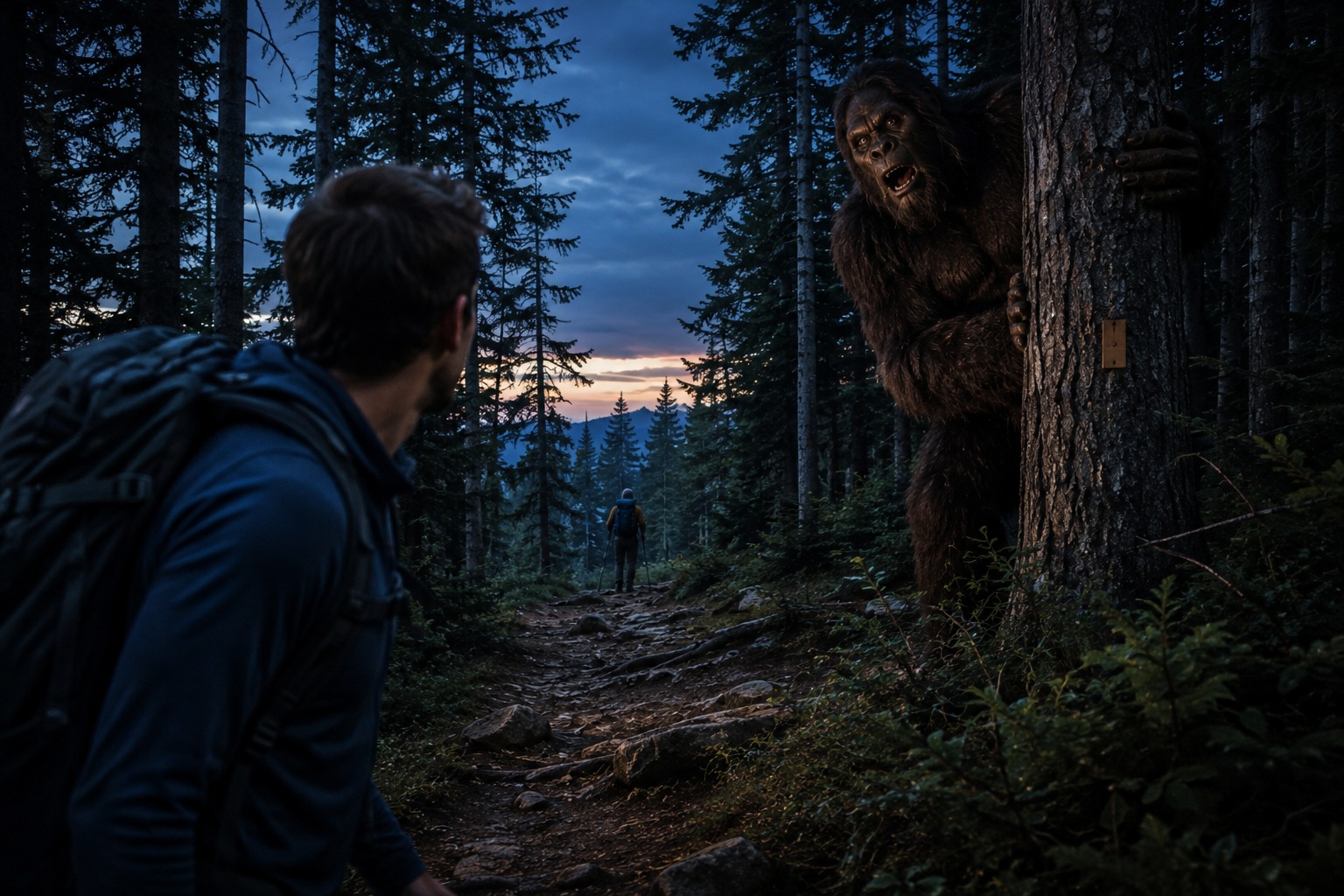
But some reports include a detail that is considerably harder to dismiss emotionally: the voice appears to copy the listener. The Creepiest Reports Describe Something Calling Back Suppose someone walking a forest trail loses sight of a friend around a bend. “Mike!”
The Detail Nobody Could Explain
A second later, something answers from the opposite direction. “Miiike.” The pronunciation is close, but stretched. The pitch is wrong. And the actual Mike walks back into view from somewhere else. That is the kind of story that turns an odd forest noise into a Bigfoot story.
Mimicry is unsettling because it suggests reaction rather than coincidence. Instead of a creature simply making noise, the listener feels as though something heard them and deliberately answered. There are perfectly ordinary animals capable of surprisingly sophisticated mimicry. Birds are the obvious examples. Ravens can imitate sounds, and some birds can reproduce human speech with remarkable accuracy under the right circumstances.
Other animals can produce calls that accidentally resemble familiar words. Distance makes the resemblance easier to exaggerate. A listener does not need to hear a perfect imitation of “hello.” They may only need to hear the correct rhythm and two roughly similar vowel sounds. Still, reported call-and-response encounters are among the reasons the almost-human voice has become such a memorable part of Bigfoot folklore.
A random scream is frightening. Something that seems to wait until you speak before answering feels like it is listening. What Witnesses Usually Check Before Blaming Bigfoot The first useful question is usually the simplest one: who else is nearby?
Campgrounds carry voices much farther than people expect. Hunters may be positioned beyond a ridge. Hikers can be hidden by thick vegetation only a short distance away. Houses, roads, and logging areas can also be surprisingly difficult to see through dense woods. Sound direction is another problem.
What They Checked Afterward
People often assume a voice came from the nearest trees because that is where it seemed loudest. The true source could be farther away, especially around valleys, rock faces, lakes, and hillsides. Then there are animals. A strange call becomes less mysterious if the area has foxes, coyotes, owls, elk, cougars, ravens, or other vocal wildlife. Listening to known local animal calls afterward can sometimes produce an immediate match.
Witnesses also compare timing. Did the sound actually respond to someone, or did it simply happen several seconds later? Did it repeat the same “word,” or did the second call merely sound similar after everyone began discussing it? These checks matter because nighttime fear can make ordinary details feel connected.
But Bigfoot stories usually survive because the witness says something else happened alongside the voice. That might be heavy movement through brush. A powerful wood knock. A large footprint.
Or, most dramatically, a glimpse of something whose size does not fit the animal explanation. When the Voice Comes With a Huge Figure Sound alone leaves enormous room for uncertainty. A visible figure changes the story.
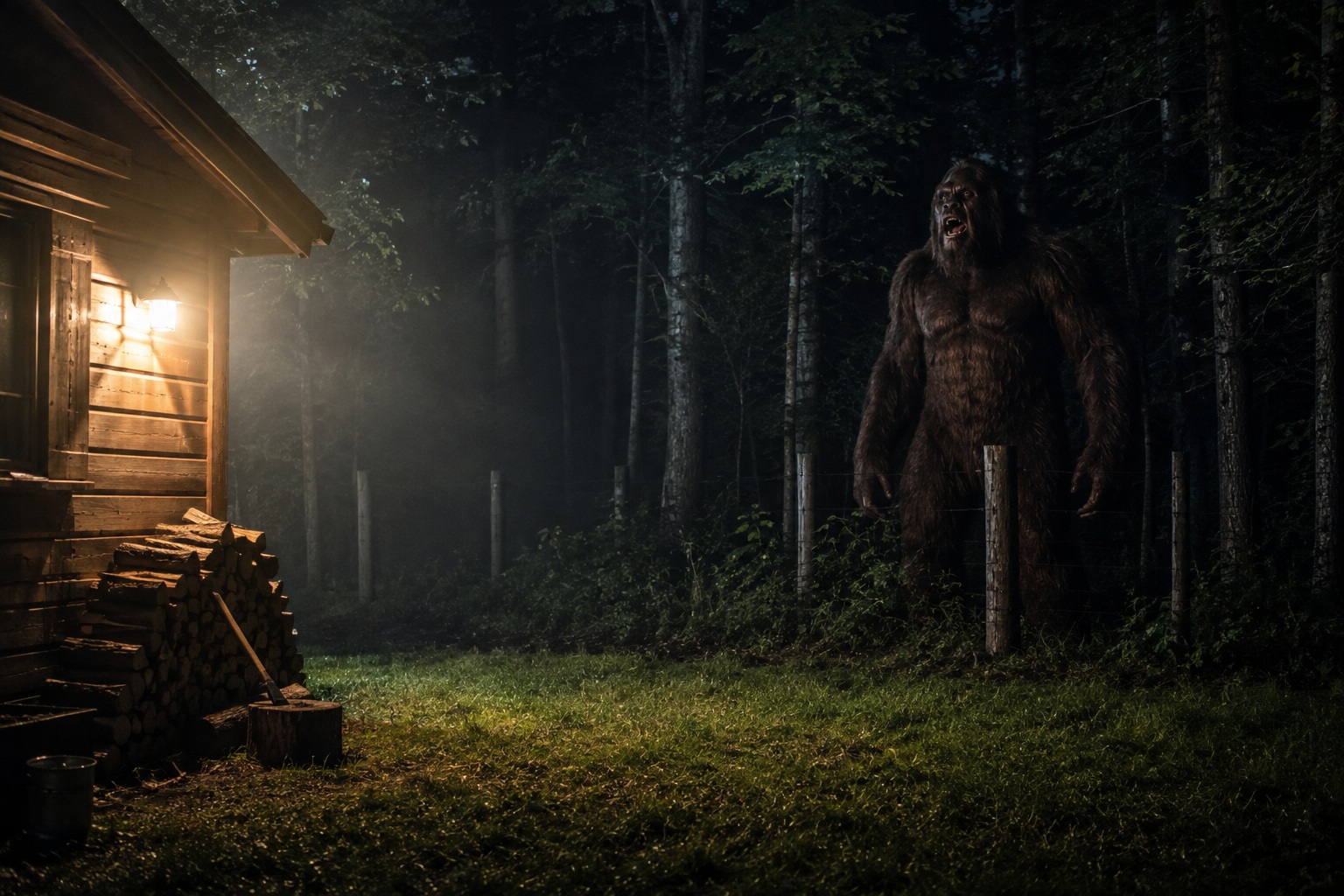
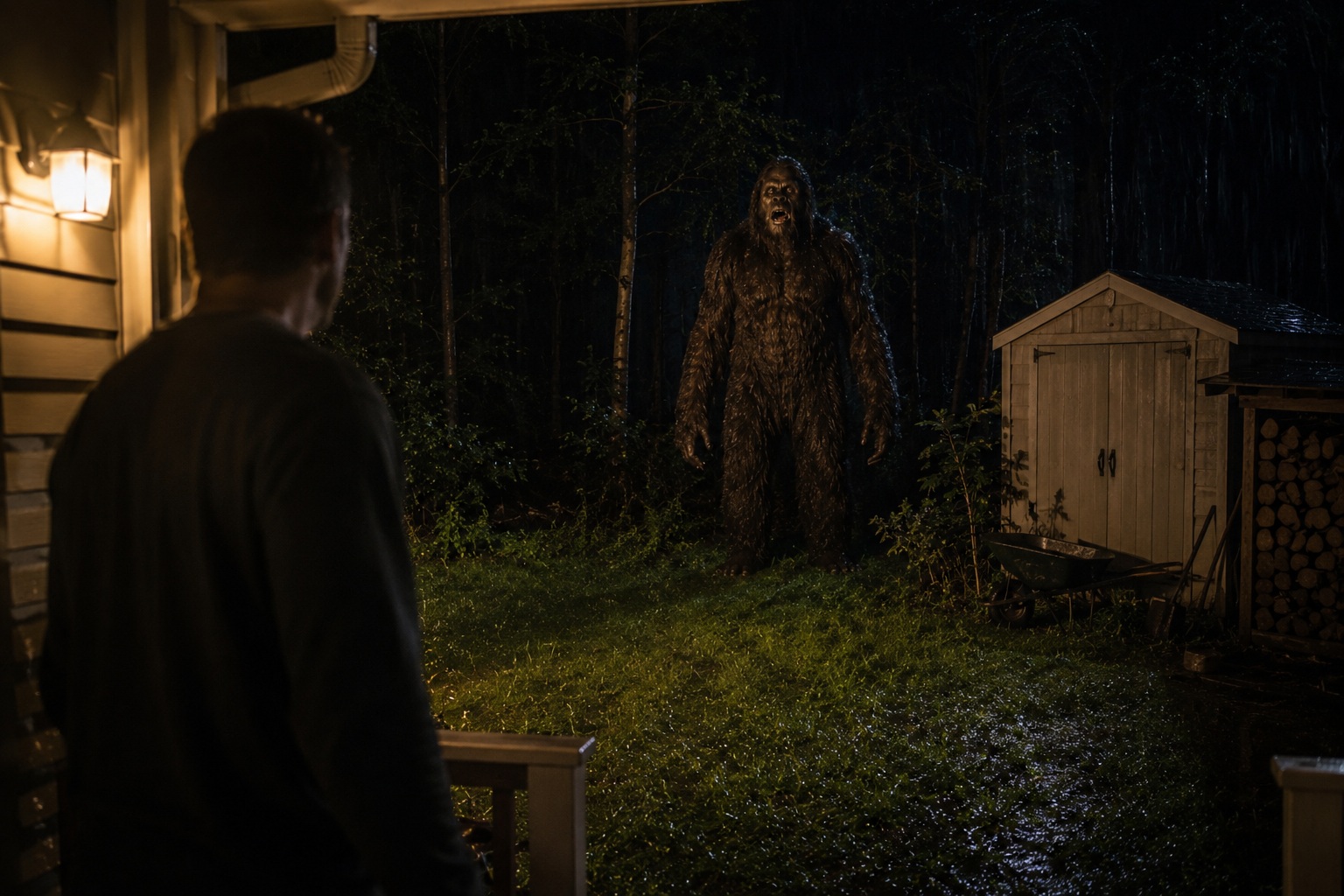
Picture a rural property bordered by woods. Someone hears a rough call from behind a shed and assumes a neighbor is walking nearby. The call repeats from the edge of the trees. Then something moves beside a mature pine. It is not hidden completely in darkness. Porch light catches enough of it to show thick dark hair across the shoulders. The head reaches far above a nearby fence post. Its arms hang low beside a body much broader than a person's.
The Moment It Became Harder To Ignore
That combination is what makes the classic Bigfoot version of the story work. The figure provides scale. A normal human silhouette is not enough. Someone standing in dark clothing near trees can easily become frightening when seen briefly. For a sighting to remain unusual, witnesses typically emphasize proportions: exceptional height, unusual shoulder width, long arms, heavy movement, or a body covered in visible hair.
Even then, darkness is unreliable. A bear standing upright can look shockingly human for a moment. Branches can hide parts of its body and change its apparent proportions. A person wearing bulky outdoor clothing can appear much larger when there is no reliable object nearby for comparison.
This is why scale clues matter. A fence, vehicle, doorway, trail marker, or known tree can help a witness estimate what they actually saw. Without something familiar beside the figure, “huge” may describe how the moment felt rather than how tall the shape really was.
Why Deep Voices Are So Difficult to Judge at Night Bigfoot vocal stories frequently emphasize depth. The call is described as too powerful, too low, or too loud to have come from a normal person. Those descriptions are understandable, but judging the physical source of a voice by sound alone is difficult.
Low sounds travel well. A deep call may remain noticeable over greater distances while finer details disappear. Forest surroundings can also make a low sound seem unusually full or powerful. Fear changes perception too. A sudden unexplained noise at 1 a.m. feels very different from hearing the same noise through speakers during daylight. Once adrenaline rises, people become intensely focused on movement and sound.
That can make a voice seem closer and more threatening. Yet there is a reason the “too deep” description remains effective in these stories. It creates the same contradiction as the almost-human pronunciation. The listener recognizes the structure of a human voice but not its apparent limits.
Why People Avoided That Spot Later
It sounds like someone shouting, except the chest behind that shout seems impossibly large. That impression becomes much stronger when the sound is followed by heavy footsteps or snapping branches. A small animal can make an astonishing noise. It is harder emotionally to accept that explanation when something large appears to be moving through the darkness immediately afterward.
Why These Stories Often Happen at the Edge of the Treeline The treeline is almost perfect for creating uncertainty. On one side is open space where people can see normally. On the other is dense cover where visibility collapses after only a few yards. A person standing near a cabin, campsite, road, or backyard therefore has enough light to recognize the forest but not enough to see what is inside it.
Sound crosses that boundary easily. A voice can come from darkness while the listener remains in a lit area, unable to identify its source. That creates a powerful imbalance. Whatever made the sound may be able to see the person standing near the fire or porch light. The person cannot see back.
Bigfoot folklore frequently places the creature at exactly this boundary: beside roads, behind cabins, near campsites, or just inside forest edges. There is a practical reason too. People spend more time along edges than deep inside thick woods. Roads, trails, camps, farms, and houses create far more opportunities to hear wildlife.
But as a scary setting, the treeline also creates the perfect question. How close is it? A howl from a distant mountain is atmospheric. A voice coming from twenty feet beyond the last place your flashlight reaches feels personal.
Why The Story Still Gets Shared
The Almost-Human Part May Be the Detail People Remember Best Memory does not preserve every part of a frightening encounter equally. People often remember the detail that broke their expectations. Not simply that something made a noise, but that it sounded like a man until it suddenly became too deep.
Not simply that something moved, but that the branch shaking was higher than a person could comfortably reach. Not simply that a call repeated, but that it repeated immediately after someone shouted. Those contradictions become the center of the story. Years later, a witness may forget exactly how many seconds passed between two calls while remaining completely certain about the feeling produced by the second one.
It sounded almost human. That word “almost” is doing most of the work. Known animals can make startling noises. Forest acoustics can distort calls. Darkness removes visual information. Expectation can turn unclear syllables into recognizable words. All of those explanations deserve consideration before assuming something unknown was speaking from the woods.
But the Bigfoot version of the story remains unsettling because it combines several ancient fears at once: something large is hidden nearby, it may be watching from a place you cannot see, and the sound coming from that darkness is close enough to your own voice to suggest intelligence.
Maybe the strangest calls have ordinary sources that were never identified. Maybe some witnesses heard an animal at exactly the wrong distance, from exactly the wrong angle, on exactly the wrong night. The lingering question begins when the forest seems to answer. And it gets much harder to forget when, just after the voice stops, something enormous stands up between the trees.