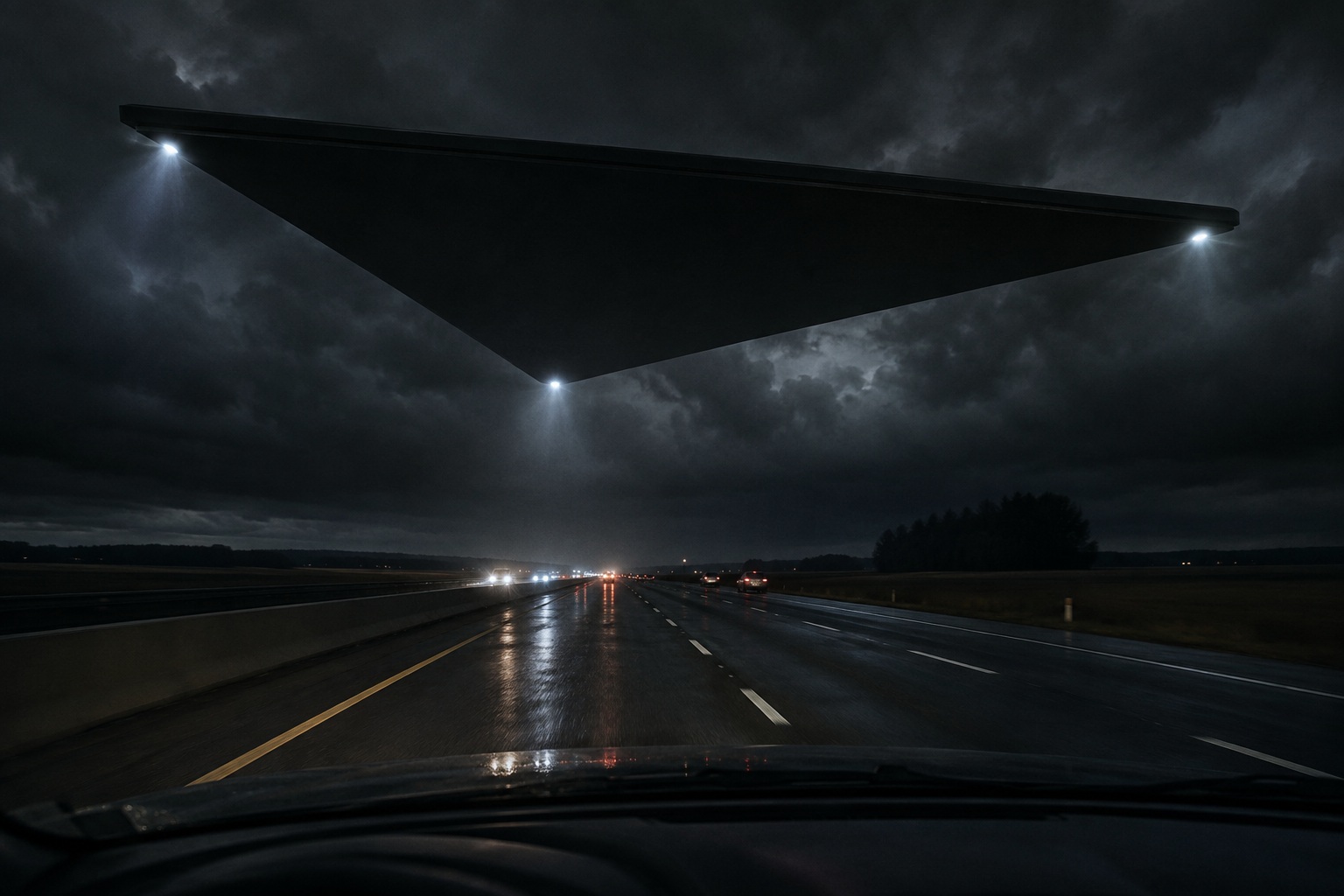
Why Do People Report Black Triangle UFOs Over Highways? The three lights stayed the same distance apart even when the highway curved. A driver was heading home after midnight on a nearly empty divided highway, with dark fields on one side and a line of trees on the other. At first, the lights ahead looked ordinary—three pale points low in the sky, perhaps belonging to a distant aircraft. Then the road bent left.
The lights did not. They seemed to belong to one enormous black shape hanging over the highway. The driver could make out straight edges against the slightly brighter clouds. There was no blinking red light, no obvious wings, and no engine noise loud enough to hear through the closed windows.
The strangest moment came when the car passed almost underneath it. Instead of shrinking behind him like an aircraft moving away, the triangle seemed to remain over the road for several seconds. In the rearview mirror, there were suddenly only clouds and darkness. Stories like this appear again and again in UFO discussions: a dark triangular object, usually seen at night, moving slowly or apparently hovering over a highway, rural road, neighborhood, or open field.
Why do highways appear so often in black triangle UFO reports? Part of the answer may have less to do with where mysterious objects travel and more to do with how roads shape what people can see, hear, compare, and remember. Why Highways Are Perfect Places to Notice Something Strange
Highways create an unusually clear view of the night sky. In cities, buildings, trees, streetlights, signs, and other structures constantly interrupt the view overhead. A strange light can disappear behind an apartment building before someone has time to study it. On a highway, especially outside a city, the view can remain open for miles.
The First Time It Happened
Drivers may watch the same object for several minutes while approaching it. They can see whether it appears to move with them, cross the road, remain stationary, or disappear behind trees. The road itself also gives the observer a strong sense of direction. That matters because many strange lights in the sky are difficult to judge without reference points.
A bright point against an empty black sky gives almost no reliable information about its distance or size. Put that same light above telephone poles, highway signs, trees, overpasses, and moving cars, and the brain suddenly has objects to compare it with. This can make an ordinary aircraft easier to identify.
But it can also make something unfamiliar look much more disturbing. If three lights seem to stay perfectly arranged while passing above several roadside objects, the observer may stop seeing them as separate lights and begin seeing the dark space between them as one solid shape.
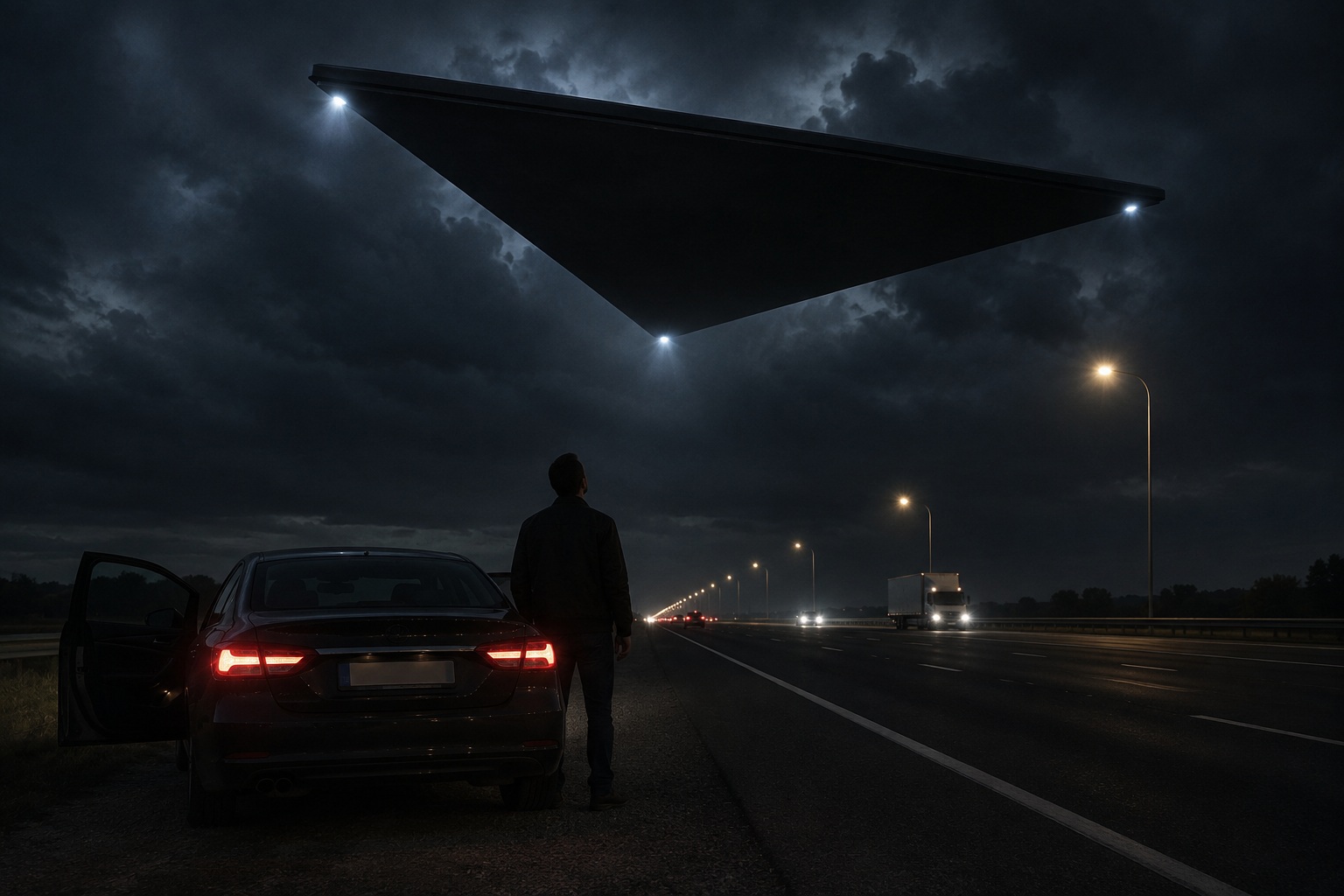
That is often the moment a distant light sighting becomes a black triangle story. Why Three Lights Can Look Like One Huge Craft The classic black triangle description is surprisingly simple. Three lights form the corners. The area between them looks darker than the surrounding sky. Sometimes witnesses mention another light in the center. The object appears triangular, silent, and much larger than a normal airplane.
But nighttime vision makes size extremely difficult to estimate. Imagine three lights separated across the sky. If you believe they are 300 feet away, the implied object between them might be the size of a house. If they are several miles away, those same apparent gaps could represent something much larger.
Without knowing distance, apparent size becomes guesswork. There is another problem: the human brain is very good at connecting points. Three lights naturally suggest a triangle. If clouds or stars are visible around those lights but not between them, the impression of a solid black surface becomes even stronger.
Why The Place Felt Wrong
Sometimes that darkness could genuinely be caused by a physical object blocking the sky. In other situations, the observer may simply be looking at a patch of darker sky framed by three unrelated or distant lights. Aircraft formations can create especially convincing versions of this effect.
Several aircraft moving together may hold roughly consistent spacing. From the ground, their lights can appear connected even though enormous distances separate them. But not every report fits that explanation comfortably. Some witnesses describe seeing a straight edge, a clearly defined underside, or a triangular shape passing in front of clouds. Those details are more interesting because the report is no longer based entirely on connecting lights.
The person believes they saw the object itself. Why Black Triangles Often Seem Completely Silent Silence may be the most frightening detail in these stories. People generally know what a low airplane sounds like. Even before looking upward, they expect the growing rumble of engines.
So when something apparently enormous moves slowly overhead without that familiar sound, the experience feels immediately wrong. There are several ordinary reasons an aircraft might seem quieter than expected. Distance is the biggest one. At night, people routinely underestimate how far away lights are. An aircraft that appears to be directly above the highway may actually be much farther away. Sound also travels more slowly than light, meaning the noise can arrive noticeably after someone first sees an aircraft.
Wind direction matters too. Strong winds at altitude can change how sound reaches someone on the ground. Terrain, trees, traffic noise, closed car windows, heating fans, tires, and music can hide an engine sound that would be obvious in a quiet field. The highway itself adds another complication.
The Detail Nobody Could Explain
A car traveling at highway speed produces continuous low-frequency noise. Tires roar against pavement. Air moves around mirrors and doors. The engine hums. A driver may not notice how much background noise surrounds them until they slow down. That makes a supposedly silent object especially difficult to judge from inside a moving vehicle.
Yet some black triangle stories specifically include witnesses stopping their cars. They pull onto the shoulder, switch off the engine, open the door, and listen. When the object is still described as low, huge, and silent after that, the usual explanation becomes less satisfying—not impossible, but harder to apply without knowing exactly what was seen.
Why Slow Movement Makes the Triangle Feel Impossible Speed changes the entire character of a UFO sighting. A fast light can be interpreted as an airplane, satellite, meteor, drone, or something else moving at an unfamiliar distance. A huge object apparently crawling above a highway is harder for witnesses to fit into those categories.
Black triangle reports often include phrases such as "moving slower than a plane," "floating," or "barely moving." But apparent speed depends heavily on distance. A distant aircraft can seem almost motionless when traveling toward the observer. Anyone who has watched a passenger jet approaching head-on has seen this effect. For a surprisingly long time, it may appear fixed in one part of the sky.
Then its position suddenly changes as the viewing angle changes. A highway can intensify this illusion because the observer is moving too. The driver may be traveling 60 or 70 miles per hour while watching another moving object from changing angles. Trees, signs, hills, and curves continuously alter the visual relationship between the car and the lights.
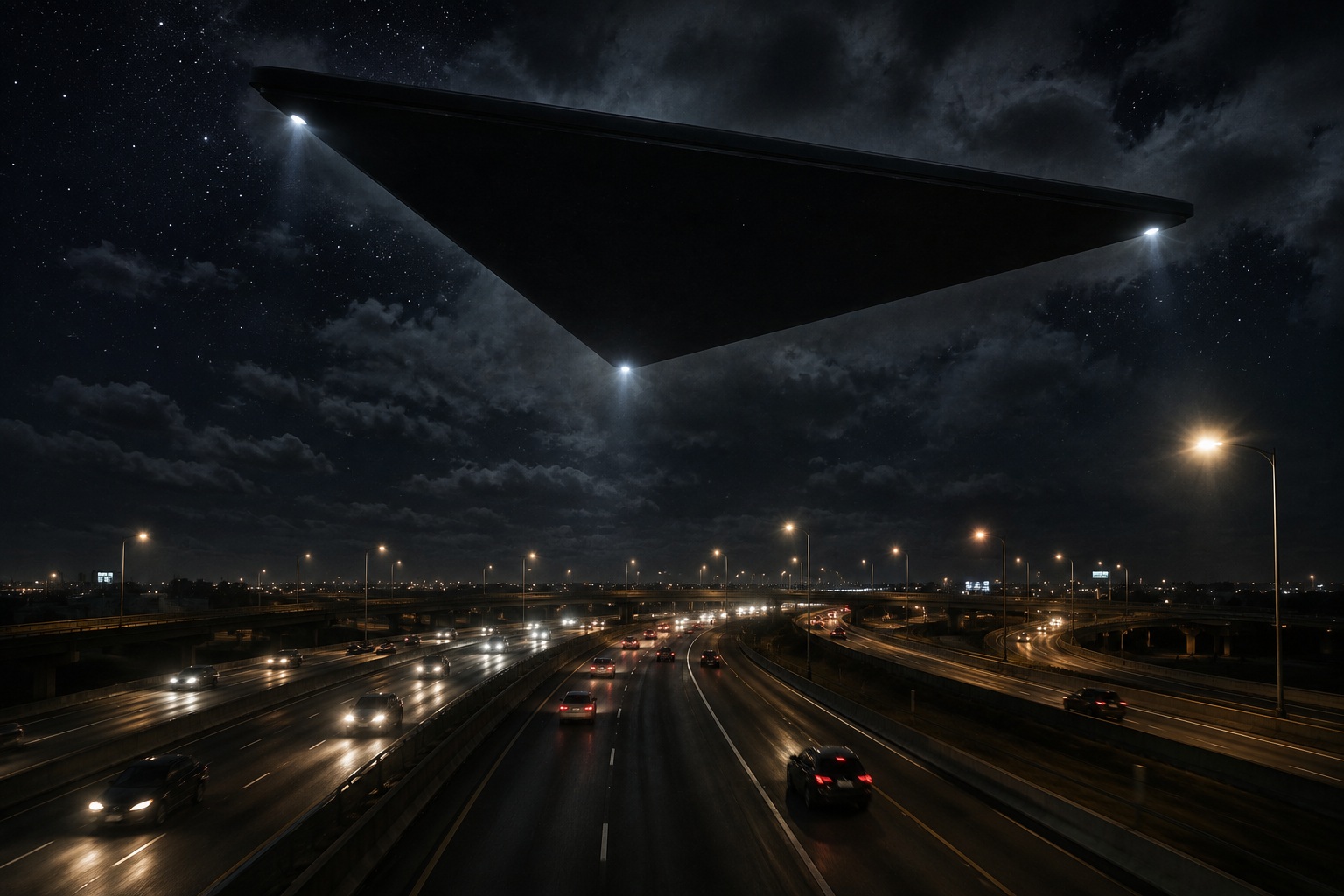
This can produce strange impressions. An aircraft may seem to follow the car. A distant light may seem to stop when the road turns toward it. Something traveling across the driver's path may suddenly appear to accelerate when the viewing angle changes. There is also the "huge and slow" problem.
What They Checked Afterward
If someone decides an object is extremely large, their brain may naturally interpret its movement as slower. A small object nearby and a huge object far away can create surprisingly similar movement across the field of vision. That uncertainty is one reason black triangle sightings can remain unsettling even after ordinary possibilities are considered.
The witness remembers something enormous drifting overhead. The available visual information may never have been enough to establish how enormous it actually was. What Drivers Usually Check After Seeing One The first checks people make are usually very ordinary.
Was there an airport nearby? Could it have been a passenger jet approaching a runway? Were military aircraft operating in the area? Was there a helicopter?
Could several aircraft have been flying in formation? More recently, drones have joined that list. Navigation lights are another important clue. Conventional aircraft generally use recognizable lighting patterns, although viewing angle, distance, weather, and brightness can make those patterns difficult to interpret. A driver may only notice the brightest lights.
Clouds can complicate things further. Low cloud layers can hide parts of an aircraft while making its lights look larger and softer. Thin mist can create halos that make several lights appear connected. Then there are stars and planets. A bright planet near the horizon can look surprisingly strange from a moving vehicle, especially when trees repeatedly block and reveal it. Because the observer is moving, the light may appear to follow the road.
The Moment It Became Harder To Ignore
But stars and planets do not explain a clearly visible dark object passing across the sky. That is why the most useful question is often not simply, "Were there three lights?" It is: "What could the person actually see between the lights?" A triangle created by three bright points is one kind of sighting.
A dark triangular body visibly blocking stars or passing beneath clouds is another. When the Ordinary Explanations Get Weaker The difficult black triangle reports tend to contain several details at once. The object appears close enough for the witness to describe its underside. Its edges remain visible for more than a brief moment. It passes in front of clouds or stars. It changes direction without the witness losing sight of it. Multiple people see the same shape from different positions.
None of those details automatically makes the object extraordinary. Memory can change after frightening or confusing experiences. Two witnesses standing together can influence each other's descriptions. Darkness can hide important details. People are often much worse at estimating altitude and size than they realize.
But the more specific the observation becomes, the narrower the normal possibilities become too. Consider a driver who sees three lights for five seconds through a windshield. There are many possibilities. Now consider several motorists who stop at different points along a highway and describe a dark triangular body slowly crossing above the road.
That requires a different level of explanation. It could still involve aircraft, unusual viewing conditions, military activity, or mistaken estimates of distance. But simply saying "probably a plane" does not explain every detail unless the proposed aircraft also matches the object's lighting, direction, apparent speed, and shape.
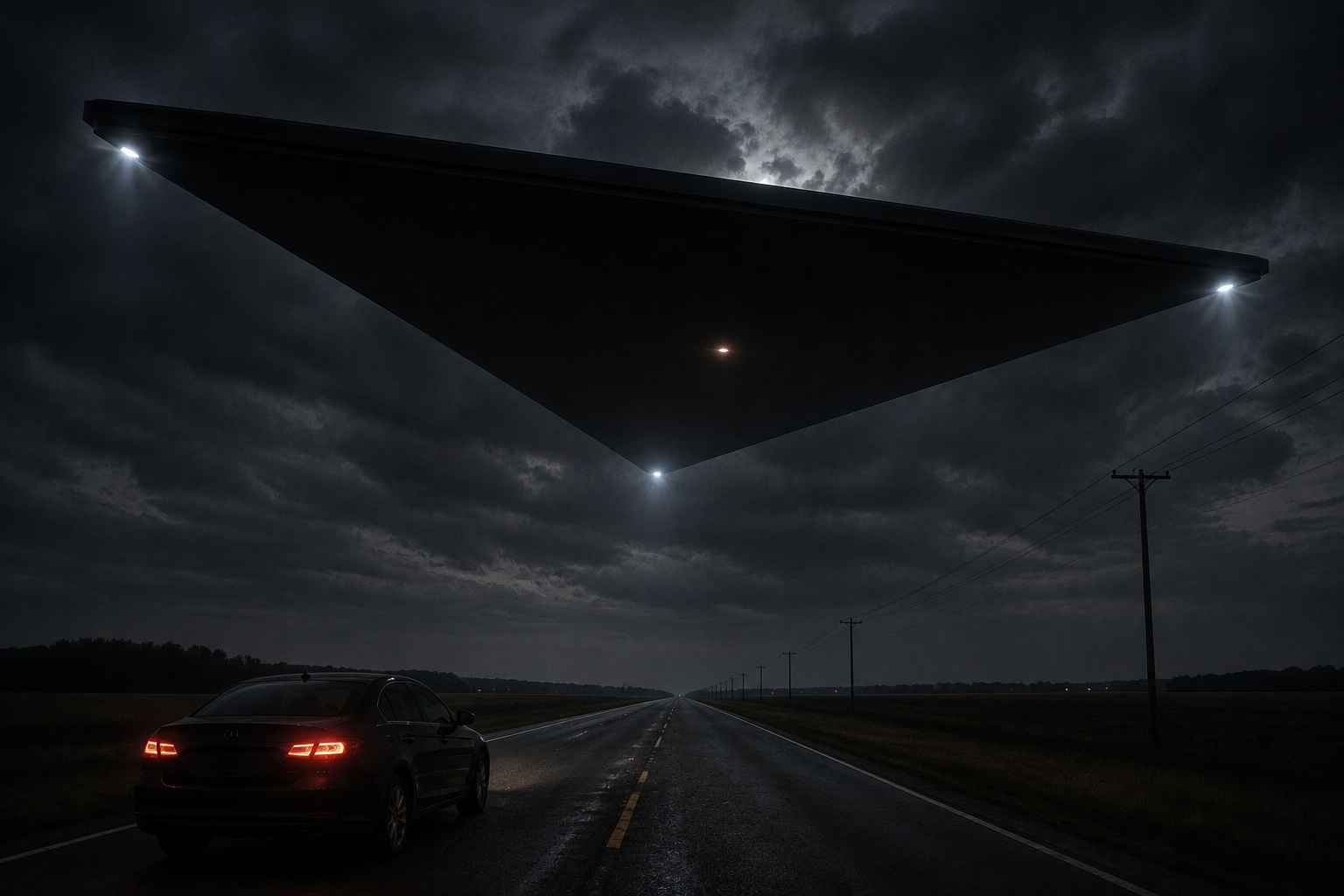
Why People Avoided That Spot Later
This is where careful UFO discussion becomes difficult. There is a large gap between "we cannot confidently identify what someone saw" and "therefore it was an unknown craft." Black triangle stories often live inside that gap. Why Highway Sightings Stay So Vivid in Memory
A strange object seen from a backyard is unsettling. A strange object seen while driving can feel threatening. The witness cannot stand still and study it. They are controlling a vehicle, watching traffic, checking mirrors, judging exits, and deciding whether to stop. The experience becomes a series of quick choices.
Look up. Look back at the road. Check the mirror. Slow down.
Look again. That fragmented attention can make the memory unusually vivid while still leaving important details uncertain. There is also something psychologically powerful about a highway at night. The environment feels familiar but isolated. Headlights illuminate only a small section of road ahead. Everything beyond that beam disappears into darkness.
Then something enormous appears above the route home. Even if the eventual explanation is ordinary, the initial feeling can be difficult to shake. Black triangles are particularly effective at creating that feeling because they invert what people expect from aircraft. Instead of a bright fuselage against darkness, witnesses describe darkness itself taking shape.
Three lights define the corners. The middle is black. And for a few seconds, the sky seems to have a solid underside. That image is simple enough to remember for decades.
Why The Story Still Gets Shared
What Black Triangle Reports Really Tell Us There probably is no single explanation for every black triangle seen over a highway. Some reports can likely be explained by ordinary aircraft viewed from misleading angles. Others may involve formations, helicopters, drones, distant lights, clouds, or incorrect estimates of distance and size.
Highways themselves help create the conditions for confusion. Drivers are moving. Their viewing angle constantly changes. Background noise hides sound. Open stretches provide long views of lights that might otherwise disappear quickly behind buildings. But highways also provide something useful: reference points. Trees, road signs, power lines, clouds, hills, and other vehicles can sometimes help witnesses describe where an object appeared and how it moved.
That is why the most interesting black triangle stories are not simply the ones involving three lights. They are the ones where the witness describes a coherent dark object in open view, where its shape remains readable as the viewing angle changes, and where ordinary aircraft explanations struggle to match the entire experience.
That still does not tell us what the object was. It tells us what makes the question difficult. And perhaps that is why the highway version of the black triangle story has lasted so long. You are driving through a place designed to take you somewhere predictable. The road is marked. The exits are numbered. Every vehicle around you follows lanes and rules.
Then you look through the windshield and see something above those lanes that seems to follow none of them. Three pale lights. A vast black triangle between them. And when you finally find somewhere safe to stop and listen, the night above the highway is completely quiet.