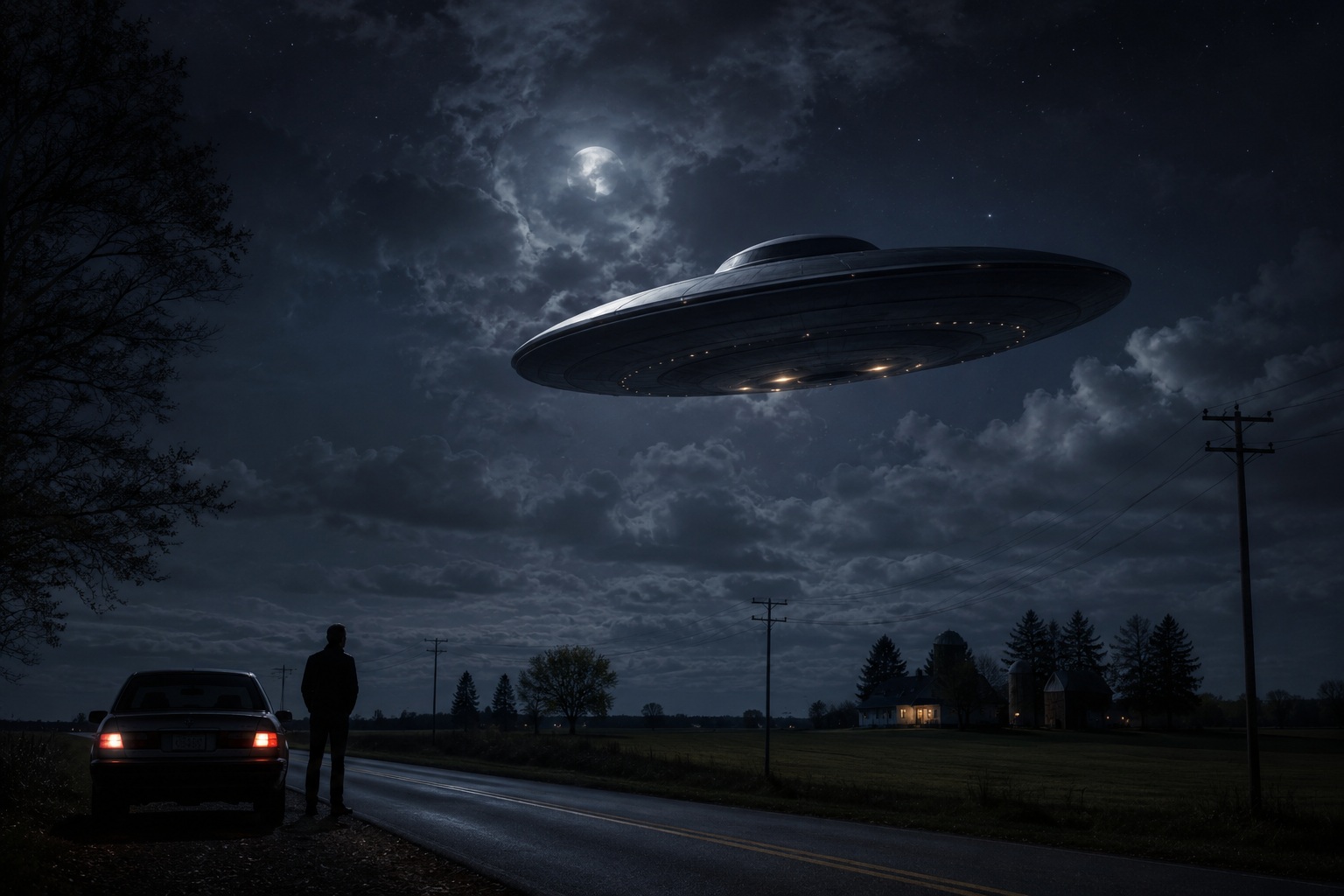
The object crossed the stars without blinking. A man standing beside his car on a quiet rural road had first noticed what he thought was an aircraft approaching from the west. There was a pale light in the sky, low enough to seem closer than the usual traffic passing overhead. He waited for the familiar red and green wing lights to appear.
They never did. Instead, the light widened into a shape. Against a patch of thin cloud, he could make out a dark circular body with a raised center, almost like two shallow bowls pressed together. There were no wings sticking from either side. No tail followed behind it.
Then came the detail that made him stop reaching for his phone. The object seemed to turn without banking. Its circular body slid sideways across the road while remaining almost perfectly level. There was no growing engine roar. No obvious nose pointed in the direction it was traveling. Seconds later, it accelerated toward the distant fields and became a small white point.
Stories like this are why saucer-shaped UFO reports feel different from ordinary aircraft sightings. It is rarely just the round shape that bothers someone. The stronger reports usually combine shape, movement, lighting, sound, and perspective in ways that do not immediately resemble a plane.
So what actually makes a supposed flying saucer look different from an aircraft, and how easily can ordinary objects create the same impression? The First Difference Is Usually The Missing Wings A plane has a shape our brains recognize extremely quickly. Even at night, we expect certain features. There is usually a long body, wings extending from it, and a tail at the rear. Depending on the viewing angle, those parts may be difficult to see, but the overall shape tends to make sense once the aircraft moves.
A classic saucer report removes those familiar reference points. Witnesses describe circles, flattened ovals, discs, domes, or objects resembling two plates placed rim to rim. Some descriptions include a raised section in the center. Others describe a completely smooth disc. That difference becomes especially noticeable when the object passes in front of a bright sky, thin clouds, or the moon.
The First Time It Happened
Instead of seeing a narrow fuselage with wings, someone may see one continuous dark body. That can be genuinely unsettling because the observer has nothing obvious to tell them which end is the front. Imagine looking upward and seeing a dark oval moving steadily from left to right. There is no nose pointing right. There is no tail pointing left. The entire thing appears almost symmetrical.
Planes rarely create that impression when seen clearly from the side. But viewing angle matters enormously. An aircraft approaching almost directly toward someone can hide much of its length. Wings can become difficult to judge at night, particularly when bright landing lights overwhelm the darker body.
That is why shape alone is rarely the most interesting part of a saucer report. Movement is often what changes the story. A Saucer Can Seem To Move Without Pointing Anywhere Aircraft are directional machines.
A plane's body tells you where it is going. The nose leads. The tail follows. When the aircraft makes a substantial turn, it normally banks. People understand this movement even if they know almost nothing about aviation. Saucer stories frequently describe something stranger: a shape that does not appear to have a front at all.
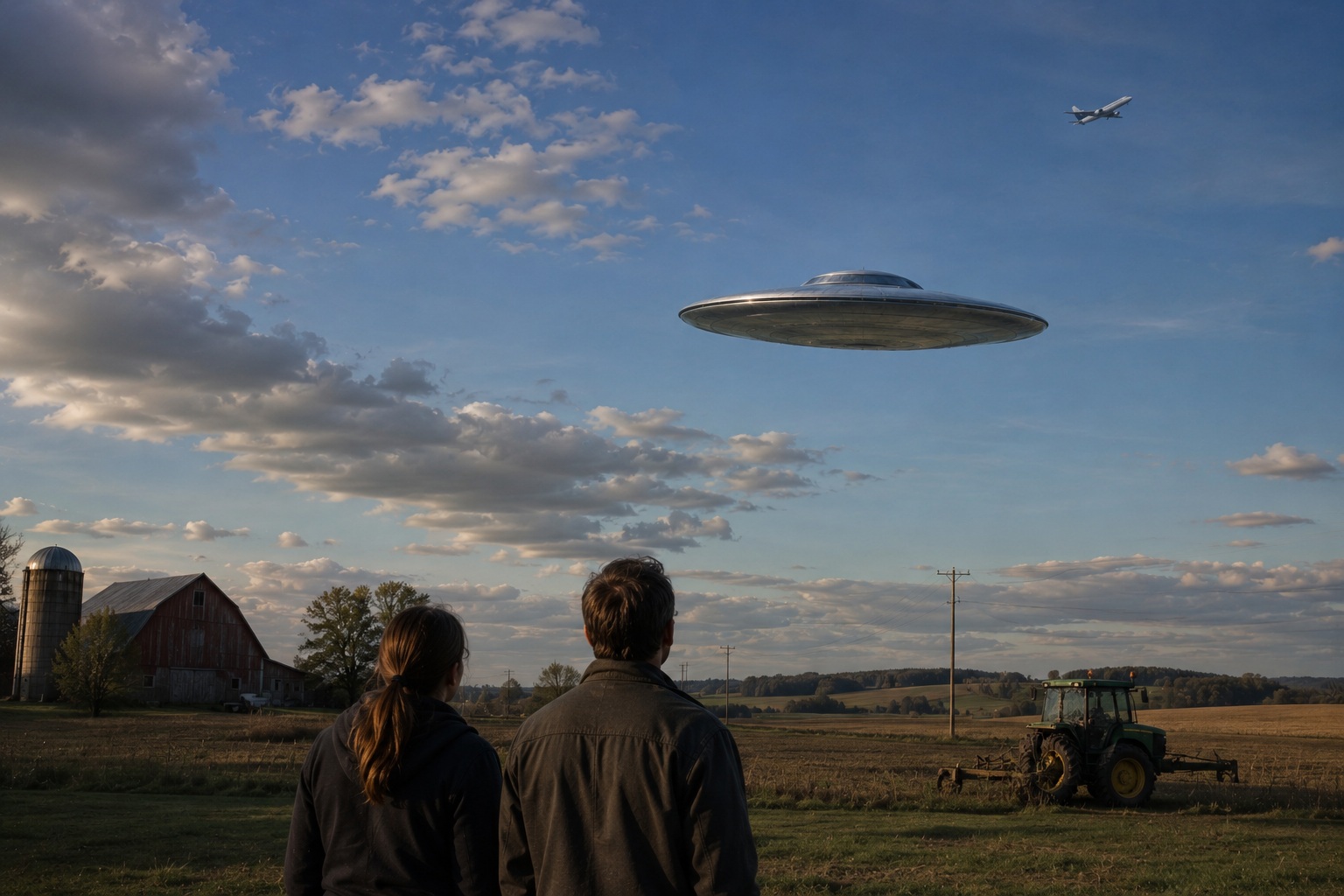
A circular object might drift horizontally while keeping the same appearance. A witness may describe it stopping, sliding sideways, or changing direction without visibly rotating into the turn. That is much harder to mentally match with an airplane. Picture a broad silver-gray disc above a field at dusk. It moves toward a line of trees, stops for several seconds, then begins moving to the right. The same circular profile remains visible throughout.
Why The Place Felt Wrong
There is no obvious banking wing. No nose swings toward the new direction. The object simply goes somewhere else. Those descriptions are a major reason saucers became such a recognizable part of UFO stories. A symmetrical craft allows movement that looks visually wrong compared with familiar airplanes.
However, judging motion in the sky is surprisingly difficult. Without nearby objects, a person may not know whether something has actually stopped. An object moving toward or away from the observer can appear nearly stationary. Changes in the observer's own position can also make a distant light seem to shift direction.
The effect becomes stronger at night, when the object may have nothing behind it except darkness. A strange path is more useful when there are clear references nearby: clouds, trees, rooftops, hills, stars, or another aircraft moving through the same area. Why Aircraft Lights Can Create A False Saucer
Night changes everything. During daylight, an aircraft is mostly recognized by its physical body. At night, the body can disappear while its lights remain extremely bright. That can create shapes that are not really there. An approaching airplane with powerful landing lights may initially look like one glowing object. As its angle changes, additional lights become visible. If haze surrounds them, the separate points can appear connected by a glowing oval.
From the ground, that can briefly resemble a luminous disc. Navigation lights provide another clue. Conventional aircraft normally use recognizable lighting arrangements, including colored navigation lights and flashing anti-collision lights. But distance, clouds, atmospheric haze, and viewing angle can make those patterns difficult to read.
A red light may disappear behind part of the aircraft. A white strobe can dominate everything around it. Landing lights can make the craft's darker outline nearly invisible. This is why witnesses trying to identify something strange often watch the lights for several minutes rather than concentrating on a single bright moment.
The Detail Nobody Could Explain
Do they blink regularly? Do red and green lights eventually become visible? Does the glowing "disc" transform into an obvious aircraft as it turns? If it does, the mystery may disappear quickly.
A stronger saucer description usually involves someone seeing the physical shape itself rather than mentally connecting several distant lights. The Sound Often Changes How Strange The Object Feels An airplane passing low overhead usually announces itself. Even before someone identifies the aircraft, they may hear engines approaching. The sound grows, peaks as the plane passes, and gradually fades.
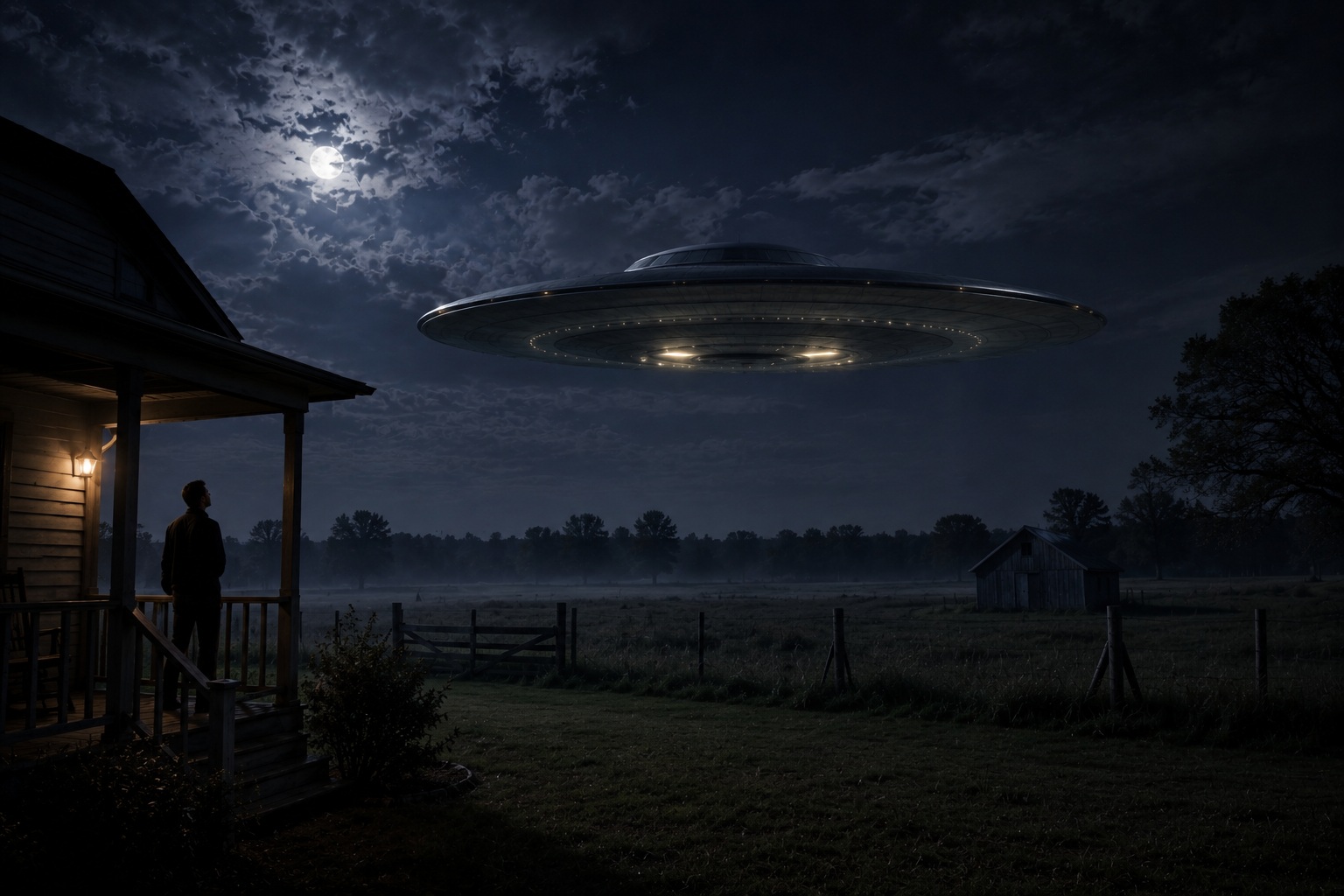
A helicopter is even harder to mistake once its sound reaches the observer. Many saucer stories emphasize silence for exactly this reason. Someone sees a large object that appears close enough that they expect noise, yet hears almost nothing. Consider a disc moving over an open pasture at night. A farmhouse, utility poles, and trees give the observer some sense of scale. The object appears broad enough to be an aircraft and low enough that its underside is visible.
Yet the night remains quiet. No jet roar follows it. No propeller rhythm reaches the field. That mismatch can be more frightening than the shape itself.
But sound also has traps. Distance is notoriously difficult to estimate when looking at an unfamiliar object. Something small and relatively close can appear similar to something enormous and far away. Likewise, something believed to be directly overhead may actually be much farther toward the horizon.
What They Checked Afterward
Wind can carry aircraft noise away from an observer. Terrain and buildings can alter it. There can also be a noticeable delay between seeing a distant aircraft and hearing it. So "silent" becomes more interesting when the observer also has strong reasons to think the object was genuinely close.
Seeing it pass behind a nearby tree line, beneath low clouds, or near a recognizable structure provides far more useful scale than simply saying it looked huge. Distance Is The Trickiest Part Of Any Saucer Sighting A strange object against an empty sky has almost no built-in scale.
Hold a coin at arm's length and it can cover something enormous in the distance. The eye knows the coin is small because your brain already knows how far away your hand is. A mysterious object provides no such help. This creates one of the biggest problems in UFO stories.
A witness might describe a disc as "the size of a house," but that estimate depends on knowing its distance. If the distance is wrong, the estimated size can be wrong too. This is also how surprisingly ordinary objects can become strange. A balloon can look enormous when its distance is misunderstood. A distant aircraft can seem smaller and closer. A bright planet may appear to hover just beyond a nearby ridge even though it is unimaginably farther away.
The strongest visual moments happen when something crosses a known reference. A disc moving beneath a recognizable cloud layer is easier to judge. So is an object crossing in front of a distant hillside, passing near a radio mast, or moving over a road where vehicles provide scale.
Imagine standing beside a highway and watching a circular object cross directly above utility poles before continuing over an open field. Now there are multiple things in the scene whose approximate sizes are known. The observer can make a much better estimate. That still does not tell us what the object is.
The Moment It Became Harder To Ignore
It simply removes one of the easiest ways the sky can fool us. Ordinary Things Can Look Remarkably Saucer-Like Not every disc-shaped object in the sky requires an exotic explanation. Balloons are obvious candidates because many are round, reflective, and capable of drifting in directions that seem strange from the ground.
Some can rotate in sunlight, repeatedly changing from bright to dark. Aircraft can also appear disc-like from unusual angles. A plane banking at a great distance may briefly expose a broad wing surface while hiding much of its fuselage. Under poor lighting, the resulting shape can look far rounder than the aircraft really is.
Drones complicate modern sightings further. They can hover, move sideways, stop quickly, and operate with lighting patterns that observers may not recognize. At night, judging their size becomes difficult. Atmospheric conditions create another category of confusion. Thin clouds can spread bright lights into larger glowing patches. Haze can erase the edges of an aircraft. Bright celestial objects can appear to move when a person watches them against darkness without fixed references.
There is even a simple human factor: expectation. Once someone thinks they are looking at a disc, the brain naturally tries to organize incomplete details around that shape. This does not mean witnesses are lying or foolish. It means human vision was built to interpret useful scenes full of familiar objects, not to calculate the size, speed, and distance of an unknown light against an almost empty sky.
That is why the most useful question is not simply, "Did it look like a saucer?" It is, "What could the person actually see?" The Details That Make A Plane Explanation Weaker Some descriptions are easier to fit to aircraft than others.
A distant glowing oval that eventually develops blinking lights and continues along a smooth path is not particularly difficult to explain. A clearly visible physical disc can be different. The description becomes harder to match with a conventional plane when several details appear together: a readable circular body, no visible wings or tail, unusual movement, no expected aircraft lighting, and good nearby references for distance.

Why People Avoided That Spot Later
Daylight can make a major difference. Suppose several people are standing beside a lake in late afternoon. A dull metallic disc moves across open sky below scattered clouds. Its edge is clearly visible. A raised center catches the sunlight. It travels horizontally, slows noticeably, and then moves away while keeping roughly the same orientation.
That is a much more specific description than "I saw a strange light." There are still possibilities to check. Was there air traffic nearby? Could it have been a balloon?
How long was it visible? Did everyone describe the same shape independently? Did it disappear because it accelerated, or because clouds swallowed it? Could perspective explain the apparent stop?
These questions do not ruin the story. They are what separate a genuinely puzzling observation from a moment that only seemed impossible for a few seconds. Sometimes a normal explanation becomes obvious. Sometimes several possibilities remain. And occasionally the description stays strange because the important details do not fit neatly into any one explanation.
Why The Classic Saucer Shape Stays So Memorable
There is something especially uncomfortable about seeing a machine without understanding how it is supposed to move. Planes make visual sense. Their wings explain lift. Their engines explain the noise. Their nose and tail explain direction. Even someone who has never flown one can look at an airplane and understand the basic idea.
Why The Story Still Gets Shared
A saucer removes those clues. The shape appears equally capable of moving forward, backward, or sideways because there may be no obvious forward direction at all. That simplicity is part of what makes the image powerful. It also explains why saucer stories remain culturally memorable even as modern UFO descriptions have expanded to include triangles, spheres, cylinders, and other shapes.
A disc hanging above an ordinary landscape creates an immediate contradiction. The barn looks normal. The road looks normal. The clouds look normal.
Then there is a circular machine sitting in the middle of the sky where an airplane should have wings. That does not mean every saucer report describes something extraordinary. Misjudged distance, aircraft angles, balloons, drones, haze, and bright lights can all produce convincing mistakes. But when people describe the sightings they could not easily dismiss, they usually remember more than a circle.
They remember the missing wings. They remember the lack of a tail. They remember watching the object slide without banking. They remember waiting for an engine sound that never arrived.
And sometimes they remember the moment the object stopped behaving like the aircraft they had originally assumed it was. That combination is what makes a reported saucer UFO look different from a plane. The shape gets someone's attention. The movement makes them keep watching.
And the absence of the familiar details is what makes the empty sky suddenly feel wrong.