The Morning the Garden Looked Rearranged
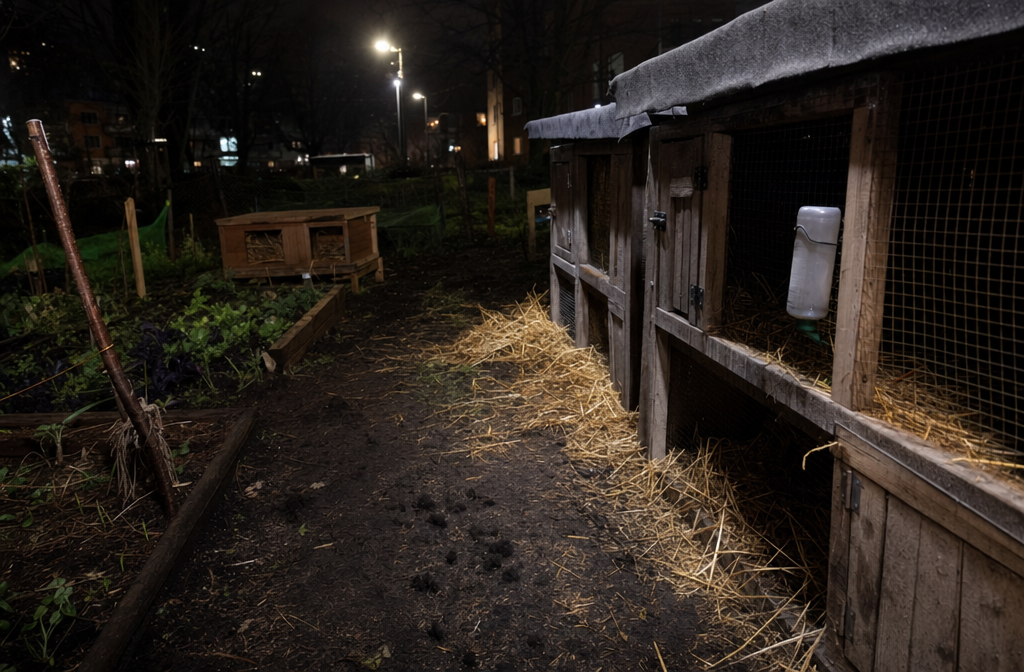
The first volunteer reached the community garden just after sunrise, expecting the usual chores: unlock the shed, check rain barrels, and feed the rabbits kept in teaching hutches near the back fence. Instead, she found straw pulled out in flat ribbons, fresh bite marks on the latch boards, and a narrow drag line smoothed through damp soil.
Nothing looked theatrical. The fence was standing, the inner cages were still locked, and no rabbit was missing. That restraint is what made the scene bother people. It looked less like an attack than a careful test of the hutches, followed by a retreat toward the compost bins.
By midmorning, three volunteers were comparing photos and trying to decide whether this was raccoon damage, a prank, or a small piece of possible chupacabra evidence.
Why the Rabbit Hutches Matter
The rabbits are part of a compost education program. Children learn how bedding becomes fertilizer, and the hutches sit beside labeled bins for greens, browns, curing compost, and finished soil. The area is fenced, locked, and checked twice daily, so the timeline is unusually tight.
An evening volunteer finished feeding at 8:12 p.m. and posted a routine photo to the garden chat. In it, the latch boards are clean, straw is contained, and the path to the bins is rough with shoe prints.
At 6:41 a.m., the morning photo shows a different path. The middle strip is smooth, almost polished, while old shoe prints remain along both edges. Something low had crossed that space after the last check.
The Chew Marks Were Oddly Placed
Most ordinary animals go for corners, food smells, or weak seams. Raccoons pry. Rats gnaw low. Dogs scratch from above and leave splintered pressure marks. Here, the freshest marks were on the outer latch boards, just above the easiest bracing point.
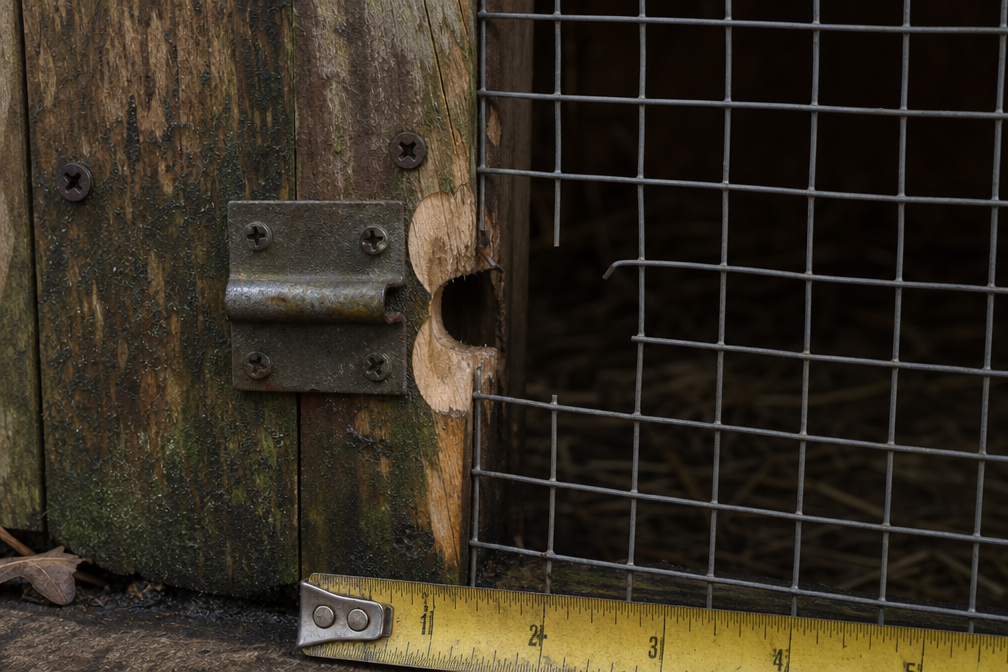
The marks appeared in paired clusters. Each cluster had two deeper punctures with shallow scraping between them, wider than rat damage but narrower than a typical dog bite. One volunteer photographed a tape measure against the board. Another compared the pattern to old raccoon damage from a feed bin and said it did not line up cleanly.
Chew marks are easy to overread, especially on damp wood. Still, everyone present agreed on one cautious point: whatever made them seemed to bite and pull sideways, as if testing the latch rather than eating the wood.
The wire mesh added to the uncertainty. Several squares near the latch were bowed in a way that could be panic pressure from inside, outside pressure snapping back, or both.
The Soil Drag Line to the Compost Bins
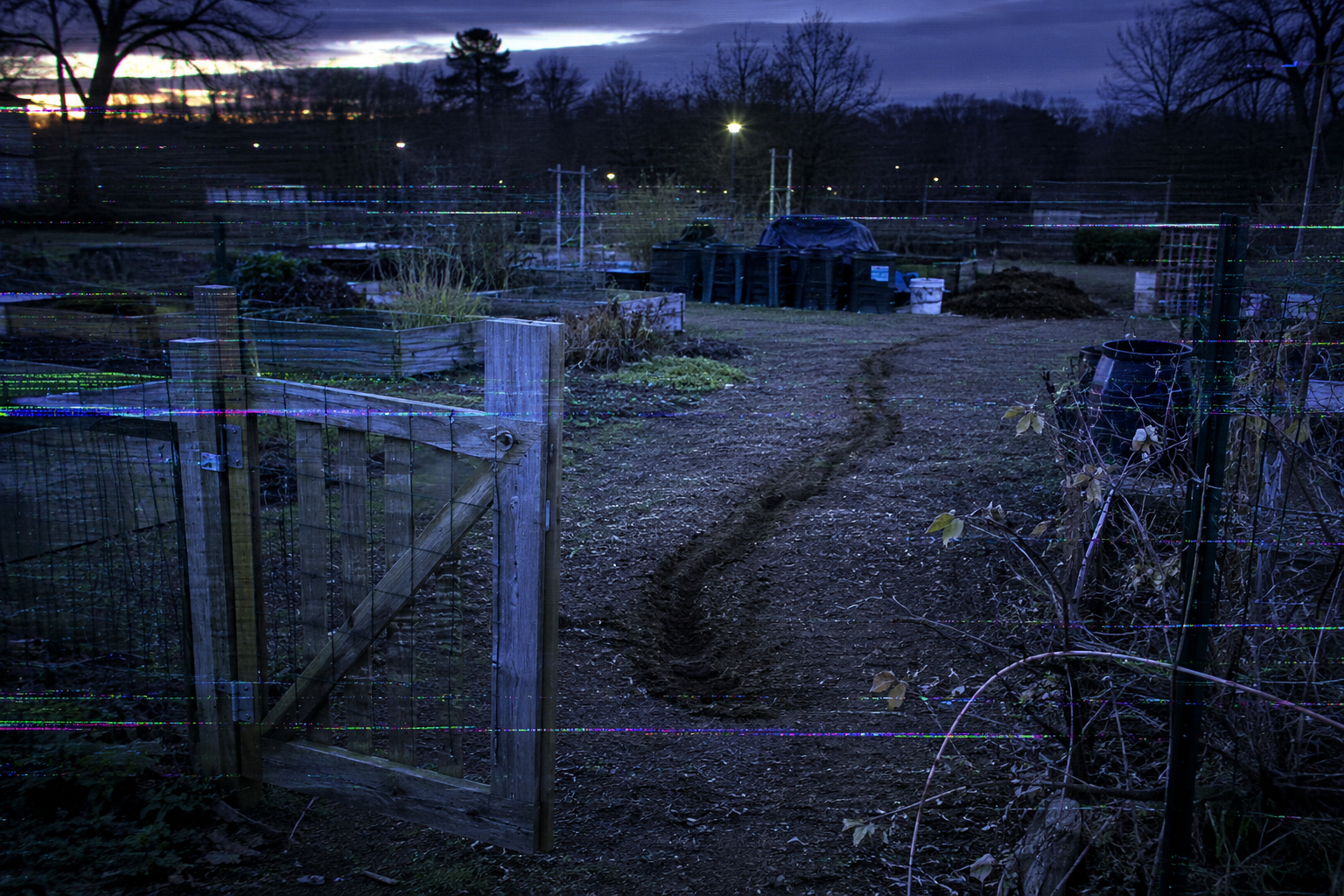
The drag line was the detail that ended the vandalism jokes. It began under the front lip of the middle hutch, crossed the path in a shallow curve, and disappeared beneath the oldest compost bin. It was not a thin tail groove. It was a smooth band, roughly dinner-plate wide, with two faint dotted tracks along the sides.
A heavy bag could have made part of it. A child dragging a bucket could have made a cleaner one. But the gate was locked, no tools were missing, and the line began where nothing had been stored.
The side marks were shallow and irregular, almost like small hard pads touching only sometimes. A gardener who traps nuisance raccoons for a nearby park said raccoons usually leave busy, handlike prints. This looked quieter and lower.
By noon, the sun had dried the soil and erased the sheen. The early photos became the best record.
The Low Dark Shape Under the Bin
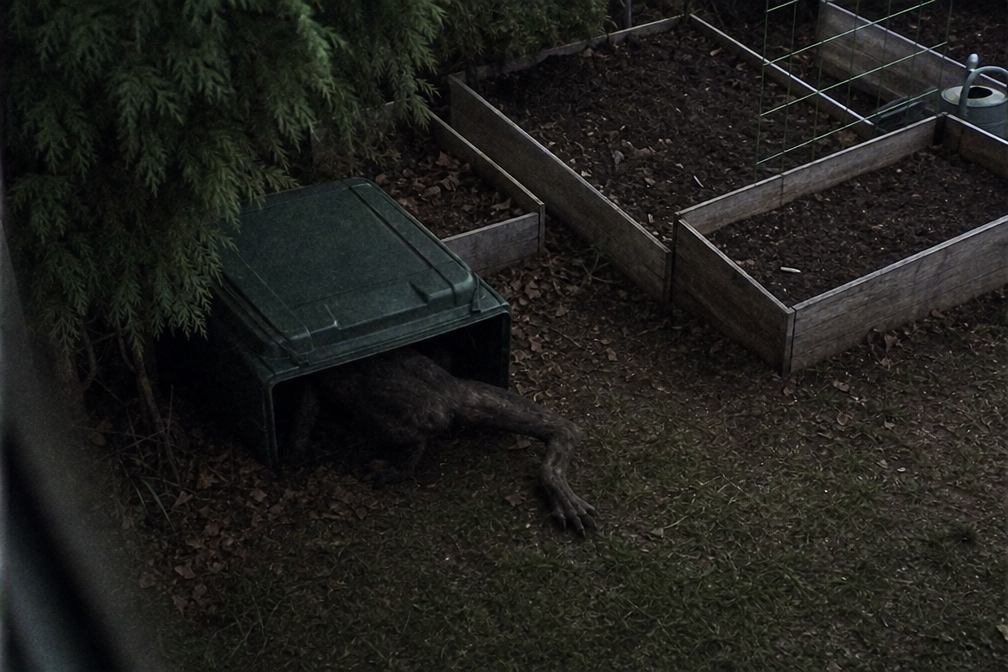
The compost bin was a large plastic municipal model with a hinged lid and open bottom. When volunteers lifted one side, they found disturbed soil beneath it and fresh compost pushed toward the back fence. There was no den, no fur, and no clear print.
A sour odor was noted, but compost bins create sour odors after rain. The real reason the bin matters is one gate camera still from 3:17 a.m.
In that frame, a low dark shape appears partly under the bin. The image is not clean enough for identification. It could be a raccoon at a bad angle, a shadow, or two objects overlapping. But the shape seems to have a hunched back, a narrow front, and one thin limb braced near the soil.
The volunteers did not claim certainty. They only said the frame lined up too neatly with the drag line to ignore.
The Gate Camera Glitch
The gate camera is cheap and imperfect. It misses moths, washes out under headlights, and occasionally drops Wi-Fi. A glitch alone would mean little. The timing is what made people save the camera still.
At 3:16 a.m., the camera shows an empty gate with compost bins in the background. At 3:17 a.m., the camera still starts with horizontal digital bands across the lower frame. Through them, the low shape is visible near the bin. The picture freezes for less than a second. When it resumes, the shape is gone, and straw near the hutches appears shifted.
At 3:19 a.m., the camera records normally again. No person enters, no gate opens, and no headlight crosses the lens. The Wi-Fi log does show a brief signal drop at the same minute, which may explain the corruption. Skeptics have a fair point. So do the volunteers asking why the corrupted camera still is the only one with the shape.
What Could Explain It Normally
A raccoon remains the strongest ordinary explanation. Raccoons are clever, strong, and comfortable around compost. They can bite wood, pull bedding, bend wire, and vanish into shadow. One partly under a bin could look strange in a bad camera frame.
A loose dog is possible but less tidy. The gate was latched, the fence showed no obvious climb point, and the marks lacked broad paw scraping. A fox could fit the low profile, but foxes usually leave clearer tracks and would be more interested in the rabbits than the hardware.
Human involvement is possible too. Someone could have reached over the fence or created a line with a bag. But nothing was stolen, the rabbits were unharmed, and the camera did not catch a person at the gate.
None of these explanations should be dismissed. They are all more likely than a legendary predator. Yet none explains every detail cleanly, which is why the phrase chupacabra evidence kept returning.
Why It Entered Chupacabra Talk
The chupacabra label gets attached too quickly to unexplained animal damage. Here, it came from the combination: a small livestock enclosure, odd mouth marks, a low dark form, and behavior that seemed focused on access rather than food scraps.
Classic reports vary wildly. Some describe a hairless canine. Others describe a hunched creature with spines, long limbs, or glowing eyes. Many later become coyotes with mange, dogs, or misidentified wildlife. The useful part of the label is not certainty. It groups incidents where ordinary animal disturbance includes details that feel wrong.
In this case, the wrong details were subtle. The hutches held. The rabbits survived. The compost bin was empty by morning. Still, the scene suggested a creature approaching low, working at the latches, retreating under the bin, and leaving no clean trail out.
The Evidence Worth Keeping
The strongest items are simple and timestamped: the evening hutch photo, morning damage photos, the measuring-tape image of the chew marks, drag line pictures before the soil dried, and the 3:17 a.m. gate camera still. None proves a chupacabra. Together, they create a tidy mystery with enough anchors to avoid pure campfire talk.
The weakest item is the shape itself. A dark frame with digital bands can turn a raccoon, shadow, bucket, or compost flap into a monster. Any honest version of this story has to say that first.
The best reason to keep watching is pattern. If the same paired chew marks return, if the drag line reappears, or if another camera catches a low animal moving between hutches and bins, the case becomes stronger. Until then, it sits in the strange category of evidence that is not proof, not prank, and not easy to forget.
For now, the garden has added second latches, moved the compost bins away from the fence, and aimed a better camera at ground level. The rabbits are fine. The volunteers are calmer in daylight. But several admitted they still check under the compost bin before stepping close.
Whatever was there, it taught the garden to look lower than usual.
Reader Context
This Weird Witnessed story is an editorial reconstruction, written as eerie visual storytelling rather than a verified report. For more context, see Creatures, Crawlers, and Cryptid Stories Guide and How WeirdWitnessed Creates Reconstructed Horror Stories.