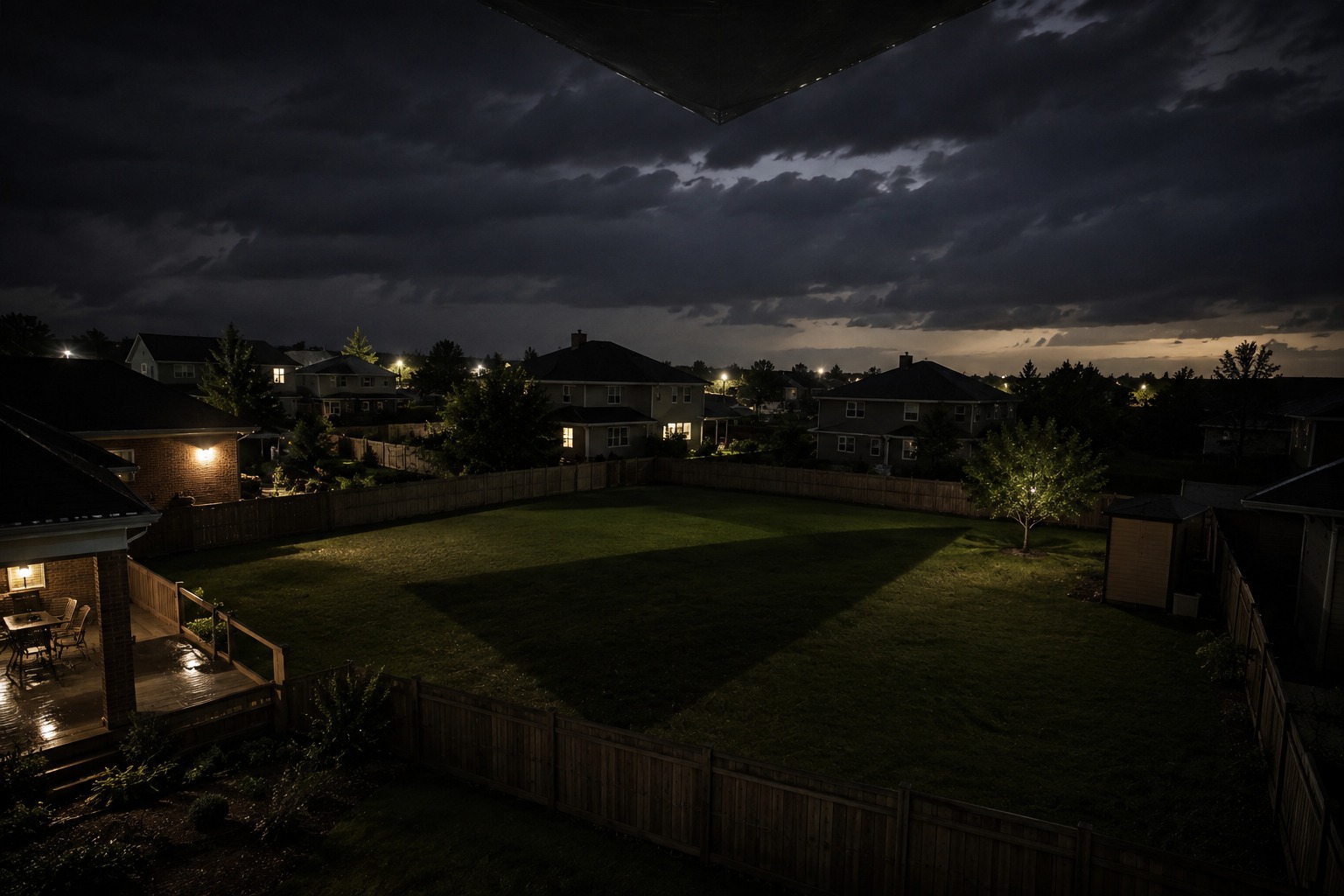
The shadow crossed the lawn without touching the fence. A man standing at his kitchen sink noticed it just after midnight, moving from the far corner of the backyard toward the house. At first, he assumed someone was walking behind the row of trees beyond his property. The shape was roughly human-sized, long through the shoulders and narrow below, and it moved at about the speed of someone taking slow steps.
But nothing moved with it. The branches were still. The patio light stayed steady. There was no person on the grass and no body between the light and the ground. Even stranger, the dark shape passed across a white garden table and then continued across the lawn without changing shape or breaking around the table legs.
His dog noticed it next. The dog had been asleep beside the kitchen door. It stood suddenly, stared through the glass, and backed away without barking. Within seconds, the shadow reached the darker strip beside the house and disappeared. Stories like this appear in different forms: a human-shaped darkness crossing a yard, a large shadow sliding over a roof, or something passing beneath a porch light when nothing visible is there to cast it.
So what can actually create a silent moving shadow outside—and what makes some backyard shadow stories so difficult to dismiss in the moment? Why A Moving Shadow: Feels: More: Frightening: Than A: Moving: Figure A person walking through a backyard is alarming for an obvious reason. You can see the person.
A shadow without a visible source creates a different problem. Our brains normally understand shadows instantly. Something blocks light, and darkness appears on another surface. We rarely need to consciously work out which object created which shadow. That automatic understanding is exactly why a shadow can become disturbing when the expected object is missing.
The First Time It Happened
If a dark human-like patch moves across grass, the immediate instinct is to look in the opposite direction for the person creating it. When nobody is there, the scene suddenly stops behaving the way we expect. The silence adds to that feeling. A person crossing gravel should make noise. Someone stepping through plants should disturb leaves. A large animal might shake a bush or trigger barking.
A shadow can cross the same space without producing any of those secondary clues. That leaves the witness watching movement without seeing the thing that supposedly moved. Some descriptions make the shadow sound almost flat, like darkness sliding across the surface of the yard. Others describe something more upright: a black human form moving between trees or standing beside a shed.
Those are actually two different kinds of experience, and separating them matters. The First Question Is: Whether: It: Was: Flat: Or: Upright: When someone says they saw a "shadow figure," the phrase can describe several very different things. One is a normal-looking shadow projected onto the ground, wall, fence, or side of a house.
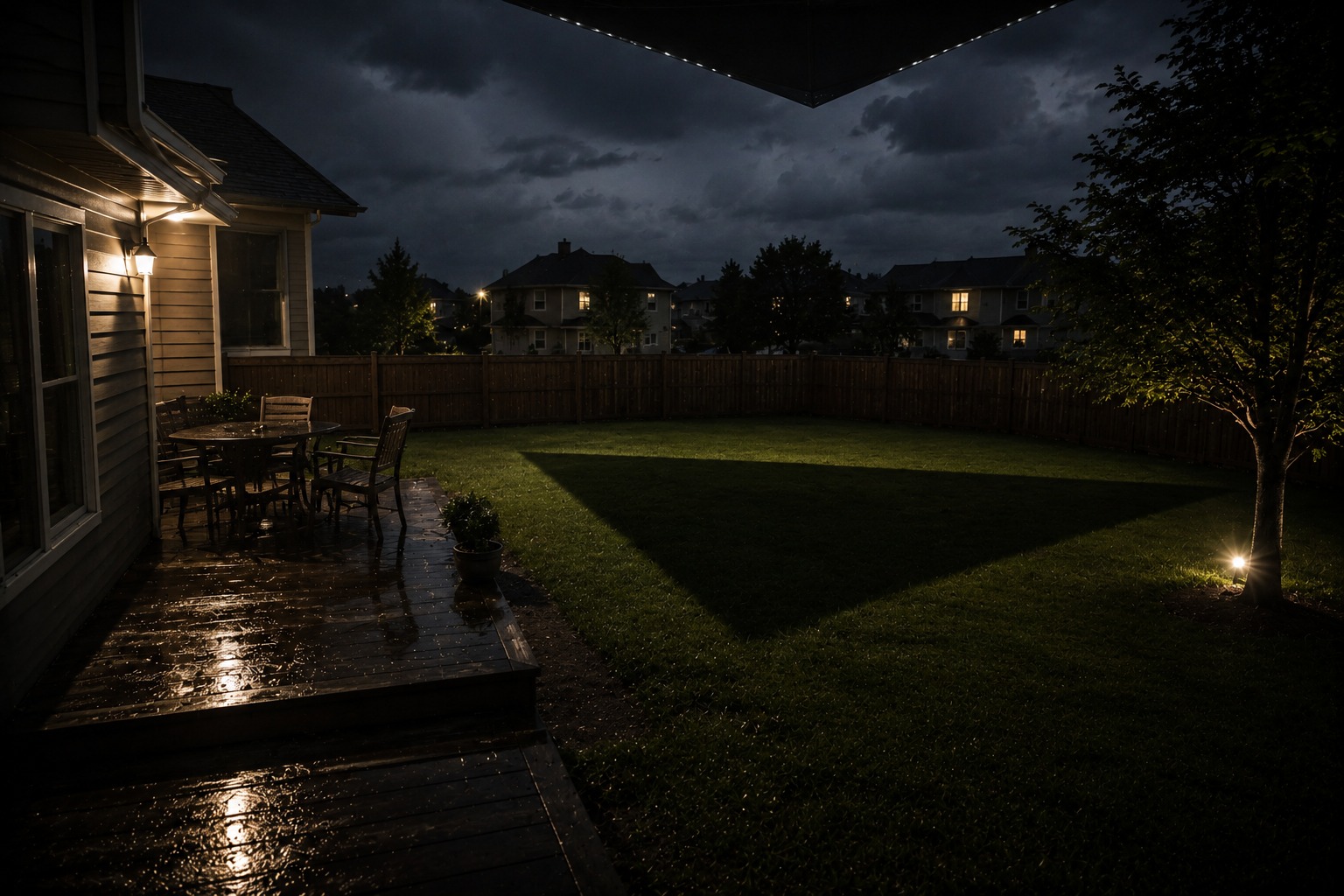
Another is an upright dark shape that appears to occupy space like a person. The first category usually has more ordinary possibilities. A moving light source can send huge shadows racing across a yard. A passing car can project the shadow of a mailbox, tree, railing, or even something inside a window onto surfaces far away.
The result can look surprisingly human. Imagine headlights moving along a road behind a house. Their angle changes every second. A small shrub near the driveway may suddenly throw a stretched shadow across an entire lawn. Because the light itself is moving, the shadow appears to walk or glide.
An upright shape is harder to explain in the same way because the witness is not merely seeing darkness on a surface. They believe they are looking at something standing between them and the background. That does not automatically make it paranormal. Darkness removes depth information extremely well.
Why The Place Felt Wrong
But it changes what needs to be checked. Passing Cars Can Make: Shadows: Behave: Strangely: One of the strongest normal explanations for fast-moving backyard shadows is traffic. It does not require a road directly behind the property.
Headlights can travel through gaps between houses, reflect from windows, strike fences, or pass through tree branches. A car turning at an intersection can briefly sweep light across a backyard from an angle that seems impossible from inside the house. The strangest part is that people often notice the darkness rather than the moving light.
Suppose a backyard is dimly illuminated by a porch lamp. A second, brighter light from a passing vehicle briefly hits the yard. A tree trunk blocks that new light. Its shadow suddenly becomes much darker than everything around it. As the vehicle turns, that shadow races sideways.
The tree never moves. Only the light does. Similar effects can come from a neighbor carrying a flashlight, motion lights switching on, bicycles, delivery vehicles, distant construction lights, or someone opening and closing curtains in a brightly lit room. Wind makes the effect even more complicated.
Branches moving close to a light can cast enormous shapes farther away. Several branches overlapping can briefly resemble shoulders, arms, or a head. Then the wind changes and the "person" disappears. Why The Shadow Sometimes: Seems: To: Cross: Solid: Objects: This is one of the details that can turn an ordinary backyard scare into something much stranger.
The Detail Nobody Could Explain
A witness may say the shadow moved across the lawn, reached a chair or table, and appeared to continue straight across it. That can happen naturally. A projected shadow is not an object traveling along the ground. It is simply an area receiving less light. If the same blocked light reaches both the lawn and the side of a chair, the dark patch can appear to climb from one surface onto another.
From the right viewing angle, the transition may be difficult to notice. Distance also flattens a scene. At night, a lawn, fence, patio furniture, and vegetation can visually merge into one dark background. The brain may interpret several separate patches of darkness as one continuous moving shape.
There is another useful clue: distortion. Normal projected shadows should react to the surfaces they cross. A shadow moving from flat grass onto a vertical fence should stretch, bend, change direction, or alter its apparent speed. That is why stories in which a shadow supposedly remains perfectly human-shaped while crossing several surfaces sound especially strange to witnesses.
The important question is not simply whether the darkness crossed an object. It is whether its shape behaved like projected light should. Animals Reacting Does Not: Automatically: Identify: The: Cause: Dogs feature heavily in nighttime shadow stories.
Sometimes the witness notices the yard first. Sometimes the dog does. A sleeping dog may suddenly lift its head, stare toward a window, growl at the patio door, or refuse to go outside. When that reaction happens at the same moment someone sees a dark shape, the two events feel connected.
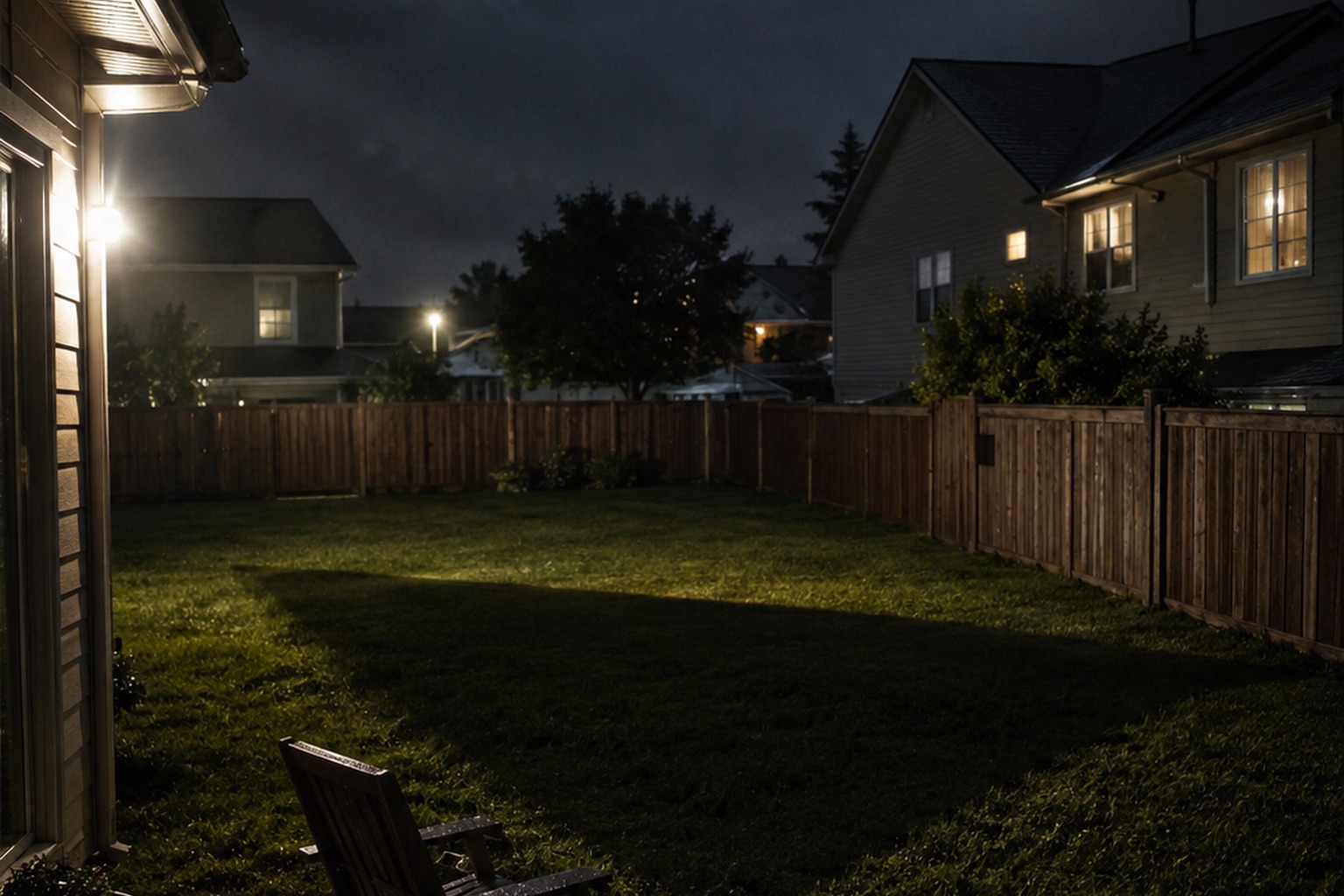
They might be. But animals detect plenty of things humans miss. A dog may smell a fox behind a fence, hear a cat moving through vegetation, notice rodents under a deck, or respond to a distant animal that is completely invisible to its owner. That creates an interesting possibility.
What They Checked Afterward
The person may see an unrelated moving shadow while the dog reacts to an ordinary animal somewhere nearby. Because both happen simultaneously, they become one event in memory. There is also a more straightforward explanation. If an actual animal moves through a poorly lit yard, a person watching through glass may see mostly its shadow while the dog detects the animal itself.
Still, certain descriptions are understandably unsettling. A dog staring directly at an empty patch of illuminated grass while a human-shaped darkness crosses it is much harder for the person standing beside that dog to forget. The animal's reaction does not tell us what the shadow was.
It tells us that something in the environment may have changed. Windows Can Create A: Second: Backyard: That: Is: Not: Really: There: Many backyard shadow sightings happen from inside a house. That introduces glass.
At night, windows become weak mirrors. If the room behind you is brighter than the yard ahead, objects inside the house can appear superimposed over the outdoor scene. A person walking through a hallway behind you might appear as a faint figure moving across the lawn.
A ceiling fan can create repeating movement among trees. Someone passing a lamp can send a large dark shape across the window. Even your own movement can produce a shadow that seems disconnected from you because the reflection is faint and appears visually farther away.
The Moment It Became Harder To Ignore
This is easy to test after the fact. Turn off the indoor lights and look again. Move around the room. Check whether lamps, television screens, hallway lights, glass cabinets, or reflective doors sit behind the viewing position.
Opening the door and stepping outside also changes the scene completely. That last check matters because some of the creepiest reports specifically involve people who saw the shape both through the window and after changing position. Once the glass is removed from the equation, reflection becomes a much weaker explanation.
When The Human Shape Comes From Almost Nothing People are extremely good at finding human forms in incomplete visual information. At night, that ability can work against us. A trash bin beside a shrub becomes a person with broad shoulders. Two fence posts and a dark gap become legs. A hanging coat glimpsed through patio glass becomes someone standing outside.
Movement makes these mistakes more convincing. The human visual system does not wait for perfect information before deciding what something might be. If a dark shape moves approximately like a person, the brain can fill in the missing body. This is especially powerful in peripheral vision.
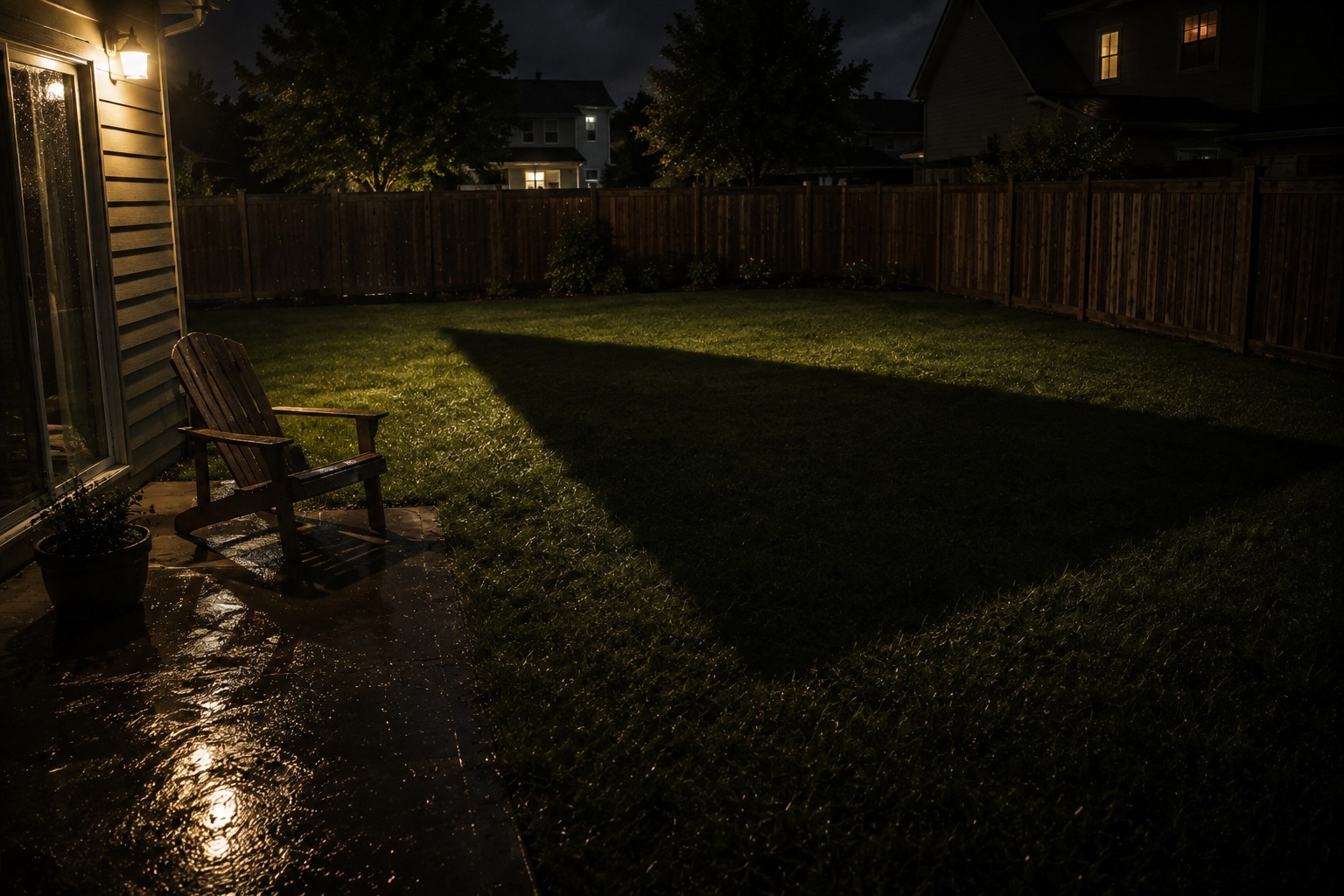
Peripheral vision is excellent at detecting movement but poor at fine detail. You may clearly notice that something crossed the lawn without being able to accurately describe its edges. When you turn your eyes directly toward it, it is gone. That does not mean the person imagined the movement.
Why People Avoided That Spot Later
It means the brain may have interpreted genuine movement incorrectly. A bird flying close to an outdoor lamp can throw an enormous shadow. A moth near a light can create a surprisingly large moving blur. An owl crossing above a yard can produce a silent sweep of darkness that seems far larger than the bird itself.
The closer an object passes to a light source, the more dramatic its projected shadow can become. That is one reason the apparent size of a mysterious shadow tells us very little about the size of whatever created it. The Details That Make: An: Ordinary: Explanation: Weaker: Most nighttime shadow sightings do not provide enough information to eliminate reflections, headlights, animals, moving branches, or simple visual mistakes. But some details make those explanations less comfortable. One is repeated movement along the same path when there is no repeating light source. Another is a shadow that stops.
A projected shadow from a passing vehicle usually sweeps continuously through the scene. A dark shape that crosses half the yard, pauses beside a tree, and then changes direction behaves less like the simple headlight effect people commonly imagine. Shape consistency matters too. If the darkness travels over grass, patio stones, steps, and a vertical wall while somehow retaining exactly the same proportions, a straightforward projection becomes harder to picture.
Then there is viewpoint. If two people standing several feet apart both describe an upright dark form in the same location, reflection from one viewing angle becomes less useful as an explanation. The strongest practical check is changing position. Move to another window. Turn off the indoor lights. Step outside if it is safe. Look for traffic. Check the sky. Watch the trees. See whether a neighbor's motion light has switched on.
A strange shadow that disappears after one of those changes may suddenly make sense. A shape that remains in the same physical spot from multiple viewpoints is a different kind of puzzle. Why Backyard Shadow Stories: Stay: With: People: Backyards are supposed to be familiar.
Why The Story Still Gets Shared
People know where the fence stands, how the trees move, which neighbor's lights reach the lawn, and what the patio furniture looks like after dark. That familiarity makes an unexpected shape more effective. The setting is not an abandoned building or a dark forest. It is ten feet beyond the kitchen door.
There is another reason these stories linger. They often end without resolution. The shadow reaches the side of the house. It passes behind the shed.
It enters the darkness beneath a tree. The witness turns on another light—and nothing is there. No intruder runs away. No animal appears. No obvious object falls over and explains the movement. The backyard simply looks normal again.
In many cases, that probably means a brief combination of light, movement, reflection, and nighttime vision created something far stranger-looking than its source. But the stories people struggle with most contain one stubborn detail: a shadow that seemed to move deliberately when nothing visible was there to cast it.
That detail does not tell us that something paranormal crossed the yard. It explains why someone might still check the lawn before opening the back door at midnight.