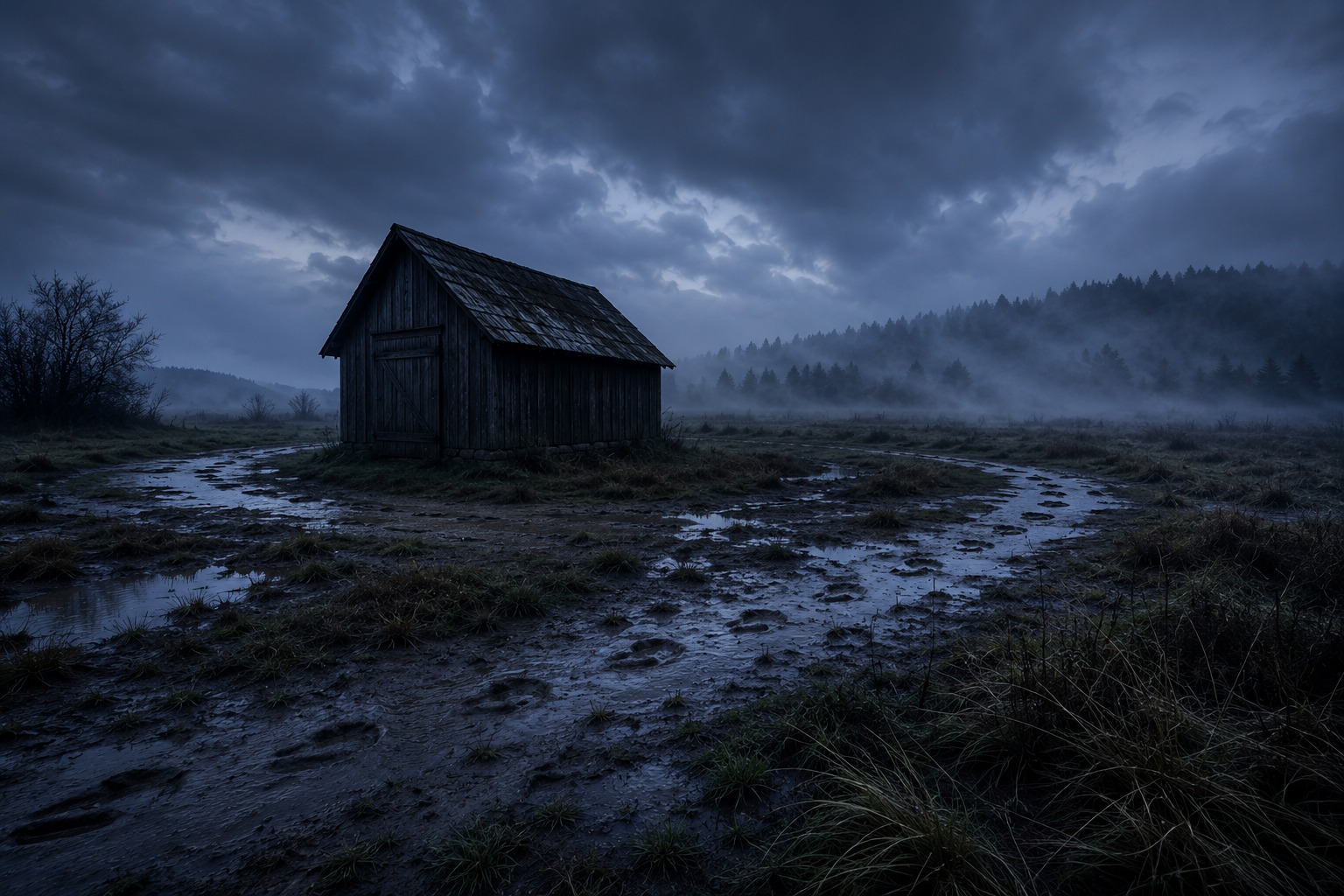
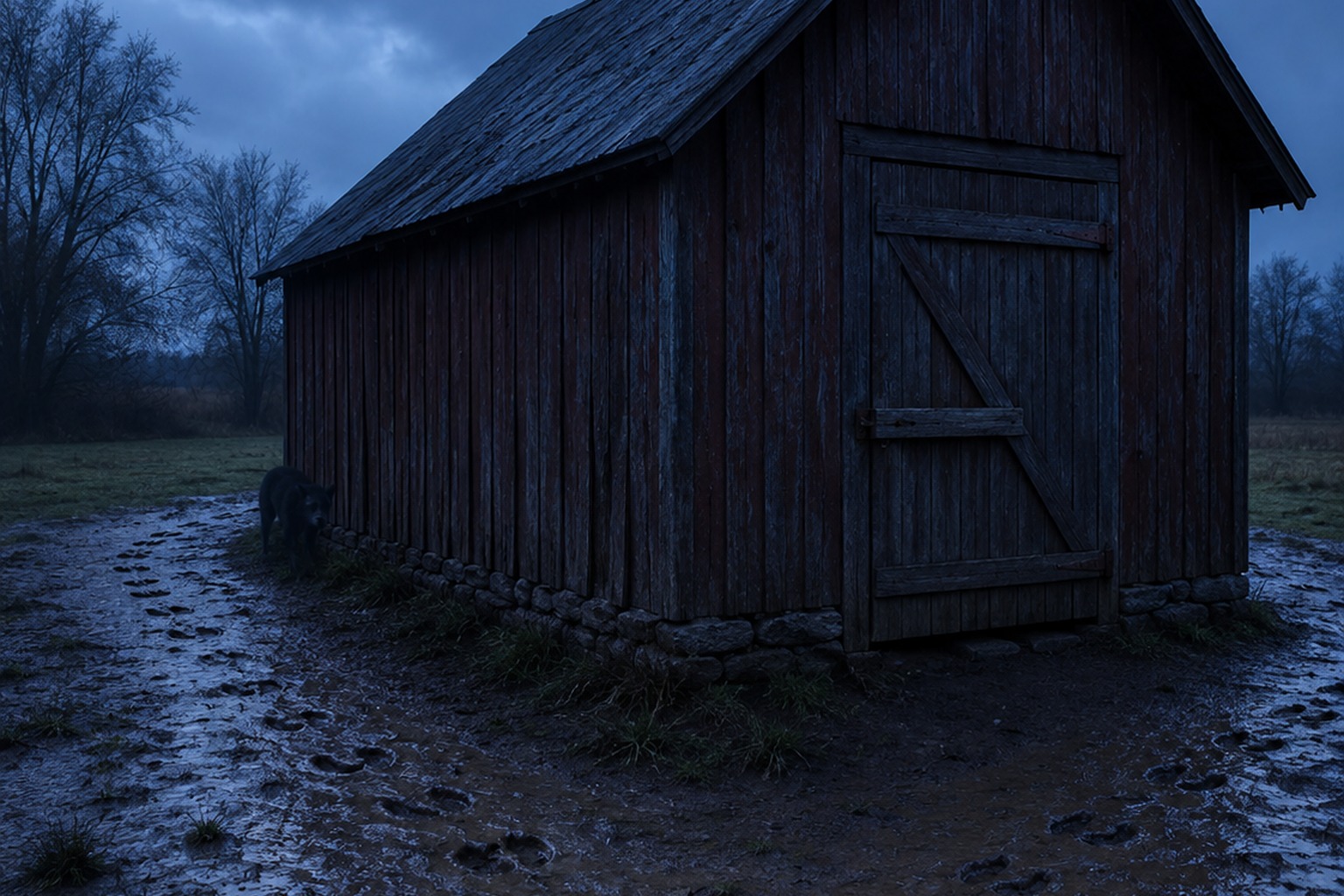
The hoofprints went all the way around the barn, but none of them crossed the open strip of snow leading to it. They began beside the rear wall. A farmer checking the property before sunrise could follow them clearly: two narrow marks pressed deep into fresh snow, spaced like the steps of a small deer. They passed beneath a window, continued around the corner, crossed in front of the double doors, and disappeared behind the opposite side.
There was nothing especially strange about finding animal tracks near a barn. What was strange was where they started. The snow between the barn and the surrounding fence line was smooth. No trail approached from the field. No tracks came from the trees. The barn doors had stayed shut overnight. Yet something seemed to have walked a complete circuit around the building.
At one corner, the prints stopped beneath the overhanging roof. Several feet farther on, they started again. Stories like this turn up in rural folklore, strange-animal reports, and old winter mysteries. Sometimes the tracks resemble deer hooves. Sometimes they look unusually narrow, oddly deep, or almost like a split foot. Occasionally people connect them with stories of horned creatures, the Jersey Devil, mysterious livestock predators, or even the old legend of the Devil's Footprints.
Usually, however, the first question is much simpler: What ordinary animal could leave hoof-like tracks around a barn—and why can those tracks sometimes look impossible? Why Hoofprints Around A: Barn: Feel: Different A footprint in a field tells you that an animal crossed a field.
A footprint circling a building feels like something was interested in the building. That difference matters. Barns are especially effective settings for frightening track stories because they create boundaries. There is an obvious inside and outside. There are walls, doors, windows, feed bins, livestock smells, and narrow spaces where an animal might hide.
When tracks follow those walls closely, people naturally imagine intention. Something wasn't merely passing through. It appeared to be checking the barn. That impression becomes stronger when the trail repeatedly approaches doors or windows. A deer wandering for food may behave that way, but when someone sees the finished trail the next morning, the movement can look almost methodical.
The First Time It Happened
Snow makes the effect even stronger because it removes visual clutter. A dark pair of hoof-shaped holes against untouched white ground creates an easy path for the eye to follow. Every interruption suddenly becomes important. Why did the tracks stop there? Why did they get deeper beside the door?
Why are there no tracks approaching the barn? And why does the trail begin again on the other side? Those questions are where an ordinary wildlife puzzle can begin feeling like a creature story. The Animals Most Likely: To: Make: Hoof-Shaped Tracks
The obvious candidate is a deer. Deer regularly approach rural buildings, especially when food, stored crops, salt, gardens, livestock feed, or sheltered ground attracts them. Their split hooves can produce the classic paired impression people expect. But deer aren't the only possibility. Depending on the location, goats, sheep, pigs, wild boar, cattle, and escaped livestock can leave prints that someone might loosely describe as hoofprints. Even animals without hooves can create surprisingly hoof-like marks under the right conditions.
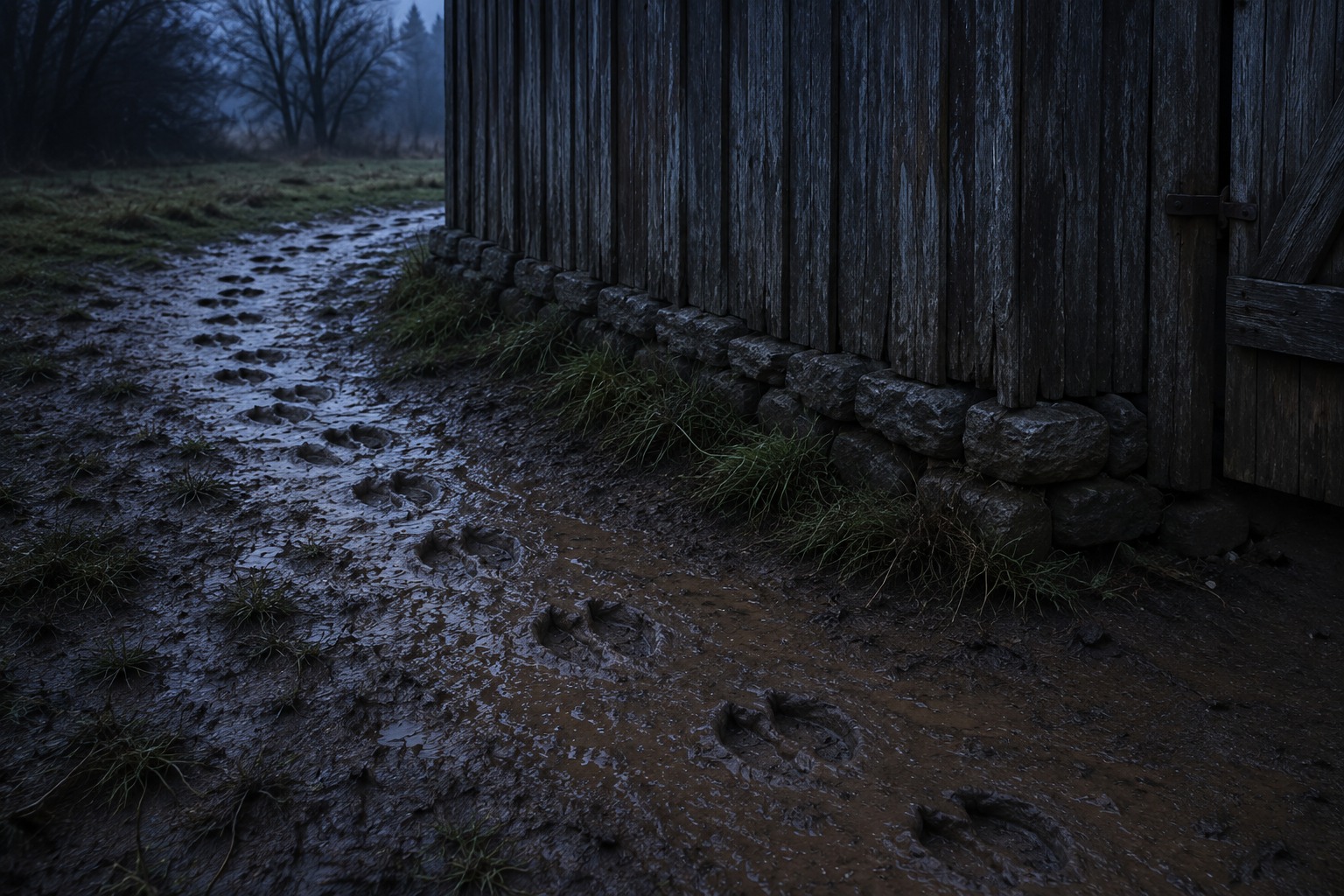
A rabbit moving through deep snow is a good example of how misleading tracks can become. Multiple foot impressions may overlap. Melting can merge separate marks. A small paw can lose its toe details as the edges collapse. The result may look nothing like the animal that made it.
This becomes especially important when someone discovers the trail hours later. Fresh tracks preserve small details. Older tracks don't. Sunlight, wind, falling snow, drifting powder, freezing, thawing, and even loose snow dropping from a roof can reshape an impression. Two paw marks can become one hole. Toes can disappear. A rounded track can develop a split appearance.
So the question isn't simply, "What animal has a hoof shaped exactly like this?" It is also, "What animal could have made the original mark before the weather changed it?" Why Tracks Can Seem To Begin From Nowhere This is often the most disturbing part of the story.
Why The Place Felt Wrong
A trail suddenly appears beside a building even though the surrounding snow looks untouched. There are several ways that can happen without anything supernatural walking out of thin air. Snow depth is one. An animal crossing hard-packed or wind-scoured ground may leave impressions too shallow to notice. When it reaches softer snow beside a barn, the same animal suddenly produces deep, obvious prints.
To the person following them backward, the trail appears to begin there. Wind can create another illusion. Tracks in exposed areas may fill rapidly while impressions protected by a wall remain sharp. A barn itself can therefore preserve the strangest-looking part of the trail while the approach route disappears.
Roofs complicate things further. Snow falling from an overhang can erase tracks immediately beside a building. Dripping water can distort them. Areas sheltered beneath eaves may contain very different snow from the open yard only a few feet away. There is also the possibility that the animal didn't approach along the ground in the way the observer assumes.
Animals jump. A deer can cover a surprising distance in a bound. A rabbit can leave grouped impressions separated by clean patches. A bird can land, walk, and take off, leaving a short trail that genuinely has no walking approach or departure. This is why the beginning and end of a strange trackway deserve more attention than the middle.
They often reveal how the illusion happened. The Roofline Is Where: The: Puzzle: Gets: Creepy: Imagine following paired tracks around a barn at dawn. They are regular at first.
Step. Step. Step. Then they reach a side wall beneath a low section of roof.
The Detail Nobody Could Explain
Nothing. The snow is smooth for six feet. Beyond that gap, the same marks continue. This is exactly the kind of detail that turns an animal trail into a story about something impossible.
But gaps can have ordinary causes. The animal may have jumped. Snow may have fallen from the roof after it passed. Wind may have erased shallow impressions. The creature may also have stepped onto exposed stones, boards, frozen ground, vegetation, or another surface that simply didn't hold tracks.
The useful question is whether the gap fits the movement of a known animal. A short interruption is not especially mysterious. A huge gap with no obvious landing point is more interesting. So is a trail that repeatedly stops and resumes without changes in snow conditions.
And if the marks appear on surfaces an ordinary hoofed animal should have difficulty reaching, the normal explanations become narrower. That doesn't automatically point to a paranormal creature. It means the trackway needs closer examination. The strangest track stories often survive because only the most dramatic part was noticed, while details such as snow depth, weather, nearby surfaces, animal activity, and the exact shape of individual prints were never recorded.
When A "Hoof" Doesn't Behave Like A Hoof Shape gets attention. Movement tells you more. Suppose the marks look exactly like tiny cloven hooves. That sounds impressive until the spacing shows an animal moving like a rabbit.
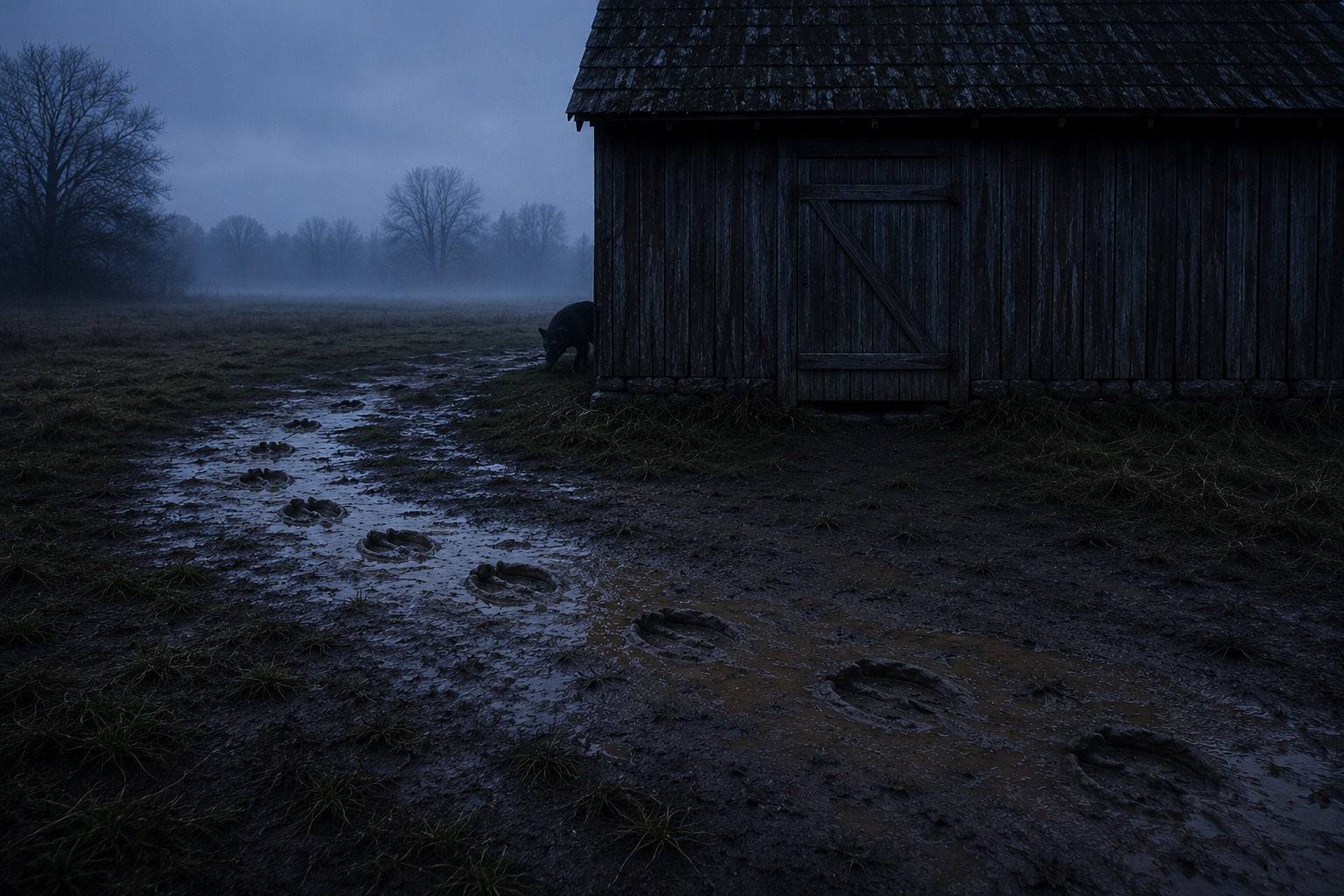
Or perhaps each apparent "hoofprint" is actually two overlapping paw impressions. This is why trackers look beyond a single footprint. A real trail contains rhythm. Animals walk, trot, hop, bound, stop, turn, slip, and change direction. Those movements create repeating patterns. A deer trackway should behave like a deer trackway, not merely contain a few deer-shaped holes.
What They Checked Afterward
Depth matters too. If something supposedly small creates unusually deep marks, there may be a simple explanation: the prints melted outward after being made, or the animal broke through a crust that supported less weight elsewhere. But unusual depth combined with unusual spacing is worth noticing.
So are tracks that seem extremely narrow yet penetrate hard snow. Then there are the details people often describe in creature stories: a hoof that seems too long, an impression ending in sharp points, a stride that looks too wide, or marks that continue through terrain where the expected animal would normally change pace.
Those details sound dramatic, but photographs with a ruler or another size reference are far more useful than memory. Without scale, a three-inch track can become a six-inch track surprisingly quickly in the retelling. Why Horned-Creature Legends Get Attached To The Tracks
Humans have been telling stories about strange hoofed beings for a very long time. That makes mysterious hoofprints unusually good fuel for folklore. A strange pawprint might suggest an unknown dog. A strange hoofprint can suggest something much darker.
European folklore is filled with horned figures, devils, wild men, and creatures that combine human and animal features. In North America, some strange-track stories become attached to regional creatures such as the Jersey Devil, often described with a bizarre mixture of wings, hooves, horns, and other animal features.
The Moment It Became Harder To Ignore
Then there is the famous type of story sometimes called the Devil's Footprints: long trails of hoof-like marks appearing across snowy landscapes and seemingly passing obstacles in ways witnesses found difficult to explain. Whether a particular trackway has anything to do with those legends is another matter.
The important point is that people don't interpret tracks in a cultural vacuum. If someone has already heard stories about a hoofed creature, an unexplained split print beside a barn immediately has a possible identity. That identity can then influence which details get remembered.
A narrow print becomes "goat-like." A long stride becomes "unnaturally long." A missing section becomes "the creature vanished." This doesn't mean witnesses are lying. It means people naturally build a picture from incomplete information.
Tracks provide just enough information to make that picture frightening. The Details Worth Checking: Before: Calling: It A: Creature: The best time to examine strange tracks is before anyone walks through them. First, look at several prints rather than choosing the weirdest one.
If ten tracks look like ordinary deer impressions and one looks monstrous, the odd print may have collapsed, melted, overlapped another track, or struck the ground at an unusual angle. Next, follow the trail in both directions. Don't stop where the obvious marks stop.
Look farther away for faint depressions, broken crust, displaced snow, bent grass, disturbed leaves, or tracks on harder ground. Check beneath the eaves. A clean gap exactly matching an area where roof snow recently fell tells a very different story from tracks that vanish in the middle of an undisturbed open patch.
Why People Avoided That Spot Later
Then look for other animals. Are there deer trails along the property edge? Rabbit tracks near feed? Signs of goats, pigs, or other livestock nearby? Stride is especially useful. Measure the distance between repeated impressions instead of estimating it visually. A creature that seems enormous because of deep tracks may turn out to have the ordinary step pattern of a familiar animal.
And photograph the trail from above as well as from ground level. A dramatic low-angle image can make prints look deeper and larger than they are. An overhead view makes the movement pattern easier to understand. The goal isn't to make the story less interesting.
It is to find out what actually makes it interesting. When The Ordinary Answers Start Feeling Weaker Some trackways remain difficult to reconstruct even after obvious possibilities are considered. The strongest puzzles aren't simply "we found hoofprints."
They contain several unusual features at once. Perhaps the marks have a consistent shape but don't match the expected wildlife. Perhaps the trail crosses fresh snow without any obvious approach. Maybe the spacing stays strangely regular across changing terrain.
Or the prints reach a vertical obstacle and appear on the far side without the disturbance expected from a jump. Even then, "unexplained" is not the name of an animal. It simply describes the limits of what can be worked out afterward. There may have been weather changes nobody noticed. The trail may be older than assumed. Multiple animals might have crossed the same route. Snow conditions can hide information that would have been obvious on mud or bare soil.
But there is a reason certain track stories remain unsettling. Footprints imply a body. You may never see the animal itself, yet the trail encourages your mind to build one step by step. Two pointed impressions suggest hooves.
Why The Story Still Gets Shared
Deep marks suggest weight. A wide stride suggests height. A circle around the barn suggests interest. By the time the trail reaches the door, the imagined creature already has a shape.
So What Leaves Hoofprints Around A Sealed
Barn? Most of the time, the best place to start is with ordinary wildlife—especially deer or another local animal—combined with snow conditions that changed, hid, or distorted part of the trail. That explanation covers a surprising number of "impossible" footprint stories.
A sealed barn doesn't prevent an animal from walking around the outside. Missing approach tracks don't necessarily mean there never were any. And a hoof-shaped impression doesn't always require an animal with hooves. Still, the truly memorable stories contain something that resists that easy reconstruction.
The trail is too regular. The gaps occur in the wrong places. The stride doesn't fit the animal suggested by the print. Or someone follows the marks around the building and realizes they have returned to the exact spot where the trail began—with no path leading toward it and no path leading away.
Then daylight comes. The barn is still closed. Nothing is standing in the field. There is only a ring of dark impressions pressed into the snow, close enough to the walls to make it look as though something spent the night walking slowly around the building.
And whatever made them never left an obvious trail home.