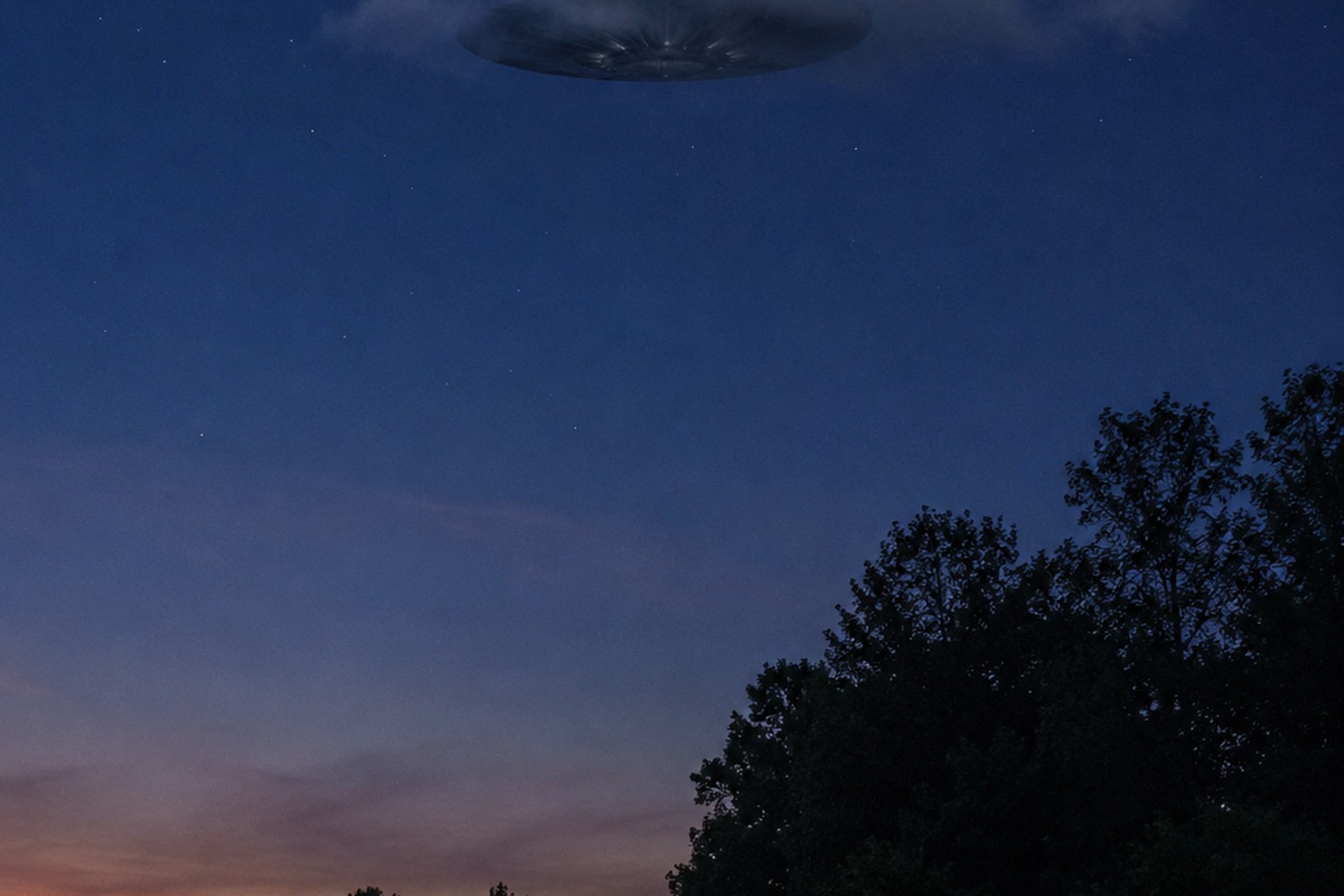
The strange part was not that the silver disc disappeared into the cloud. It was that it never came out. A man standing beside a quiet country road had been watching the object for almost a minute. It looked nothing like a distant point of light. Against the blue evening sky he could make out a flattened circular body, a darker underside, and a hard metallic edge that flashed whenever it tilted. It moved steadily above an open field without any obvious wings or tail.
Ahead of it floated one small white cloud. The disc reached the cloud's edge and slipped into the gray-white vapor. The man kept watching the opposite side, expecting it to emerge almost immediately. The cloud was narrow enough that he could see blue sky surrounding it on every side.
Five seconds passed. Then ten. Nothing appeared. The cloud itself kept drifting slowly across the sky, thinning at its edges. There was no second cloud nearby and no visible object moving away above, below, or behind it.
By the time the cloud began breaking apart, the sky around it was completely empty. Stories like this form one of the stranger patterns in UFO reports: a clearly visible disc, oval, or structured object crosses open sky, enters a single cloud, and apparently never comes back out.
So what can actually make a disc-shaped UFO seem to vanish behind one cloud? Why One Small Cloud: Makes the Disappearance So Strange A large bank of clouds can hide almost anything. If an aircraft enters a thick overcast layer, nobody expects to keep seeing it. The hidden space may stretch for miles. The aircraft can change direction, climb, descend, or simply continue beyond the observer's view.
The First Time It Happened
A single isolated cloud feels different. The witness can often see blue sky around the entire thing. That creates what seems like a simple visual test: the object goes in on one side, so it should eventually appear somewhere else. When it does not, the cloud starts feeling less like ordinary cover and more like the exact point where the object disappeared.
That is why these stories can be more unsettling than reports in which a UFO simply fades into the distance. The witness has a visible reference point. There was an object. There was a cloud. The object reached the cloud.
Then there was only the cloud. The mind naturally treats those events as connected, even though several less mysterious things can happen during the few seconds when the object is hidden. A Cloud Can Hide Much More Sky Than It Seems To One problem is that judging distances in an empty sky is surprisingly difficult.
A small-looking cloud may actually be enormous and much farther away than it appears. A disc that seems to be approaching the cloud could be hundreds or thousands of feet in front of it, behind it, above it, or below it. From the ground, those separate distances can collapse into one flat-looking picture.
This matters because people often describe the object as having "entered" the cloud when what they really know is that the object's line of sight crossed the cloud. Imagine holding your thumb in front of a distant building. Your thumb appears to cover part of the building, but it is obviously nowhere near it.
Why The Place Felt Wrong
The sky creates the same problem without giving you convenient distance markers. An object might pass behind a cloud that is much larger than the witness realizes. Once hidden, it may have enough room to change its apparent position substantially before becoming visible again. And if it emerges against a brighter patch of sky, turns edge-on, or travels away from the observer, the witness may never relocate it.
The disappearance can therefore feel instantaneous even when nothing actually vanished. Why Disc Shapes Are: Especially: Easy to Lose A disc is an unusually tricky shape to follow in the sky because its visible size can change dramatically depending on its angle. A broad circular object seen from below presents a large surface.
Tilt that same object until it is nearly edge-on, and it becomes a thin line. At a great enough distance, that line can fall below what the eye can easily separate from the surrounding sky. This offers one ordinary possibility for some "never came out" reports.
The object disappears behind the cloud while showing a broad face. During the hidden interval, its angle changes. It emerges showing a much narrower profile. The witness keeps searching for the large silver shape that entered the cloud. A tiny dark line may already be moving away.
Brightness can create the same problem. A reflective object may look brilliant when sunlight strikes its surface, then become extremely difficult to see after only a slight change in angle. That can produce an eerie sequence: bright disc, cloud, empty sky. The cloud may not have caused anything. It simply provided the few seconds during which the object's appearance changed.
What Witnesses Usually Check First
The Detail Nobody Could Explain
When someone sees this happen, the first reaction is often to scan the cloud's edges. Did the object come out higher? Lower?
Did it reverse direction? Did it emerge from the same side? Witnesses may also look for an aircraft trail, engine noise, blinking navigation lights, or some smaller object that could explain what they had been watching. The cloud itself becomes important too.
If it is growing or joining a larger cloud bank, there is plenty of hidden sky available. If it is an isolated puff surrounded by clear blue sky, the disappearance seems harder to understand. People also tend to notice how long the object should have remained hidden.
Suppose something appears to cross open sky at a steady pace and reaches a cloud only slightly wider than its own apparent travel distance over several seconds. A witness may expect it to emerge quickly. When thirty seconds pass without anything appearing, that expectation becomes the heart of the story.
But apparent speed is another uncertain measurement. An object moving slowly nearby and an object moving extremely fast at a great distance can produce similar motion across a person's field of view. Without knowing the object's size and distance, it is difficult to calculate where it should have emerged.
The Most Ordinary Explanations Happen
What They Checked Afterward
During the Hidden Seconds The few seconds behind the cloud create a blind spot. Several things can happen inside that blind spot without requiring anything extraordinary. The object can change direction.
It can climb or descend. It can turn so its visible profile becomes much smaller. It can move farther away. The observer can also simply lose the correct patch of sky.
That last possibility sounds weak until you try tracking a small aircraft or bird through scattered clouds. When it disappears, your eyes stop receiving the motion cues that helped you follow it. You may continue looking where you expect it to appear rather than where it actually does.
Even a small difference in direction can be enough. There are also ordinary objects capable of looking surprisingly disc-like under certain conditions. Balloons, distant aircraft, birds seen at unusual angles, reflective objects, and even lenticular-looking shapes can be misread when there is little scale information.
Atmospheric haze can erase details and make an ordinary object look smooth. Sunlight can turn one side bright silver while hiding wings or other features. None of those explanations fits every report. They simply explain why "it went behind the cloud and disappeared" is not automatically as impossible as it feels.
When the Easy Explanation Starts Feeling Weaker The more detailed the sighting, the harder some simple explanations become. Consider a witness who watches a structured object for several minutes rather than several seconds. They describe a stable circular body, a distinct underside, and a consistent path across a large section of open sky. Several people are watching from the same location. The object then passes behind a sharply defined isolated cloud.
The Moment It Became Harder To Ignore
Everyone watches all sides of the cloud. Nothing returns. That still does not tell us what the object was, but it removes some easy possibilities. A momentary flash of reflected sunlight becomes less satisfying if the shape remained visible through changing angles.
A bird becomes less convincing if observers consistently saw a rigid geometric body. Losing track of the object becomes less convincing if several people were deliberately watching different sides of the cloud. The most puzzling versions go one step further: the cloud itself thins or breaks apart shortly afterward.
Imagine watching the last wisps disappear and expecting the hidden object to become visible again. Instead, there is only blue sky. That visual ending is probably one reason the pattern survives so strongly in UFO storytelling. The cloud seems to open like a curtain.
There is nothing behind it. Could the Object Still Be Hidden After the Cloud Moves? Yes, because the object and cloud do not have to be at the same distance. This is one of the easiest mistakes to make when imagining the scene.
A witness may think of the UFO as physically sitting inside the cloud. But if the object is actually much farther away, the cloud only blocks the line of sight from one particular viewing position. While hidden, the object continues moving. By the time the cloud drifts away, the object may be nowhere near that original patch of sky.
Why People Avoided That Spot Later
This becomes even more important when winds at different altitudes move in different directions. The cloud may drift one way while an aircraft, balloon, or unknown object travels another. From the ground, the geometry can be almost impossible to judge accurately. That is why useful details in these reports are not just descriptions of the craft. They include how long it was visible, its direction of travel, the cloud's apparent size, surrounding weather, whether other clouds were present, whether the object changed brightness, and whether multiple people kept watching.
Those details help separate a strange-looking disappearance from a genuinely difficult one. Why Some Reports Describe the Cloud Itself as Unusual There is another version of the story that pushes the mystery further. Sometimes witnesses say the cloud seemed unusual before the object reached it.
Perhaps it was the only cloud in an otherwise clear sky. Perhaps it held its shape longer than expected. In stranger stories, a disc appears to enter a cloud that seems barely large enough to contain it. That has encouraged speculation that UFOs might deliberately use clouds as cover or even create cloud-like concealment around themselves.
There is no need to assume that explanation from the sighting alone. Isolated clouds are normal. Perspective can make them look smaller than they are. Clouds also constantly form, evaporate, stretch, and change shape in ways that can look surprisingly dramatic from one fixed viewpoint.
Still, the timing is what makes these reports memorable. If a strange object disappears anywhere in open sky, the observer may wonder whether they simply lost it. If it disappears exactly as it touches the only cloud in sight, the cloud becomes part of the mystery.
Why The Story Still Gets Shared
People remember the boundary. Clear sky on one side. Clear sky on the other. A visible object entering the middle.
And no visible object leaving. The Unresolved Part Is the Missing Exit There is no single answer for every report of a disc UFO vanishing behind a cloud. Some likely involve distance mistakes. Others may involve ordinary aircraft or balloons changing angle, brightness, or direction at exactly the moment they become hidden. In some cases, the witness probably searches the wrong section of sky after losing visual contact.
Those are powerful explanations because the sky gives us almost no reliable sense of scale. But the strongest stories contain details that keep the question open rather than answering it. The object is clearly visible for a long time. Its shape remains consistent. Several people watch it. The cloud is isolated. The surrounding sky stays clear. The witnesses deliberately search above, below, and around the cloud.
And still nothing comes out. That does not tell us that the object vanished in some impossible way. It tells us something narrower and stranger: the witnesses saw a recognizable object reach a place where their view was briefly blocked, and when the view became clear again, they could no longer find it.
That tiny interruption is enough. For a few seconds, the cloud hides the answer. Then the cloud moves on. And the answer is gone with it.