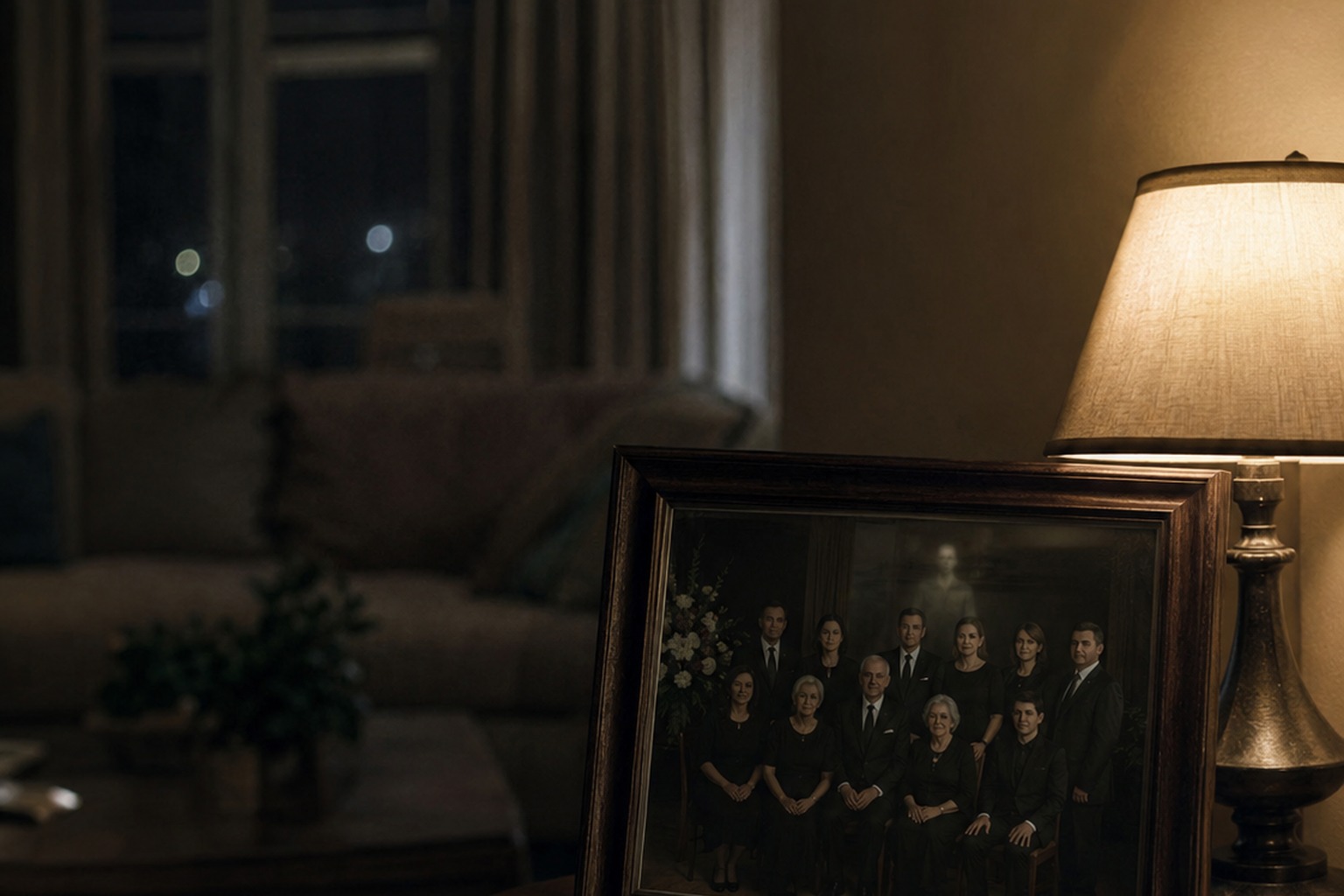
The woman in the back row had no face. Everyone else in the funeral photograph was easy to recognize. Dark coats, tired eyes, hands folded in front of bodies that seemed unsure what to do with themselves. The family had gathered outside the chapel after the service, and someone had taken a group picture before people began driving home.
But after midnight, when one relative looked through the photographs again, there seemed to be one more person standing behind them. She was tall enough that her head appeared above two men in the last row. Her clothes were pale rather than black. Her arms hung straight at her sides. Where her face should have been, the image softened into a gray blur.
The relative counted everyone. Then counted them again. There had been twelve people outside the chapel. The photograph appeared to contain thirteen. The disturbing part wasn't simply that nobody remembered the pale woman. It was where she stood: directly behind the empty space left for the dead woman's husband, who had stepped away moments before the picture was taken.
Funeral photographs have carried stories like this for generations. Sometimes the strange addition is a transparent person. Sometimes it is a face behind a shoulder, a hand resting where no hand should be, or someone who resembles the person whose funeral has just taken place.
So what are people really seeing when a funeral photo seems to contain someone who wasn't there? Why Funeral Photos Feel: Different: After: Midnight A photograph from an ordinary birthday party can contain a blur without becoming frightening. A photograph from a funeral is different before anyone even notices something strange.
Everyone looking at it already knows someone is missing. That absence changes how the picture is read. Viewers naturally scan faces, compare relatives, notice empty spaces and think about the person who should have been standing among them. When an unclear shape appears near the group, the mind has an unusually powerful reason to turn that shape into a person.
The First Time It Happened
Late-night viewing can make this stronger. At midnight, the house is quiet. The funeral is over. Visitors have gone home. Someone may be tired, grieving and staring at the photograph much longer than they normally would. Small visual details begin to stand out. A bright section of curtain resembles a dress. A branch seems like an arm. Two shadows form what looks like a face. A reflection in chapel glass creates a second head behind someone in the group.
Most of these discoveries have ordinary explanations. The frightening funeral-photo stories begin when the shape doesn't behave like random visual clutter. It has shoulders. It appears to be standing.
And it occupies exactly the kind of place where another mourner could have been. The Extra Person Is: Usually: What: People: Notice: First: The classic funeral-photo story isn't about a mysterious light floating in the corner. It is about a person who appears to have joined the group.
That matters because humans are extremely sensitive to human shapes. We can recognize something resembling a face from very little information. Three dark marks can become eyes and a mouth. A coat hanging in a doorway can become someone standing still. Group photographs make this even easier.
Heads overlap. Bodies are partly hidden. Someone in the second row may only show a forehead and one shoulder. A person farther back may be blurred because the focus landed on the front row. That means a completely normal photograph already contains incomplete human shapes.
Then there are people who really were present but weren't remembered later: a funeral-home worker, distant relative, neighbor, church volunteer or someone passing behind the group. This is why identifying every visible person is usually the first useful check. If twelve people remember twelve mourners but a thirteenth figure appears in the picture, the important question isn't immediately, "Who is the ghost?"
Why The Place Felt Wrong
It is simpler. Could a thirteenth living person have been there? Often, that question is enough to make the mystery disappear. Sometimes it isn't.
Why Faces Become Blurred, Blank, Or Wrong The faceless figure is especially common in frightening photographs because faces are where photographic problems become most noticeable. A person moving slightly can lose facial detail while their larger body remains recognizable. Low light makes the effect worse. A phone or camera may smooth noise, combine exposures or brighten darker areas. A pale face can become strangely flat while dark eye sockets remain visible.
Old photographs introduce different problems. Damage, fading, scratches, chemical marks and poor copying can remove tiny facial features without destroying the larger outline of a body. A person who originally looked ordinary may become far stranger after the picture has been copied several times. Compression creates another problem. Send the same image through messages and social media repeatedly and fine details can disappear.
But the appearance of a blank face carries an emotional weight that a blurry shoe doesn't. A human body with no readable face looks fundamentally wrong. That is why stories often concentrate on the same description: someone is standing there, but you cannot see who they are.
The normal explanation may simply be lost detail. The frightening interpretation comes from the fact that everything except the identity remains. Reflections Can Put Someone: Where: Nobody: Was: Standing: Funerals are often photographed around visually complicated places.
The Detail Nobody Could Explain
Church entrances have glass doors. Chapels have polished windows. Cars are parked nearby. Framed pictures may sit inside reception rooms. Mirrors, glossy stone and even dark windows can create reflections that aren't immediately recognized as reflections. Imagine six people standing outside a chapel. Someone else is several feet away, outside the photographer's view. Their reflection appears in a dark glass door behind the group.
In the finished photograph, that reflection may look like a pale person standing inside the chapel. Because the reflected person can be partly transparent, it becomes even easier to interpret them as something unnatural. This is one reason the location of the strange figure matters.
A shape inside glass should be compared with people and objects outside the frame. Reflections can appear at surprising angles, particularly when several panes of glass are involved. The same applies to a mysterious face beside someone's shoulder. It may not belong to anyone directly behind them. It could be a reflection from someone standing somewhere else entirely.
That explanation becomes especially convincing when the strange figure shares colors, posture or clothing with someone known to have been nearby. Yet reflections don't explain every reported image. If the figure appears in open space rather than reflective glass, another possibility has to be considered.
Double Exposures Created Some Of The Creepiest Old Images
Older funeral photographs can become much stranger because photography itself used to create mistakes that are uncommon today. One of the best-known possibilities is double exposure. When the same piece of film or photographic material receives two exposures, parts of separate scenes can overlap. A person from one exposure may appear faintly inside another.
The result can look remarkably ghostlike. A transparent face floats beside someone. A pale body seems to stand behind a chair. A second set of features appears over a dark wall. Long exposures could create similar effects when people moved. Someone who stood still for only part of the exposure might appear faint. If they walked away before the exposure finished, the background could remain visible through their body.
What They Checked Afterward
Nothing paranormal is required to produce an image that looks exactly like the popular idea of a ghost. There is also a historical reason for caution. Ghostly portrait effects were sometimes deliberately created. Photography was mysterious technology to many early customers, and spirit photography became popular enough that supposed dead relatives appearing beside living sitters became a recognizable style.
That history doesn't mean every strange old funeral photograph was intentionally altered. It means transparency alone is weak as a test. A faint human figure is one of the easiest ghostlike effects for photography to produce. The Detail That Makes A: Funeral: Photo: Harder: To: Dismiss: The more interesting stories usually contain something beyond "there is a blur." They contain a recognizable detail. Perhaps the extra figure appears to wear the same unusual coat the dead person frequently wore. Perhaps relatives recognize the shape of the person's hair.
Perhaps the figure is the right height and seems to be standing beside a spouse. These details make stories powerful, but they need to be handled carefully. Recognition is surprisingly flexible. If someone is told, "Doesn't that look like Grandma?" they may begin searching for Grandma's features. Once a resemblance has been noticed, it becomes difficult to see the shape as meaningless again.
Memory also changes. People may remember clothing from an older photograph and unintentionally connect it with the strange figure. Family stories become attached to images. After years of retelling, "someone thought it looked like him" can gradually become "everyone immediately knew it was him." A stronger mystery would need more specific information that existed before the strange shape was interpreted.
For example, an unusual piece of clothing clearly visible enough to compare with known photographs is more interesting than a general resemblance. Even then, resemblance isn't identification. It simply makes the picture harder to explain with a quick glance. Why Hands And Faces: Appear: Around: Shoulders
The Moment It Became Harder To Ignore
Another funeral-photo pattern is more unsettling because the supposed person isn't complete. There is only a hand. A pale hand seems to rest on someone's shoulder even though both of that person's hands are visible. Or a face appears between two mourners where there doesn't seem to be enough room for a body.
These images can look impossible until the geometry of a crowded group is reconstructed. People lean. Children stand between adults. Someone behind the group may extend an arm while the rest of their body is completely blocked.
Perspective also compresses distance. Two people who were several feet apart can appear almost shoulder-to-shoulder in a photograph. Faces are particularly easy to hide. A person standing behind a taller mourner might contribute nothing to the picture except half a face. This is why the edges of the supposed ghost matter.
Can the shape be followed downward? Does it connect naturally to a hidden body? Could another person's arm reach that position? When the answer is yes, the strange detail usually becomes less mysterious.
When the visible head or hand seems to pass through a solid object, emerges from empty wall space, or cannot connect to any possible body position, the ordinary reconstruction becomes more difficult. Not impossible. Just less immediate. When The Normal Explanations Start Getting Weaker
Why People Avoided That Spot Later
No single weird detail makes a funeral photograph unexplainable. The useful approach is to remove possibilities one by one. Was another person nearby? Is there glass?
Could the shape be a reflection? Was the picture taken on film? Could someone have moved during the exposure? Has the image been edited, scanned, enhanced or repeatedly copied?
Is the supposed face actually made from background objects? Modern photographs add another question: what processing happened automatically? Phones routinely combine information from multiple frames, brighten dark areas and make computational decisions about moving subjects. Panorama modes can duplicate or distort people. Portrait effects can produce strange boundaries around hair and clothing.
Once those possibilities are considered, many ghost-photo stories become much less mysterious. The unusual cases are the ones where the figure remains clearly human-shaped without fitting the physical scene. Imagine a pale woman visible from head to knees behind three mourners. There is no glass.
Everyone who was present can be identified elsewhere in the photograph. Her lower body fades before reaching the ground. Her head occupies open space, so she isn't simply another face peeking between shoulders. That still would not tell us what she was.
But it would leave fewer easy answers. Why People Keep Looking: At: These: Pictures: Years: Later: Funeral photographs have an emotional feature ordinary paranormal pictures rarely possess. The viewer already knows exactly who they hope—or fear—they might see.
Why The Story Still Gets Shared
That makes them powerful objects. A vague figure in an empty warehouse is just a vague figure. A vague figure behind a grieving family can become a father, sister, grandmother or friend. For some people, that possibility is comforting. For others, it is deeply unsettling.
And the strangest photographs sit directly between those reactions. A pale face may be a reflection. A transparent body may be an exposure problem. A hand may belong to someone hidden behind another mourner.
A figure discovered after midnight may seem much more frightening than it would have looked in daylight. But careful explanations don't remove the emotional force of the image. Someone can understand every common photographic mistake and still feel uneasy when counting the people in a funeral picture.
Especially when the count comes out wrong. The safest conclusion is also the least dramatic: strange funeral photographs should be examined as photographs first. Look at reflections, positioning, movement, image processing and who was actually present before deciding what a shape resembles. Most mysteries weaken under that kind of inspection.
The ones that don't remain what they were at the beginning: unsettling pictures with missing information. And sometimes the detail people remember isn't that the extra figure looked exactly like the person they had buried. It is that everyone else in the photograph was facing the camera.
The pale figure behind them appeared to be looking at the empty place where the dead person's closest relative should have been standing.