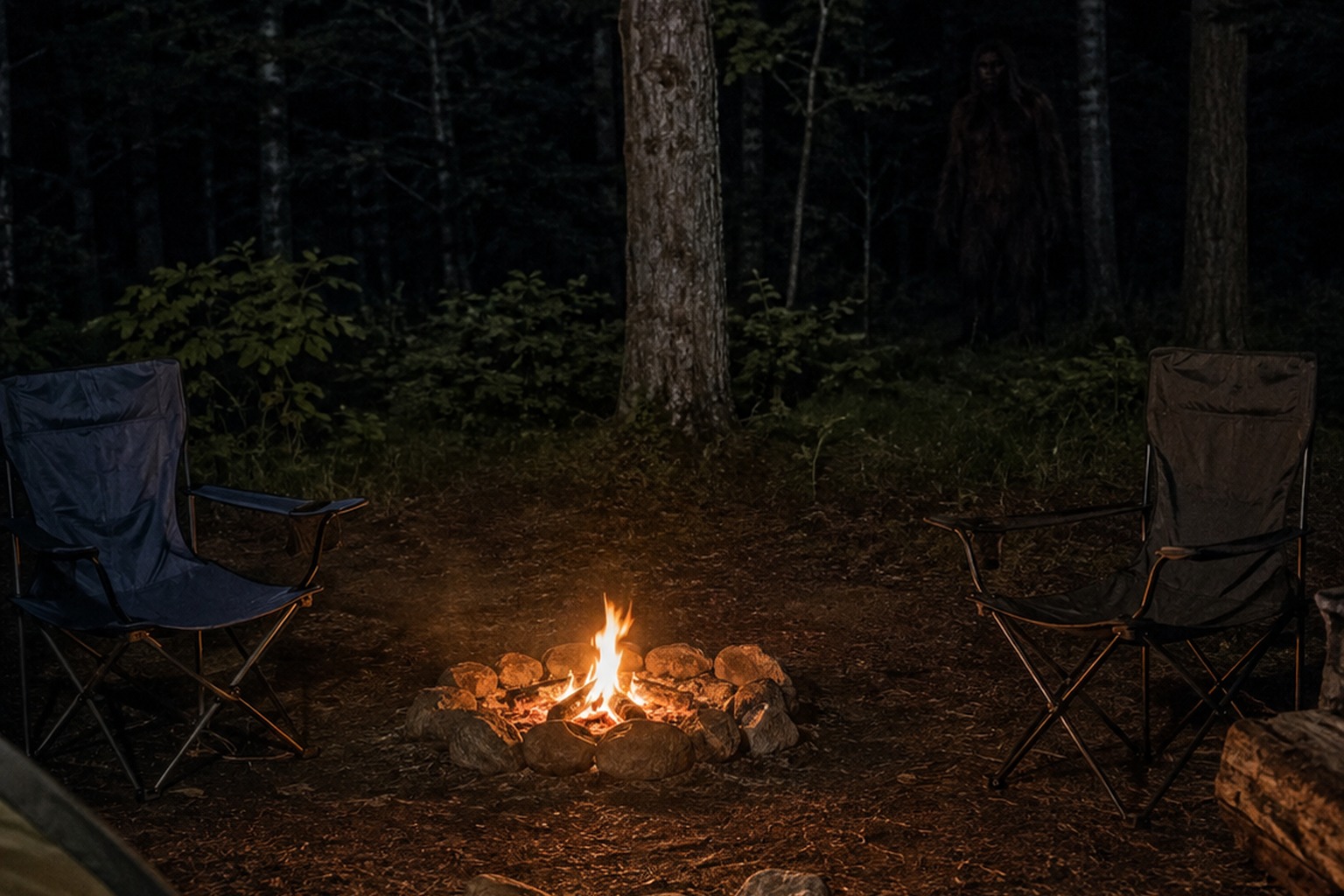
The first stone landed inside the fire. Not beside it. Not somewhere in the dark beyond the tents. A fist-sized rock came out of the trees, struck a burning log hard enough to scatter sparks, and dropped into the glowing coals. The three campers stopped talking.
They waited for laughter from another campsite. Nothing came. A second stone hit the dirt behind an empty folding chair. Then another struck the side of a cooler. Each seemed to come from the same patch of woods about thirty yards away, where the firelight faded between the trunks. One camper shouted that whoever was throwing them needed to stop.
The woods stayed quiet. Then a smaller stone sailed out and landed almost perfectly in the center of their circle. Nobody had heard footsteps. Nobody had seen a flashlight. More strangely, the stones seemed to arrive only when someone spoke loudly or stepped toward the treeline. When they finally aimed their lights into the trees, there was no person standing there.
Stories about stones being thrown from dark woods appear again and again in camping tales, Bigfoot reports, ghost stories, and ordinary encounters that never receive a satisfying explanation. So what actually throws stones near campfires? Why A Thrown Stone: Feels: Different: From A: Falling: Branch
A forest makes noises constantly. Acorns strike tents. Pinecones drop onto roofs. Branches snap. Animals disturb loose rocks. Wind shakes debris from trees. Once darkness removes the ability to see where a sound began, even ordinary forest activity can become difficult to identify. A stone flying sideways into a campsite feels different.
The First Time It Happened
People instinctively understand the basic movement involved in throwing something. When a rock arrives from the side, bounces across flat ground, strikes camping equipment, or repeatedly lands near people, it suggests direction and force. That immediately creates a disturbing thought: something chose where that rock went.
The fear becomes stronger around a campfire because the people sitting beside it are brightly visible while anything beyond the firelight remains hidden. From the darkness, a person could potentially watch every camper around the fire. The campers might see almost nothing beyond twenty or thirty yards.
That imbalance is one reason stone-throwing stories are so effective. The frightening part isn't simply that something moved in the woods. It is the possibility that whatever is hiding there can see the campers much better than the campers can see it. Why Campfires Create The: Perfect: Conditions: For: Confusion: Campfires damage night vision more than many people realize. Look directly at bright flames for several minutes and the surrounding woods become an almost solid wall of darkness. Someone standing between trees beyond the light can be surprisingly difficult to notice. Sound becomes equally confusing.
Trees, hillsides, water, tents, vehicles, and uneven ground can reflect or redirect noises. A rock striking something beside camp may sound as though it came from a completely different direction. This matters because frightened witnesses often try to reconstruct the throw backward. They hear an impact behind them and assume the object came from directly opposite that location. But a bouncing stone may have struck another object first. A rock rolling downhill can change direction. Something falling through branches can ricochet several times before reaching camp.
Why The Place Felt Wrong
There is also the simple problem of distance. At night, a tree that appears forty yards away might be seventy yards away. A person partly hidden beside it may disappear completely whenever a flashlight moves away. That means the first explanation worth considering is usually another person.
Nearby campers, teenagers, hunters, hikers, or someone deliberately trying to frighten people can throw rocks without immediately revealing themselves. But some reports contain details that make that explanation harder to maintain. The Pattern Gets Stranger: When: The: Stones: Seem: To: Answer: One detail appears often in the creepiest versions of these stories: timing.
Someone hears movement beyond camp. A camper shouts, "Who's there?" A rock arrives. Someone shouts again.
Another rock comes from approximately the same direction. That sequence feels less like random forest debris because the impacts appear connected to what the campers are doing. Sometimes the pattern becomes even more specific. People describe rocks landing when they approach the woods but stopping when everyone remains near the fire. Others report stones arriving shortly after someone throws one toward the treeline.
This "answering" behavior is especially common in stories associated with Bigfoot. Bigfoot folklore includes reports of rocks, sticks, wood knocks, whistles, and other noises apparently coming from concealed positions in forests. In these stories, the suspected creature frequently remains mostly or completely unseen. There is no reliable way to conclude that an unseen Bigfoot caused a thrown rock simply because a campsite is remote. Human pranksters and mistaken interpretations remain much simpler possibilities.
The Detail Nobody Could Explain
Still, responsive timing is useful when evaluating the story. One rock can fall. Several rocks repeatedly arriving immediately after people shout toward the woods requires a different explanation. Animals Can Move Rocks, But Throwing Is Another Question
Wild animals create far more strange nighttime sounds than campers usually realize. A deer moving through steep terrain can kick loose stones downhill. Raccoons climb and disturb debris. Bears turn over rocks while searching for food. Smaller animals can send surprisingly large objects rolling when they scramble across unstable slopes.
These events can sound intentional. Imagine a campsite beneath a rocky hillside. Something moves above the campers, loosening several stones. Each rolls downhill separately and crashes through leaves near the tents. Without seeing the slope clearly, someone might reasonably believe the rocks are being thrown.
Trees introduce another possibility. A stone trapped among roots or loose soil can fall after erosion or animal movement. Rocks can also strike branches during their descent, producing trajectories that seem impossible from the campsite. The useful question is therefore not simply, "Was there a rock?"
It is: how did the rock move? A rock rolling downhill is different from one crossing level ground through the air. A stone dropping vertically from branches is different from one striking the side of a tent. Multiple rocks coming from different elevations suggest something different from repeated objects following similar arcs from one location.
What They Checked Afterward
Trajectory matters more than atmosphere. What Campers Usually Check: In: The: Morning: Darkness makes almost everything harder to judge, so daylight can completely change the story. The first useful check is the terrain.
Is there a slope above camp? Loose gravel? A cliff? A road? Another campsite hidden behind vegetation? A trail passing through the trees? A supposedly impossible direction sometimes becomes obvious after sunrise. The stones themselves can also provide clues. If rocks landing around camp match loose material from a nearby slope, rolling or disturbed debris becomes more plausible. If the campsite sits on soil with almost no exposed stone but several similar rocks appeared overnight, the question becomes more interesting.
Campers can also look for ordinary signs that someone was nearby. Footprints, crushed vegetation, cigarette butts, food wrappers, bicycle tracks, vehicle tracks, or a hidden trail may explain what darkness concealed. Animals leave signs too. Tracks, droppings, claw marks, disturbed logs, and overturned stones can reveal nighttime visitors that nobody saw.
What should not happen is jumping immediately from "we couldn't identify it" to "something paranormal threw it." Not knowing who or what caused something is exactly that: not knowing. When The Prankster Explanation Starts Feeling Weak A hidden person is capable of explaining almost every basic feature of a rock-throwing story.
The Moment It Became Harder To Ignore
Humans can hide. Humans can throw accurately. Humans can wait silently. Humans can deliberately respond when campers shout.
That explanation becomes less comfortable when the location makes unnoticed human activity difficult. Consider a remote campsite reached after hours of hiking. Rocks begin arriving from dense woods far from any marked trail. Several people immediately shine lights into the area. Nobody hears anyone retreating through dry leaves or breaking brush.
That still doesn't make a paranormal explanation necessary. A person might know the terrain. Sound might carry poorly. The thrower could remain still rather than running away. But repeated throws create another practical problem: ammunition and position. Someone throwing ten or fifteen stones needs access to stones. They also need enough movement to pick them up and throw them without repeatedly exposing themselves.
The strangest reports describe objects coming from more than one direction without obvious movement between those locations. Again, that is not proof of an unknown creature. It simply removes some of the easiest explanations. Why Bigfoot Stories So: Often: Include: Rock: Throwing: Rock throwing fits unusually well into the traditional image of Bigfoot as a large, intelligent animal that avoids direct contact with people. If such a creature existed, throwing objects would offer an obvious advantage: it could drive something away without approaching it. That is why witnesses sometimes interpret stones landing near campsites as warnings rather than attacks.
Why People Avoided That Spot Later
The reported pattern is often surprisingly restrained. The stones supposedly land beside tents rather than tearing through them. They strike trees near people. They land around campfires. The activity stops when campers leave. In the story logic, the message seems to be: go away. There is a problem with interpreting behavior from something that was never clearly seen, however.
Once someone already suspects Bigfoot, almost any unexplained forest disturbance can fit that idea. A rock becomes a warning. A snapped branch becomes intimidation. A distant knock becomes communication. The interpretation can grow faster than the facts. A much stronger report would combine stone throwing with an independent observation: for example, several people clearly seeing a huge upright hairy figure at the location where the rocks originated.
Without that additional detail, the responsible answer remains broader. Something moved the rocks. The identity of that something may remain unknown. The Most Unsettling Detail: Is: Often: What: Happens: After: Silence: Stone-throwing stories frequently become memorable because of what happens when the activity stops.
Campers expect the source to reveal itself. Instead, everything goes quiet. No footsteps retreat through the woods. No prankster laughs. No animal crashes away through the brush. The forest simply returns to normal.
That silence leaves people mentally stuck at the campfire, staring toward the last place a rock appeared. There is also a basic survival instinct involved. Humans are extremely sensitive to objects entering our personal space. A distant howl can be frightening, but it remains distant. A stone landing beside your boot means something from the darkness has physically reached your position.
Why The Story Still Gets Shared
It has crossed the boundary between "something out there" and "something interacting with us." That is why even a completely ordinary explanation discovered later does not necessarily erase the fear. For a few minutes, the campers experienced something very simple and very old: they were visible beside the fire, and something outside the light appeared to know exactly where they were.
So What Is Usually Throwing The
Stones? There is no single answer. Some cases are probably people playing pranks or deliberately trying to frighten campers. Others may involve animals disturbing loose rocks, natural falls from slopes, objects dropping from trees, or sounds being misinterpreted in darkness.
Occasionally, the available details do not neatly identify a source. Those are the stories that survive. The strongest mystery is not simply "a rock appeared near camp." It is repeated, directional behavior: several stones crossing level ground, arriving from the same hidden location, changing when campers react, or landing with accuracy that looks difficult to explain as falling debris.
Even then, strange does not automatically mean paranormal. If stones begin arriving at a real campsite, the safest response is not to march into dark woods looking for whoever—or whatever—is responsible. Stay together, use lights from a secure position, move camp if necessary, and inspect the area in daylight.
Maybe the morning reveals a trail, loose hillside, neighboring campsite, or animal tracks. Maybe it reveals nothing useful. And that second possibility is why these stories remain so effective. Long after the tents are packed away, witnesses often remember the same moment: the fire burning brightly, the trees completely black beyond it, and another stone suddenly sailing out of a place where nobody could see anyone standing.