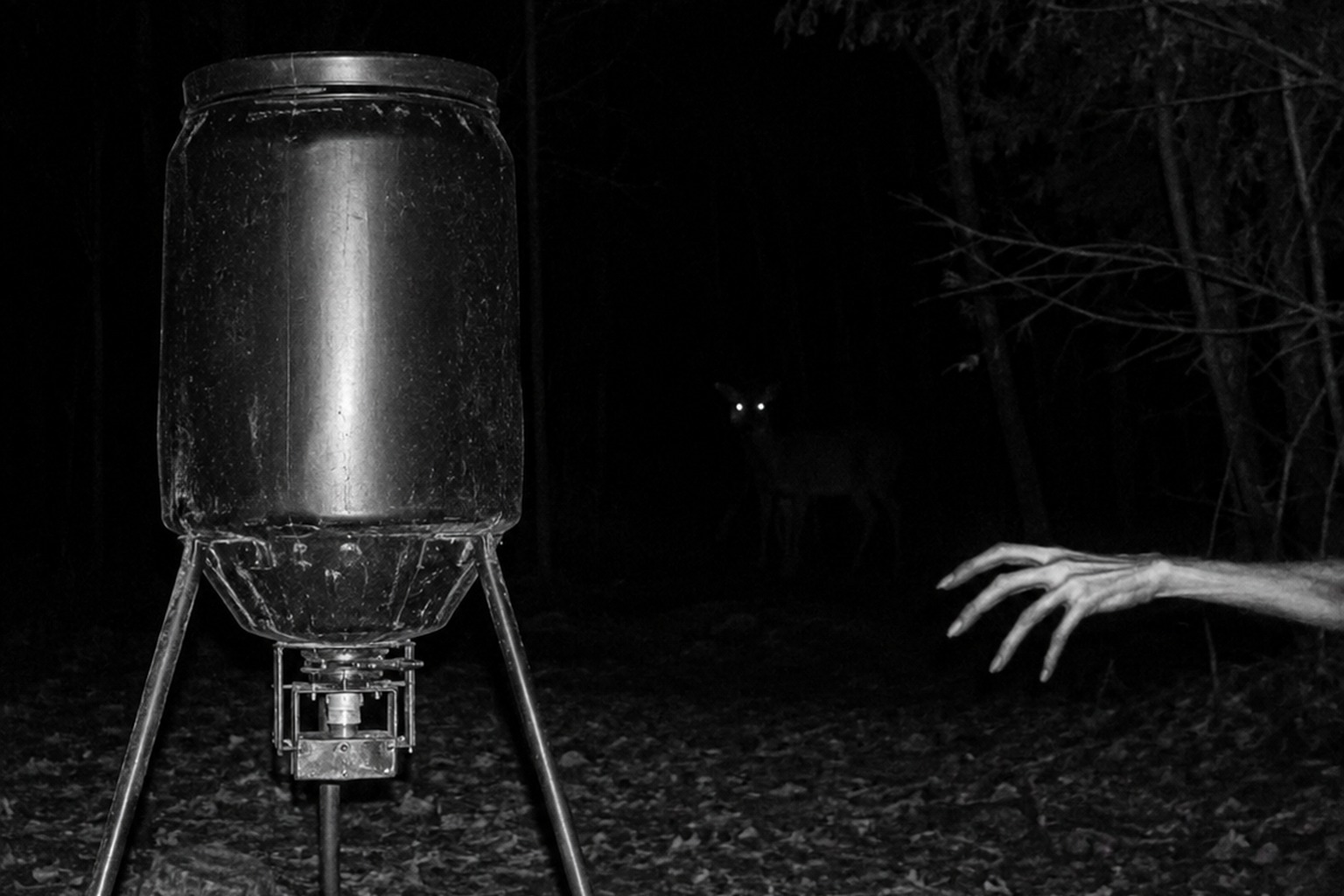
The fingers were already wrapped around the feeder before anything else entered the frame. A deer feeder stood at the edge of a small clearing, its metal legs surrounded by churned dirt, spilled corn, and the usual nighttime visitors. Earlier images showed raccoons climbing underneath it. A doe passed shortly after midnight. Then came a picture in which the clearing appeared empty except for something reaching from behind a tree.
It looked disturbingly like a hand. The skin was pale enough to stand out against the dark bark. Four narrow fingers curled around the trunk, apparently much longer than normal human fingers. No sleeve was visible. No face appeared beside them. Stranger still, the hand seemed to be reaching toward the feeder from a height that would have placed its owner’s shoulder well above the top of an ordinary person’s head.
In the next image, the tree was empty. That kind of picture sits in an uncomfortable category of nighttime animal-camera stories: pale hands, long fingers, thin arms, or human-looking limbs appearing near feeders, bait piles, mineral blocks, and game trails. Most have ordinary possibilities. Night photography is extremely good at making ordinary animals look anatomically impossible.
But the reason these pictures spread is simple. Sometimes the thing beside the feeder looks less like an animal than a person who has learned to reach without stepping into view. Why Feeders Produce So: Many: Strange: Night: Images: Animal feeders create almost perfect conditions for unsettling photographs.
They attract wildlife into one small area. Deer, raccoons, opossums, bears, squirrels, birds, coyotes, and other animals repeatedly approach from the same paths. They climb, stretch, stand upright, reach around objects, and fight over food. Then all of that movement is photographed in darkness. A normal animal can look radically different when only one part of its body is visible. A raccoon reaching around a feeder leg may show five finger-like digits while the rest of its body disappears behind the equipment. An opossum climbing downward can produce a pale foot that looks remarkably hand-like.
The First Time It Happened
Even deer can create strange shapes. A pale section of leg photographed at an awkward angle can appear surprisingly similar to a forearm. The feeder itself makes the illusion stronger because people immediately understand its scale. We know roughly how large a feed barrel, tree trunk, fence post, or deer should be.
So when something apparently human-shaped reaches beside one, our brains start estimating its size. And sometimes that estimate is what makes the picture frightening. A hand that seems slightly too large is creepy. A hand that seems to belong to something seven feet tall is harder to dismiss emotionally, even when perspective may still explain it.
The Fingers Are Usually What People Notice First
Faces are easy to misread in darkness. Two bright spots can become eyes. Branches can suggest mouths. Leaves can resemble hair. Hands are different. Human hands have a pattern we recognize almost instantly: palm, thumb, separate fingers, joints, and fingertips.
That is why pictures involving long pale fingers can feel more disturbing than blurry faces. The viewer is not merely seeing a vague shape. They think they recognize anatomy. The trouble is that many animals also have surprisingly hand-like feet. Raccoons are the obvious example. Their front paws have five long digits designed for manipulating objects. Under infrared illumination, wet fur or exposed skin around the digits can appear unusually bright.
Opossums are stranger still. Their feet are adapted for climbing, and the hind foot includes an opposable toe. When only the foot and part of a leg are visible, the result can look startlingly human. There is also motion blur. If an animal moves its paw while an image is being captured, the fingers can stretch into pale streaks. A perfectly ordinary three-inch digit may appear twice as long.
Why The Place Felt Wrong
That produces one of the classic features of these pictures: fingers that look impossibly thin and elongated. The animal never had fingers that long. The photograph effectively built them. Infrared Light Can Turn: Fur: Into: Pale: Skin: Night images also distort color. Many animal cameras use infrared illumination because visible flash can disturb wildlife. The resulting image does not reproduce colors the way human eyes see them during daylight. Dark fur may become gray. Light fur can become almost white. Reflective surfaces can flare dramatically.
That matters when only a limb is visible. Imagine a raccoon mostly hidden behind a tree. Its body blends into the darkness, but one extended paw receives strong infrared light. The paw becomes bright while the animal attached to it nearly disappears. Now remove the context.
Instead of seeing “raccoon climbing tree,” the viewer sees a pale hand apparently emerging from darkness. Overexposure can erase additional details. Fur texture disappears. The edge between individual toes becomes sharper. A leg may look smooth rather than hairy. Nearby objects can be distorted too.
A branch crossing in front of an animal can seem like an extra finger. Two overlapping paws can merge into one oversized hand. A bright leaf behind the limb can become part of the apparent palm. The stranger the photograph looks, the more important it becomes to ask what information the darkness removed.
Why A Hand Around A Tree Looks Worse
One particular version of the image tends to unsettle people more than an isolated pale shape: fingers curling around something. A pale blur near a feeder could be almost anything. Four or five fingers visibly wrapping around a tree trunk suggest deliberate gripping.
The Detail Nobody Could Explain
That instantly creates a story in the viewer’s mind. Something is hiding behind the tree. That impression can happen naturally because climbing animals do exactly this. A raccoon ascending the far side of a trunk may place one paw around its edge. The animal's head and body remain hidden while the digits are visible.
Perspective can then enlarge the paw. If the tree is closer to the lens than expected, or the limb extends toward the camera, the apparent proportions become unreliable. Wide-angle lenses make this particularly noticeable near the edges of an image. But there is another reason the tree version feels wrong.
A tree gives the unseen body somewhere to be. The viewer automatically imagines whatever is attached to those fingers standing just out of sight. And the imagined creature is usually much worse than the visible hand. What People Usually Check: Before: Calling: It: Strange: The best way to examine one of these pictures is not to begin with the hand. Start with everything around it. Look at images immediately before and after the strange one. If a raccoon appears thirty seconds earlier, the mystery becomes much smaller. If deer suddenly scatter, that is interesting, but it still does not identify what frightened them.
Check the feeder dimensions. A known barrel diameter or feeder-leg height can provide a rough scale, although perspective must still be considered. Objects at different distances cannot be compared directly as if they were standing on the same line. Then inspect where the supposed wrist ends.
What They Checked Afterward
Does it disappear naturally behind a tree? Does it merge into another shape? Is there fur farther up the limb? Could the “palm” actually be an animal’s face, belly, or overlapping feet?
Weather matters too. Spiderwebs, rain droplets, fog, insects, and vegetation close to the lens can become huge glowing forms under infrared light. An insect leg inches from the camera can look larger than a deer standing twenty feet away. That is why scale alone cannot settle the question.
The most convincing-looking strange images are often created by two ordinary things occupying very different distances from the lens. The Harder Pictures Show: More: Than A: Floating: Hand A single pale shape is weak information. The more complete the anatomy becomes, however, the harder the normal explanations have to work.
Suppose the image clearly shows five separate digits attached to a palm, the palm connects to a narrow wrist, and the wrist continues into a long forearm. Suppose the limb passes behind a tree in a way that establishes roughly where it is standing. Now there is more to explain.
An animal identification should account for the whole structure rather than only one convenient piece of it. The same applies when several images show movement. One picture might make an opossum foot resemble a human hand. If the next picture shows the same limb extending from an unmistakable opossum, the puzzle is solved.
The Moment It Became Harder To Ignore
But if several frames instead appear to show a long pale arm withdrawing behind a tree while never revealing an ordinary animal body, the image remains visually unsettling. That still does not tell us what was there. It only means the easiest explanation has not yet become visible.
This distinction matters with paranormal stories. “I cannot identify this” and “this is a strange creature” are not the same statement. The first can be reasonable. The second requires far more information. Why Feeders Fit Creature: Stories: So: Well: There is also a storytelling reason these images gather around feeders. A feeder represents food placed intentionally for animals. When something apparently human approaches it at night, the scene crosses two familiar categories. It is behaving like wildlife, but part of it looks like us.
That contradiction appears repeatedly in creature folklore. Stories describe thin figures crouching near fields, pale shapes watching livestock, unusually tall beings standing beside treelines, or something with human-looking hands moving on the wrong kind of body. The details vary enormously, and there is no reason to assume all such stories describe the same thing.
But the long hand is especially effective because hands imply intelligence. A hoof beside spilled corn suggests an animal feeding. A paw suggests the same. Fingers curling around the feeder leg suggest something capable of grasping it.
That small difference changes the entire emotional meaning of the scene. There is another uncomfortable feature: feeders are usually placed away from houses. The person checking the images knows exactly where the clearing is. They may have walked there alone dozens of times. They know the tree beside the feeder. They know the narrow trail disappearing behind it.
Why People Avoided That Spot Later
A strange shape in an unknown forest is abstract. A pale hand beside the tree you plan to visit tomorrow morning is personal. When The Normal Explanation Gets Weaker Most strange animal-camera pictures should remain strange pictures, not become creature identifications.
There simply is not enough information. Still, some details are worth examining carefully. Repeated appearances from different angles are more useful than one isolated image. Clear anatomical continuity matters more than a bright blur. Known distances are better than guessed scale. Behavior can matter too.
If the shape consistently appears at ground level where raccoons climb, an ordinary animal becomes more likely. If a clearly connected arm appears at a height difficult to reconcile with the animals known to visit the feeder, the picture becomes more interesting—but height estimates from a single camera angle can still be deceptive.
Tracks would help, but even those require caution. Deer tracks overlap. Raccoon prints can distort in mud. Rain destroys edges. Several animals walking over the same patch can create shapes that look unlike any individual footprint. The strongest normal explanation is one that explains everything visible without ignoring inconvenient details.
The same standard should apply to stranger interpretations. Calling something a pale crawler, ghost, unknown primate, or other creature does not explain the image merely because the label sounds compatible with it. The question remains the same: What physical shape is actually visible, and what ordinary process could have produced it?
Why The Story Still Gets Shared
Sometimes the answer becomes obvious. Sometimes the photograph simply refuses to give enough information. The Creepiest Detail Is: What: Never: Enters: View: That first imagined feeder scene is frightening because almost nothing happens.
There is no creature charging toward the lens. No face fills the picture. No enormous monster stands conveniently beneath the feeder. There are only fingers around a tree.
That restraint is exactly what makes these images memorable. The photograph provides enough information for the brain to construct a body but not enough to check whether that body is really there. Usually, the missing body is where the ordinary explanation lives: a climbing raccoon, an opossum, overlapping limbs, vegetation, motion blur, infrared glare, or an object much closer to the lens than it appears.
Those possibilities should come first. But occasionally a picture remains difficult because the visible shape is unusually coherent. There seems to be a palm. Fingers bend around something. A wrist continues into an arm. The proportions look wrong. Without clearer views, tracks, multiple angles, or another identifiable feature, it is safest to leave such an image unresolved.
And perhaps that is why the long-white-hand pictures linger. A blurry monster asks whether you believe in monsters. Five pale fingers curling around a familiar tree ask a much simpler question: What was standing on the other side?