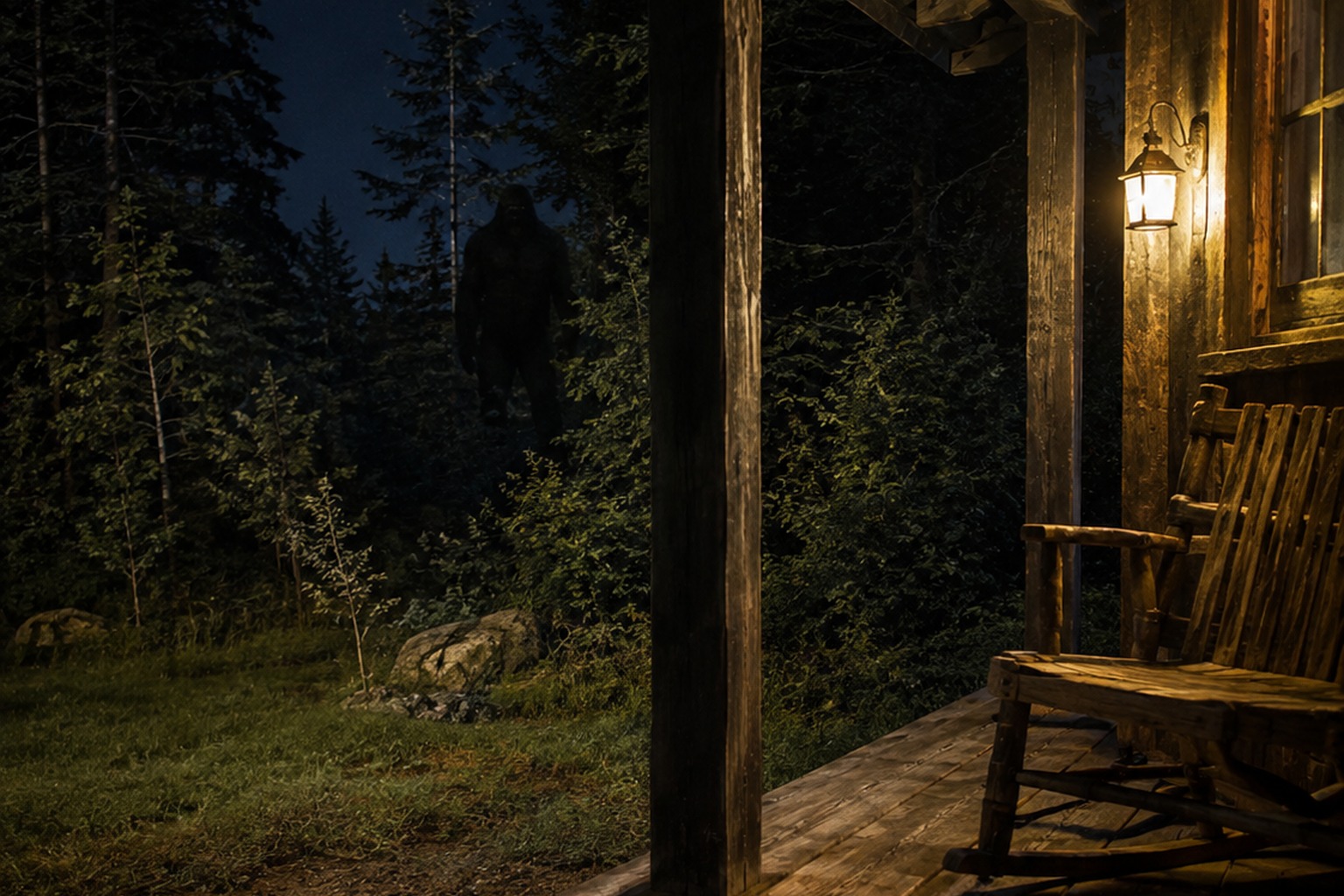
The crickets stopped so suddenly that the refrigerator inside the cabin sounded loud. A few seconds earlier, the clearing had been full of ordinary summer noise. Insects buzzed beside the porch light. Frogs called from somewhere beyond the trees. Something small kept scratching through dry leaves near the woodpile. Then all of it seemed to shut off at once.
The man standing on the porch noticed another detail. His dog had been wandering between the steps and the fire ring all evening. Now it was pressed against the cabin door, staring toward the trees with its ears forward. Nothing moved between the trunks. Then a call came from farther up the slope.
It began low, climbed into a long wavering howl, and ended with a rough note that sounded disturbingly close to a human voice pushed far beyond a human throat. The man later described it as louder than he expected anything in those woods to be.
Afterward, the insects slowly returned. That sequence appears again and again in Sasquatch stories: a noisy forest, an abrupt hush, an uneasy animal, and then a strange call from somewhere beyond the light. Why would a cabin or campsite seem to go quiet before a supposed Sasquatch vocalization?
The answer may involve ordinary animal behavior, the way humans notice sound under stress, and the unusual acoustics of forests at night. But the timing is exactly what makes these stories so difficult to forget. The Silence Is Often: Scarier: Than the Call A strange howl in the woods is frightening, but people already expect animals to make strange sounds outdoors.
Sudden silence feels different. Our brains quickly learn the normal background sound of a place. At a cabin, that might include crickets, frogs, wind through leaves, birds settling down, distant coyotes, or small animals moving through brush. Most of the time, people barely notice these sounds individually. They become part of the background.
The First Time It Happened
When that background disappears, the change can grab attention immediately. It is similar to sleeping beside a running fan and suddenly waking when the fan stops. Silence is not necessarily louder than noise, but the change itself demands attention. That helps explain why so many frightening wilderness stories begin with some version of, “Everything suddenly went quiet.”
The silence tells the listener that something has changed before they know what changed. In Sasquatch stories, the effect becomes especially powerful when the quiet is followed by something apparently large making a sound just beyond the visible clearing. The listener naturally connects the two events.
The woods became silent because something entered them. That conclusion may not always be correct, but emotionally it is extremely convincing. Why Animals Really Can: Become: Quiet at Once There are completely ordinary reasons for patches of forest to become unexpectedly quiet.
Many animals change their behavior when they detect danger. Birds may stop calling when a predator approaches. Small mammals can freeze instead of rustling through leaves. Some insects change their activity with temperature, wind, approaching rain, or disturbances nearby. A deer moving through brush might interrupt smaller animals. An owl can change the behavior of birds and rodents. A fox, coyote, bear, bobcat, or human walking through an area may temporarily alter the sound around it.
Even the person listening can be part of the disturbance. Someone stepping outside a cabin, opening a door, turning on a flashlight, talking, or walking across a porch can cause nearby animals to pause. The important point is that a quiet forest does not require a mysterious creature.
Why The Place Felt Wrong
But it also explains why the detail fits Sasquatch stories so well. If a genuinely large animal were moving quietly through a wooded area, nearby wildlife might react to it before a person could see it. That is why witnesses sometimes describe the silence almost like an early warning.
They did not see anything approaching. They noticed the forest reacting first. Why the Call Can Sound Much Closer Than It Is Nighttime forest acoustics can be surprisingly confusing.
Trees, hills, valleys, water, humidity, and temperature layers can all affect how sound travels. A noise originating hundreds of yards away may seem much closer, while another nearby sound can appear strangely distant. Direction can also be difficult to judge. A person standing beside a cabin has walls, a roof, trees, and uneven ground reflecting sound around them. A call from one side of a valley may seem to come from the trees immediately behind the building.
That becomes important with animals capable of loud vocalizations. Coyotes can produce an astonishing range of yips, screams, barks, and howls. Foxes can make cries that sound disturbingly human. Owls produce hoots, shrieks, whistles, and calls that many people do not recognize. Cougars are famous for screams that can resemble a woman yelling somewhere in the darkness.
Even deer can make grunts, bleats, wheezes, and other sounds that seem completely wrong if the listener expects a gentle woodland animal. A person who hears one of these calls without seeing the animal has to identify it using sound alone. At night, that can be extremely difficult.
And once the woods have already become strangely quiet, the listener is primed to interpret the next unfamiliar sound as the reason for the silence. The Calls That Keep: Sasquatch: Stories: Alive: Not every reported Sasquatch call sounds like a simple howl. That is partly why the subject remains so popular.
The Detail Nobody Could Explain
People have described long screams, deep whoops, short barking noises, whistles, repeated “woo” sounds, and strange vocalizations that seem to move between animal-like and almost human. The “almost” matters. A normal wolf howl can be frightening, but once recognized, it becomes understandable. A human shout from another cabin can also be explained.
The most unsettling reports seem to sit between those categories. Imagine hearing something from a dark ridge that begins like a person yelling “hey,” but stretches into a booming howl lasting far longer than expected. Or hearing three short whoops from the trees, followed several seconds later by another series farther away.
The listener starts testing possibilities. Was somebody messing around? Was it a coyote? Was it an owl?
Could another campsite be nearby? Those questions become more urgent when the apparent voice sounds powerful enough to suggest a very large chest and lungs. That does not establish what produced it. Sound alone is notoriously difficult to identify. But it explains why unusual calls remain one of the strongest ingredients in Sasquatch folklore.
You can mistake what you see for a second. A strange voice in total darkness can stay with you for years. Dogs Often Become Part of the Story Another recurring detail in cabin and camping stories is the behavior of dogs.
What They Checked Afterward
A dog that had been happily exploring suddenly refuses to leave the porch. Another growls toward the treeline. Another tries to get inside. Sometimes the dog simply freezes and listens before the humans notice anything unusual.
This behavior can feel significant because dogs hear and smell things people cannot. There are plenty of ordinary explanations. The dog may detect a deer, raccoon, bear, coyote, or another dog. It might hear movement too faint for its owner to notice. A nervous dog can also make its owner nervous.
If your dog suddenly raises its hackles and stares into a black patch of forest, that patch of forest immediately becomes more threatening. The interesting Sasquatch stories are the ones where several details arrive together. The insects seem to fade. The dog focuses on one section of trees.
Heavy movement follows somewhere beyond the clearing. Then the call begins. Each detail alone has ordinary possibilities. Combined in the right sequence, they create the feeling that something large is circling outside the visible area. That sequence is what witnesses tend to remember.
What People Usually Check After Hearing One
Once the initial fear passes, most people start looking for normal sources. The first question is often whether another person could have made the sound. Cabins are frequently surrounded by trails, hunting land, neighboring properties, logging roads, campgrounds, and recreation areas. Sound can travel much farther than expected at night.
The next possibility is wildlife. People may compare the call with coyotes, foxes, owls, elk, deer, bears, cougars, and other animals found in the region. Distance matters too. A sound that seemed to come from fifty yards behind the cabin might actually have originated across a valley.
The Moment It Became Harder To Ignore
Weather can explain changes in background noise as well. Wind may temporarily drop. Insects can respond quickly to temperature changes. A passing cloud or approaching storm can alter conditions around a clearing. Even attention changes what people hear. After an alarming noise, someone may become so focused on the direction of the call that ordinary background sounds seem to disappear.
This creates an important complication: sometimes the forest may not have become completely silent. The person may simply have stopped noticing everything except the strange sound. Memory can strengthen that impression afterward. The remembered sequence becomes clean and dramatic: everything stopped, then the scream came.
Real nights are usually messier. When the Easy Explanations Start Feeling Weaker Some stories become harder to dismiss because the sound is only one part of what happened. Suppose two people hear the same call from the same hillside.
Their dog reacts before either person says anything. Then something heavy moves parallel to the cabin through dense brush. A few minutes later, another call comes from farther along the slope. Now identifying a single fox scream does not necessarily explain the whole experience.
There can still be ordinary answers. A bear can move through brush with impressive force. Deer can produce surprisingly heavy footsteps. Multiple coyotes can create the illusion of something moving and calling from different positions. Humans are also very good at combining separate events into one story.
A deer may cause the movement. An owl may produce one sound. Coyotes may produce another. Once people are frightened, all three can feel like one creature circling the cabin.
Why People Avoided That Spot Later
Still, witnesses understandably become more unsettled when the pieces appear synchronized. The most memorable Sasquatch stories often contain that synchronization: silence, movement, animal reaction, vocalization. Nothing individually settles the question. The timing is what makes the experience feel intentional.
Why Cabins Make the Pattern Feel Worse A cabin creates a strange psychological boundary. Inside is light, furniture, walls, familiar objects, and controlled space. Outside may be almost completely black.
That contrast makes every sound beyond the windows feel closer. A person standing beside a campfire can turn around and inspect the trees. Someone inside a cabin may hear something directly behind a wall yet see nothing through the dark glass. The building can also amplify certain noises while blocking others.
Footsteps on leaves may vanish behind one wall and suddenly become audible near another. A howl can echo from a hillside and seem to surround the structure. Porch lights make visibility even stranger. They illuminate the nearest trees while making the darkness behind them appear deeper. A large animal could stand beyond that bright edge without being easy to identify.
This is where Sasquatch stories sometimes add the visual detail people remember most. A tall, broad, hair-covered figure appears briefly between two trunks. It seems far larger than a person when compared with the porch railing or nearby tree. Then it steps sideways and disappears into the woods.
Why The Story Still Gets Shared
Such sightings remain claims rather than settled identifications, and darkness is terrible for judging size and distance. But paired with a strange call and sudden silence, even a brief shape can turn an odd night into a lifelong story. The Quiet May Be the Detail People Remember Best
There is no single reason forests become quiet before reported Sasquatch calls. Sometimes the silence may be ordinary wildlife reacting to a predator. Sometimes changing weather or insect activity may be responsible. Sometimes the forest may only seem quieter because a frightened listener has focused completely on one unexpected noise.
And sometimes several unrelated nighttime sounds may become connected in memory. Yet the pattern remains effective because it follows one of our oldest danger signals. First, the normal world changes. Then something happens.
That is why the silence matters so much. A strange howl by itself is a mystery to identify. A strange howl immediately after the insects stop and the dog backs toward the cabin feels like an arrival. There is still a wide gap between that feeling and knowing what was actually outside.
For anyone trying to understand such a report, the useful questions are simple: What animals live nearby? What was the weather doing? How far can sound travel across that terrain? Did multiple people hear the same thing independently? Was anything actually seen? Those questions often make a frightening night less mysterious.
But they also explain why a small number of stories remain difficult for the people who experienced them to put away. Because sometimes what they remember first is not the howl. It is the moment before it, when a forest that had been noisy all night suddenly seemed to be listening too.