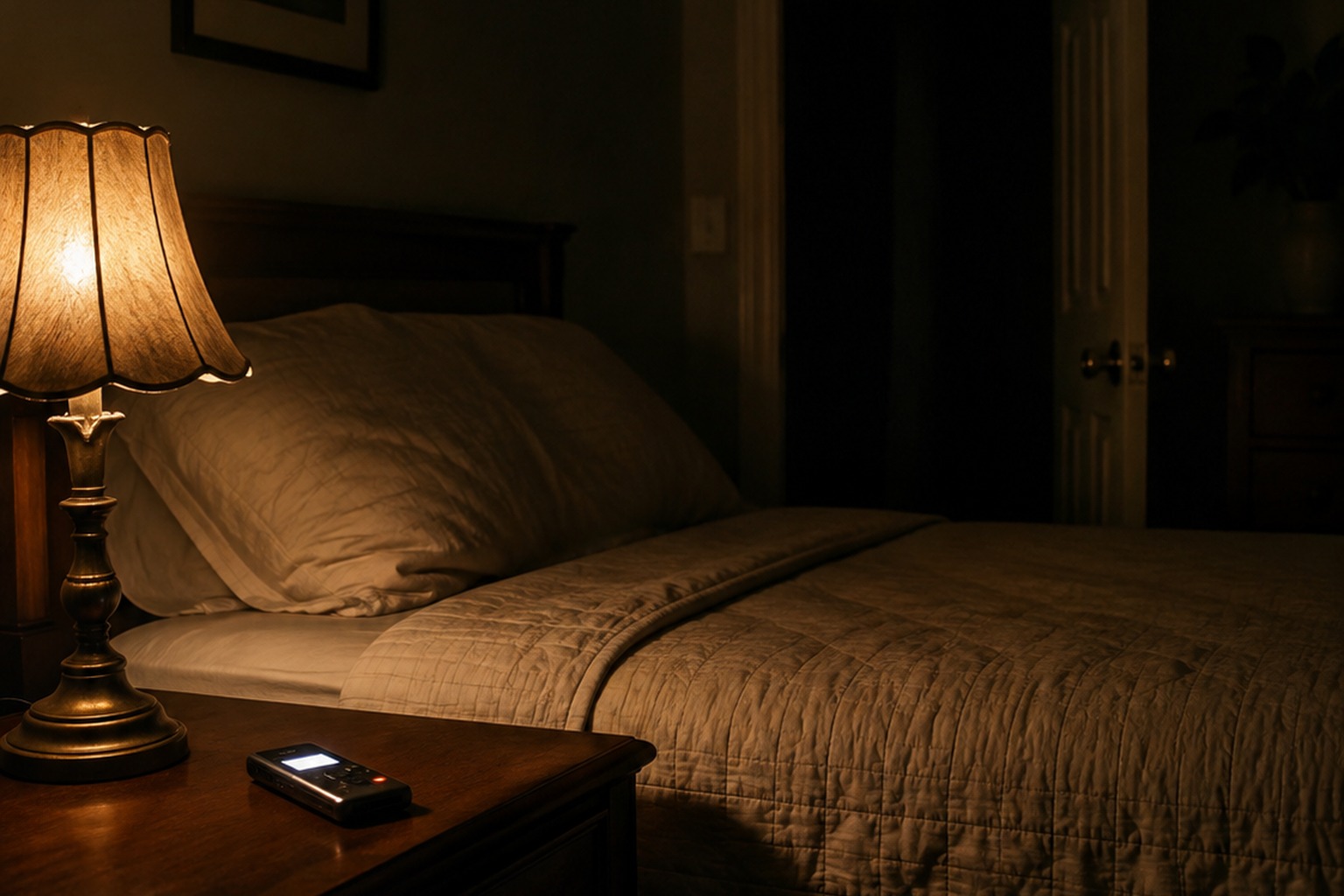
The lamp flickered three times just before the voice said her name. She had been awake already, staring across an unfamiliar guest room at the thin strip of hallway light beneath the door. The house was quiet. Her hosts had gone upstairs nearly an hour earlier. Rain tapped softly against the window, and the bedside lamp was the only light she had left on.
Then its warm glow dropped almost to black. It returned, dimmed again, and flashed once more. She reached toward the switch, assuming the bulb was loose. Before her hand touched it, a woman's voice came from the dark corner beside the wardrobe. Her name. Quietly. Clearly.
Not shouted from another room. Not whispered through the wall. It sounded close enough that someone should have been standing beside the bed. She switched on the ceiling light. The corner was empty. The wardrobe doors were closed. There was nowhere for a person to be hiding. When she checked the hallway, nobody was there either.
Stories that combine flickering lights with voices appear again and again in haunted-house folklore, hotel stories, family memories, and ordinary nighttime experiences. The electrical part often has an easy explanation. The voice sometimes does too. What makes the combination frightening is the timing: the light changes first, almost like a warning, and then someone seems to speak from a room that should be empty.
Why the Flicker Feels Like a Warning A lamp flickering by itself is usually annoying rather than terrifying. Bulbs fail. Plugs loosen. Old switches wear out. LED bulbs can behave strangely with certain dimmers. Houses experience small voltage changes when appliances switch on. But our reaction changes when another unusual event immediately follows the flicker.
The First Time It Happened
If a lamp dims and then the refrigerator starts, most people connect the two mechanically. If it dims and a voice says their name from an empty corner, the first event suddenly feels connected to the second. That sequence matters. The flicker becomes a kind of countdown.
This is one reason these stories are often remembered in a very specific order: light, darkness, voice. Witnesses may forget what time they went to bed or what they were wearing, but they remember that the lamp changed first. The few seconds between those events also create anticipation. The room looks wrong before anything clearly frightening has happened.
For someone alone in a guest room, that can be especially effective. They are already sleeping in a space where every sound, reflection, and electrical quirk is less familiar than it would be at home. Then the room appears to react. Why Guest Rooms Make: Small: Things: Feel: Wrong: Guest rooms are unusually good settings for this kind of experience because visitors do not know what the room normally does at night. A radiator clicking in your own bedroom may barely register after a few months. In somebody else's house, the same click can sound like a footstep beside the wall.
The electrical system is unfamiliar too. A bedside lamp might have a loose socket. An extension cord may be hidden behind the nightstand. A wall switch might control an outlet in a way the visitor does not expect. Heating systems, pipes, refrigerators, pumps, and outdoor lights can create sounds or changes at unfamiliar times.
Even the darkness is different. A coat hanging from a wardrobe can resemble shoulders. Streetlights can throw moving branches across a wall. A mirror may reflect a doorway that cannot be seen directly from the bed. None of this means people simply imagine everything that frightens them.
Why The Place Felt Wrong
It means the brain has fewer familiar reference points. That becomes important when a second event happens immediately after the first. A person who sees the lamp flicker and then hears what sounds unmistakably like a human voice is not merely reacting to darkness. They are trying to understand two events that appeared to occur together.
And humans are extremely sensitive to voices. Why Hearing Your Name: Is: Hard to Ignore There are few sounds more capable of instantly grabbing attention than your own name. Even in a noisy room, people often notice it. At night, when someone is half asleep and listening to an unfamiliar house, the effect can be much stronger.
Sometimes the source is ordinary. A television in another room can produce a fragment of dialogue that resembles a name. Pipes, air vents, fans, rain, and distant conversation can combine into speech-like sounds. A sleeping person may also experience a brief auditory hallucination while drifting into or out of sleep.
These can be surprisingly clear. Someone may hear a knock, a short sentence, a familiar voice, or their name spoken close to them even though nobody actually spoke. The unsettling guest-room stories tend to include an extra detail, however: the voice seems to have a location.
It does not feel like a thought inside the person's head. It seems to come from beside the wardrobe, behind the bedroom door, near the foot of the bed, or directly over one shoulder. That perceived direction makes the experience much harder to dismiss in the moment.
The Detail Nobody Could Explain
The natural reaction is to look toward the source. And sometimes that is when the story becomes stranger. When the Dark Corner Seems Occupied Imagine the same sequence again, but this time the voice is followed by something visible.
The lamp flickers. A man's voice quietly says, "Hello." When the light steadies, a pale human shape appears to be standing halfway inside the open doorway. It has the height and general proportions of a person, but the face is blurred into a featureless patch. One shoulder seems to fade into the doorframe. It remains there for a second and disappears when the witness reaches for the ceiling light.
This kind of visual detail changes the story. In ghost reports, figures are often described as almost human rather than perfectly human. They may appear transparent, unusually still, faceless, partly hidden where a person could not comfortably stand, or visible only for a moment. There are normal reasons a frightened person might briefly perceive a figure.
Low light destroys detail. Peripheral vision is especially poor at identifying shapes. Clothing, furniture, curtains, reflections, and open doors can become convincing human forms when the brain expects somebody to be present. The voice itself can strengthen that expectation. Once you hear someone speak, your brain starts looking for the speaker.
A vague vertical shape that would normally register as "coat on door" may suddenly register as "person." That does not settle every story. It does explain why voices and brief figures so often appear together. The first strange event prepares the witness to interpret the next one.
What People Usually Check First
After the initial fear passes, most people do something surprisingly practical. They check the lamp. They tighten the bulb, touch the switch, inspect the cord, or move the plug. They turn on other lights to see whether those flicker too.
What They Checked Afterward
Then they check for the voice. They open the bedroom door. They listen for televisions. They ask whether anyone was awake. They look through the wardrobe, bathroom, adjoining hallway, or nearby rooms. These checks matter because they can separate an eerie sequence from a straightforward household problem.
If several lights dim when the heating system starts, the lamp probably was not reacting to anything mysterious. If a family member was speaking downstairs beside an air vent, the voice may have travelled through the house in a confusing way. Older houses can be particularly deceptive. Sound travels through ducts, stairwells, chimneys, hollow walls, and floor cavities. A voice originating several rooms away can seem strangely close.
Hotels create similar problems. A television behind the headboard wall can sound as though it is inside the room. People in a corridor may briefly sound like they are standing beside the bed. Plumbing can carry noises between floors. Usually, tracing one of those sources makes the story much less mysterious.
But sometimes the obvious checks do not reproduce what happened. When the Normal Explanation Gets Weaker The interesting part of these stories is not simply that someone failed to discover an explanation. It is when the details resist the easiest explanation.
Suppose only one lamp flickers while every other light remains steady. The bulb is tightened and works normally afterward. Nobody else in the house was awake. There was no television playing.
The Moment It Became Harder To Ignore
The voice used the guest's name rather than producing an unclear sound that merely resembled speech. And the voice seemed to come from a specific point only a few feet away. None of those details establishes a paranormal cause. Electrical faults can be intermittent. People can misremember timing. Houses carry sound in unexpected ways. Sleep-related experiences can feel completely external.
Still, each removed explanation makes the event harder for the witness to file away. Repeated timing can make it stranger. Some stories describe the lamp flickering again on another night shortly before footsteps, whispering, or a voice. At that point, the witness begins watching the lamp itself.
That creates another complication. Once someone expects a flicker to mean something, they become much more attentive to every small brightness change. A minor electrical fluctuation that previously went unnoticed now becomes important. Expectation can strengthen a pattern. But it can also make genuinely unusual timing easier to notice.
That tension is why these stories remain difficult to reduce to one universal explanation. Why Electricity Appears So: Often in Ghost Stories Lights have become one of the most familiar pieces of modern ghost folklore. There is a practical reason.
Lighting is extremely noticeable. A tiny temperature change may pass unnoticed. A faint noise might blend into the house. But when the only lamp in a dark bedroom suddenly dims, the entire room changes at once. Shadows move. Corners disappear.
Why People Avoided That Spot Later
Reflections vanish and return. A familiar piece of furniture can look completely different for half a second. Older ghost stories often used candles in a similar way. A flame might gutter, shrink, or go out immediately before something frightening occurred. Modern stories have replaced the candle with lamps, hallway lights, televisions, and other electrical devices.
There is also a popular paranormal idea that ghosts somehow interfere with electricity. That idea is common in books, television, and online discussions, but a flickering bulb by itself cannot establish such a connection. There are simply too many ordinary ways for lights to fluctuate.
The more useful question is whether the electrical behavior can be reproduced. Does touching the cord cause the flicker? Does another appliance trigger it? Does replacing the bulb stop it?
Does the lamp behave strangely during the daytime too? Those checks may not feel as exciting as a ghost story, but they are exactly what helps distinguish a spooky coincidence from a recurring physical problem. Why the Sequence Stays in Memory A strange voice alone can be explained away later.
Maybe someone outside spoke. Maybe the witness was falling asleep. Maybe the sound came through the wall. A flickering lamp alone is even easier to dismiss.
Put them together in the right order, though, and they form a miniature story. Something changed. There was a pause. Then someone spoke.
Why The Story Still Gets Shared
The brain remembers sequences like that because they suggest cause and effect. The first event appears to announce the second. That is why a witness may describe the flicker years later with unusual precision. "The lamp went dark twice, and then I heard my mother call my name."
The important detail is often not that the light malfunctioned. It is that the voice arrived immediately afterward. And if the voice belongs to someone who could not have been in the room, the memory becomes even harder to shake. Perhaps the most unsettling version is also the simplest.
A guest wakes in an unfamiliar room. The lamp beside the bed dims. From the empty doorway, a familiar voice says the guest's name. The light returns.
Nobody is standing there. Most pieces of that experience have reasonable possible explanations when considered separately. Electrical faults happen. Houses distort sound. Half-sleep can produce remarkably convincing voices. Darkness turns ordinary objects into people for a second. What keeps the story alive is the timing.
The lamp does not merely flicker. It flickers just before the room seems to speak.