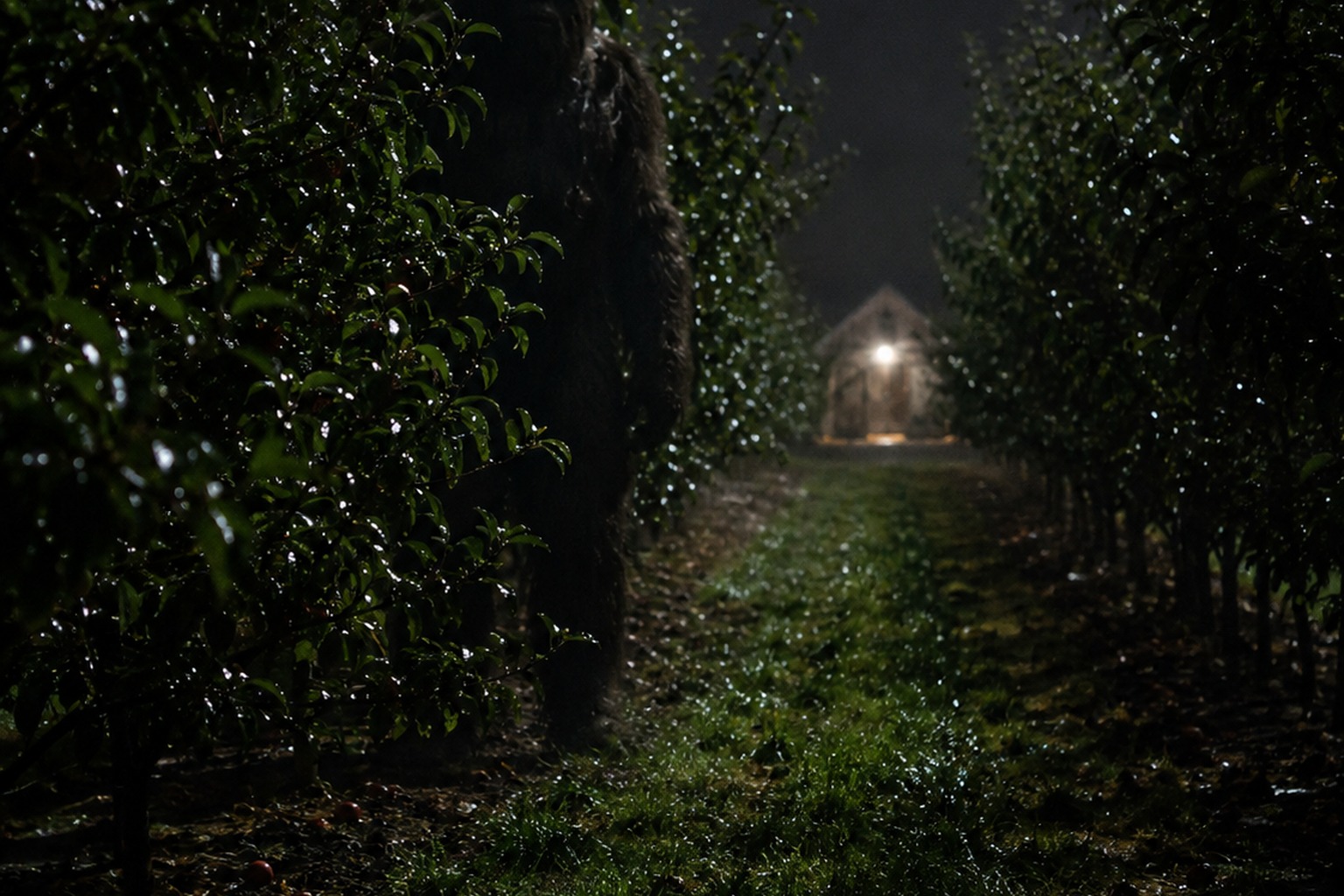
The figure did not move when the tractor lights reached it.
It stood between two rows of apple trees about sixty yards from the gravel lane, tall enough that its shoulders seemed level with branches well above a man's head. The worker first thought someone had walked into the orchard wearing a dark coat. Then the headlights swept across the row again, and he saw the detail that made him stop the tractor: the arms hung almost to the knees.
There was no jacket. What looked like clothing appeared rough and uneven, more like dark brown hair covering the shoulders, chest, and legs. The face was difficult to make out beneath a heavy brow, but the head was clearly turned toward the tractor. The worker shouted.
The figure stayed where it was. He shouted again and raised his flashlight. Instead of running directly away, the hairy shape took one long sideways step behind a tree trunk. For several seconds, nothing happened. Then it appeared one row farther back. No footsteps. No cracking branches. No obvious sprint between the trees.
Just the same tall shape standing in another corridor of the orchard, still facing him. Stories about huge hairy figures are usually associated with deep forests and mountain trails. Yet orchards, vineyards, farms, and fruit-growing areas produce their own version of the encounter: someone notices something unusually large standing between neat rows of trees, apparently watching from the darkness.
The First Time It Happened
Why are orchard rows such an effective setting for Bigfoot-like sightings, and what makes these reports feel so disturbing? Why Orchard Rows Make A: Standing: Figure: Look: Wrong: An orchard is not quite a forest. That distinction matters.
Trees in an orchard are planted deliberately, often in long straight rows with fairly regular spacing. From the end of one row, a person can sometimes see surprisingly far into the property. Trunks repeat at predictable intervals. Branches form walls on either side, while the open strip between them creates a narrow tunnel.
Put a large upright figure inside that tunnel and the human eye has plenty of reference points. A witness can compare its height with branches, fence posts, irrigation equipment, picking ladders, bins, or the trees themselves. That can make an unusually tall figure more striking than it would be among random trees in a dense forest.
The rows also create an uncomfortable visual effect at night. A person may be clearly visible while standing in the open center of a row, then disappear completely after taking only one step sideways. Every tree becomes cover. This helps explain a detail that appears repeatedly in stories about strange figures around orchards: the impression that something is deliberately peeking out, withdrawing, and appearing again farther down the row.
Sometimes that may be exactly what an ordinary person or animal is doing. But when witnesses describe something seven feet tall, broad through the shoulders, and covered in hair, the geometry of the orchard can make the encounter much harder to dismiss emotionally. Why The Figure Often: Seems: To: Be: Watching
Why The Place Felt Wrong
People are extremely sensitive to being watched. We notice faces, eye direction, and body orientation quickly, even in poor light. A shape that appears to be facing us therefore feels very different from an animal simply crossing our path. Many orchard creature stories revolve around this distinction.
The figure is not described as charging. It is not always eating fruit. It may not even approach. It simply stands between the trees with its head and upper body turned toward the witness.
That behavior is frightening partly because the witness cannot understand its purpose. A deer grazing under an apple tree makes sense. A bear searching for fallen fruit makes sense. A trespasser stealing produce has an obvious reason to be there. A massive hairy figure standing motionless at the end of a row seems to have only one activity: watching.
Of course, that impression can be misleading. Animals frequently freeze when they notice people. A black bear standing upright may remain still while trying to identify a smell or sound. Darkness can hide the animal's lower body and distort its proportions. But witnesses who interpret the shape as Bigfoot-like usually mention more than stillness. They describe shoulders, long arms, an upright posture, or a head that seems attached differently from a bear's.
Those body details are what turn a brief scare into a story remembered for years. Fruit Trees Give Ordinary: Animals A: Reason: To: Be: There: Before reaching for a paranormal explanation, there is an obvious fact worth remembering: orchards contain food. Fallen apples, pears, peaches, cherries, berries, nuts, and other crops can attract wildlife. Depending on the region, that may include deer, raccoons, wild pigs, coyotes, and bears.
Bears deserve particular attention in hairy-figure stories. A bear can stand on its hind legs. Seen briefly through branches, its upright body can look surprisingly human. Its front legs may be mistaken for hanging arms, especially when only part of the animal is illuminated.
The Detail Nobody Could Explain
Distance makes the problem worse. At night, people are bad at judging exact size when they cannot clearly see the ground beneath an object. A five- or six-foot animal on slightly higher ground can appear considerably taller. Workers can also mistake other workers, hunters, thieves, scare devices, coats, tarps, stacked materials, or strangely shaped trees for figures when visibility is poor.
An orchard provides enough repeating shapes for the brain to assemble a person from surprisingly little information. That is why the first useful question is not, "Was it Bigfoot?" It is much simpler. What could physically have been standing there?
The Arms And Walking Style Matter More Than The Hair
Hair sounds like the defining feature of a Bigfoot report, but at night it may be one of the least reliable details. Brown fur, black clothing, wet bark, heavy shadows, and dense foliage can all create a hairy-looking surface.
Proportions are more useful. Witnesses often become convinced they saw something unusual because of where the hands appeared to reach, how wide the shoulders looked, or how the figure moved when it finally left. A person normally has familiar proportions even when wearing bulky clothing. A bear on two legs tends to have another recognizable body shape and usually returns to four-legged movement.
The classic Bigfoot-like description is different: a tall upright body, relatively short-looking neck, very broad shoulders, and arms hanging noticeably lower than expected on a human. Movement can be equally important. Some witnesses describe long, smooth steps through terrain where a person would normally hesitate. Others say the figure crossed from one row to another with surprisingly little upper-body movement.
What They Checked Afterward
None of those descriptions automatically identifies an unknown creature. Memory becomes less precise after a frightening encounter, and darkness removes many details people normally use to judge motion. Still, if someone gets a prolonged view in decent light, the question becomes more interesting than it is after a half-second glimpse.
"Hairy" alone tells us little. Body shape, movement, distance, duration, and visible scale clues tell us much more. Why Disappearing Between Rows: Feels: Almost: Impossible: Imagine looking down twenty straight rows of trees.
Something stands in row eight. It steps behind a trunk. You expect it to emerge on the other side. Instead, nothing appears.
Then someone beside you points toward row ten. The figure is there now. This sounds impossible until you consider how orchards are structured. Tree trunks, low branches, support poles, leaves, irrigation lines, elevation changes, and darkness break the space into hundreds of overlapping blind spots. A person or animal moving diagonally can remain hidden much longer than expected.
At night, the witness may also be illuminated while the figure is not. A worker beside a tractor, barn light, vehicle, or flashlight has reduced night vision. Whatever stands beyond that pool of light has an enormous advantage. That imbalance creates one of the creepiest parts of these encounters.
The Moment It Became Harder To Ignore
The witness feels exposed. The thing between the trees does not. If the figure appears to understand the rows well enough to remain concealed while changing position, ordinary animal behavior can start feeling strangely deliberate. That does not mean the figure actually planned its movements around the witness. But it explains why orchard encounters often acquire the feeling of a game: visible, hidden, visible again.
What Witnesses Usually Check After The Scare
Daylight changes an orchard dramatically. A towering figure from the previous night may turn out to have been standing on raised ground. A strange shoulder may become a broken branch. The supposedly empty area may reveal an access road used by workers.
That is why returning to the exact spot can be useful. The most important check is usually height. If a witness remembers the figure's head reaching a particular branch, that branch provides a rough scale reference. Measuring it is far more useful than saying the creature "looked eight feet tall."
Tracks are another obvious thing to examine, although orchards do not always provide good surfaces for them. Hard-packed soil, dry grass, leaf litter, irrigation, farm vehicles, and workers can quickly destroy footprints. People also look for disturbed fruit, broken branches, hair caught on rough surfaces, animal droppings, or tracks belonging to known wildlife.
Dogs sometimes become part of these stories too. A farm dog barking toward one specific row can make an unclear sighting feel much more unsettling. Yet dogs react strongly to deer, bears, coyotes, unfamiliar people, and scents humans cannot detect. An animal reacting tells you that something may be nearby.
It does not tell you what that something is. When The Bear Explanation Gets Weaker For many brief orchard sightings in bear country, a bear is a strong possibility. But not every description fits equally well.
Why People Avoided That Spot Later
The explanation becomes less comfortable when a witness sees the figure continuously for a long period, observes it walking upright over significant distance, and has reliable objects nearby for scale. Several witnesses independently describing the same proportions also makes simple misidentification harder to lean on.
The setting matters too. A dark hairy figure seen for two seconds at 150 yards is extremely difficult to identify. A figure watched for thirty seconds from forty yards under a bright farm light is a different kind of observation. Likewise, "it was huge" is vague.
"Its head was above the irrigation crossbar we measured the next morning" gives the story something concrete to examine. Even then, unusual does not automatically mean Bigfoot. People underestimate how strange familiar animals can look when seen from unfamiliar angles. Fear also changes attention. A witness may remember the most frightening interpretation of an unclear shape more strongly than the uncertainty surrounding it.
The most interesting stories are therefore not necessarily the most dramatic ones. They are the ones with simple details that can be checked. Why Orchard Sightings Stay: With: People A strange figure in a remote forest is frightening because the wilderness already feels unpredictable.
A strange figure in an orchard creates a different fear. Orchards are controlled spaces. People planted the trees. Someone mows the lanes. Workers prune branches, run irrigation, harvest fruit, repair equipment, and drive the same paths repeatedly. The landscape is supposed to be known.
Why The Story Still Gets Shared
Then something stands inside that orderly grid that does not seem to belong there. That contrast may explain why the "watching from the rows" image is so effective. The trees provide scale, repetition, and concealment at the same time. The witness can see enough to recognize a body but not always enough to identify it.
And once the figure steps behind a trunk, every dark opening between the next hundred trees becomes a possible place for it to reappear. There is no need to assume every orchard story describes an unknown animal. Bears, people, darkness, distance, and expectation can explain plenty of frightening sightings.
But the strongest reports leave behind a narrower question. Not simply, "What did I see?" It is: "What was standing at that exact branch height, with arms that long, looking back at me?" That is why hairy figures watching from orchard rows remain such a persistent version of the larger Bigfoot story.
The orchard gives the witness something a dense forest often does not: straight lines, familiar distances, and objects that can be measured afterward. And perhaps the creepiest part is the simplest. When someone returns in daylight, the rows usually look completely ordinary again. The branch is still there.
The tree is still there. The place where the figure stood is easy to find. Only the figure is gone.