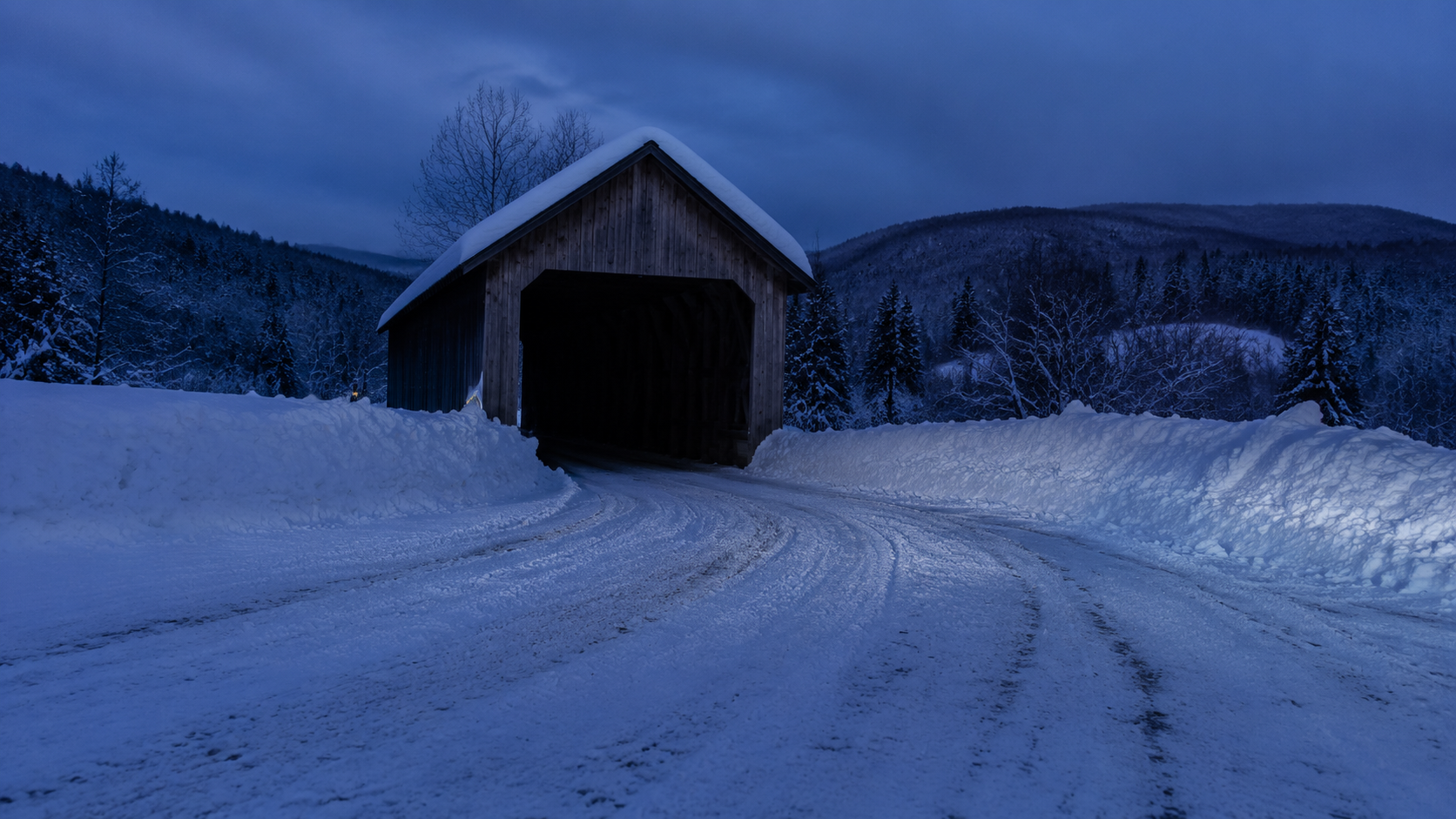
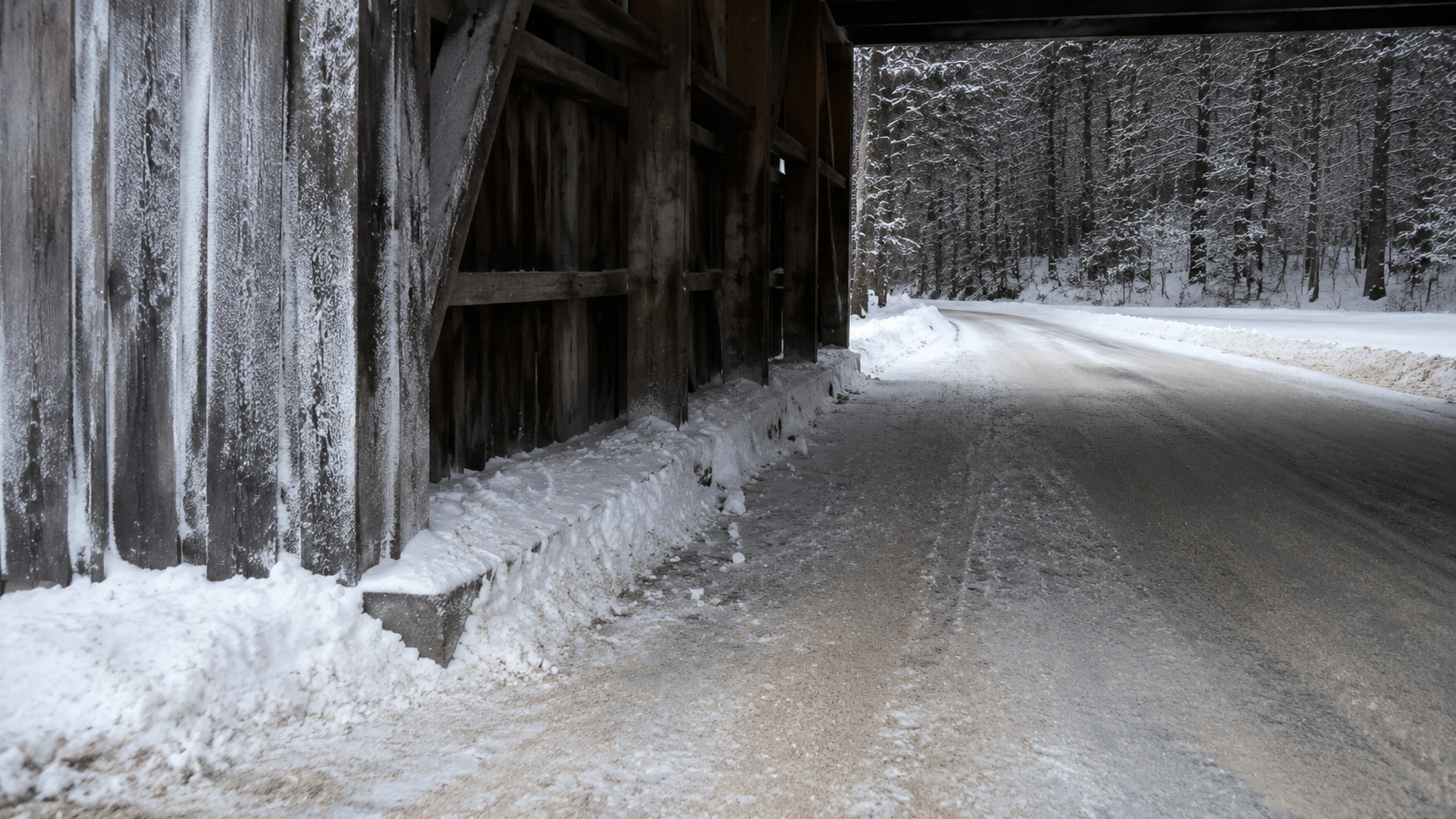
The strange part of the covered bridge still is not only the dark upright shape near the snowplow turnaround. It is that the snow appears to remember a path.
In the recreated version, a county road camera was aimed at a remote wooden covered bridge where winter plows had to back, turn, and leave room for emergency vehicles. Most nights it recorded headlights, drifting snow, and deer.
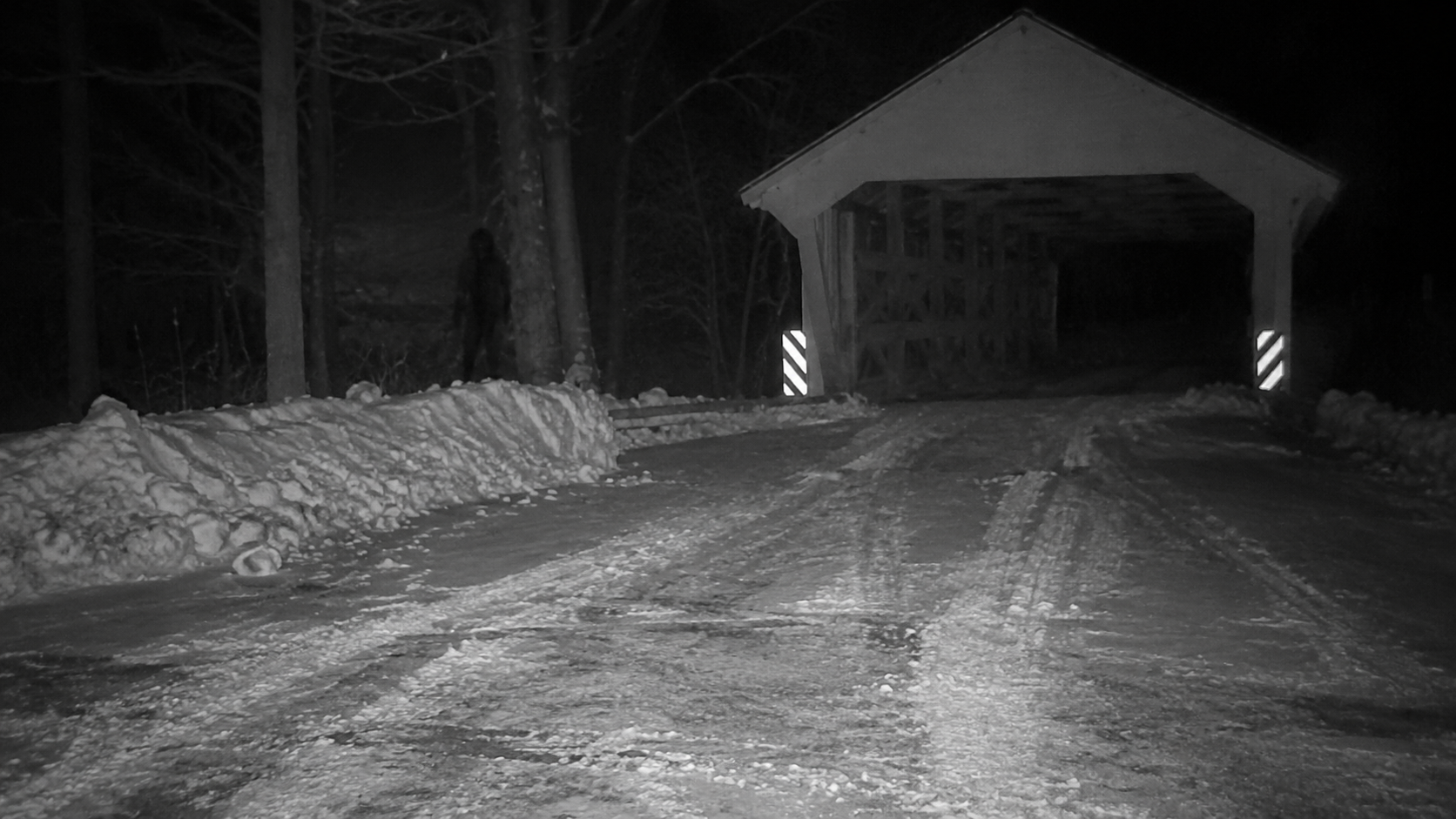
Then a still from after midnight circulated among road workers and nearby residents. In the frame, a broad dark figure appears near the plow turnaround at the bridge mouth. By itself, that would be weak evidence. Winter cameras make ordinary things look tall, and snow glare can carve a human shape out of brush.
The details around the shape are why this became a Sasquatch story instead of a forgotten blurry still.
WHAT THE ROAD CAMERA STILL SHOWS
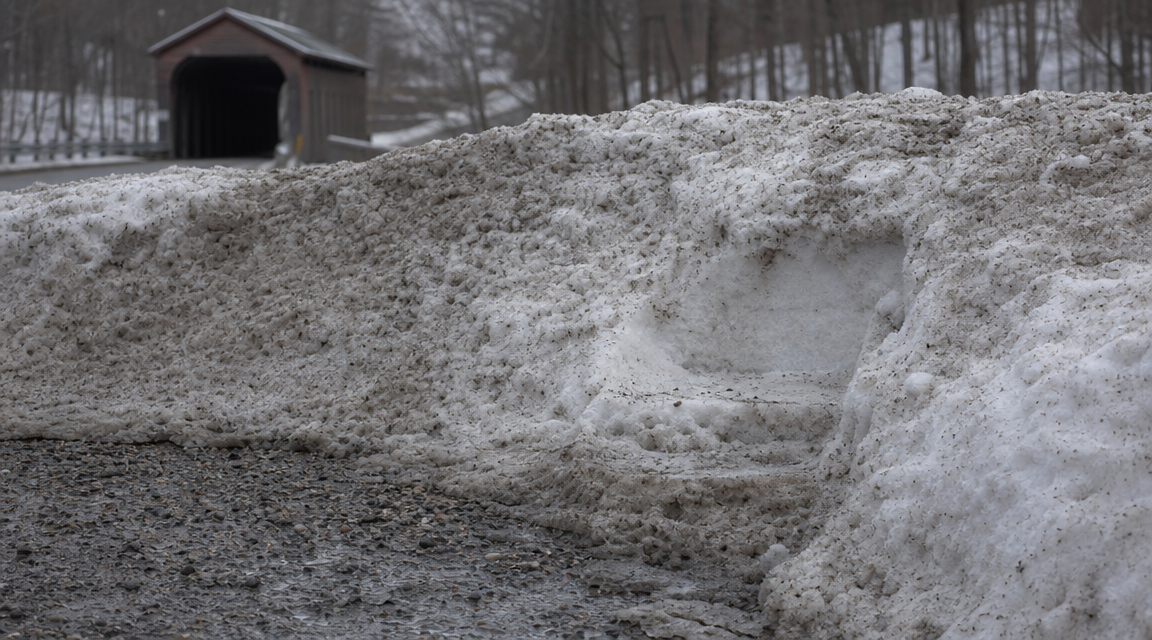
– A dark upright shape near the snowplow turnaround at one end of a covered bridge. – A high plow berm with one wide compacted mark on the shoulder side. – A faint packed-snow line leading from the berm toward the bridge entrance. – Frost or loose snow reportedly disturbed along one lower bridge wall. – No clear face, no noted body measurements, and no a detail people read as a Sasquatch.
1. The Camera Was Watching the Turnaround, Not the Woods
The setting matters because this was not described as a trail-cam clip from deep timber. It was a road-maintenance view of a practical winter problem: keeping a one-lane covered bridge usable after storms.
The turnaround was a widened patch where a plow could push snow into a crescent berm, reverse, and line up with the road again. It was not a scenic pull-off or trailhead. There was reportedly little reason to stand there after midnight unless someone lived nearby, had vehicle trouble, or wanted privacy.
That makes the still grounded but difficult. A road camera can flatten the bridge, berm, brush, and road edge into one confusing plane.
Still, the account says the shape was not in the tree line. It was beside the plowed area, close enough to the bridge mouth that the snow marks became part of the discussion.
2. The Plow Berm Had One Wide Compressed Spot
The first physical detail people pointed to was a mark on the plow berm. In the reconstruction, it appears as a wide pressed area on the shoulder side, as if something heavy stepped onto the ridge and crushed the loose snow downward.
That can happen in ordinary ways. A plow blade can leave uneven chunks. A deer can punch through a berm and collapse the top. A person wearing winter boots can climb over, especially if the snow has crusted and then softened.
What made the mark interesting was placement. It sat near the dark figure and was described as broader than a typical boot print. Not a clean footprint with toes. Not a castable track. More like a flattened oval where weight came down and slid slightly.
Careful readers should treat that cautiously. Snow melts, refreezes, sags, and lies by omission. A wide berm mark can look dramatic long after its cause has blurred.
Even so, the berm mark gave the still a location anchor. The shape was not floating in darkness. It seemed connected to one place where something crossed piled snow.
3. The Packed-Snow Line Ran Toward the Bridge Mouth
The second detail was a faint line of packed snow from the berm toward the covered bridge entrance. Locals reportedly described it as a short stripe where loose powder had been pressed dull and firm.
That line does not prove a large animal. A shovel, sled, loose chain, or plow edge can create a similar mark. Wind can also scour snow into lines that look like movement.
But the direction kept the story alive. The line did not simply follow the road. It angled from the outer berm toward the dark bridge opening, as if something crossed the turnout rather than walked along the lane.
In Sasquatch discussions, people often focus on footprints. This account is weaker and stranger because it does not offer clean prints. It offers compression, direction, and a piece of timing.
If the still showed a figure beside untouched snow, the explanation would lean toward camera artifact. If the snow showed marks without a figure, it would be road-maintenance noise. Together, they formed the pattern that makes a scary reconstructed moment sticky.
4. Frost on the Lower Bridge Wall Looked Disturbed
The covered bridge added a detail a normal roadside sighting would not have. According to the reconstruction, the lower wooden siding near the entrance held frost and windblown snow. After the still was noticed, someone reportedly saw a scraped or brushed patch along that lower wall.
This is not as strong as it sounds. Covered bridges collect frost unevenly. Passing vehicles push warm air and road grit through the entrance. Snow thrown by a plow can strike siding and fall away later. Even a dog or deer could disturb the powder.
Still, the location lined up with the packed-snow line. The brushed area was near the mouth, where the shape seemed to be standing or moving.
That is why the detail matters. It did not identify a creature. It suggested contact with the environment. A shadow does not press snow. A compression artifact does not disturb frost. If those marks were truly fresh, the still becomes less easy to write off as only a camera illusion.
The caution is that freshness is hard to prove after the fact. Unless someone photographed the wall immediately before and after, the frost mark remains atmosphere, not evidence.
5. The Shape Looked Too Broad for a Pedestrian, but Not Clear Enough to Prove Anything
The dark figure is the reason people remember the account, and also the weakest part if examined alone. In the still, it is described as upright, dark, and broad across the upper body. The lower half blends into snow shadow near the berm.
That description fits many possibilities. A bulky parka can appear huge beside reflective snow. A stranded driver, hunter, or nearby resident could be caught mid-step. A bear rearing or turning near the berm could also create a brief upright posture.
There are no visible facial details. No hands. No hair texture. No reliable height marker except bridge timbers, and perspective near an entrance can fool the eye.
The broadness gave some viewers pause. Compared with the bridge opening and plow berm, the figure looked heavier than average. But without the original camera file, lens information, exact distance, and frames before and after, that impression cannot carry the claim.
The Most Mundane Explanation Still Deserves Space
The simplest explanation is a person and a plow berm doing what winter roads do.
Someone may have stopped after midnight, climbed over the berm, brushed the siding, and walked back out of frame. The camera caught bulky dark clothing, and snow glare exaggerated the silhouette. The compressed mark could be a boot scuff. The packed line could be a shovel, sled, dragged bag, or plow edge. The frost patch could be old road spray sliding off the boards.
A deer or bear is also plausible, depending on region. Animals use plowed roads because deep snow is exhausting. A bear near a berm, or a deer collapsing part of the ridge, can leave marks that look larger after wind softens the edges.
Camera limitations matter too. Low-light road cameras can smear moving objects. Reflective snow brightens the foreground and darkens the background. A post, brush clump, and moving animal can merge into one human-like mass.
None of those explanations require a Sasquatch. They also do not require anyone to be lying. Most strange winter evidence is a stack of ordinary causes discovered in the wrong order.
Why This Covered Bridge Account Still Gets Retold
The reason this story lingers is that it has a built-in route. The berm mark, the packed line, the frost disturbance, and the figure all belong to the same tiny winter stage: the mouth of a covered bridge where the plow turns around.
That makes it feel different from a generic dark shape in the woods. The bridge gives scale. The snow gives memory. The road camera gives time. None of those pieces solve the case, but they let people reconstruct movement.
Maybe someone crossed there for an ordinary reason and never heard the story that grew from the still. Maybe the marks were made hours apart by plow work, wind, and animals. Maybe the figure was a person whose shape became strange only because the camera froze the worst possible frame.
Or maybe the account keeps drawing attention because the scene feels too organized to dismiss quickly.
For WeirdWitnessed, the responsible position is not to declare a Sasquatch at the bridge. It is to preserve the odd overlap without pretending the evidence is stronger than it is.
A dark figure alone is not enough. A snow mark alone is not enough. A frost scrape alone is not enough.
But place all three at a remote covered bridge turnaround after midnight, and the question becomes harder to ignore: what crossed the plow berm, moved toward the bridge mouth, and left the camera with one broad, unresolved shape in the snow?
Reader Context
This Weird Witnessed story is an editorial reconstruction, written as eerie visual storytelling rather than a verified report. For more context, see Bigfoot and Sasquatch Stories Guide and How WeirdWitnessed Creates Reconstructed Horror Stories.