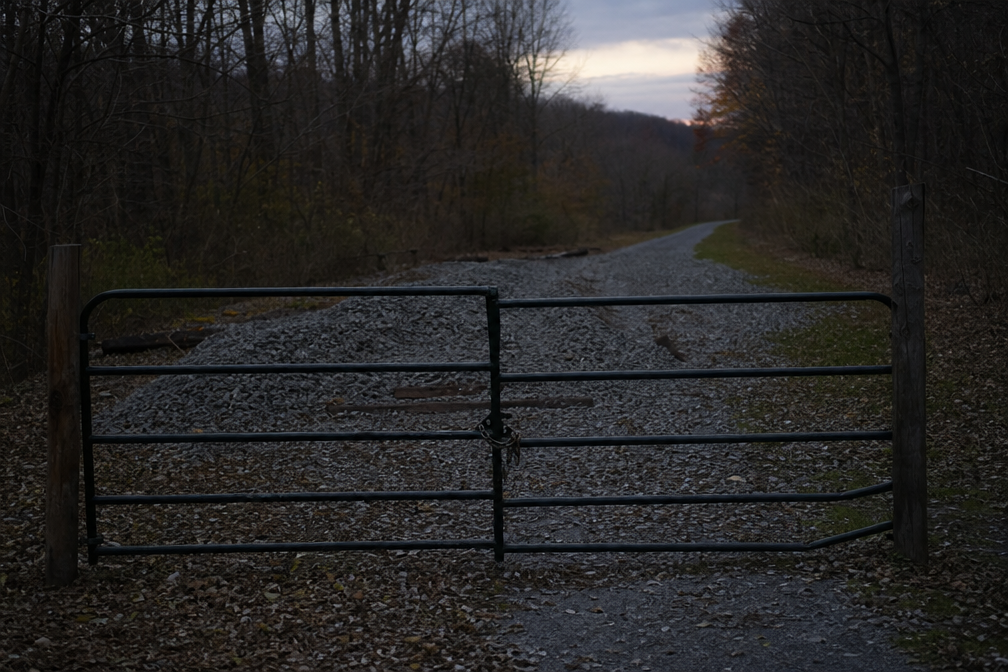
A locked service gate is supposed to make one question easier: if something heavy moved past it, someone with a key probably moved it.
That is why this local rail-trail account keeps getting repeated. Fresh gray ballast was reportedly found scattered on the wrong side of a locked maintenance gate, beyond the point where ordinary trail users and vehicles were supposed to stop.
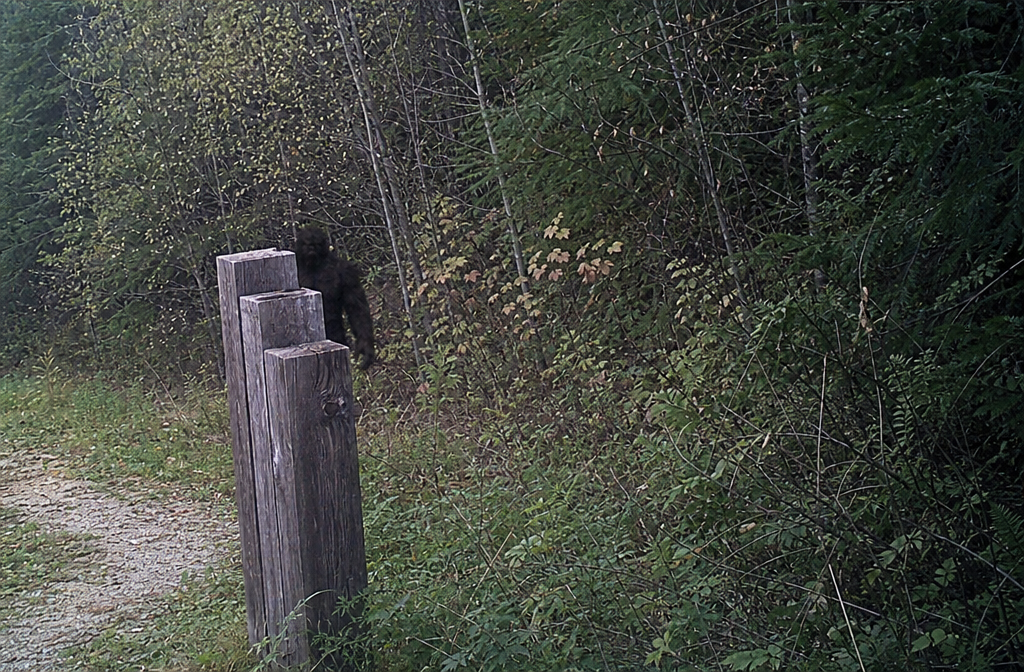
Then came the reported camera still. In the frame, a large opaque dark upright shape appeared near the treeline, mostly hidden behind stacked mile-marker posts beside a small maintenance shed.
This article treats the image as a reported still and an AI/editorial reconstruction of the account, not as verified proof. The question is narrower: why did a routine maintenance oddity feel strange enough for locals to keep arguing about it?
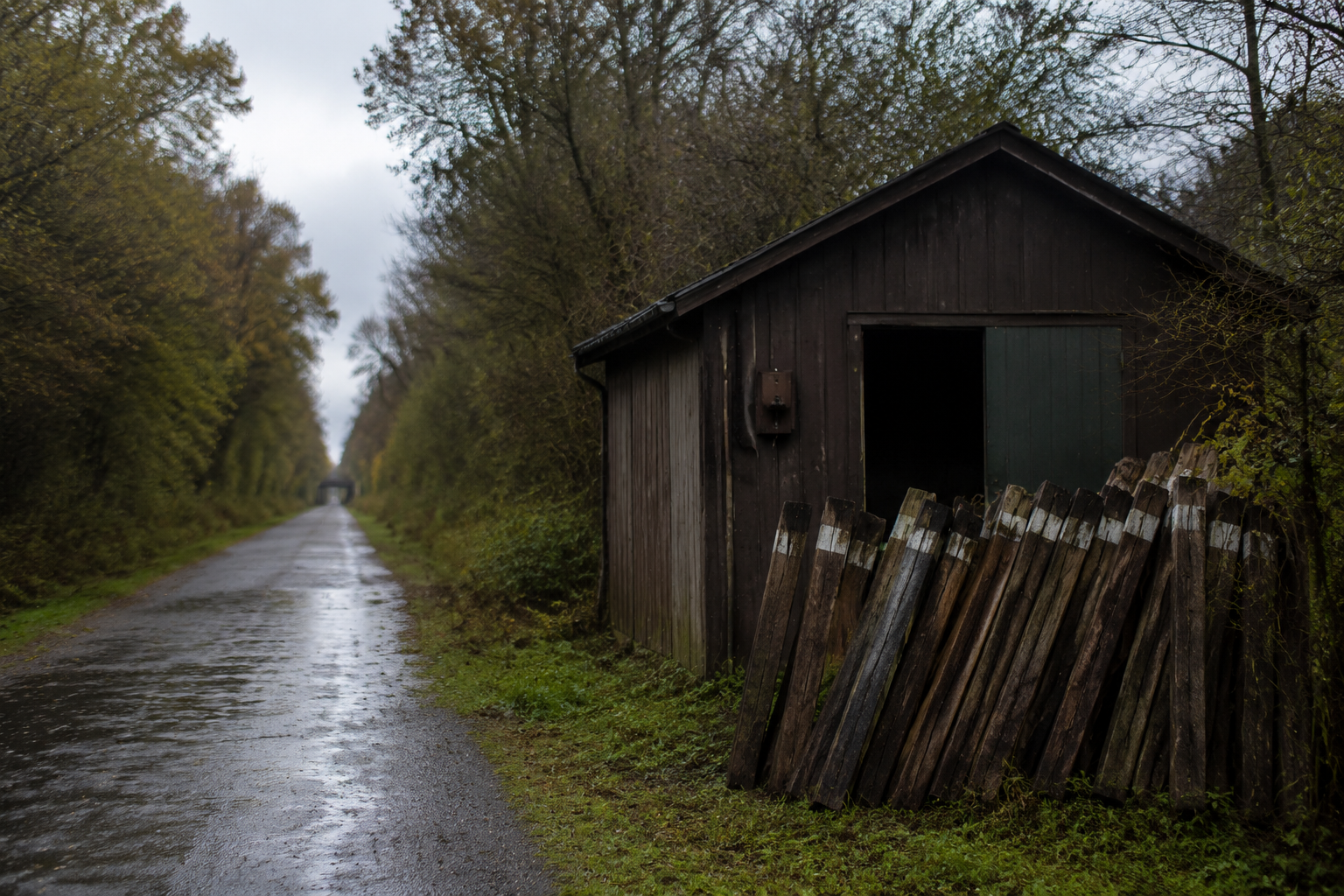
WHAT THE RECREATED MOMENT SHOWS: – Fresh ballast found beyond a locked service gate. – No simple public vehicle access reported at that point. – A fixed shed camera said to catch one unusual still. – A large dark upright shape partly blocked by stacked mile-marker posts. – The shape looked solid and opaque, not pale, smoky, or ghostlike. – Brush and distance made the figure difficult to identify. – Ordinary explanations remain possible, but not fully satisfying to everyone who heard the account.
1. The Ballast Was on the Wrong Side of the Gate
The first detail was not the figure. It was the gravel.
Rail-trails often keep small maintenance areas near culverts, washed-out shoulders, or former rail spurs. A locked gate may protect a shed, tools, or stockpiled material. Fresh ballast in such a place is not strange by itself.
What made this account stick was the reported location of the material. The gravel was said to be beyond the locked service gate, where casual walkers, cyclists, and weekend curiosity seekers were not supposed to have vehicle access.
That does not make the account supernatural. It makes it logistical.
If a crew placed the ballast there, the answer is simple. If a volunteer with permission hauled it in, the answer is still simple. But the local version says no scheduled drop was immediately remembered, and the gate was still locked when the oddity was noticed.
For a Bigfoot-style account, that matters because the mystery starts before the silhouette appears. The image does not have to carry the entire story. The scene already had one small contradiction built into it.
2. The Gate Was Still Doing Its Job
Locked gates are boring until a story depends on them.
In this account, the service gate was not described as broken open, hanging loose, or obviously bypassed by truck tires. It was simply closed and locked, separating the public trail corridor from the work area.
That detail narrows the possible movement. A person could climb over, a smaller load could be carried by hand, or a side path might exist outside the camera’s view.
Still, fresh ballast is awkward. It is heavy and usually moved by machine, wheelbarrow, bucket, or repeated trips. If the material was truly new and truly misplaced, the gate becomes the anchor for the account.
Creepy scenes often grow around this kind of practical problem: not a scream in the woods, just a locked barrier and material where it supposedly should not be.
3. The Shape Was Hidden by Stacked Mile-Marker Posts
The reported figure was not standing in the open center of the trail. It was partly obscured behind stacked mile-marker posts near the treeline.
That gives the account a more believable texture than cleaner internet monster images. Real shed cameras rarely frame mysteries perfectly. They catch corners, background movement, clutter, and half-blocked shapes.
The stacked posts matter visually. They break up the outline and create a measuring problem, because viewers compare the dark shape to the posts without knowing the exact distance between them.
In Bigfoot or Sasquatch evidence discussions, scale is often where arguments begin. Was the figure large, or simply closer to the camera than it seemed? Was the top above the posts, or was the treeline shadow making it look taller?
The cautious answer is that the still does not settle those questions. But the arrangement creates tension: visible enough to notice, hidden enough to resist easy identification.
4. The Figure Looked Solid, Not Like a Ghost
Some strange-image stories drift into apparition language. This one should not.
The account describes a dark upright shape that appeared solid and opaque. It was not transparent, floating, misty, or pale. It was more like a block of darkness with a vertical posture, partly masked by posts and leaves.
That distinction matters for the category. This is a Bigfoot / Sasquatch Evidence-style account because the interpretation depends on a possible large physical presence near a wooded corridor.
Rail-trails can be wild at their edges. They run through drainage ditches, creek crossings, deer travel lanes, and narrow strips of woods behind neighborhoods or farms. People use the packed surface. Animals use the margins.
A dark upright shape at the boundary of work yard and treeline fits the folklore pattern of something watching from cover rather than stepping into full view.
It also fits ordinary patterns of shadow, brush, stacked material, or a person in dark clothing. The solid look makes it feel physical, but physical does not automatically mean unknown.
5. The Timing Made the Still Harder to Shrug Off
The reported still mattered because it was connected to the ballast discovery, not because it was a perfect portrait.
If someone had found an odd shape in a random archived frame, the story would be weaker. Cameras create strange shapes all the time. Compression, low light, motion blur, branches, and distance can turn ordinary things into upright figures.
But the recreated scene links the image to a short window around the maintenance oddity. First, fresh gravel was noticed where people did not expect it. Then the camera was checked. Then the dark upright shape became part of the same story.
That sequence is why people returned to the still.
A single image can be dismissed more easily than a pattern. A misplaced material pile can be dismissed more easily than an image. Together, they create a small chain of circumstances: not proof, but a reason for curiosity.
The Most Reasonable Mundane Explanations
The grounded explanations should come first.
A maintenance worker may have placed the ballast there and simply not logged it in a way later storytellers remembered. A volunteer group may have moved material through the gate earlier. A side access route may have existed outside the camera’s view.
The dark shape could also have been a person in dark clothing. It could have been stacked material, a tarp, a shadowed tool rack, or brush lining up with the posts at the wrong angle.
Trail and shed cameras can make hard edges look organic. Low resolution can erase details that would identify a jacket, a tree trunk, or a leaning object. A single still also removes the before-and-after context that would show whether the shape moved.
There is also the simplest social explanation: a small maintenance confusion became a better story each time it was retold.
None of those possibilities should be brushed aside. The reason the account survives is not that ordinary explanations are impossible. It is that, in the remembered version, none fully removed the odd feeling around the locked gate and the partly hidden figure.
What the Still Cannot Tell Us
A still image is a narrow kind of evidence.
It cannot show gait unless there are multiple frames. It cannot prove size without exact measurements. It cannot reveal whether a gate had been opened earlier, whether a side trail existed, or whether a person had permission to be in the work area.
It also cannot preserve the original context. The people who first saw the gravel would know where the posts sat, how high they were, what shadows appeared in that corner, and whether the ballast looked newly dumped or merely newly noticed.
Without that context, the still becomes suggestive rather than decisive.
That is why the safest wording is recreated scary moment, reported still, and AI/editorial reconstruction. The image can illustrate the mystery without pretending to close it.
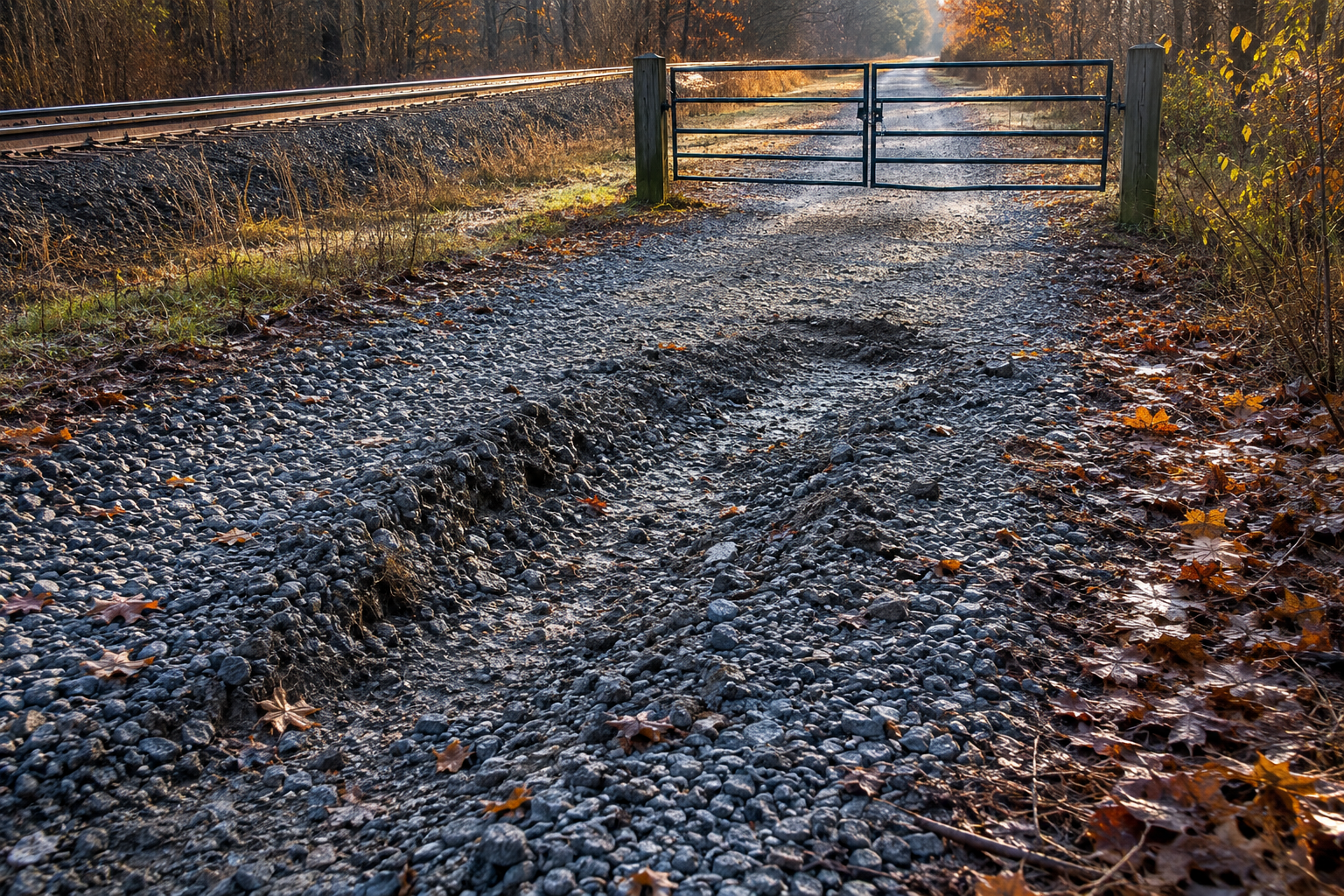
The Unresolved Question at the Gate
The best version of the mystery is not “Was it Bigfoot?” That question is too large for one reported still.
The better question is smaller: what moved the ballast, and why did the camera frame contain a large dark upright shape near the same work area?
Maybe the answer is a worker, a shadow, and a forgotten maintenance task. Maybe the account became sharper in memory because the setting already felt strange. Or maybe the still captured something physical at the edge of the trail that nobody was able to identify afterward.
That last possibility is why the story remains useful as folklore and cautious evidence discussion. It does not need to be treated as proof to be worth examining.
A locked gate, fresh ballast, stacked mile-marker posts, and one dark solid shape at the treeline are enough to make people look twice.
And sometimes, on a rail-trail that seems ordinary by daylight, looking twice is where the local legend begins.
Reader Context
This Weird Witnessed story is an editorial reconstruction, written as eerie visual storytelling rather than a verified report. For more context, see Bigfoot and Sasquatch Stories Guide and How WeirdWitnessed Creates Reconstructed Horror Stories.