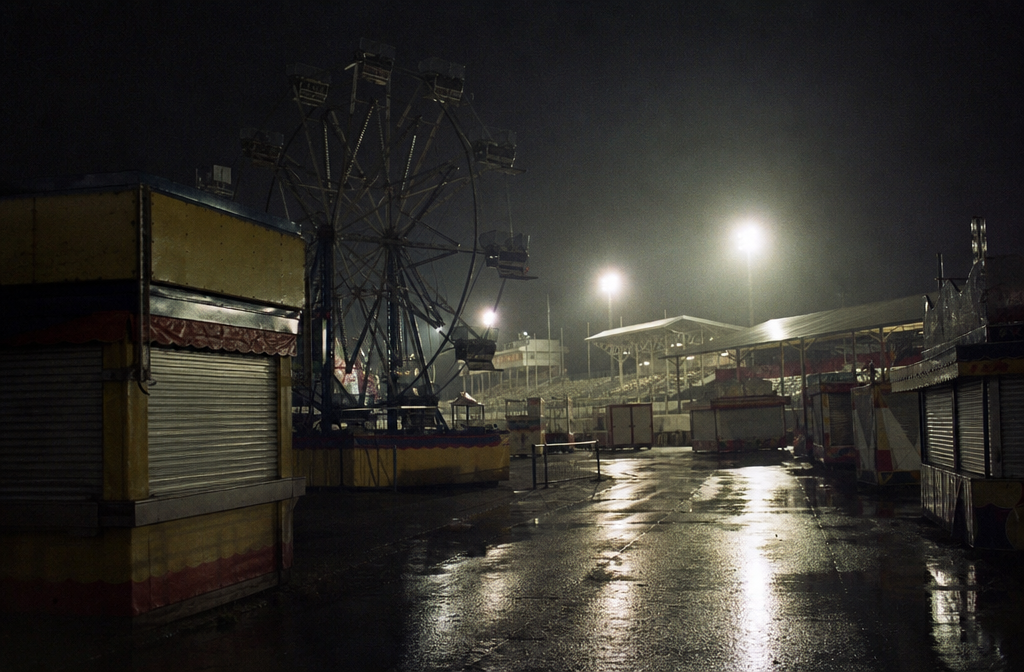
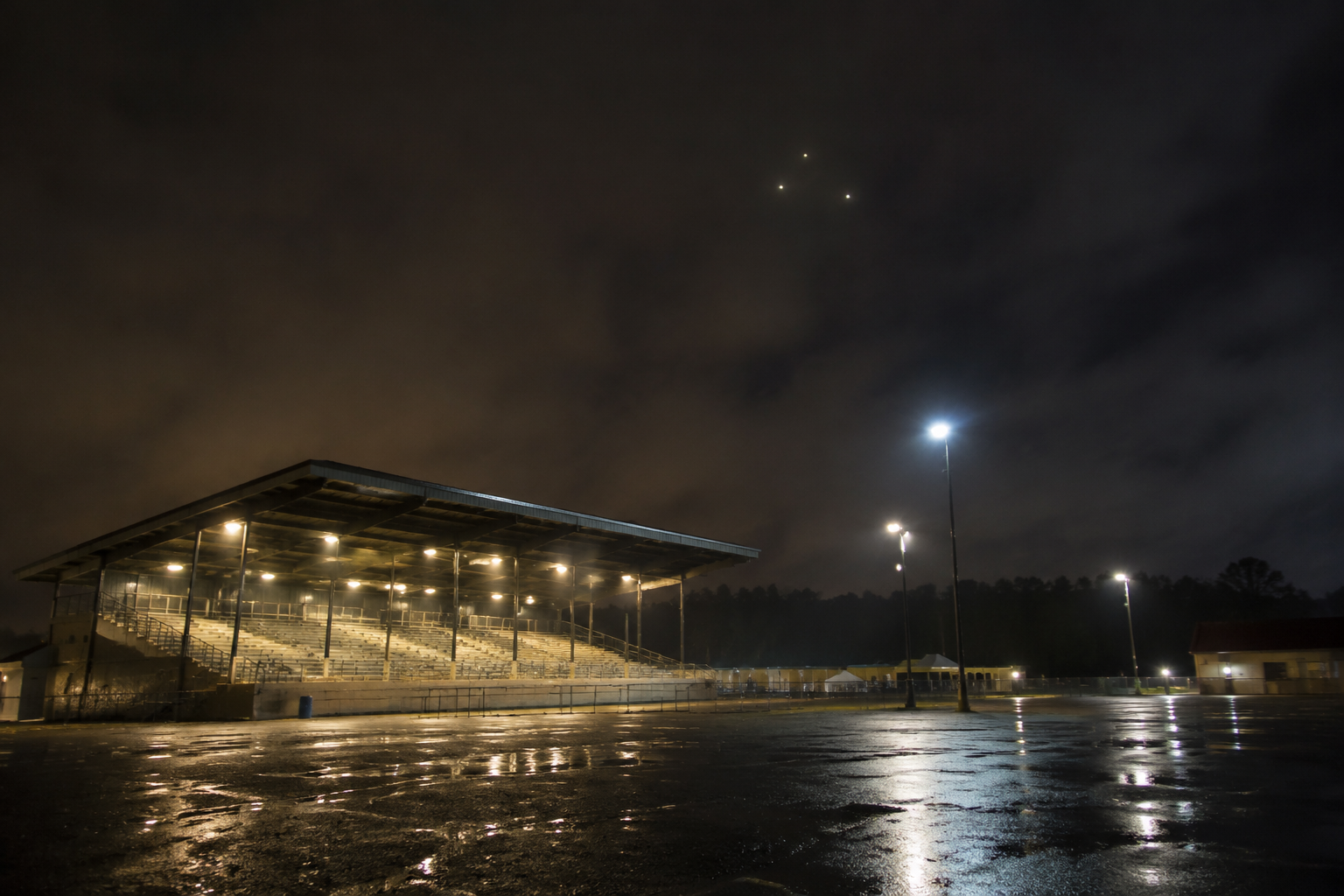
Rainwater glittered on the closed midway when two walkers reportedly stopped near the county fair grandstand and took phone photos. In one later image, above the floodlights, a dark triangular shape seemed to hang where they remembered only low clouds.
Most local UFO stories begin with someone staring at the sky. This one, according to the account, began as an empty-fairground photo after a storm.
That difference matters. The walkers did not describe chasing an object, hearing a roar, or watching a craft cross the horizon. They described ordinary pictures that became strange only after the camera roll was reviewed at home.
The account is best treated as a scary reconstructed moment and editorial reconstruction, not a detail people read as a visitor. Still, five details make the reported sequence worth examining.
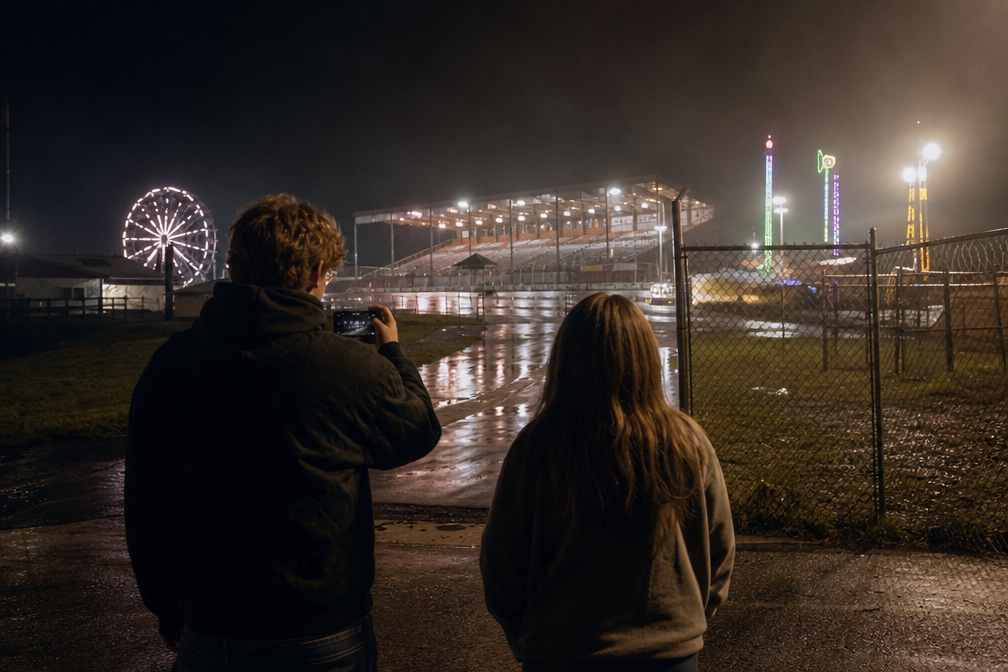
WHAT THE PHOTOS REPORTEDLY SHOW – An empty county fair midway after rain. – Grandstand floodlights shining into a low, wet sky. – A dark triangular form, or three separated lights in a triangle, above the floodlights. – No clear memory from either walker of seeing the shape while standing there. – A phone timestamp sequence that appeared to skip one minute between nearby images.
1. The Shape Was Not Noticed Until After the Walk
The first odd detail is how late the object entered the story.
In the recreated version, the walkers had gone out after rain because the fairgrounds were quiet and the pavement made the midway lights look doubled. The annual fair had ended days earlier. A few booths still stood closed.
They reportedly took photos because the place looked abandoned in a cinematic way, not because they were watching the sky.
Only later, while deleting blurry shots, one walker noticed a dark interruption above the grandstand lights. It was not a crisp saucer, and it was not described as a close object. It looked more like a triangular patch where the clouds should have been, with three dim points arranged near its corners.
That delayed discovery does not make the image stronger by itself. Phones often reveal things the eye ignored: lens flare, insects, aircraft, reflections, and compression artifacts. But it leaves a colder question: what did the camera record that the walkers did not consciously register?
2. The Grandstand Floodlights Complicate the Image
The second clue is the lighting.
Grandstand floodlights are harsh, directional, and unforgiving. After rain, they do even more strange work. They bounce off wet pavement, shine through mist, catch droplets on a lens, and create ghost images inside phone optics.
In the reported photo, the suspected object was positioned above those floodlights. That is exactly where skeptics would expect a light artifact to appear.
It is also exactly why the photo stayed interesting to the people who studied it locally. If the triangle was only a reflection, they wondered why it appeared dark rather than bright. If the three points were lens flare, why did they seem to sit above the grandstand instead of repeating the shape of the lamps below?
Those questions do not eliminate a mundane explanation. They simply show why the floodlights are both the best explanation and the reason the image feels unsettled.
3. The Three Lights Were Spaced Like Corners, Not a Line
The third detail is the reported arrangement.
Many night-sky sightings become less mysterious once the lights are plotted. Aircraft lights move in lines. Drones blink or shift. Distant towers sit fixed against the horizon. Reflections often mirror the strongest light sources below.
This account says the three dim points did not form a neat row. They appeared separated, with one higher point and two lower points, creating the impression of a wide triangle. Behind or between them was the darker patch that some viewers interpreted as a solid form.
Human vision is excellent at connecting dots, especially in dark images. Three lights can become a triangle because the mind wants a shape. Even so, the spacing is why the photo became a UFO story instead of just another blurry night shot.
The account does not need ground visitors or chase scenes. Its effect comes from three small points sitting in the wrong-looking place over a familiar public structure.
4. The Missing Minute Changed the Timeline
The fourth detail is the most useful one for the story, because it is not purely visual.
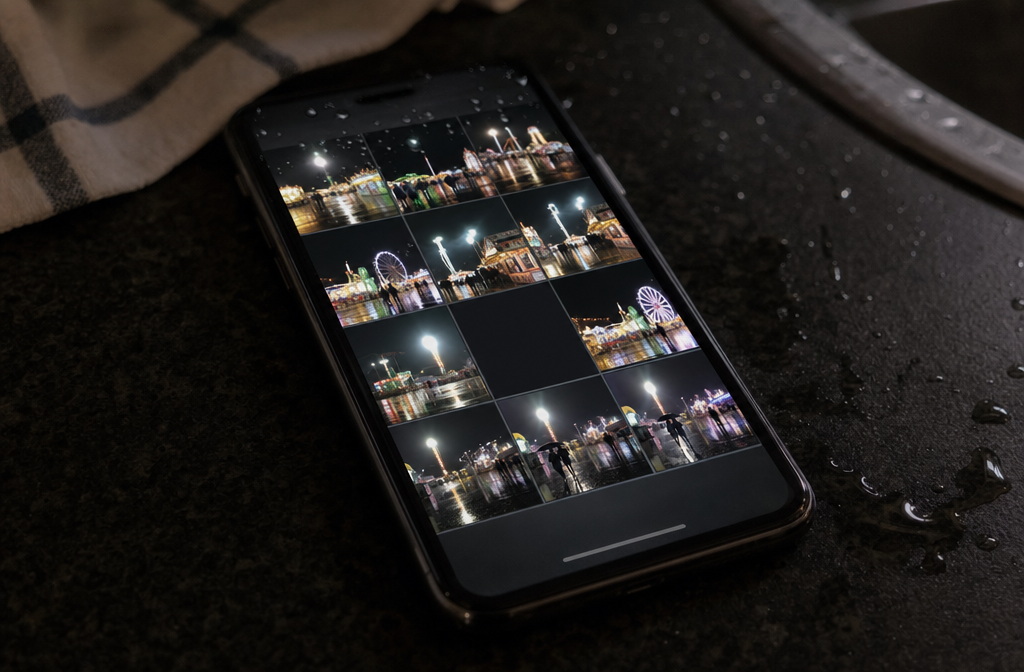
The walkers reportedly took several photos within a short stretch of time. One showed the wet midway and grandstand lights. Another, after they shifted position, showed the area again. Between them, the phone sequence appeared to skip one minute.
That missing minute has to be handled carefully. Phones do not always label images intuitively. A camera app can delay saving a shot. Burst images, cloud sync, low-light processing, and simple deletion can make a sequence look stranger than it is.
The account does not prove that time vanished. It only says the visible sequence did not match what the walkers expected. In local retellings, that skipped minute became the hinge of the whole case.
For a camera-evidence story, absence can be powerful.
5. Neither Walker Remembered Hearing Anything
The fifth clue is quieter.
Both walkers reportedly remembered the fairground sounds: water dripping from metal awnings, tires hissing on the distant road, and the buzz of the grandstand lights. Neither described an engine, helicopter beat, or small-drone whine.
That matters because a nearby object over floodlights should have had some relationship to the environment. If it was a low aircraft, why no obvious sound? If it was a drone, why no movement or motor noise?
None of those questions force an extraordinary answer. Distance, wind direction, wet air, and attention can all affect memory. People also misremember quiet moments after a story becomes strange.
Still, the absence of sound gives the account a clean, unsettling shape. The photo suggests something overhead. The memory of the walk does not.
The Most Mundane Explanation Is Still Strong
The strongest ordinary explanation is a combination of rain, glare, low clouds, and phone processing.
A wet lens can create dim repeated lights. Floodlights can bounce within a phone camera and produce secondary shapes. Low clouds can form dark gaps that look structured. A plane or drone passing at the right moment could add three points of light without being remembered.
The missing minute may be just as explainable. The walkers may have deleted a bad frame, the phone may have delayed saving a low-light exposure, or the camera roll may have sorted images by processed time rather than tap time.
This explanation is not weak. It is probably where any serious review should begin.
What keeps the story alive is not that the mundane answer fails. It is that the pieces line up neatly: the triangle above the lights, the wet fairground, the delayed discovery, and the skipped minute.
Why a Fairground Makes the Account Feel Different
Fairgrounds are designed to feel temporary.
During fair week, the midway is noise, color, food smoke, music, and motion. After closing, the same place can look like a set left behind after the actors disappeared. Rain exaggerates that emptiness by turning every bulb into a reflection and every dark booth into a sealed doorway.
That setting gives the reported UFO image its emotional weight. A strange formation above a grandstand feels almost staged, because the grandstand is where people gather to watch.
In this account, the watchers were below, taking pictures of a place built for looking. The object, if it was an object, appeared above the lights meant to illuminate performances.
What the Reported Photos Cannot Tell Us
The photos, as described, cannot identify distance, size, altitude, or intent.
A dark triangular impression in a night image may be a physical object. It may also be a cloud gap, lens artifact, bird group, drone lights, aircraft angle, or a coincidence created by three unrelated points.
The timestamp sequence cannot prove missing time without device logs, original metadata, and a clear chain of custody. Even then, a technical explanation would need to be considered first.
This is why the case should be framed as a reported recreated scary moment and AI/editorial reconstruction rather than an authenticated evidence package. The interesting part is how ordinary camera evidence can create a small chain of questions that witnesses keep revisiting.
A good UFO story does not always need a clean answer. Sometimes it survives because every answer leaves one awkward detail behind.
The Detail That Still Lingers
The most haunting part of the fair midway account is not the possible triangle itself. It is the thought that the walkers may have stood beneath an unusual sky and noticed only the rain, the puddles, and the empty booths.
If the photo is glare, it is a lesson in how easily cameras manufacture mystery. If it is a passing aircraft or drone, it is a reminder that night images turn normal lights into strange geometry.
But if the account is describing something genuinely unexplained, then the missing minute becomes more than a phone oddity. It becomes the blank space where the clearest answer should have been.
That is why locals returned to the photo sequence, according to the story. Not because it proved anything, but because it refused to become completely ordinary.
The grandstand lights were there. The wet midway was there. The walkers were there.
And above the place where the fair usually asked people to look, the camera seemed to catch something they still could not comfortably name.
What would you trust more: the memory of a quiet walk, or the one strange minute a phone camera failed to explain?
Reader Context
This Weird Witnessed story is an editorial reconstruction, written as eerie visual storytelling rather than a verified report. For more context, see UFOs and Unknown Visitors Guide and How WeirdWitnessed Creates Reconstructed Horror Stories.