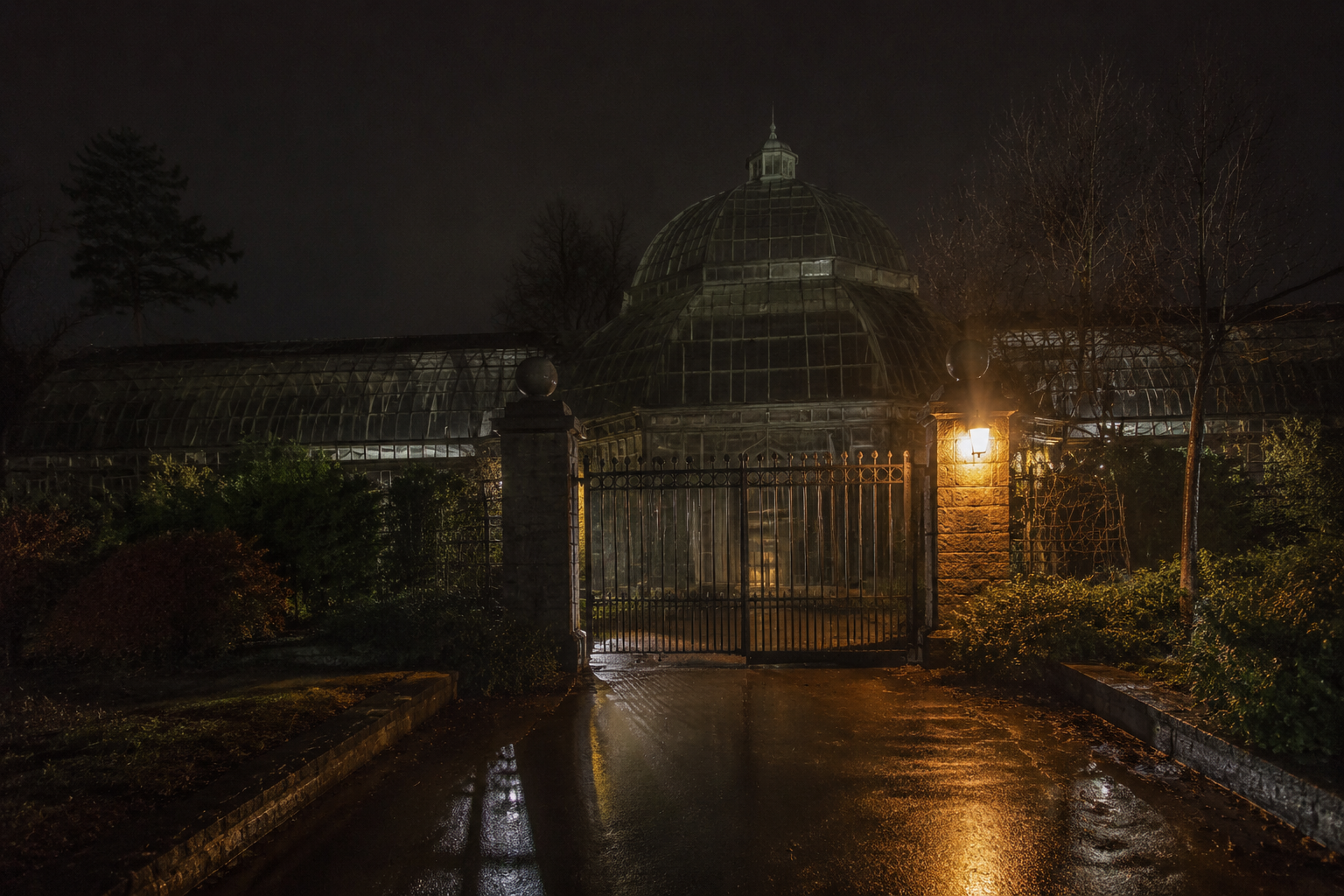
The fern room was already humid enough that night.
That is why the after-hours misting stood out. In the version repeated by people familiar with the conservatory, the doors were locked and the evening watering cycle had finished. Staff expected the glass to fog slowly after sunset.
Instead, a camera still reportedly showed fresh mist rolling through the ferns, bright enough to catch the security light.
Then someone noticed the darkness between the glass panels.
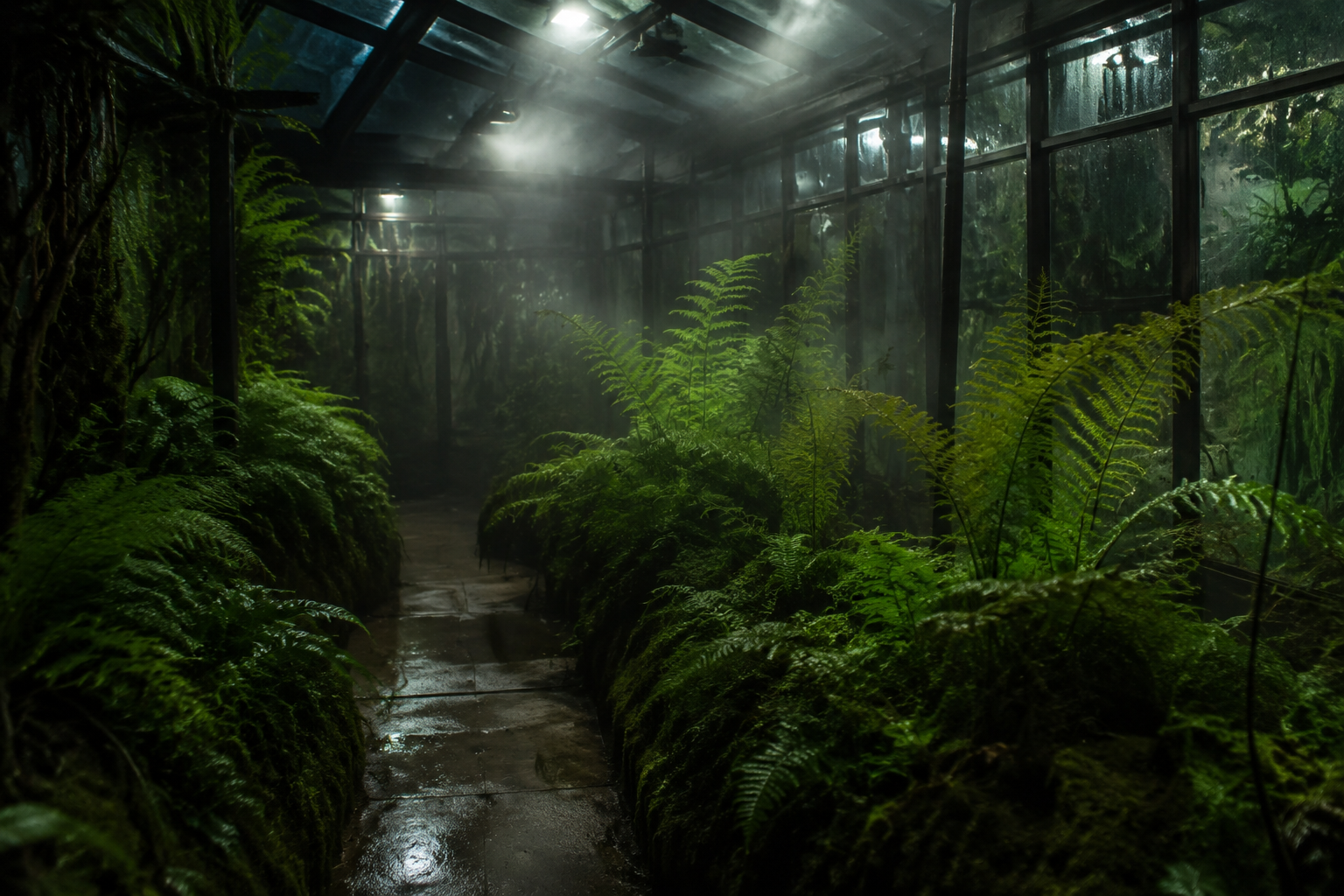
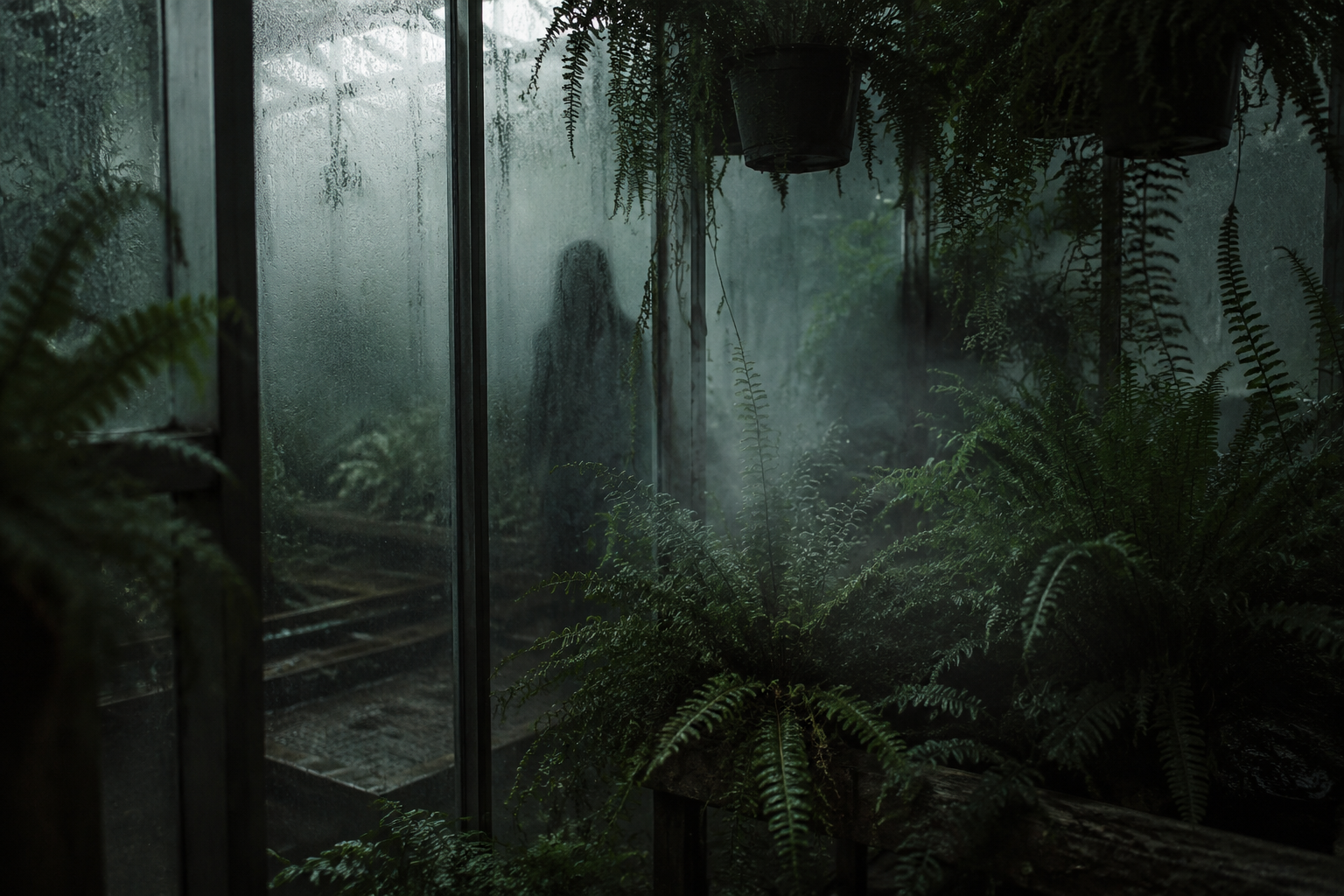
Not a clear person. Not a face pressed to the pane. Just an upright shape, near the seam where two interior glass sections met, with the ferns blurred by vapor.
WHAT THE CAMERA SHOWS
- A closed public botanical conservatory after visitor hours.
- A fern room with dense planting beds, narrow paths, and interior glass panels.
- Mist visible in the room during a time when no timer cycle was reportedly scheduled.
- A dark upright shape near the glass seam, partly hidden by vapor and leaves.
- No confident a detail people read as a person, entry, or haunting.
This is an editorial reconstruction of a recreated scary moment, not evidence that anything supernatural occurred. The question is smaller: why did a maintenance system and a wall of plants create an image people kept reopening?
1. The Room Was Supposed to Be Predictable
Conservatories are full of odd noises, but they are not random places to the people who maintain them. Fans come on. Vents click. Pumps hum. In a fern room, even the fog has a schedule.
That schedule is what made the story travel.
According to the account, the fern room had already gone through its late-day humidity routine. The public paths were checked. The main lights were reduced for the night. Nothing about the room was described as abandoned or derelict. It was a cared-for municipal space with old systems and newer repairs layered together.
When the mist appeared later, it did not feel strange because mist itself was rare. It felt strange because it arrived at the wrong time.
That distinction matters. A fern room is expected to look ghostly on camera. Fog outside its reported cycle gives people a reason to look again.
2. The Timer Should Have Been the Easy Answer
The simplest explanation is still the most reasonable one: the misting system activated.
Mechanical timers fail. Digital controllers can be misread. A manual override can be left on. A pressure change can cause a nozzle to drip or spray. Greenhouse water has a talent for making confident people sound foolish.
The account does not remove those possibilities.
What it claims is that staff checked the schedule after the still was noticed and did not find a corresponding cycle. That does not mean the mist came from nowhere. It means the explanation was less tidy than expected.
There is a big difference between “impossible” and “not immediately matched to the log.” This case belongs in the second category.
But that is also where these stories live: not proof, not a clean debunk, just a mismatch between what the room was supposed to do and what the camera seemed to catch.
3. Fern Rooms Already Make Human Shapes
If you want a room to produce false figures, fill it with ferns.
Fronds overlap like fingers. Hanging roots become hair. Plant stakes become limbs. Large fronds bow under moisture and then lift again as the air changes. A person looking at a still image can turn three shadows into a body before they realize it.
The reported dark shape could easily belong to that family of illusions.
In the still as described, the shape stood near a vertical seam between glass panels. That is a perfect place for reflections to stack. A black corridor, a fern trunk, a pipe shadow, and a wet pane can combine into something upright.
That should be said plainly because it is probably the safest explanation.
The reason the account remained interesting was not that the shape looked detailed. It was that it looked placed, as if the darkness had stepped into the narrowest visible lane in the room.
That is a feeling, not a measurement. Still, feelings are often what make a local image circulate.
4. The Glass Panels Complicated Everything
Glass is where certainty goes to get watered down.
The fern room reportedly had interior partitions meant to protect plant beds and guide visitors along the path. At night, those panels could reflect the room, the corridor, the ceiling, and the camera’s own light angle. Add mist, and every reflection softens.
A dark object outside the room can appear inside it. A plant pressed close to a panel can appear several feet away. Condensation can erase edges that would normally reveal the trick.
That is why the phrase “between the glass panels” is doing so much work in the story.
It sounds exact, but it may describe a very uncertain visual zone. Was the shape behind the seam? Reflected on it? Split by it? Darkened by moisture? Without the original file and a daytime comparison from the same angle, nobody should pretend to know.
Glass seams make ordinary shadows look intentional. A straight vertical line gives the eye a frame, and the eye starts looking for a figure.
5. The Mist Made the Shape Seem Present
Mist changes how a room behaves on camera.
It catches light that would otherwise pass cleanly through the air. It hides small details while emphasizing large blocks of darkness. It makes distance hard to judge.
In this account, the mist did more than create atmosphere. It made the dark shape seem to occupy the room.
That may be the most important visual detail. A flat reflection can look less flat when vapor moves in front of it. A shadow behind a fern can feel nearer when the mist brightens around its edges.
There is no need to invent a figure to explain that. The eye reads contrast quickly. A black patch inside a pale cloud can look like something standing there.
But people who saw or heard about the still kept returning to the same discomfort: the mist seemed to reveal the shape instead of covering it.
That is not proof. It is the reason the still was memorable.
6. The Conservatory Was Closed, Not Empty in the Usual Way
Closed public buildings have a different kind of quiet.
A conservatory after hours is not silent. Pumps move water. Old glass flexes with temperature. Leaves drip. A space like that can feel occupied even when no visitor remains.
The fern room added another layer because it was designed to feel lush and enclosed. Ferns press close to the path. The air is warm. Sound is muffled. Glass makes reflections that move when you move.
That means the report does not need a dramatic haunting to feel unsettling.
The setting itself does half the work. A locked door tells you nobody should be inside. A room of plants tells your eyes that something is always shifting. Then the camera supplies one dark vertical form at the moment the mist appears.
That combination is enough to make a practical person pause.
7. The Best Ordinary Explanations Are Still Strong
A responsible reading keeps the ordinary answers close.
The mist could have been caused by a timer error, a maintenance override, a controller glitch, pressure in the line, or a misunderstanding about the scheduled cycle. The shape could have been a fern mass, a reflection, a wet seam, a support post, or a shadow strengthened by camera compression.
Any one of those answers is more likely than an apparition.
There is also the issue of selection. Nobody talks about the thousands of empty conservatory stills that show nothing. One odd frame can become famous because the ordinary frames are forgotten.
So the account should not be treated as confirmation that someone or something stood in the fern room.
What it does show is how a controlled environment can still produce a loose end. The more a room is scheduled and maintained, the stranger it feels when one event refuses to line up neatly in memory.
8. Why This One Keeps Working on People
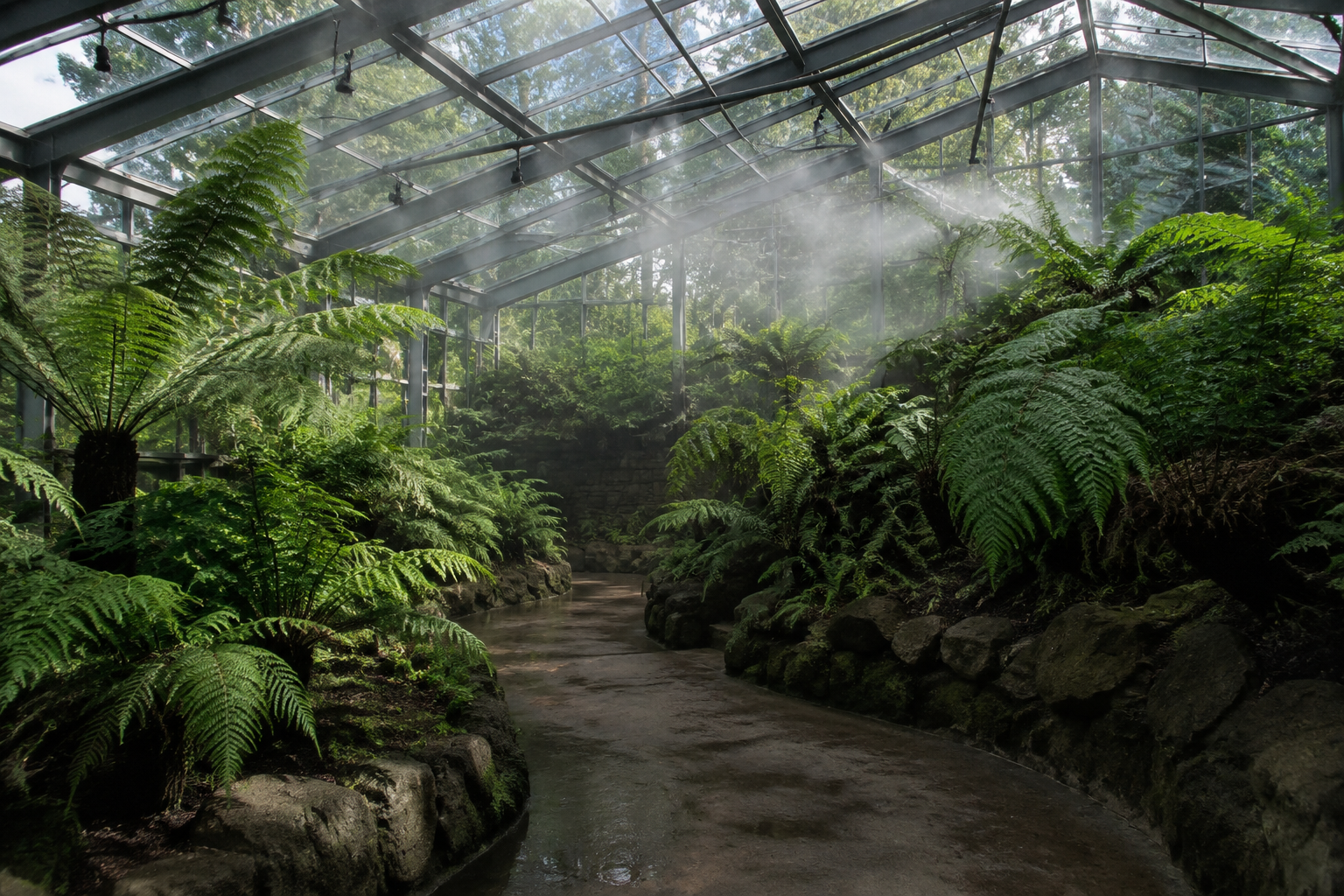
The story works because every part of it has a normal explanation, but the explanations do not arrive in the order people want.
Mist? Of course. It is a fern room.
A dark shape? Of course. It is full of plants and glass.
A closed building? Of course. Security cameras record empty rooms all the time.
But then the account adds the small snag: the mist was not expected then. The shape appeared in the most visually confusing part of the room. The glass seam made it look framed. The vapor made it look present. The room, already designed to feel alive, briefly looked like it had one more occupant than it should.
That is the Laurel-style pull of the case. Not a monster in the leaves. Not a face demanding to be believed. Just a practical maintenance question with a strange image attached to it.
Maybe it was a timer nobody understood. Maybe it was a fern and a reflection agreeing for one frame. Maybe the room only looked occupied because the mist gave the darkness a body.
For most accounts like this, that is where the honest answer stays.
Still, if you have ever walked past a conservatory after closing and seen the glass glowing from inside, you understand why this one lingers. A locked room full of plants is never completely still. Add unexpected mist, and even a shadow between panels can look like it was waiting for the room to breathe.
Reader Context
This Weird Witnessed story is an editorial reconstruction, written as eerie visual storytelling rather than a verified report. For more context, see Apparitions and Hauntings Guide and How WeirdWitnessed Creates Reconstructed Horror Stories.