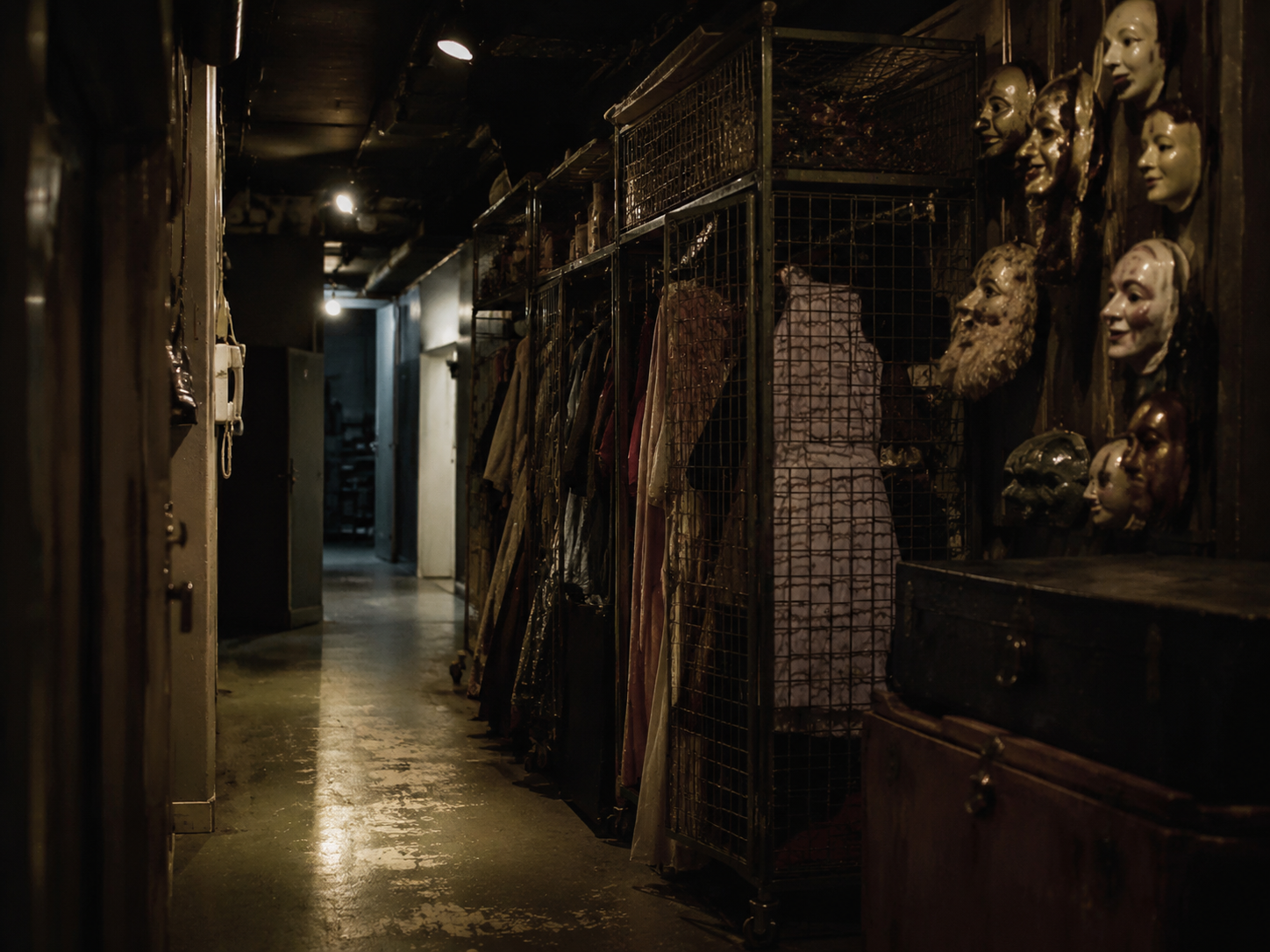
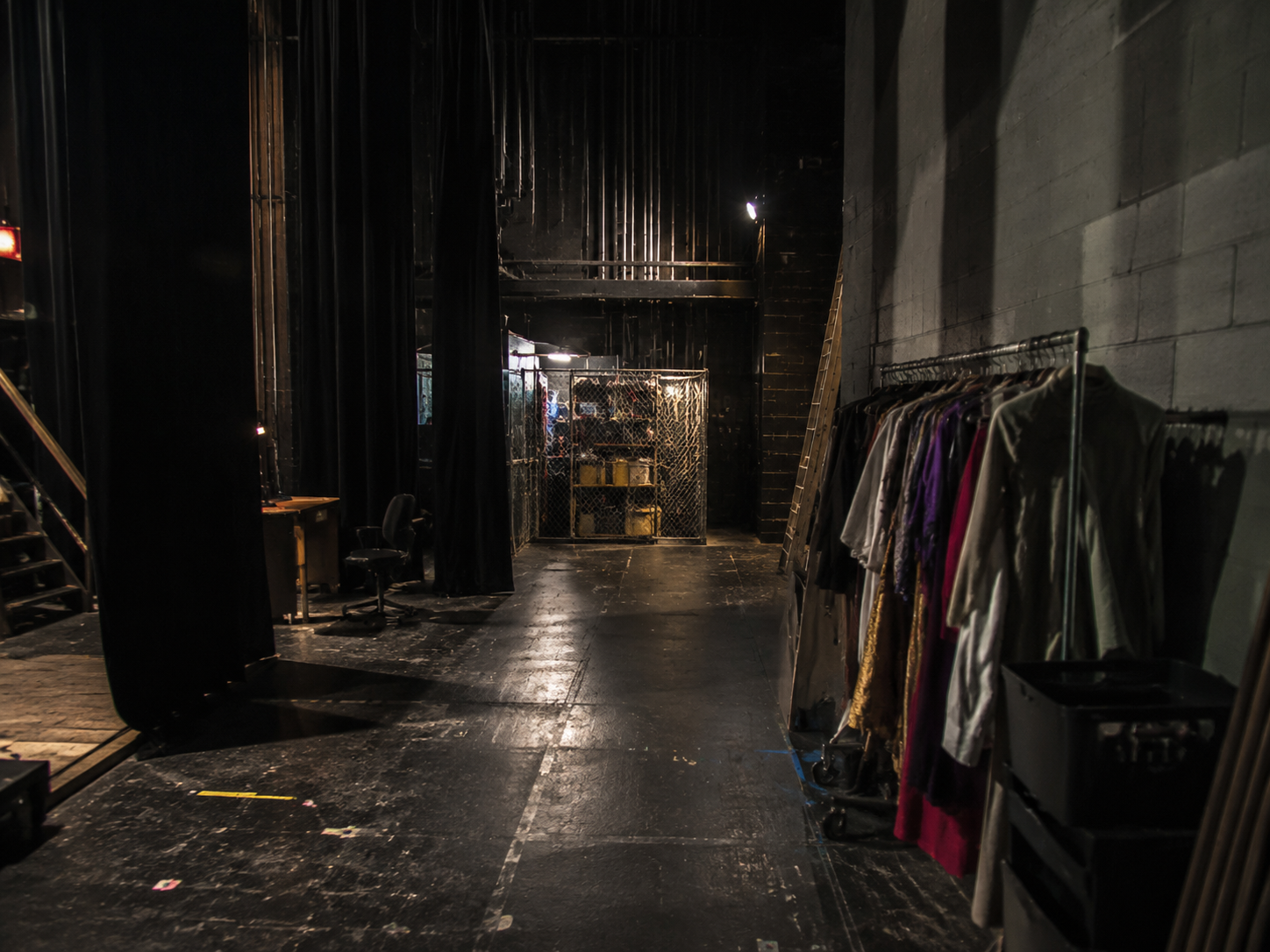
The community theater story works because almost everyone knows what a backstage room feels like after the audience has gone home. It is not a glamorous place. It is tape on the floor, folding chairs in the wrong corner, racks of donated dresses, plastic bins of hats, and a locked wire cage where the best costumes are stored so they do not wander away before opening night.
According to the version shared around town, the camera was installed for practical reasons. A few costume pieces had gone missing during a busy rehearsal week, and the board wanted a simple view of the storage cage after closing. Nobody claimed they were hunting ghosts. Nobody set up candles or asked for a sign. The camera was supposed to catch a person with a key or a forgetful volunteer.
Instead, the camera still reportedly showed a small change that was easy to miss: one mask hanging backwards on the cage, facing the wall while the others faced the aisle. Near that same stretch of camera images, a featureless figure-shaped form appeared close to the wire, too soft to identify and too still to explain quickly.
That is why the story keeps getting repeated. It does not offer proof. It offers a familiar room with one detail out of place.
WHAT THE camera still IS SAID TO SHOW
- A closed community theater after the building was reportedly locked.
- A security camera aimed at the costume cage and backstage aisle.
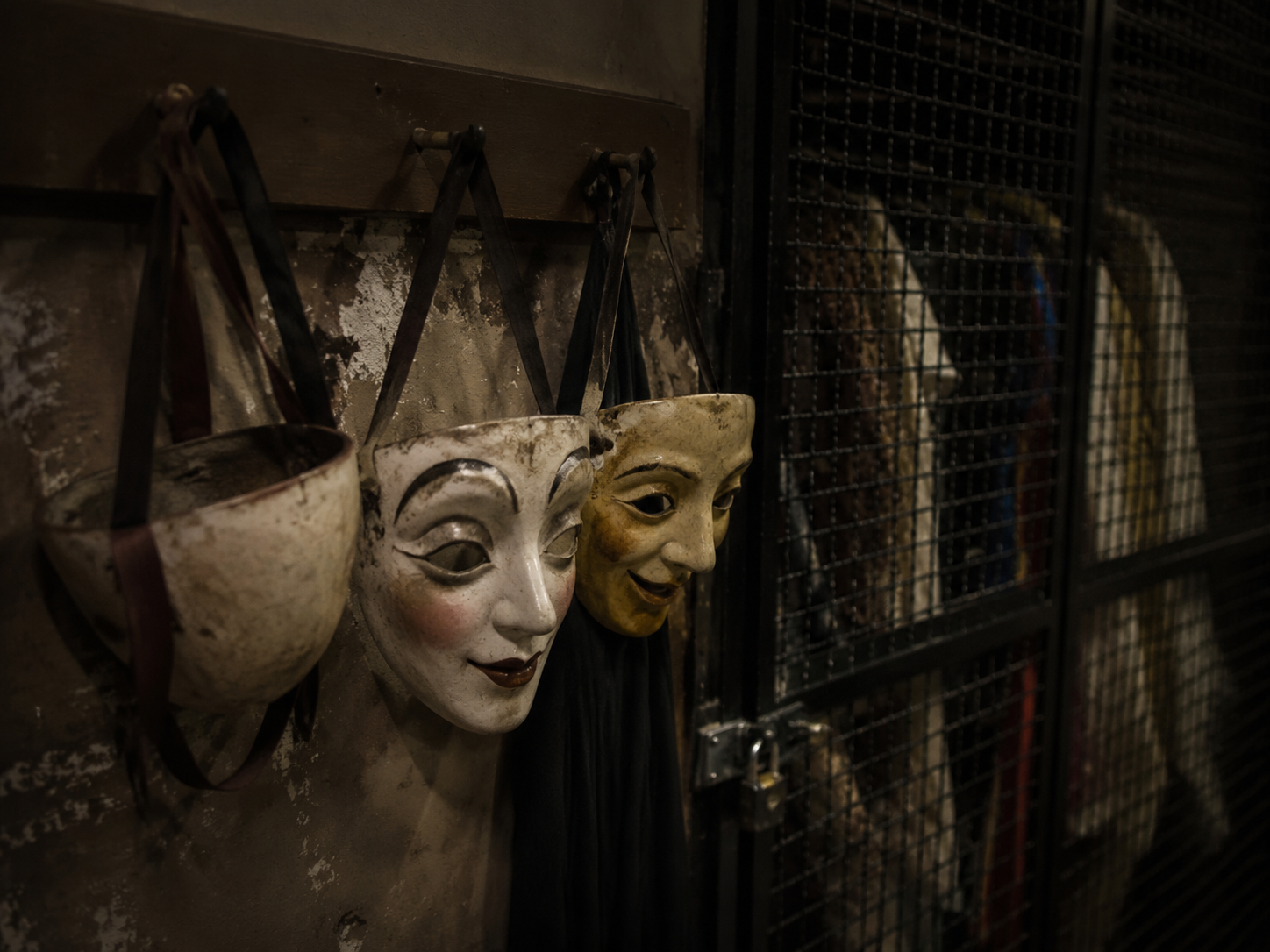
- Several masks hanging on hooks outside or beside the cage.
- One mask that appears to be hanging backwards in the reviewed camera images.
- A pale, featureless, person-like figure near the cage for a brief moment.
1. The Costume Cage Is Already a Strange Visual Trap
A costume cage is one of the worst places to ask a camera for certainty. Wire mesh breaks every object into squares. Sequins reflect tiny pieces of light. Long coats hang like bodies until someone remembers they are only coats. A feathered hat can make a shoulder where no shoulder exists.
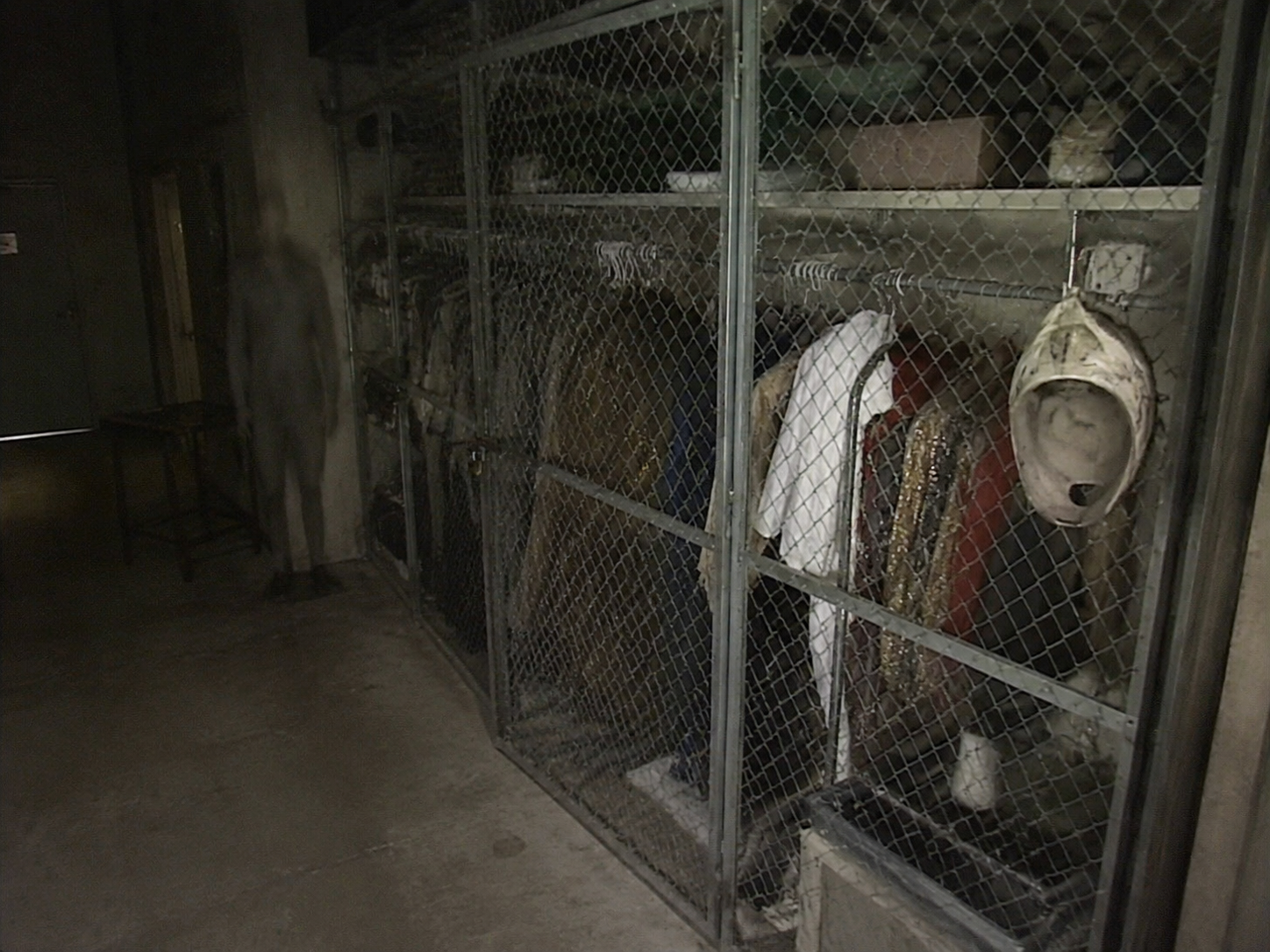
The recreated scene describes a camera with a high corner angle, which makes the cage look deeper than it is. That matters. From above, a dress form can merge with a coat rack. A foam head can sit at the height of a face. A white sleeve can look like an arm crossing the aisle.
This is the most cautious way to approach the camera still: the setting itself can manufacture apparitions. It is full of human shapes that are not human. Theater storage is basically a warehouse of fake people.
But that is also what makes the camera images feel so effective as a piece of folklore. A theater is designed to turn cloth and paint into characters. When an after-hours camera turns those materials back into a possible person, the building seems to be doing its old job without an audience.
2. The Backward Mask Gives Viewers a Specific Anchor
The figure is vague, but the mask is specific. That is the detail people remember.
In the story, the mask was one of several hanging near the cage. Most faced outward, toward the aisle. One appeared to face the wall, as if someone had lifted it off the hook and replaced it the wrong way around. It was not floating. It was not smiling by itself. It was simply oriented differently than expected.
A practical explanation is easy to imagine. A volunteer might have moved it earlier and forgotten. Someone could have bumped it during the day. A mask can twist on a hook if the strap is uneven or if a door nearby creates a little air movement. If the camera resolution is poor, a side-facing mask may only look backwards.
Still, the backward mask gives the camera still a before-and-after quality even when no clean before-and-after is available. It lets viewers ask a simple question: who touched it?
That question is stronger than a dramatic claim. It does not require a full ghost story. It requires only a locked room, a small object, and a feeling that the object changed when nobody should have been there.
3. The Figure Is Featureless, Which Cuts Both Ways
The reported figure near the cage is not described as a clear person with eyes, clothing, or a face. It is more often described as a blank upright shape, a pale smudge, or a featureless presence standing close to the mesh.
That makes the camera still weaker as evidence and stronger as a campfire story.
As evidence, a featureless figure can be almost anything. It could be a costume bag reflecting light. It could be compression noise around a rack of pale garments. It could be a person briefly entering the frame and losing detail because the camera handled motion badly. It could be a shadow from a lobby light outside the backstage door.
As folklore, though, the lack of features is exactly the unsettling part. A clear face would make the story easier to challenge. A blank form lets people project the theater’s own history onto it: an old actor, a stage manager, a child from a summer production, or just the idea of someone still waiting in the wings.
The careful version of the story does not need any of those identifications. It is enough to say that the form looked human-like and did not behave like a coat on a rack.
4. After-Hours Theater Cameras Make Ordinary Movement Look Intentional
Small theaters are noisy even when empty. Air systems hum. Exit doors settle. Rigging creaks. Old curtains shift slightly when heat turns on. A building that has held applause for decades often sounds like it is clearing its throat.
On camera, those little movements can become suspicious. A hanging costume rotates a few degrees. A mask strap slides. A rack wheel relaxes against uneven flooring. The image refresh rate catches one frame of motion and loses the next, creating the impression that something jumped.
This is why the most responsible reading stays cautious. The camera may have captured a mundane chain of events: a mask slowly turning, a rack shadow changing, and a pale costume surface briefly aligning into a person-like shape.
But the emotional reaction is understandable. Theater people are trained to notice entrances. When a human-shaped form appears at the edge of a costume cage, it feels like someone has hit a mark. The aisle becomes a stage, the wire cage becomes a set, and the backward mask becomes a prop placed for the audience.
That is why viewers pause the camera still at the same few seconds. The scene seems composed, even if it was only accident.
5. The Local Legend Is Better Without a Big Claim
The strongest versions of this story are the quiet ones. They do not say the theater is definitely haunted. They do not claim the camera still proves an apparition. They do not attach the figure to a named tragedy or insist that the mask moved by invisible hands.
They say a camera was watching a costume cage. They say one mask looked wrong. They say something featureless stood near the cage in the camera images. They say people who knew the room did not like the way it looked.
That restraint matters. Local mysteries become less believable when every detail is polished into certainty. This one remains interesting because it stays small and awkward. A locked costume area, a backward mask, and a vague figure are exactly the sort of details a volunteer might mention in the lobby after rehearsal, half joking and half hoping someone else had an explanation.
The likely answer may be cloth, camera grain, airflow, and memory. Community theaters are full of all four. Still, the camera still has the shape of a good local haunting because it uses the theater’s own materials: masks, costumes, shadows, and the uneasy feeling that something backstage is waiting for its cue.
No one has to accept it as proof to understand why it travels. In a building built for pretending, the strangest evidence is sometimes the one object that looks as if it forgot which way to face.
Reader Context
This Weird Witnessed story is an editorial reconstruction, written as eerie visual storytelling rather than a verified report. For more context, see Apparitions and Hauntings Guide and How WeirdWitnessed Creates Reconstructed Horror Stories.