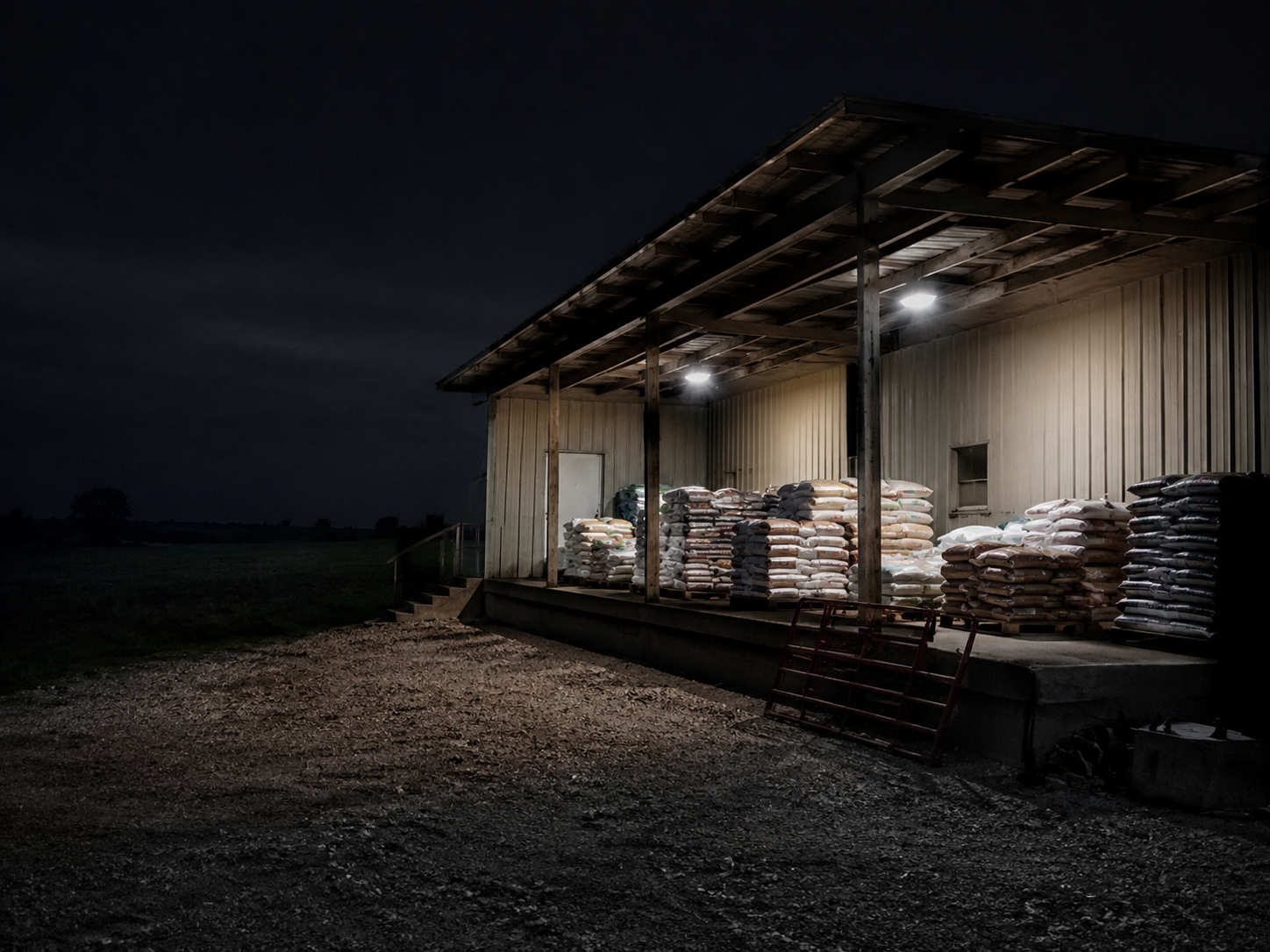
The farm supply store was not the kind of place people expected to produce a sky story.
It sold feed, fencing staples, salt blocks, sprayer parts, seed, work gloves, and the practical items that make rural life less romantic than postcards suggest. The loading dock sat behind the building, facing a gravel lane and a dark strip of pasture. At night, the dock lights turned the feed pallets into square shadows. Beyond them, the road disappeared between fields.
In the recreated version, the odd camera record happened just after midnight.
A security frame reportedly showed an oval light above the stacked feed pallets. Around the same window of time, audio picked up a forklift alarm or warning chirp, even though the forklift was parked and the key was said to be locked in the office. Nothing on the dock appeared scattered the next morning. No feed bags were torn open. No fence panel had fallen. The scene left behind was mostly ordinary, which may be why the story kept circulating.
It did not give people an event. It gave them a still image and a sound that did not belong.
WHAT THE RECREATED MOMENT SHOWS
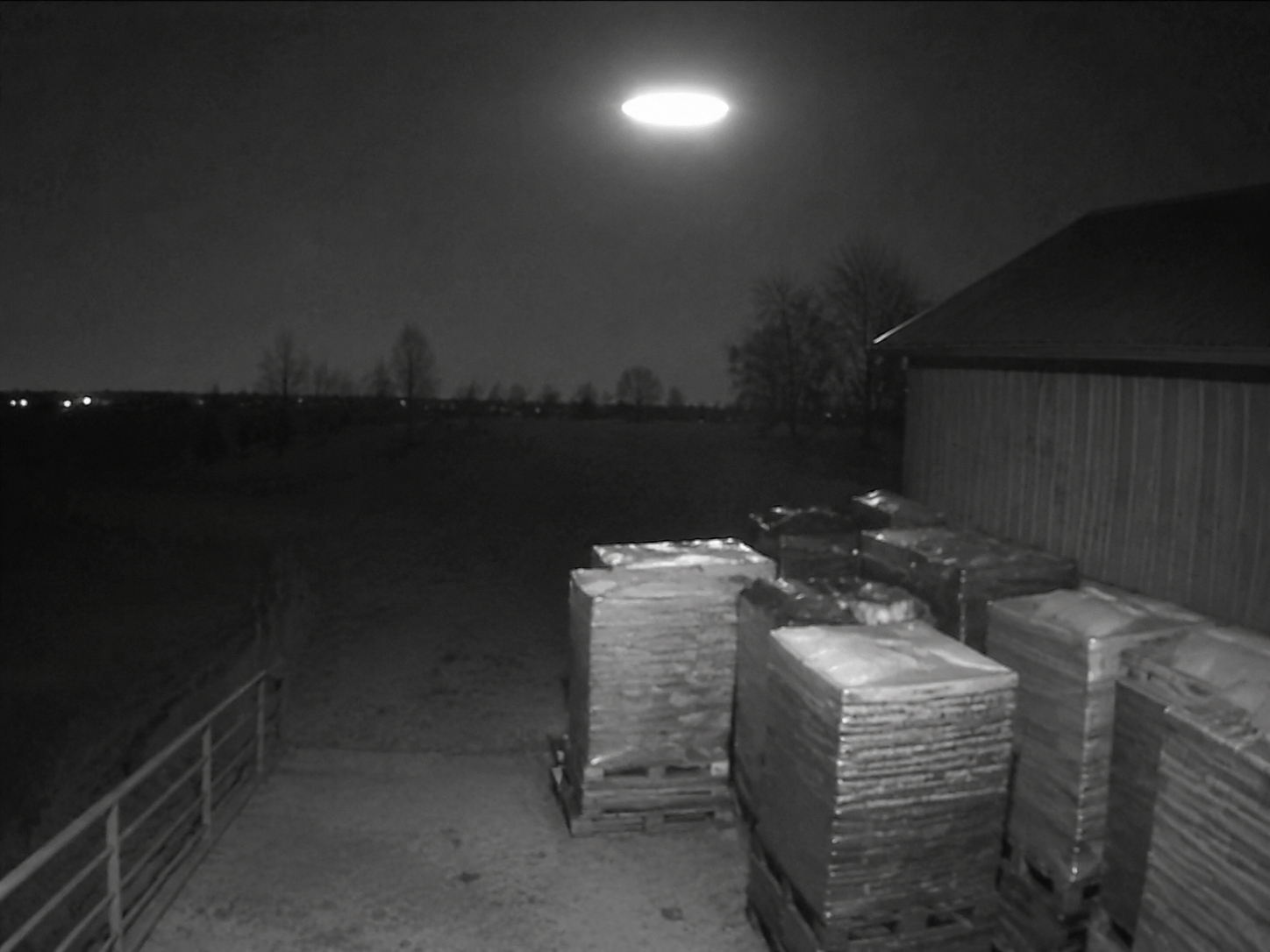
- A rural farm supply loading dock after midnight.
- Stacked feed pallets under an awning with no workers present.
- A security frame showing a pale oval light above the pallets.
- A forklift alarm reportedly recorded despite no key in the forklift.
- No clear damage or settled explanation the following morning.
This is a cautious reconstruction, not evidence of a UFO or any extraordinary event. Security cameras create strange lights. Forklift alarms can fault, chirp, or catch reflected sound. Still, the combination of an overhead oval and a keyed-off machine made an ordinary loading dock feel briefly like the center of something larger.
1. The Oval Light Was Small Enough to Be Plausible and Strange Enough to Travel
The shape matters.
In the version people repeat, the light was not a huge saucer filling the sky. It was a pale oval above the feed pallets, caught in one or a few frames near the edge of the dock camera’s view. That scale makes the story more believable as a local mystery, because it does not ask the listener to imagine a cinematic craft landing in a gravel lot.
It could have been many ordinary things.
A vehicle on the road might have thrown headlights across the awning. A reflective feed wrapper or plastic pallet cover might have bounced light toward the lens. An insect close to the camera can appear as a bright oval because it is out of focus and lit by infrared. Moisture, dust, spider silk, or a passing bird can all become strange geometry in low-resolution camera images.
Those explanations are not afterthoughts. They are the first place to look.
But the oval description survived because it hovered in relation to the pallets. It seemed placed, not smeared across the whole frame. People who saw or heard about the image described it as sitting just above the stacks, as if the dock had briefly acquired a second lamp that nobody installed.
A small mystery can be more durable than a spectacular claim. It leaves room for argument.
2. Feed Pallets Made a Perfect Reference Point
Empty sky is hard to judge. A loading dock gives the eye measurements.
The feed pallets were stacked in rows under the metal awning, with fifty-pound bags wrapped in plastic and arranged by brand and animal type. Even if the camera images was grainy, the pallets created straight lines. A light near those lines seemed easier to place than a light in open air.
That does not mean it was physically above the pallets. Camera perspective can compress distance. A light from far beyond the dock may appear to sit over a stack in the foreground. Reflections on the awning can make a source seem lower than it is. A bug on the lens can appear to float in the scene even though it is only inches from the camera.
Still, reference points are powerful. They turn a vague glow into a location.
People could say, “It was right over the feed,” not merely “there was a light.” That phrase gives the account texture. It places the event among practical objects: mineral tubs, wrapped pallets, a parked forklift, the concrete lip of the dock. The more ordinary the setting, the more noticeable the odd detail becomes.
That contrast is the heart of many rural weird-event stories. The uncanny does not arrive on a mountaintop. It appears over livestock feed.
3. The Forklift Alarm Is the Detail That Changes the Mood
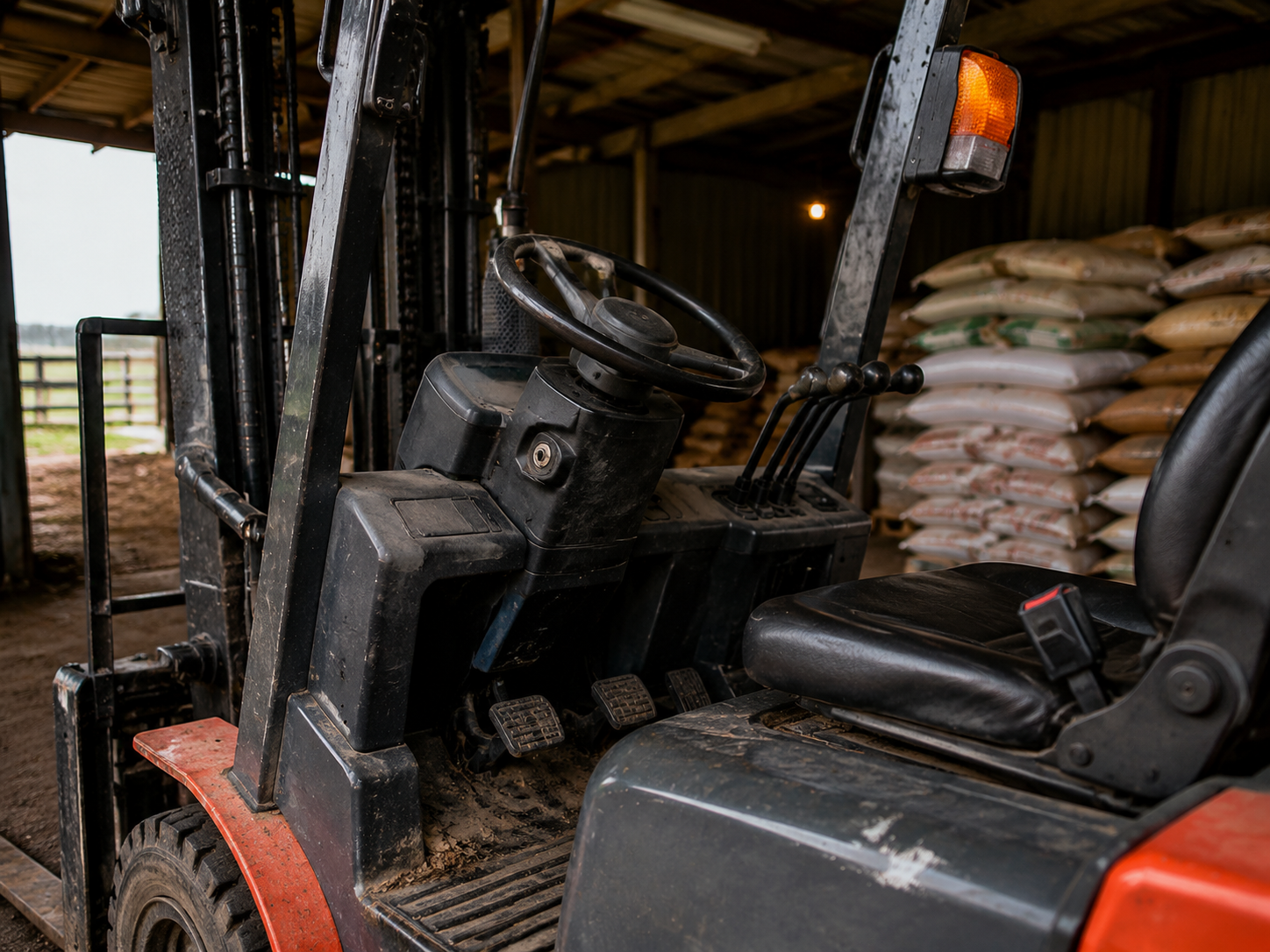
A light on a camera can be dismissed quickly. A matching sound is harder for people to ignore.
The account says the audio included a forklift alarm or warning chirp around the same time the oval light appeared. Not a long crash, not an engine starting, not a clear reverse sequence with tires moving. More like a brief electronic alert from a machine that should have been sleeping.
There are practical explanations.
Some forklifts have backup alarms, seat sensors, battery warnings, or fault chirps. A low battery can create a noise without the machine being driven. Moisture in wiring can trigger odd beeps. If the alarm was not actually from the forklift, another device on the dock might have produced a similar sound: a truck backing up on a nearby road, a delivery scanner, a gate sensor, or even audio distortion.
The “no key” detail also needs caution. A key not being in the ignition does not mean every electrical circuit is impossible. Equipment varies. Memories vary. The key may have been checked later, or the statement may come from habit rather than a formal inspection.
Even so, the alarm is why the story feels like an event instead of a weird photograph. It gives the frame a reaction. The light appears, and the machine complains.
Folklore loves sequence, even when sequence is coincidence.
4. Nothing Was Disturbed, Which Somehow Made It Stranger
The next morning did not provide the satisfying clue people wanted.
No feed pallets were knocked over. No bags were slashed. No scorch mark was mentioned. The forklift reportedly remained parked. The gravel did not reveal a dramatic pattern. Employees opened the store and found the dock mostly as it had been left.
For skeptics, that lack of aftermath supports ordinary explanations. If nothing moved, nothing landed. If nothing was damaged, the alarm may have been electrical and the light may have been optical. The world remained normal because the event was probably normal.
That is a reasonable reading.
But in scary reconstructed momenttelling, an undisturbed scene can also deepen the unease. People expect weird events to leave proof. When they do not, the absence becomes part of the mood. The pallets become witness marks without testimony. The forklift becomes a machine that made a sound and then refused to explain why.
The loading dock’s practicality adds to this effect. Farm supply stores are built around cause and effect. A bag tears because a fork caught it. A pallet shifts because a truck bumped the dock. A warning alarm sounds because someone put a machine in motion.
When the cause is missing, the place feels briefly out of character.
5. Why the Story Remains a Weird Event Rather Than a UFO Claim
The careful version does not need to call the oval light a craft.
That is important. The word UFO can simply mean unidentified in the moment, not alien, not spacecraft, not proof. In this account, the light is unidentified because the available details do not settle what it was. It may have been headlights, lens flare, an insect, a reflection, or equipment glare. The alarm may have been unrelated. The timing may feel meaningful only because humans are excellent at connecting dots in the dark.
Still, the story belongs in the weird-event category because of how the pieces line up.
A farm supply loading dock is a place of weight, inventory, and routine. Feed pallets do not invite cosmic speculation. Forklifts are tools, not omens. Yet a single frame of oval light above stacked feed and one unexplained chirp from a parked machine can tilt the whole scene toward mystery.
That tilt is what people remember.
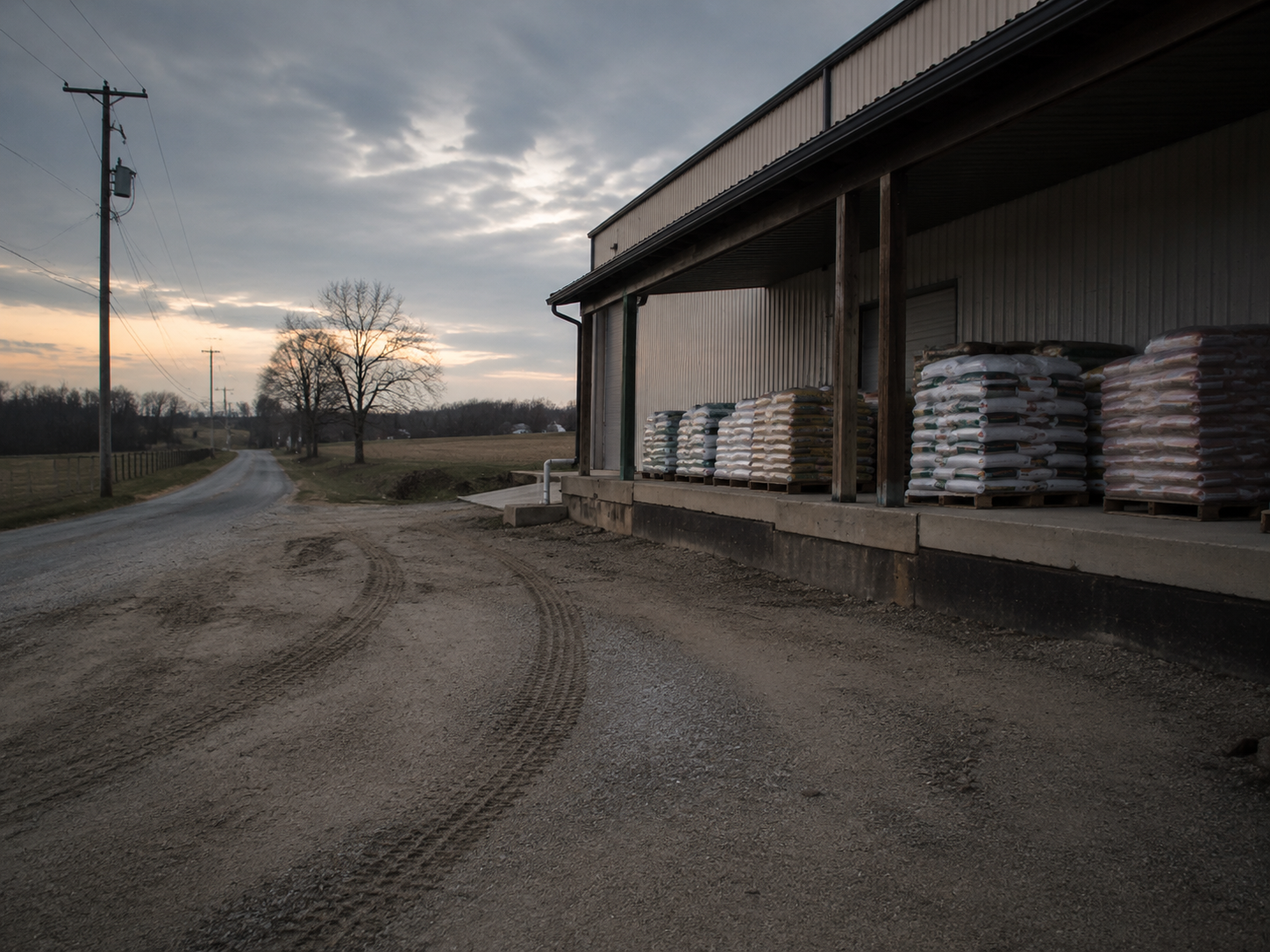
They picture the store after midnight, the gravel lot empty, the fields beyond the dock black and flat. The camera watches because cameras are supposed to make places less mysterious. Instead, it catches a pale oval where no lamp should be. The audio records a warning from a forklift nobody says was keyed on. Then morning comes, and the dock is ordinary again.
A skeptic can walk through the possibilities and likely be right about most of them. Rural roads have headlights. Cameras have bugs. Alarms fail. People misremember procedures. All of that should be stated plainly.
But the recreated scene persists because it gives one of the most practical places in town a single impractical minute. For a moment, above the feed pallets, something looked present without being explained. For a moment, a parked forklift seemed to warn about it.
No proof claim is needed. The image is enough to keep the story parked at the edge of the dock, waiting for someone to check the camera images one more time.
Reader Context
This Weird Witnessed story is an editorial reconstruction, written as eerie visual storytelling rather than a verified report. For more context, see UFOs and Unknown Visitors Guide and How WeirdWitnessed Creates Reconstructed Horror Stories.