The camera still That Looks Too Plain to Be Strange
The most unsettling camera images is not always dramatic. Sometimes it is a fixed camera, a closed building, and an object moving in a way that makes the room feel suddenly occupied.
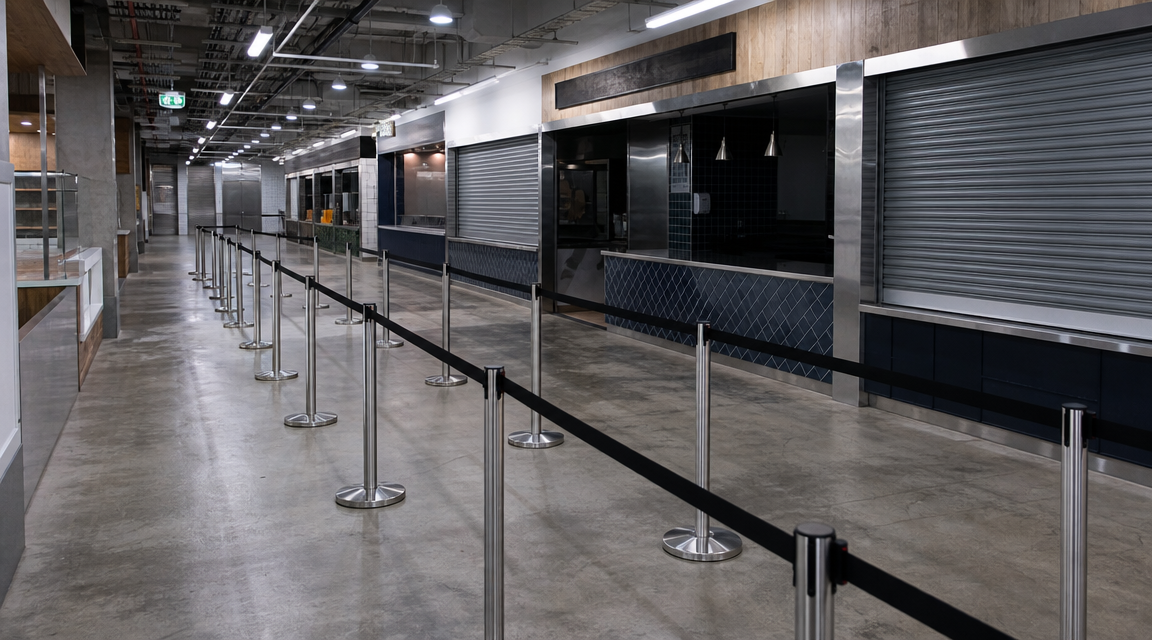
That is the effect of a CCTV camera still said to come from an indoor market before opening time. The frame shows a concourse with shuttered stalls, polished flooring, overhead lights, and a line of portable queue barriers near what appears to be a popular counter or entry point.
At first, nothing in the scene asks for attention. There are no figures at the edge of the frame, no obvious prankster hiding behind a pillar, and no cinematic burst of motion. Then the belts and posts begin to shift.
Not all at once. Not violently. They move in small, practical adjustments, as though a queue is being shaped by people who know where they are supposed to stand.
A Market Before the Morning Rush
Indoor markets have a very particular kind of silence before opening. Refrigeration units hum behind closed shutters. Cleaning lights flatten the color out of the floor. A few signs are visible but not yet useful because there is no crowd to read them.
In this camera images, that pre-opening emptiness is part of the unease. Queue barriers are normally background objects. They tell living customers where to wait, where to turn, and when to approach a counter. Without people, they are just hardware.
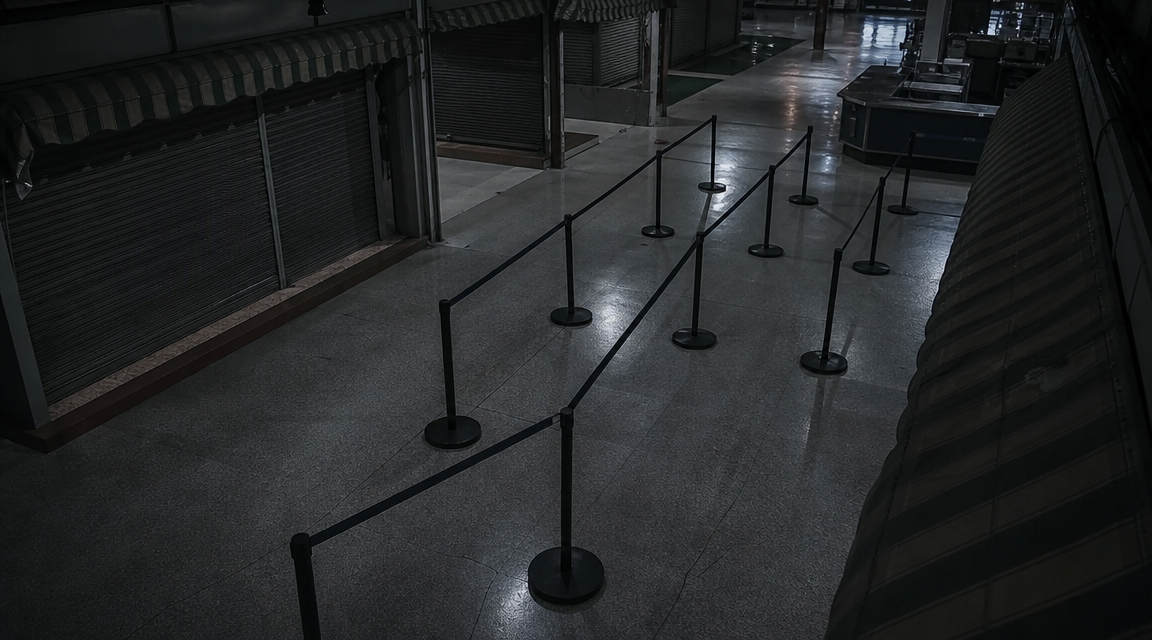
The camera appears to be mounted high, looking down across the waiting lane. Several stanchions stand in a loose arrangement, connected by retractable belts. The layout is not chaotic, but it is not perfectly taut either. It has the slightly tired look of a setup left overnight.
Then one belt draws at an angle. A post seems to pivot. Another section of the lane shifts enough to change the geometry of the queue. The movement is minor in size but major in implication.
A queue is a social shape. It only makes sense because bodies agree to occupy it. Watching that shape adjust itself in an empty market feels like watching the idea of a crowd arrive before the crowd does.
What the Camera Appears to Show
According to descriptions attached to the camera still, the camera record was made while the market was closed to the public. The visible shutters were down, and the area had not yet opened for vendors or customers.
The most repeated detail is that no bodies are visible when the barriers move. There is no person leaning into the posts, no cleaner dragging a hose through the lane, and no guard walking through the shot.
The motion looks strangely purposeful. A barrier line that had been slightly open appears to tighten. One lane widens, then narrows. The belts do not flap wildly as if caught by a sudden gust. They behave more like they are being guided, pulled, or released with control.
Still, the camera still has circulated because the visible result feels familiar. Anyone who has watched customers line up before a stall opens recognizes the little adjustments of a waiting line: a step forward, a turn around the barrier, a gap closing.
Here, the movements seem to happen without the customers.
Why Queue Barriers Feel So Human
A chair moving by itself is unnerving because chairs are made for bodies. A door opening by itself is unnerving because doors are meant to be crossed. Queue barriers belong to the same category, but with an added social meaning.
They are not just objects. They organize behavior.
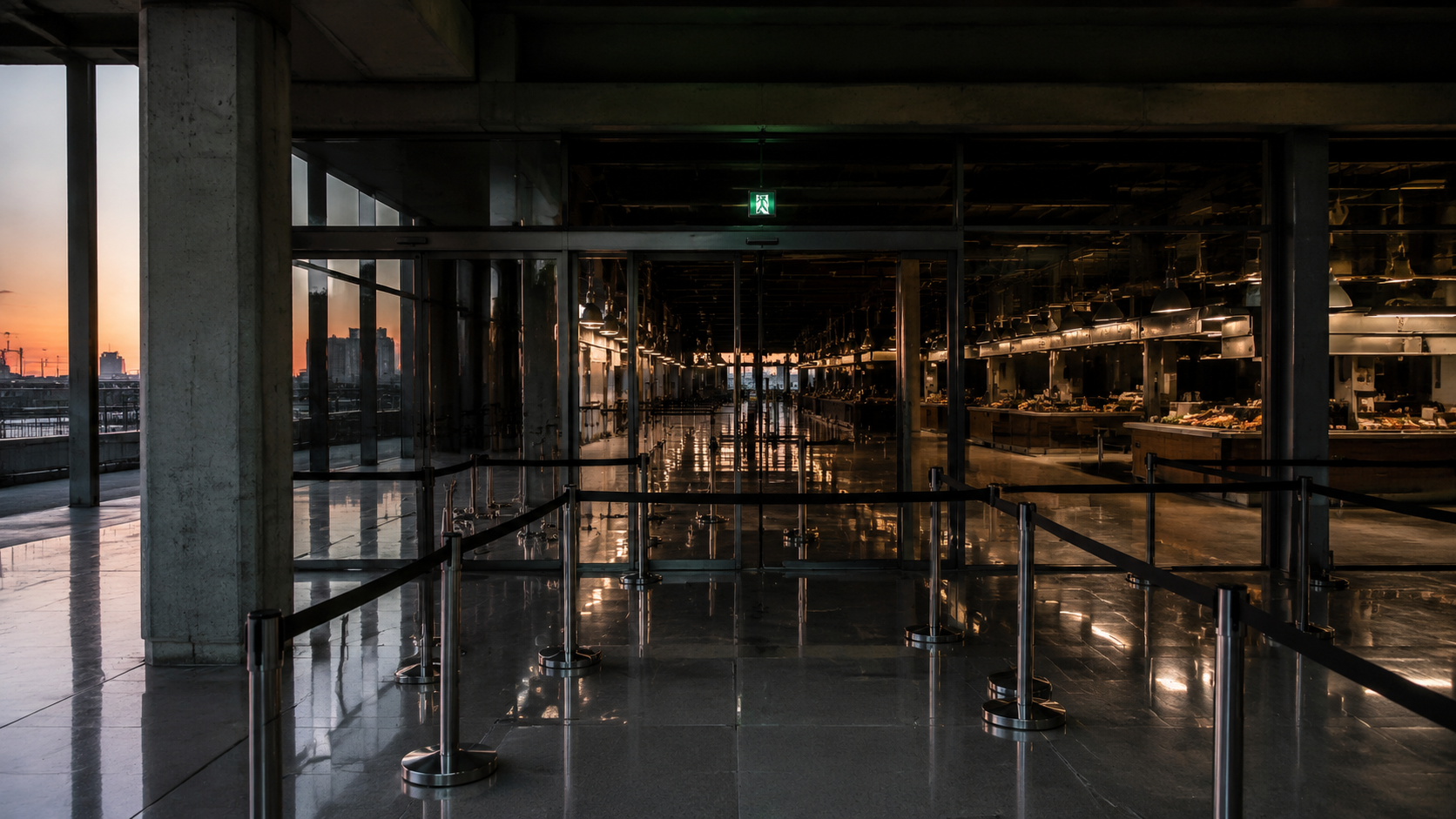
A retractable belt is a soft command. Stand here. Do not cut across. Wait your turn. Follow this path. In a busy market, people obey those lines almost without thinking.
That is why an empty queue can feel more haunted than an empty hallway. It suggests absence in a specific form. Not just nobody here, but nobody here where many people should be.
The camera still leans on that recognition. The barriers do not need to fly across the room. A small repositioning is enough. It makes the viewer imagine invisible shoulders, invisible shopping bags, invisible feet sliding forward on the market floor.
The brain completes the missing crowd because the architecture of waiting is already there.
Ordinary Explanations Worth Considering
The responsible way to look at camera images like this is to begin with the normal possibilities. Security clips are compressed, cropped, and often recorded at low frame rates. They can make simple causes look stranger than they are.
Air movement is one option. Indoor markets may seem still, but ventilation systems can create strong localized drafts, especially near entrances, service corridors, or shutters. A belt under tension could shift if a post was already unstable.
Cleaning equipment is another possibility. A floor machine, hose, or cart outside the visible frame could tug a barrier line. Staff activity just out of view could do the same. A person does not need to appear in the frame to affect something inside it.
Mechanical tension matters too. Retractable belts can slowly pull themselves back if their locking mechanism slips. A belt that was left extended overnight may release in stages, causing a post to swivel or drag slightly if the base is light enough.
None of these explanations is as memorable as an invisible queue. But they are real possibilities, and they keep the story grounded.
The Detail Viewers Keep Replaying
The moment people return to is not the largest movement. It is the timing.
The barriers begin to shift before the public opening, at a time when a line would soon make sense. That coincidence gives the camera images its hook. If the same movement happened at midnight in a storage room, it would be odd. In a market lane just before customers are expected, it feels staged by the building itself.
There is a strange patience to the camera still. The camera does not chase anything. The room does not announce itself as haunted. The market simply waits, and the queue begins to prepare.
That slow preparation is what makes the camera file effective. It gives viewers time to scan the scene, reject obvious causes, and then feel the discomfort of not finding one. The longer the frame stays empty, the more occupied it begins to seem.
In this case, the puzzle is not a shadow or a face. It is a line forming where no one is standing.
How CCTV Turns Small Motions Into Mysteries
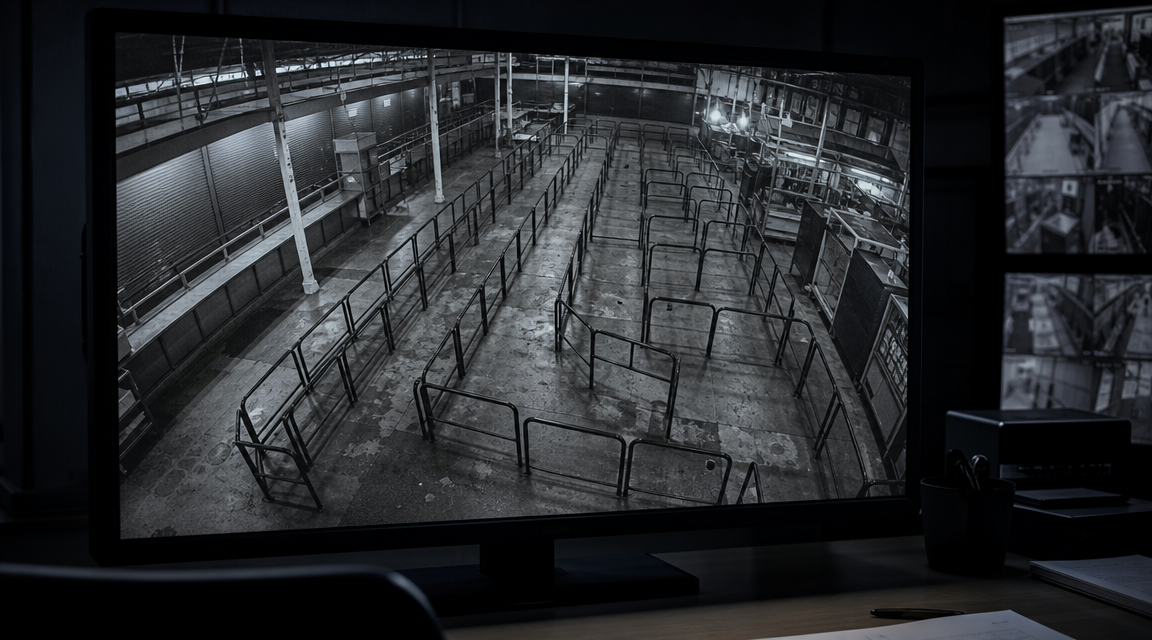
Security cameras are designed to document, not to explain. They record from one viewpoint, usually chosen for coverage rather than clarity. When something happens outside that viewpoint, the lens may capture only the effect.
That limitation is often the birthplace of mystery.
A person hidden behind a stall can become an invisible force. A reflection on polished tile can look like motion in open space. Compression artifacts can soften thin lines or cables into the background.
Even so, viewers are not wrong to feel unsettled. The emotional response comes from what is visible: ordinary objects behaving in an apparently coordinated way in an empty public space.
The camera does not need to prove a haunting to create a haunting feeling.
A Closed Building With a Public Memory
Markets are crowded places even when they are empty. Their floors hold the memory of repeated movement: morning vendors, lunch lines, families stopping at counters, people drifting toward the smell of food.
A queue lane is one of the clearest traces of that routine. It is built because staff already know people will gather there.
That may be why the camera still resonates. It seems to show the routine arriving before the people do. The market remembers the line so well that the line appears to start without them.
Of course, that is a poetic reading, not evidence. Buildings do not need memory to have drafts, loose fittings, or hidden maintenance work. But eerie camera images lives in the space between practical cause and human interpretation.
We see a barrier move, and we think of the people who should be moving it. When those people are missing, the absence becomes the story.
What Remains Unanswered
The important unknowns are practical. Was the full, unedited CCTV file reviewed? Were there additional camera angles? Was the ventilation system active at the time? Had cleaners or staff entered the building? Were the barriers old, loose, or partly connected to objects outside the frame?
Without those answers, the camera still cannot be treated as a detail people read as anything beyond an unusual camera record. It can be described, examined, and appreciated for its atmosphere, but it should not be oversold.
What it does offer is a nearly perfect example of a modern caught-on-camera mystery: a fixed lens, a mundane setting, a small movement, and a missing cause.
The empty queue is eerie because it does not behave like chaos. It behaves like order. The barriers shift into a pattern meant for people, and for a few seconds the market seems to open for customers the camera cannot see.
Maybe there was a draft. Maybe a belt slipped. Maybe someone just outside the frame made the whole scene look impossible.
But in the camera still itself, the market is closed, the concourse is empty, and the line begins to form anyway.
Reader Context
This Weird Witnessed story is an editorial reconstruction, written as eerie visual storytelling rather than a verified report. For more context, see Camera Anomalies and Strange Images Guide and How WeirdWitnessed Creates Reconstructed Horror Stories.