The camera still That Looked Too Boring to Matter
The first thing to know about the baggage claim camera file is that almost nothing happens quickly.
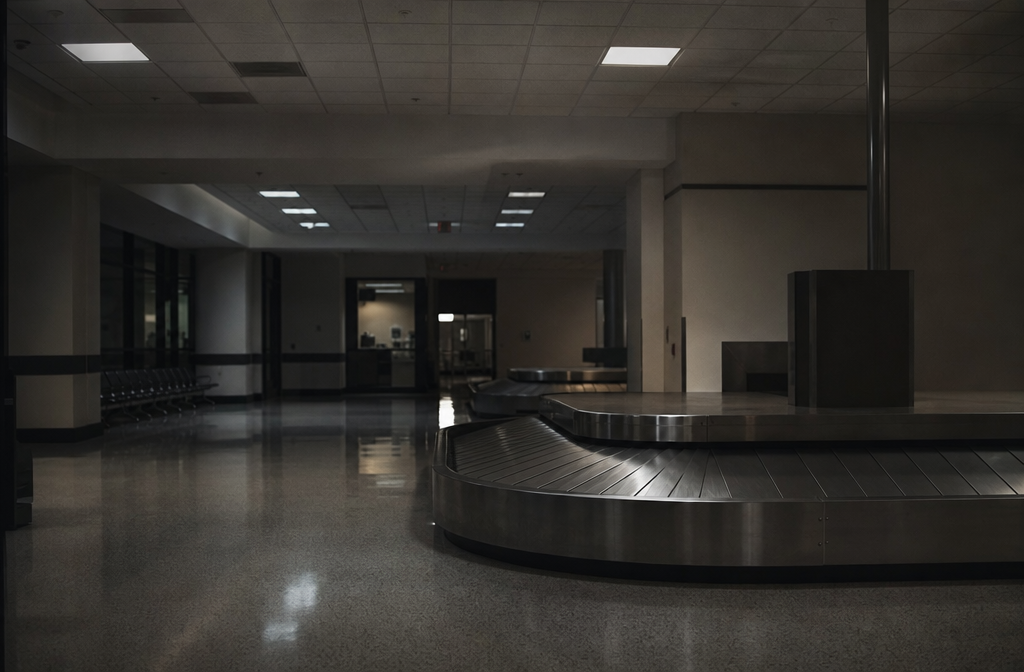
There is no crash, no dramatic entrance, and no crowd turning toward the camera. The view is fixed high in a corner of a small regional terminal, looking down at two baggage carousels, a row of dark airline counters, and a convex inspection mirror near a service corridor.
The timestamp places the camera still well after the last scheduled arrival. The rental car desks had closed. The public address system was quiet. The cleaning crew had reportedly signed out of that wing.
For several minutes, the scene is ordinary in the way late-night airports can be ordinary: too bright, too empty, and still somehow awake.
Then the left carousel starts moving.
No Arrivals on the Board
The airport has not been publicly named in the version most often shared among security and aviation watchers. That is not unusual. Small airports have little to gain from becoming known for a strange baggage belt, and internal clips usually lose identifying details before they travel.
What has remained consistent is the setting: a regional passenger terminal, not a major hub, with a baggage claim area small enough for one camera to cover most of the public floor.
According to the summary attached to the camera still, the last inbound aircraft had arrived nearly two hours earlier. Its luggage had been delivered. The belt had been stopped and cleared. No delayed bags were expected. No charter arrival was logged. No maintenance work order had been opened for that carousel.
That matters because baggage belts are not mysterious to the people who maintain them. They can be triggered locally, remotely, or during testing. They can also fault. None of that requires a ghost.
The narrower claim is more interesting: no authorized activation was recorded when the belt began to move.
What the Camera Shows
At the start, the carousel is still. Its black rubber panels form a dull loop around the metal center island. A few scraps sit near the base, but there is no luggage on the belt.
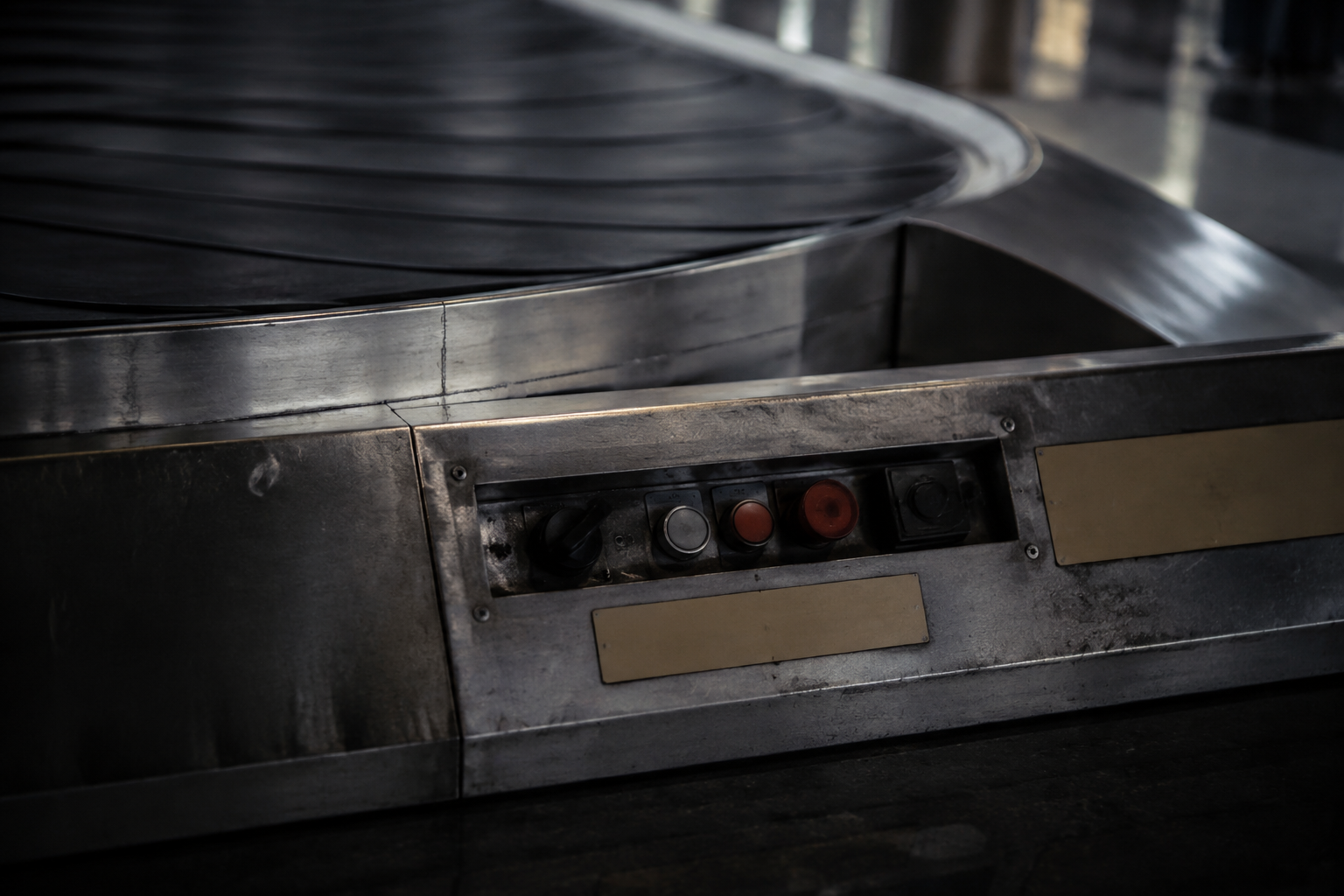
Near the middle of the camera still, the carousel shudders once. It does not roar to life. It gives a small mechanical lurch, pauses for a fraction of a second, and then begins a slow, steady crawl.
The motion is clear. Scuffed panels pass beneath a fixed reflection on the metal trim. The belt is circulating, not vibrating in place.
No person is visible at the control panel. No public door opens. No cleaner, airline worker, passenger, or guard crosses the floor.
The belt continues for less than a minute.
By itself, that would be an odd maintenance note. Airports are full of timed systems, faulty relays, and equipment that behaves differently when power loads change overnight.
The detail that gave the camera still its reputation is in the mirror.
The Mirror Catches Something
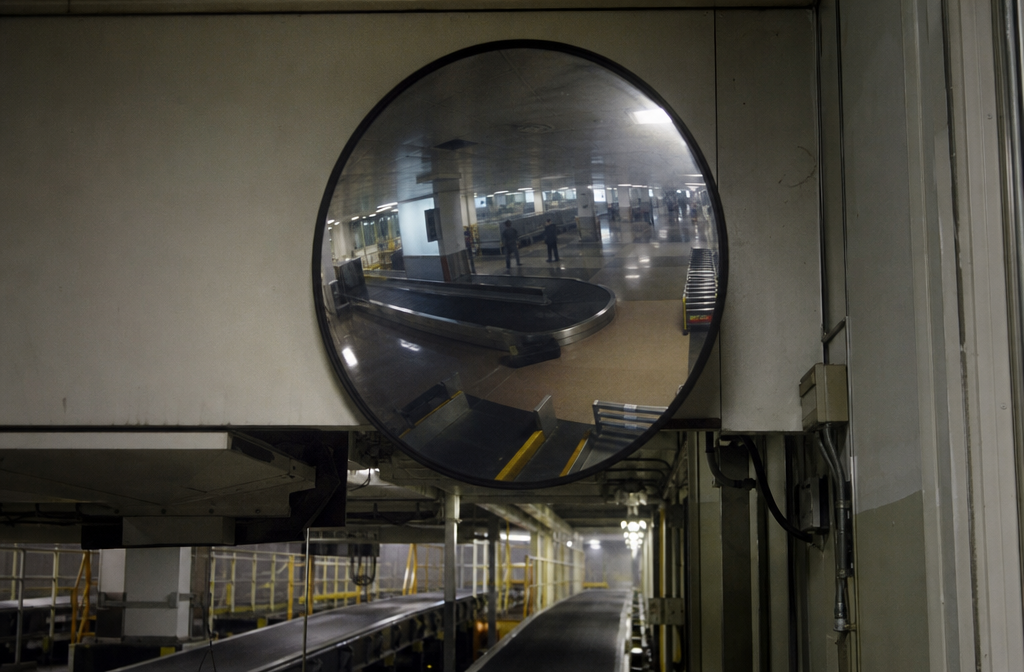
The convex inspection mirror is mounted near a service opening, the kind used so staff can see around a blind corner before moving carts or equipment. In the camera view, it is small but clear enough to show a warped slice of the area beyond the main frame.
When the carousel begins moving, the mirror shows ceiling lights and part of the corridor wall.
A few seconds later, a dark upright shape appears in that reflection.
It is not detailed. There is no visible face, clothing, or hand. It looks more like the silhouette of a person standing near the service side of the carousel, just outside the camera’s direct line of sight.
The shape remains for several seconds. It does not stride across the mirror or lean dramatically into view. It is simply there, vertical and still, in the place where a worker might stand if watching the belt from the non-public side.
Then it is gone.
The main camera never shows anyone entering or leaving.
Why Reflections Are Tricky Evidence
Reflections are dangerous evidence. They compress distance, bend angles, and turn ordinary shapes into human outlines. A trash bin, a hanging coat, a stacked cart, or a dark doorway can become a figure when viewed through a convex mirror and then through a security camera.
That is the responsible starting point for this camera still.
The mirror could have caught movement from a corridor outside the frame. It could have reflected a guard passing through an area not covered by the baggage hall camera. A change in exposure from the moving belt may also have altered contrast, making a shadow stand out only after the carousel started.
There is also compression. Many circulated security clips are copies of copies, stripped of metadata and uploaded at lower quality. Dark areas block up. Edges smear. A small reflection becomes a larger story.
Still, the timing is what keeps people watching.
If the shape was fixed, why was it not visible earlier? If it was a person, why does no other visible entry accompany it? If it was exposure, what changed in that exact part of the mirror?
Those are camera file questions, not paranormal ones.
The Missing Flight Log
The absence of arriving flights is the cleanest part of the account, and also the easiest to overstate.
No arrivals does not mean no airport activity. Regional airports remain active after the passenger schedule ends. Security patrols continue. Airline staff finish paperwork. Operations employees, police, fuel crews, and contractors may still move through restricted areas.
So the statement does not prove the baggage hall was empty.
It does remove the most ordinary reason for a baggage carousel to run: bags were coming off an aircraft.
In a normal arrival, the belt starts because workers are feeding luggage from behind the wall. Passengers gather. Announcements play. Doors open and close. The camera sees motion everywhere.
Here, the public side remains empty. No carts emerge. No bags appear. The belt turns as if serving a flight that does not exist.
That is why the camera still feels less like a jump scare and more like a procedural error from a place that usually keeps careful records.
Plausible Explanations Still Exist
A baggage carousel can start for reasons that have nothing to do with anyone standing beside it.
A stuck relay could energize a motor. A timer could be misconfigured. A remote control circuit could receive a false signal. A technician could run a test from another room. A power interruption could cause a reset behavior. A panel could be left in a state that allowed the belt to restart when power stabilized.
Those explanations are not glamorous, but they are plausible.
The stronger retellings say maintenance checked the system the next morning and found no fault code matching the activation. That claim is hard to verify without the actual report. It may be accurate. It may also be a simplified version of a less dramatic conclusion, such as “no persistent problem found.”
Anyone who has worked around building systems knows equipment can misbehave once and then pass inspection later. Intermittent faults are real. So are incomplete logs.
The carousel starting by itself is not impossible.
The question is whether the mirror figure was connected to it.
What Would Settle the camera images
This case could be clarified with ordinary records.
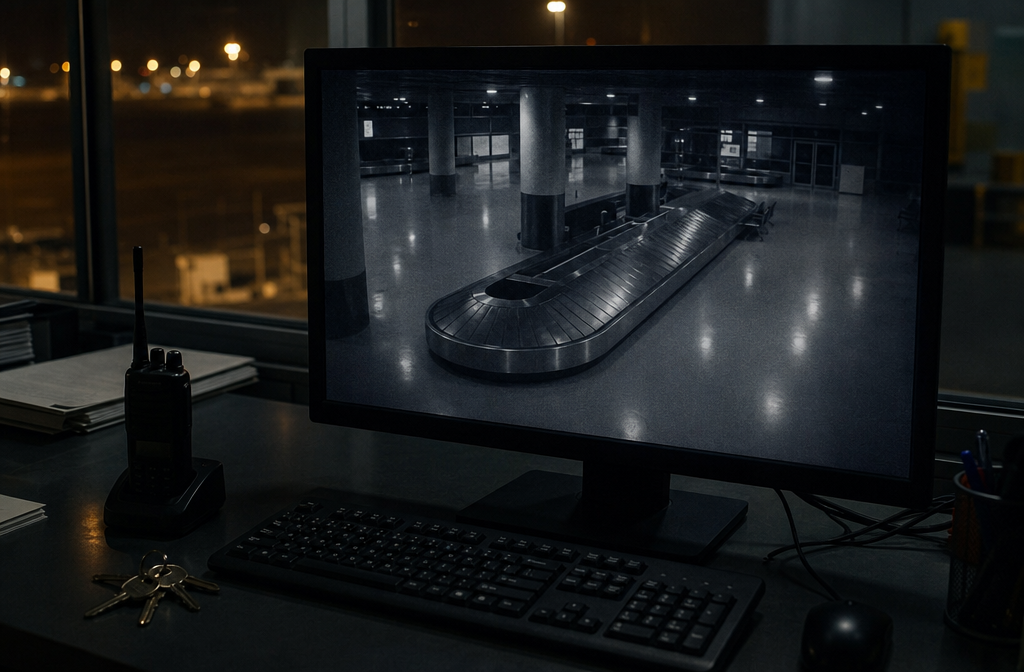
A second camera angle would help. So would access logs for the service corridor, motor control data from the carousel, security patrol records, and the original camera file file rather than a compressed copy. Even a floor plan could explain whether the mirror was reflecting a doorway, a cart bay, or a staff-only passage.
Without those materials, the camera still remains suspended between maintenance anomaly and visual mystery.
The available account supports a cautious conclusion: an after-hours baggage carousel appears to start in an empty regional airport baggage claim area, at a time when no arriving flights were scheduled, and the camera also captures a dark human-like shape in an inspection mirror that is not visible in the main frame.
Everything beyond that is interpretation.
Maybe a worker was present and unlogged. Maybe a control fault started the belt and the mirror caught an unrelated shadow. Maybe the reflection shows a person who knew exactly where the camera could not see.
The camera images does not answer.
It just keeps looping: an empty hall, a belt beginning to move, and a mirror holding a shape for a few seconds longer than comfort allows.
Reader Context
This Weird Witnessed story is an editorial reconstruction, written as eerie visual storytelling rather than a verified report. For more context, see Camera Anomalies and Strange Images Guide and How WeirdWitnessed Creates Reconstructed Horror Stories.