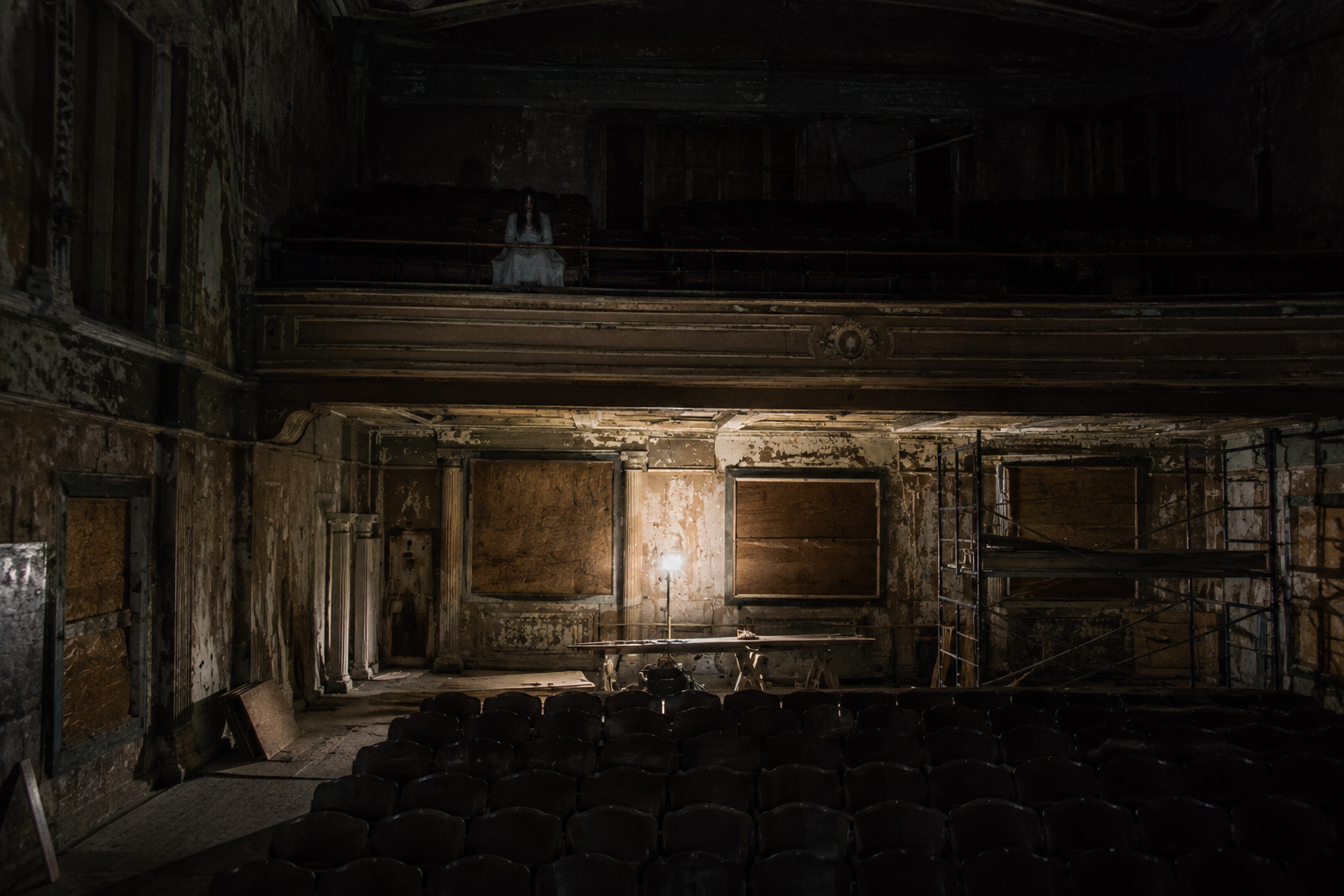
The crew took the photo because the theater looked less dead with the work lights on.
That is how the story usually starts: not with a séance, not with a dare, but with a renovation worker standing near the front rows of an abandoned movie palace and trying to show a friend what the place looked like before the real work began.
The building had been boarded for years. Plywood covered the street doors. Old posters had faded into gray rectangles behind cracked frames. Inside, dust softened every edge. The lower seats were still bolted in place, but many had split cushions and springs showing through. The ceiling held a painted pattern of clouds that must have looked elegant once, before leaks drew brown veins across the plaster.
The upper balcony was darker than the rest of the room. Even with portable lamps burning on the main floor, it stayed in shadow, a heavy black shelf above the workers.
They said nobody was up there.
Then the photo began making the rounds.
The First Day Inside
On the first day, the crew’s job was simple: document damage, check hazards, and figure out which areas were safe enough for deeper inspection. They moved slowly because abandoned theaters hide problems. A soft-looking carpet can cover rotten flooring. Decorative plaster can fall without warning. Stairs that seem sturdy can shift under a boot.
According to the local version, the balcony was not part of the day’s plan. The stairs leading up had been blocked by a chain and a locked door because the upper level needed a separate structural check. Nobody wanted a worker wandering onto a weak balcony before an engineer looked at it.
So the team stayed below. They photographed the stage, the aisles, the side exits, the orchestra pit, and the cracked lobby doors. One worker turned around near the stage and snapped a wide shot of the auditorium.
At the time, the balcony was just a dark shape above the seats.
The Seat In The Balcony
The figure was noticed later, after the crew had left and the day’s photos were being sorted.
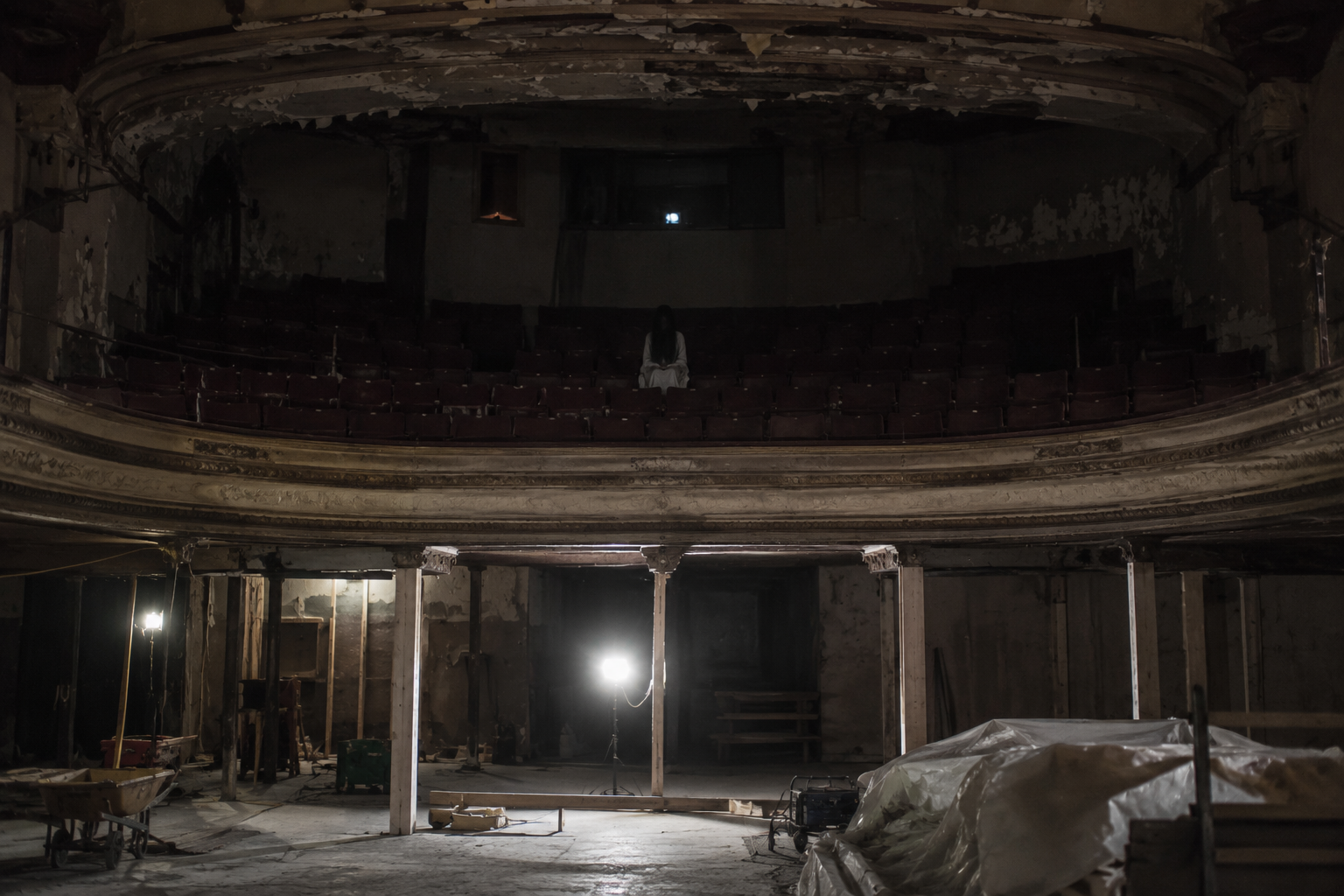
In the image, the lower level is cluttered with ordinary renovation details: extension cords, tool bags, a folded ladder, plastic sheeting, and dust hanging in the work lights. The camera faces back toward the rear of the auditorium. Above the last rows, the balcony curves from wall to wall.
Near the center, several seats back from the rail, there appears to be a woman.
She is pale against the darkness, seated upright, wearing what looks like a plain white dress. Her head is angled slightly downward, as if she is looking at the workers below. Dark hair falls around her face and shoulders, long enough to hide any expression. There is no glowing outline and no theatrical mist. She looks worse than that. She looks solid enough to be someone who found a seat and waited.
That detail bothered people who saw the photo. A blur can be dismissed quickly. A reflection can be shrugged away. But a seated figure has posture. It has placement. It makes the empty balcony feel occupied in a specific way.
The crew member who took the picture reportedly did not see anyone at the time.
The Door They Said Was Locked
The story became harder to laugh off because of the balcony access.
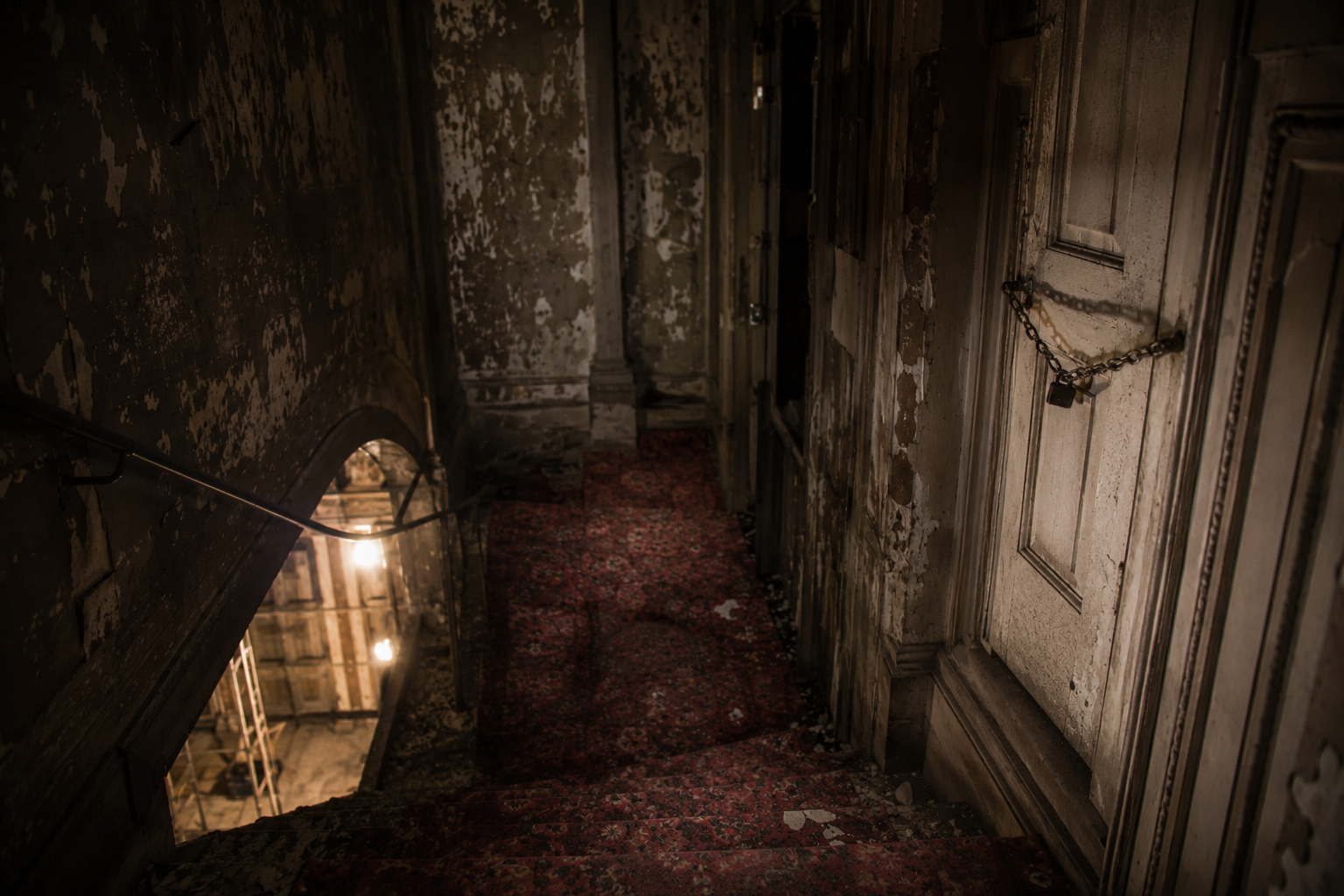
The upper level was reached by stair doors on either side of the auditorium. One was swollen in its frame and partly blocked by debris. The other had been chained shut from below, not as a warning for ghost hunters, but as a practical safety measure.
The workers said the chain was still there when they left.
If a living person had been in the balcony, there were only a few possibilities. Someone could have entered before the doors were secured and remained silent all day. Someone could have found another route through the building that the crew did not know about. Someone could have slipped in from a neighboring roof, a service hatch, or a broken emergency exit. Old buildings collect hidden paths the way they collect dust.
Still, the crew had spent hours below that balcony. They had shouted to each other. They had dragged equipment across the floor. They had aimed lights upward to check the ceiling. Nobody heard a seat creak. Nobody saw movement above the rail. Nobody noticed a white dress in the dark.
Only the camera did.
What The Photo Seems To Show
The most persistent version is simple: a long-haired woman in a white dress sits alone in the locked balcony, several rows back, centered almost too neatly in the gloom.
What makes the image unnerving is not that she is lunging or staring with bright eyes. She is not performing for the camera. She is placed like a patron who arrived before the show, took her favorite seat, and did not care that the theater had been closed for years.
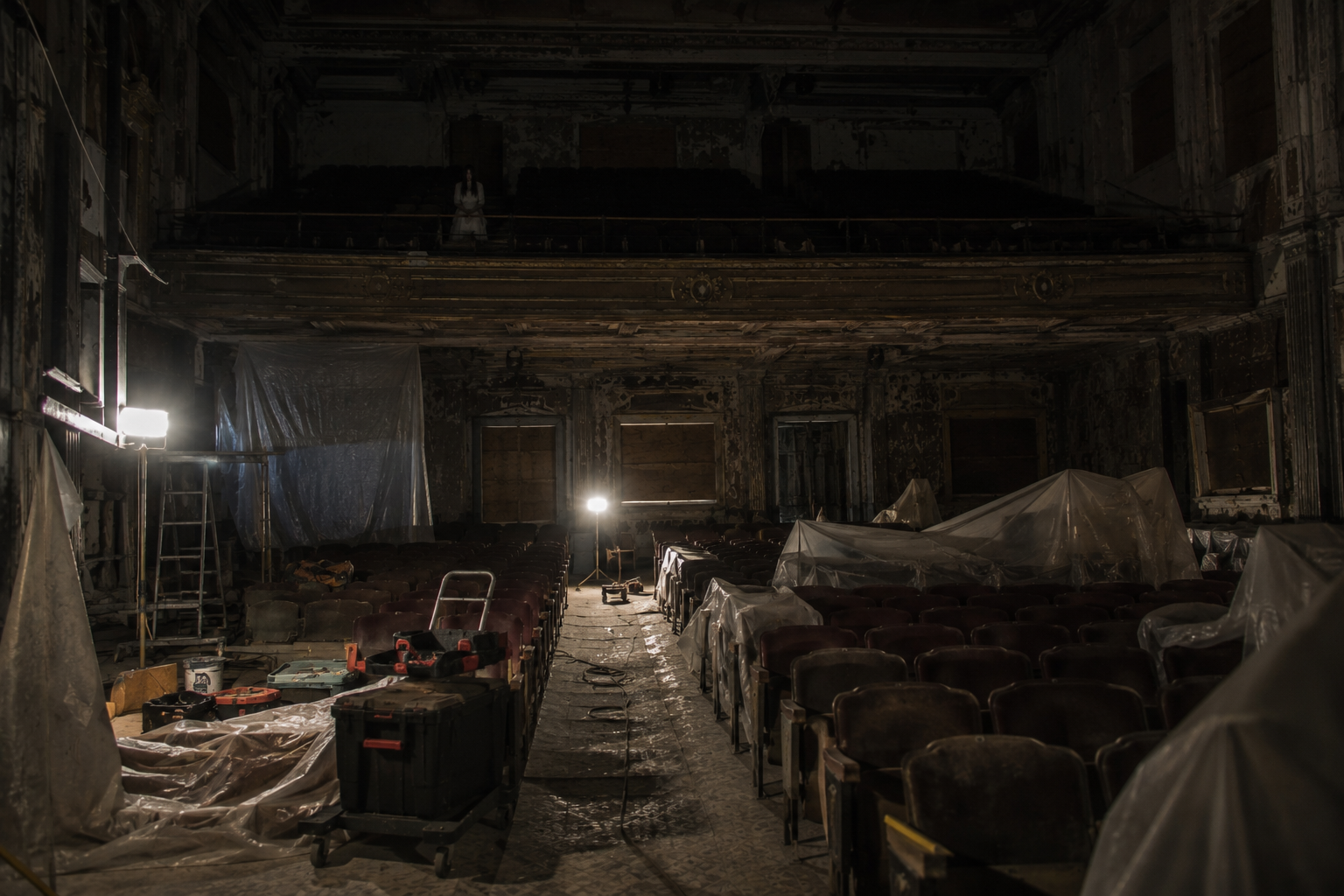
That calmness gives the story its bite. The main floor looks busy and temporary, full of people trying to return the building to the living world. The balcony looks old, private, and claimed.
If the figure is an illusion, it is a well-composed one.
The Search Upstairs
The next visit reportedly included a careful look at the balcony.
By then, the image had already made enough people uneasy that nobody wanted to go upstairs alone. The chain was removed, the door was forced open, and the stairwell gave up the smell of wet plaster and stale air. Dust on the steps showed scattered old marks, but nothing that clearly explained a recent visitor.
The crew checked the area where the woman appeared to be sitting. There was no mannequin, no stored costume, no sheet draped over a chair. One seat had a pale slash across it where the cushion had split, and a nearby piece of plaster had fallen in a shape that looked white under a flashlight.
Those details gave skeptics plenty to work with. But according to the people who preferred the stranger version, none of them matched the photo from below. The torn cushion was too low. The plaster was too far to the side. The balcony seats created many shadows, but not a full figure with a dark head and white body.
The room offered explanations. It did not offer a clean one.
A Theater Made For Watching
Old theaters are unsettling because they are designed around attention. Every line in the room points toward a stage or screen. Every seat exists for watching. When the building is empty, that purpose remains, but it has nowhere to go. That is why this story works so well. A haunting in a hallway startles you. A haunting in a theater balcony watches you.
The white dress adds another layer because it feels out of period without needing a date. It could belong to a patron, a performer, a bride from some forgotten stage production, or simply to the language of ghost stories itself. The long hair hides the face, forcing the viewer to complete it in imagination.
The photo gives just enough shape for fear to finish the rest.
The Sensible Explanations
There are grounded possibilities, and they matter. A torn seat could mimic a dress. A dark gap between chair backs could become hair. Dust, low light, and a phone camera’s attempt to sharpen a murky balcony could build a person where there was only damage.
The figure might also be a living trespasser. Boarded buildings are rarely as sealed as owners hope. People looking for shelter, copper, photographs, or dares often find ways inside that crews miss on a first walkthrough. If someone had been hiding upstairs, she may have stayed silent until the workers left.
There is also the chance of a reflection or compression artifact. Wide photos of dark interiors can flatten space. A pale object in one row and a dark object behind it may merge into a seated body. Once someone circles the shape and says, “Look at her,” the mind becomes an eager accomplice.
But the ordinary explanations do not erase the feeling that made the image spread. They only move the fear around. If it was a trespasser, why did nobody hear her? If it was debris, why did it look so deliberately seated? If it was the camera, why did the error choose the one place every worker swore was locked?
The Seat Nobody Wants
People who tell the story now tend to focus on the same imagined moment: the worker standing below, phone raised, catching the room without understanding what the balcony held.
Maybe there was nothing there but a torn cushion and a perfect arrangement of shadow. Maybe the old theater, full of dust and broken lines, briefly assembled a woman from its own decay. Maybe a living person sat upstairs and watched a crew move through a building she had no reason to enter.
Or maybe the balcony had one more patron than anyone counted.
That is the version that lingers because it is so quiet. No scream came from above. No footsteps crossed the balcony. No white figure rushed the rail. She simply sat in the dark, above the work lights, in a seat that should have been empty.
The crew came to measure damage, unlock doors, and bring the theater back.
The photo made it look as if someone had never left.