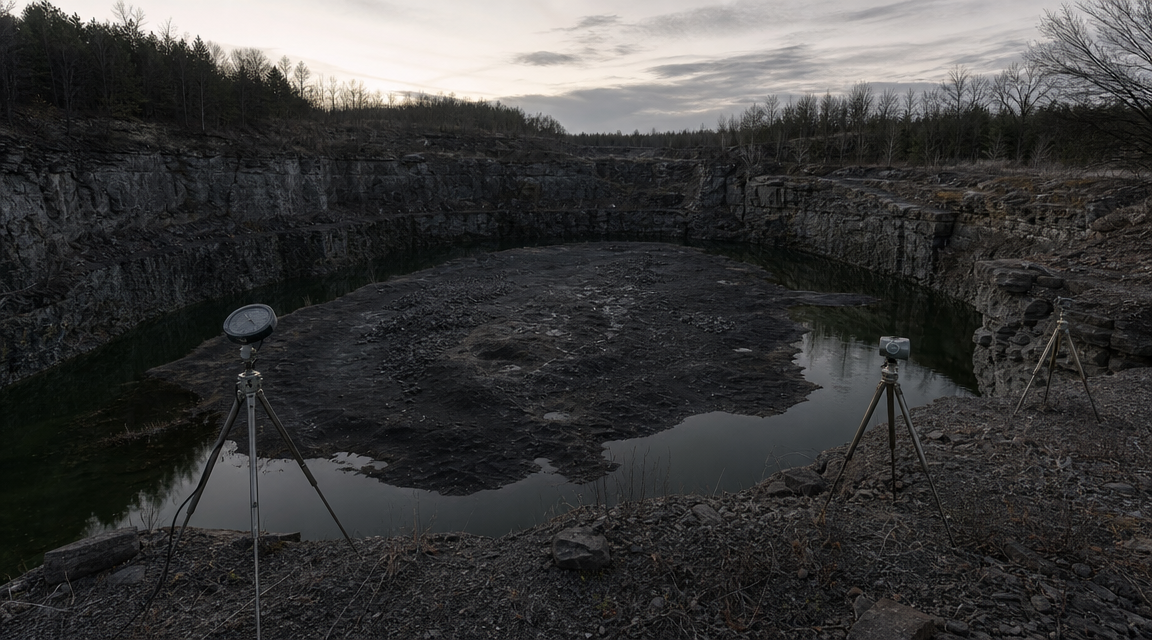
The Cinder Lake report begins with equipment, not with a shape in the sky.
That is one reason it holds attention. The evidence is not a witness sketch of a visitor or a dramatic account of pursuit. It is a set of survey compasses and magnetometers, all reportedly aimed at the same dry black pit inside an abandoned quarry, after a silent violet haze passed over the water.
There were no footprints around the tripods.
The quarry itself had been quiet for years. Locals still called it Cinder Lake, though the name made the place sound gentler than it was. The water sat low in a cut of stone, dark along the walls and glassy in the middle. At the center, where the old extraction floor rose unevenly, a dry black hollow showed through like a burn mark.
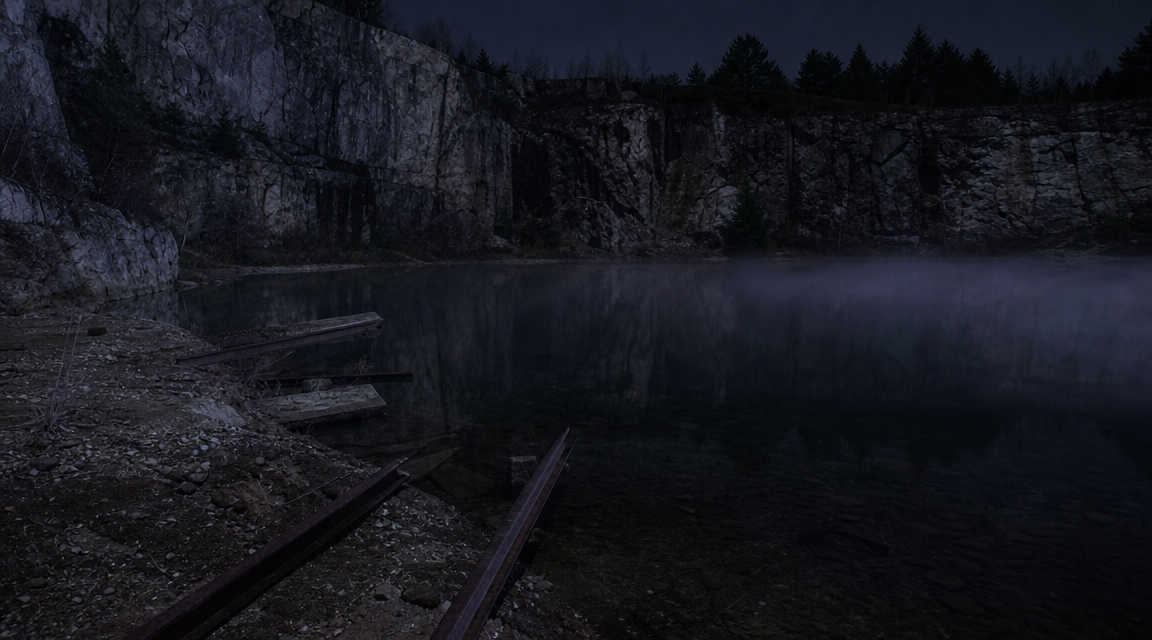
By ordinary standards, nothing there should have been calling instruments inward.
An Abandoned Quarry With a False Lake
Cinder Lake was never a natural lake. It was a quarry basin that had filled partly with rainwater and runoff after the pumps stopped. The waterline shifted with the season, exposing ledges, rusted bolts, broken drill stems, and powdery shelves of crushed rock.
That plainness matters. The place was industrial, damaged, and measurable. It was the kind of site where survey tools belonged.
A small mapping crew had come to Cinder Lake to compare old quarry records with the current basin. Their instruments were practical: tripod-mounted sighting compasses, handheld reference compasses, and portable magnetometers used to detect buried metal and magnetic changes in the rock.
The crew expected bad footing, not a directional problem.
The Instruments Before Sunset
Before the haze, the equipment appears to have behaved normally.
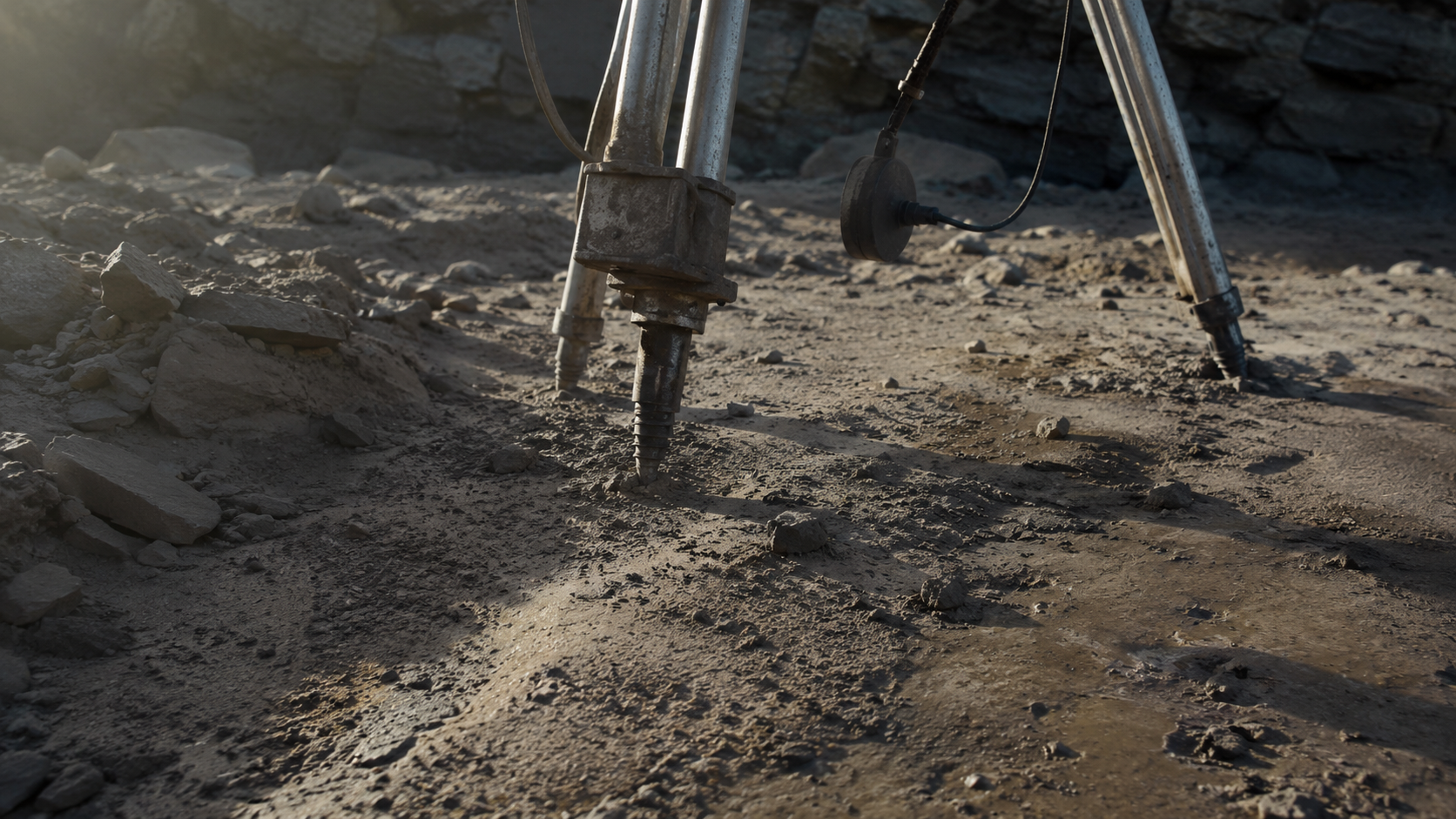
According to the account, the crew established several stations around the quarry rim and on two exposed shelves below it. Each tripod was planted carefully because the ground alternated between damp grit and loose gray dust. The magnetometers were checked against a control reading away from the water. The compass bearings were written down.
The important claim is narrower. The instruments did not begin the day pointed at the pit. Their recorded bearings varied with the survey stations. They were doing ordinary work in an ordinary, if unsettling, place.
Then the crew left some equipment standing for the night.
The Silent Violet Haze
The first unusual observation came after dusk from two people who had remained near the access road above the quarry.
They described a violet haze moving low across the water. Not a spotlight, not a flare, and not a reflection from a passing vehicle. The color was weak at the edges and brighter near the center, like a dim bruise spreading over the surface of the lake.
It made no sound.
That silence appears in every version of the report. No engine, no electrical crackle, no splash, no stonefall from the walls. The haze passed over the water and seemed to gather above the dry black pit before thinning out.
The haze lasted less than a minute.
Morning Bearings That Made No Sense
The next morning, the instruments were wrong in the same direction.
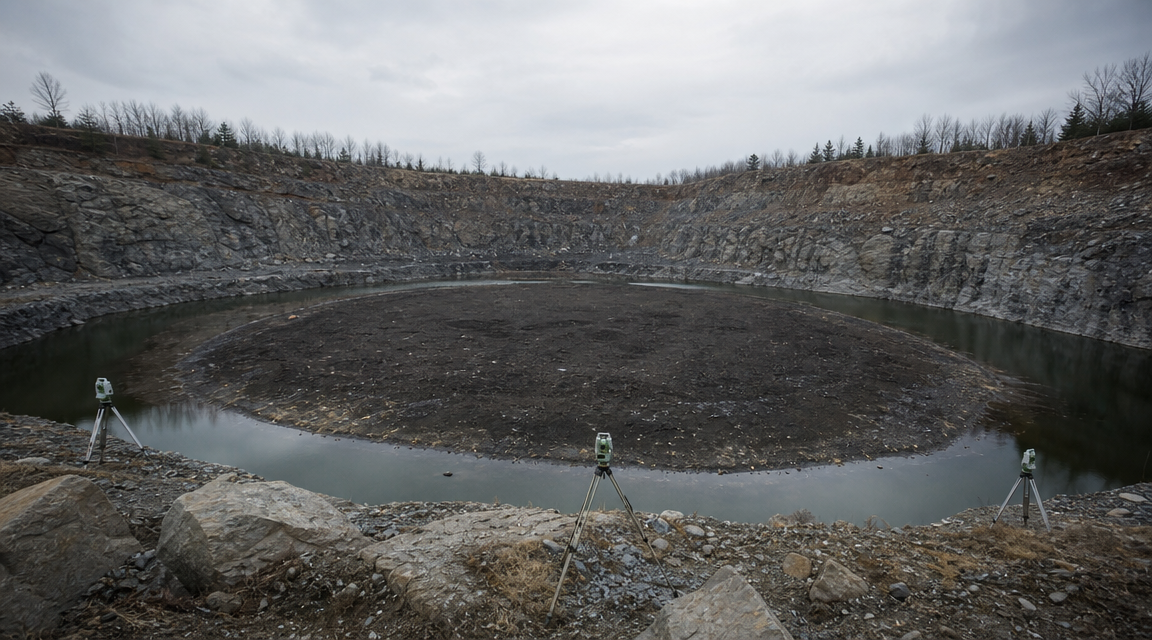
Several tripod-mounted compasses had shifted from their earlier positions. Portable magnetometers left on stands had also changed orientation. The units were not knocked down, scattered, or stolen. They were upright, intact, and reportedly aimed inward toward the dry black pit.
This is the detail that gives the case its unusual shape. A storm can topple equipment. Trespassers can vandalize it. Animals can brush a tripod leg. But scattered interference usually produces scattered results.
At Cinder Lake, the reported result was consistent. Different instruments at different stations indicated the same center point, as if the quarry had become a diagram and the black pit had become its focus.
A single compass can lie. A magnetometer can drift. A tripod can settle overnight. Several separate tools turning toward one dry hollow is harder to set aside, especially when their original bearings were said to be documented before sunset.
The Missing Footprints Around the Tripods
The ground around the equipment should have made any human explanation easier.
Cinder Lake’s lower shelves held fine dust where they were dry and soft mud where seep water collected. The crew had already left prints while placing the instruments. Those earlier marks were visible. What they reportedly did not find were new tracks approaching the tripods after the evening haze.
No fresh boot prints circled the legs. No drag marks showed where a stand had been pulled around. No handprints appeared in the dust on the cases. At some stations, the tripod feet still sat in their original small depressions, but the heads above them had turned.
Still, the claim remains uncomfortable because the tripod locations were chosen on surfaces that recorded disturbance well. If someone had walked station to station in the dark to realign the instruments, the quarry should have kept at least part of the story.
It apparently did not.
Could the Pit Have Been Magnetic?
A mundane explanation has to start with the pit itself.
Quarries can expose mineral seams that affect compasses. Buried scrap metal can distort local readings. Magnetometers are designed to notice those disturbances, and old industrial sites are full of reasons for strange numbers.
If the dry black hollow contained iron-rich stone, a buried machine part, or a pocket of magnetic material, it might explain why readings near it behaved oddly. It might even explain why a handheld compass swung inward when brought close to the basin floor.
But that does not fully match the reported sequence. The instruments were said to be stable before nightfall. The shift occurred after the violet haze. More importantly, the physical orientation of multiple tripod heads changed. A magnetic field can pull a compass needle. It should not rotate a locked mount unless the mount was loose, the instrument was poorly secured, or some other force acted on it.
That is where the case moves from anomaly into evidence folklore. The quarry may have had a magnetic personality. The claim is that something woke it, used it, or briefly made it visible.
Why This Fits Unknown Visitor Evidence
The Cinder Lake account is often placed in the unknown visitor category because it suggests interaction without showing an occupant.
There is no metal saucer descending between quarry walls. There is no creature standing by the water. Instead, the possible visitor is inferred from response. A violet haze crosses the basin. Instruments turn toward a dry black pit. The ground does not show ordinary access.
That pattern feels less like a sighting and more like residue.
At Cinder Lake, the logic was inward. Every altered tool pointed to the same empty place.
The Uneasy Value of Direction
Direction is one of the quietest forms of evidence.
What were they facing?
The black pit offered no satisfying answer. It was dry, dark, and still. No hatch was found. No fresh scorch pattern was recorded. No unusual object was recovered from its floor. By daylight, it looked once again like a stain at the center of a neglected quarry.
That may be why the report lingers. The evidence does not bloom into revelation. It stops at alignment. The compasses and magnetometers become witnesses of a kind, all silently giving the same testimony.
Something passed over the water. Something ended at the pit. By morning, the tools were looking there.
What Remains at Cinder Lake
The strongest version of the Cinder Lake story is modest and therefore difficult to dismiss cleanly.
It asks us to accept only a few claims: a violet haze was seen over quarry water; survey instruments were found reoriented toward a dry black pit; and the dust and mud around the tripod legs did not show the expected footprints of anyone who had moved them.
Each claim can be challenged. The haze may have been atmospheric. The instruments may have been loose. The footprint evidence may have been incomplete. The pit may have contained magnetic stone that made the crew notice normal deviation only after a strange night.
Even with those cautions, the arrangement remains eerie. Cinder Lake offers no dramatic visitor, only the afterimage of attention. The quarry became a room, the black pit became the center of that room, and every instrument left behind seemed to acknowledge it.
If something unknown visited Cinder Lake, it did not need to leave a body, a craft, or a message.
It may have left direction.
Reader Context
This Weird Witnessed story is an editorial reconstruction, written as eerie visual storytelling rather than a verified report. For more context, see UFOs and Unknown Visitors Guide and How WeirdWitnessed Creates Reconstructed Horror Stories.