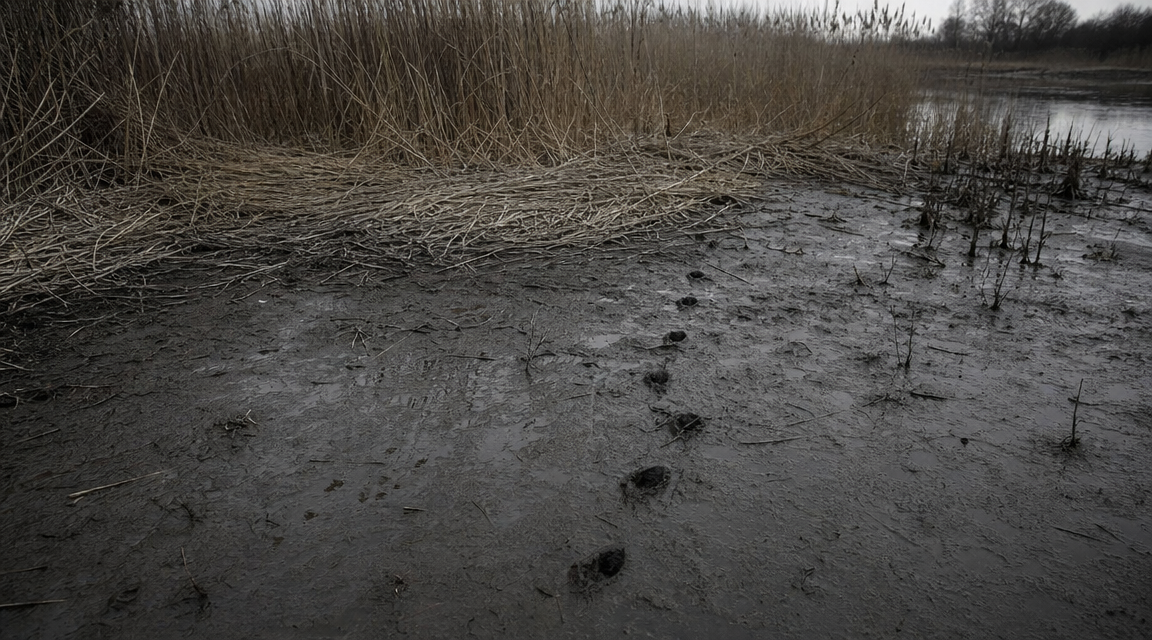
A marsh trackway is not unusual by itself.
Wet ground records everything that crosses it, and reed beds are busy after dark. Raccoons, coyotes, stray dogs, herons, muskrats, and deer can all turn mud into confusing evidence.
That is what makes the marsh-reed dog track account interesting. It does not begin with a monster sighting or a dramatic attack. It begins with ordinary prints, the kind most people would pass without stopping.
Then, at the broken drainage pipe, the line reportedly changed.
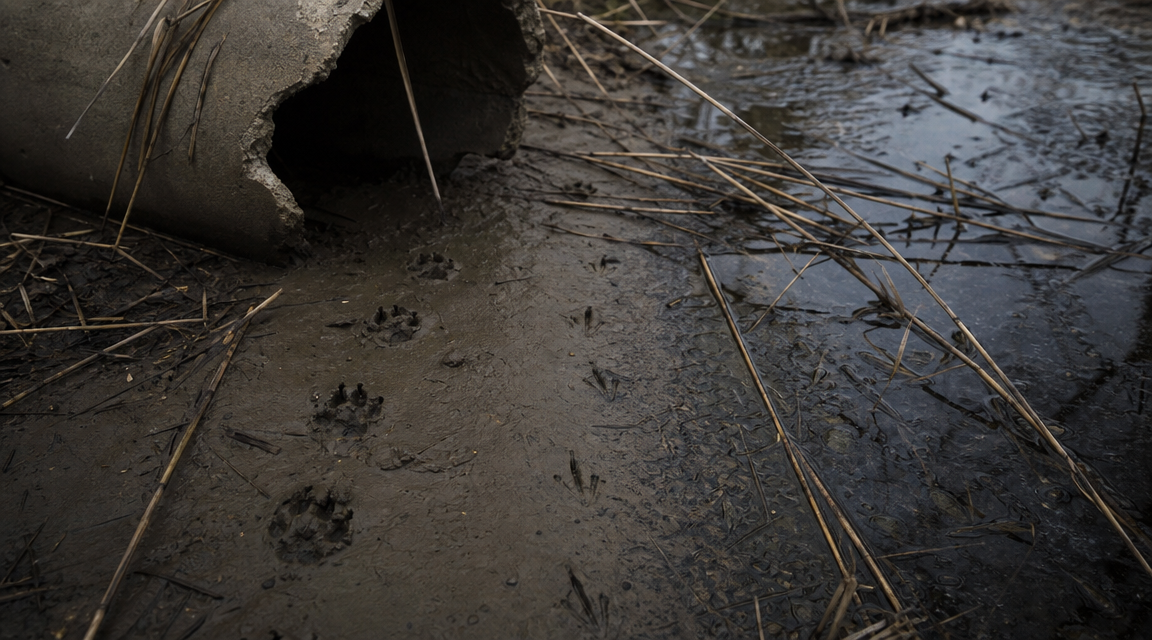
The broader dog-like pads narrowed. The toes became less distinct. In the last clear impressions before the reed bed swallowed the trail, witnesses described three clawed points pressed into silt, as if the animal had stepped differently or become something harder to name.
The later audio only made the scene feel less settled. A recorder left facing the reeds captured distant breathing in the night, slow and uneven, without the usual chorus of barking, yipping, splashing, or wingbeats that would have made the answer easier.
Where the Track Line Was Found
The site was a low marsh edge beside an old drainage channel, the kind of place built half by water and half by maintenance crews.
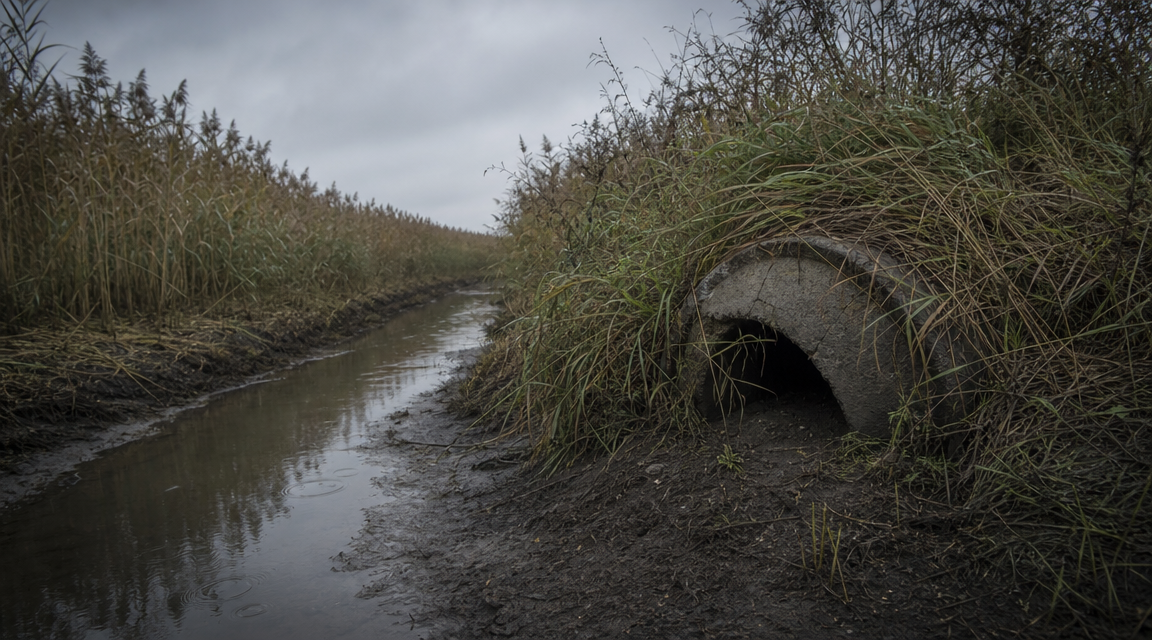
A concrete pipe emerged from the bank at a slight angle. Part of its lip had broken away, leaving a jagged crescent where runoff emptied into a shallow pool. Around it grew dense reeds, cattails, and flattened grass mats that held dew late into the morning.
The first tracks were found on the open silt shelf below the bank. Recent rain had left the surface soft but not soupy. That matters because mud can exaggerate an animal’s foot, but the witnesses insisted the early prints were clean enough to look familiar.
They appeared dog-like: four-toed, oval, and moving in a purposeful line toward the reeds.
No one claimed the marks were enormous or theatrical. Their strangeness came from the change in shape and from the place where that change occurred.
The Ordinary Prints Before the Pipe
The first section of the trail would not have started a story.
A medium dog, a coyote, or a fox moving across a marsh margin can leave prints that seem larger or smaller depending on stride, speed, and mud depth. Soft silt rounds sharp edges. Standing water collapses toe marks. A back foot can partly overlap a front foot and create a print that looks like a new category of animal.
In this case, the line reportedly began as a recognizable canid pattern. The steps were spaced evenly, angled slightly toward the pipe, and did not show signs of a frantic run.
That calm pace is one reason the trackway stayed in memory. If it had been a churned mess, there would be less to discuss. Instead, it seemed to show an animal walking steadily from the exposed bank into cover.
The witnesses were simply looking at mud because the marsh had been noisy the night before, and because someone had noticed the clean line of prints before wind and water erased it.
The Narrowing at the Broken Drainage Pipe
The reported transition happened within a few feet of the broken pipe.
At first, the prints retained a dog-like outline. Then the pad marks became faint. The outer toes seemed to disappear or merge with the edge of the impression. The final visible marks looked narrower, with three forward claw points set into the mud.
This is where skeptical explanations become both useful and incomplete.
A canid stepping onto a harder patch can leave only claw tips. A paw sliding on wet silt can smear four toes into three visible grooves. A reed stem can erase a toe or create a false claw. If the animal shifted weight over broken concrete, the print could change sharply.
All of that is plausible.
Still, the witnesses focused on the consistency of the last few impressions. They were not describing one strange smudge. They described a short run of narrow, three-clawed marks where the trail passed the pipe and entered bent reeds.
The broken pipe also complicated the scene because it offered cover. An animal could have stepped onto concrete, into shallow water, or along roots where no print would hold.
Why Three Claws Get Attention
Three-toed or three-clawed prints have a long life in creature reports because they sit in an uncomfortable middle ground.
They are simple enough to be misread. Many ordinary animals can produce partial prints that look three-toed under poor conditions. Birds leave three forward toes. Raccoons and opossums can distort their tracks in mud. Canids can lose a toe impression when the ground changes.
But the number also carries folklore weight, especially in chupacabra-adjacent reports where witnesses describe lean, dog-like movement mixed with details that do not fit a normal dog.
That does not make the marsh trackway a detail people read as anything extraordinary. It does explain why the case was filed under creature evidence instead of ordinary wildlife notes.
The story’s strength is not that three claws are impossible. They are not. The strength is the sequence: familiar dog-like prints, a narrow transition at a manmade opening, and then audio from the same reed bed that sounded like something breathing with effort.
The Recorder in the Reeds
The recorder was placed after the tracks were found, not before.
That is important. It means the audio cannot confirm what made the prints. It only shows what the marsh sounded like on a later night when someone was curious enough to leave a device running.
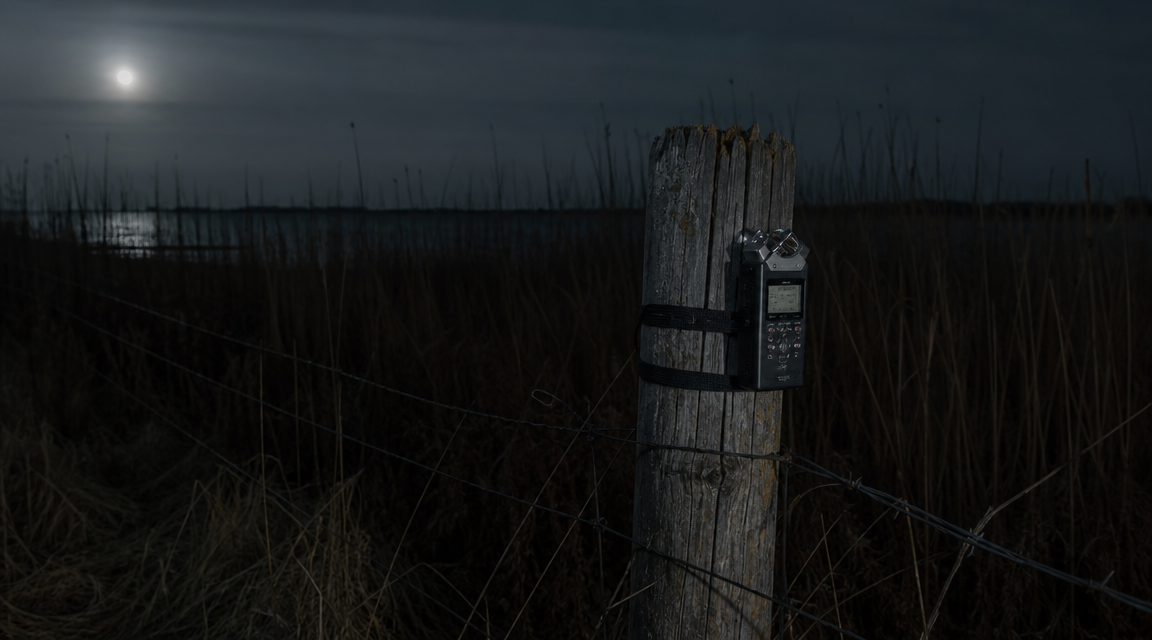
According to the account, the recorder sat on a fence post or low branch facing the drainage channel. It picked up normal wetland sounds at first: insects, distant traffic, water movement, and occasional reed movement.
Sometime deep in the camera record, a series of low breaths appeared in the background.
They were not close to the microphone. They did not form speech. They did not include a visible attack, a scream, or any cinematic reveal. The unsettling part was their rhythm: inhale, pause, exhale, then a longer silence, repeating several times as if whatever made the sound was stationary inside the reeds.
People who heard it disagreed. Some called it a large animal breathing near water. Others thought it might be wind pulsing across the pipe. A few said it sounded like someone trying not to cough.
The Best Natural Explanations
The most grounded explanation remains a combination of ordinary tracks and wetland acoustics.
A dog, coyote, or fox could have crossed the silt. Near the pipe, changing substrate and broken concrete could have altered the prints. The apparent three-clawed marks may have been partial impressions, overlap, slippage, or damage from reed stems.
The audio has equally ordinary candidates. Wind moving through reeds can mimic breath when it rises and falls in waves. Water inside a pipe can create hollow pulses. Frogs, birds, mammals, and distant human activity can all sound strange when recorded at night by a small microphone.
Recorders also remove context. A sound obvious in person can become ambiguous when isolated from direction, distance, and sight.
None of these explanations require a chupacabra or unknown animal.
But evidence cases are rarely about what is required. They are about what remains stubborn after the easy answers are applied. In this case, what remains is the clean start of the trackway, the repeated narrow claw marks at the pipe, and the breathing-like audio from the same patch of reeds.
What Keeps the Case Open
The marsh-reed track line is not strong evidence in the laboratory sense.
There was no controlled cast. No trail camera image noted the animal. No hair, scat, or clear camera file tied the prints to the breathing sound. By the time the account circulated, the mud had likely changed and the reeds had shifted.
Even so, the case has a useful honesty. It does not depend on gore, spectacle, or a perfect monster outline. It depends on a small pattern observed in a place where patterns vanish quickly.
That makes it frustrating and oddly believable.
A hoax would likely have been larger, clearer, and more dramatic. A misidentification would fit the marsh perfectly, yet the transition point at the pipe gives the story a shape that people remember.
The recorder adds atmosphere, but not proof. The tracks add physical detail, but not certainty. Together they create the kind of evidence that lives in the gap between field note and campfire story.
The Most Careful Reading
The careful reading is this: an unidentified animal, probably ordinary, crossed a marsh-edge silt shelf and entered a reed bed through or beside a damaged drainage pipe. Conditions near the pipe changed the appearance of its tracks. A later camera record captured a low breathing-like sound that may or may not have come from the same animal.
That explanation is modest, and it is probably close to the truth.
Yet the account stays with people because it preserves a moment of transformation. The ground appears to show one animal arriving and something stranger leaving, even if mud, water, and angle did most of the work.
For WeirdWitnessed, that is enough to make the marsh-reed dog track worth documenting.
Not as confirmation that a chupacabra moved through the reeds, and not as confirmation that every odd footprint deserves a legend. It is a reminder that the natural world can produce scenes so cleanly unsettling that they look arranged for mystery.
At the pipe, the dog-like trail narrowed. In the reeds, the recorder breathed back. The rest is what the mud refused to keep.
Reader Context
This Weird Witnessed story is an editorial reconstruction, written as eerie visual storytelling rather than a verified report. For more context, see Creatures, Crawlers, and Cryptid Stories Guide and How WeirdWitnessed Creates Reconstructed Horror Stories.