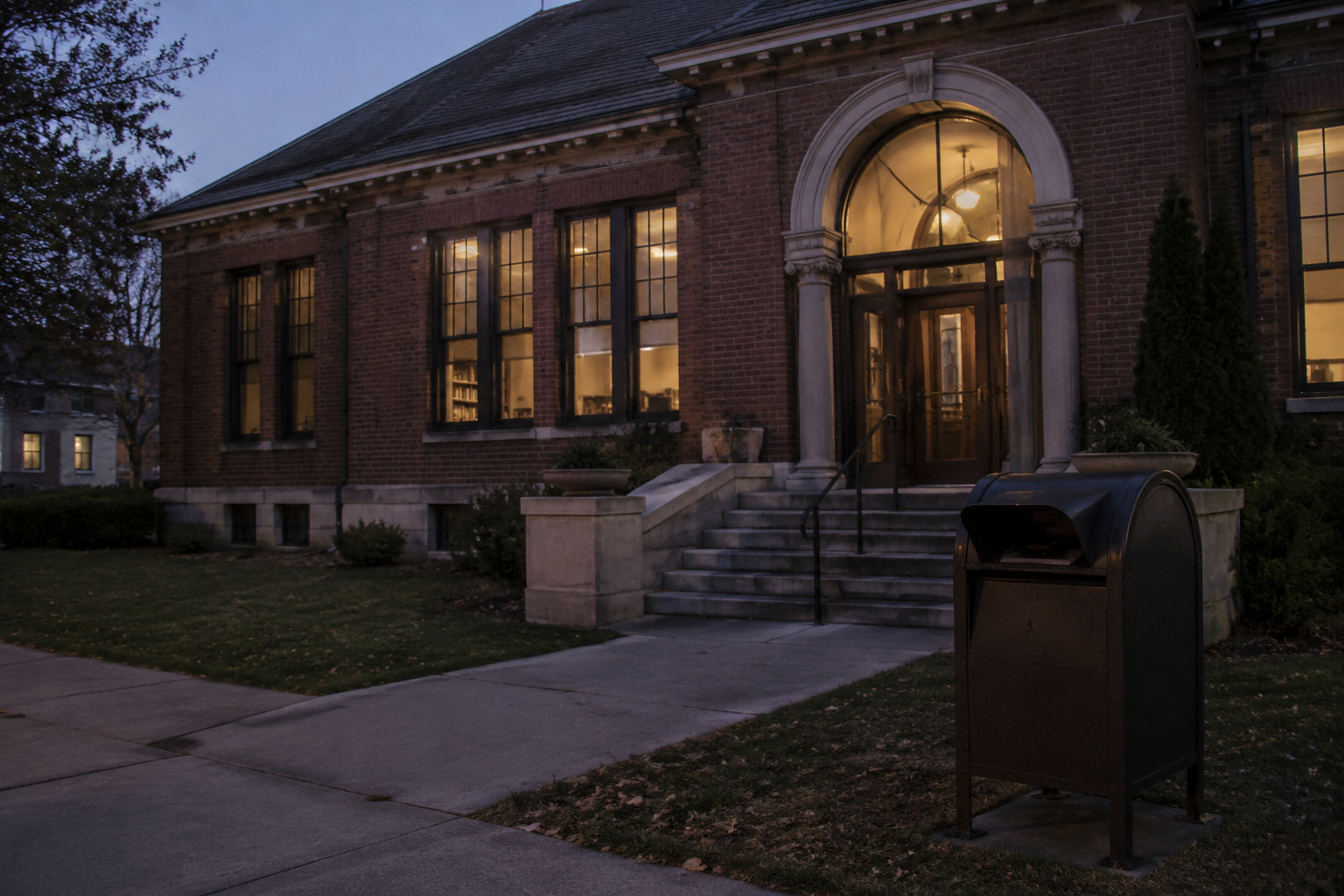
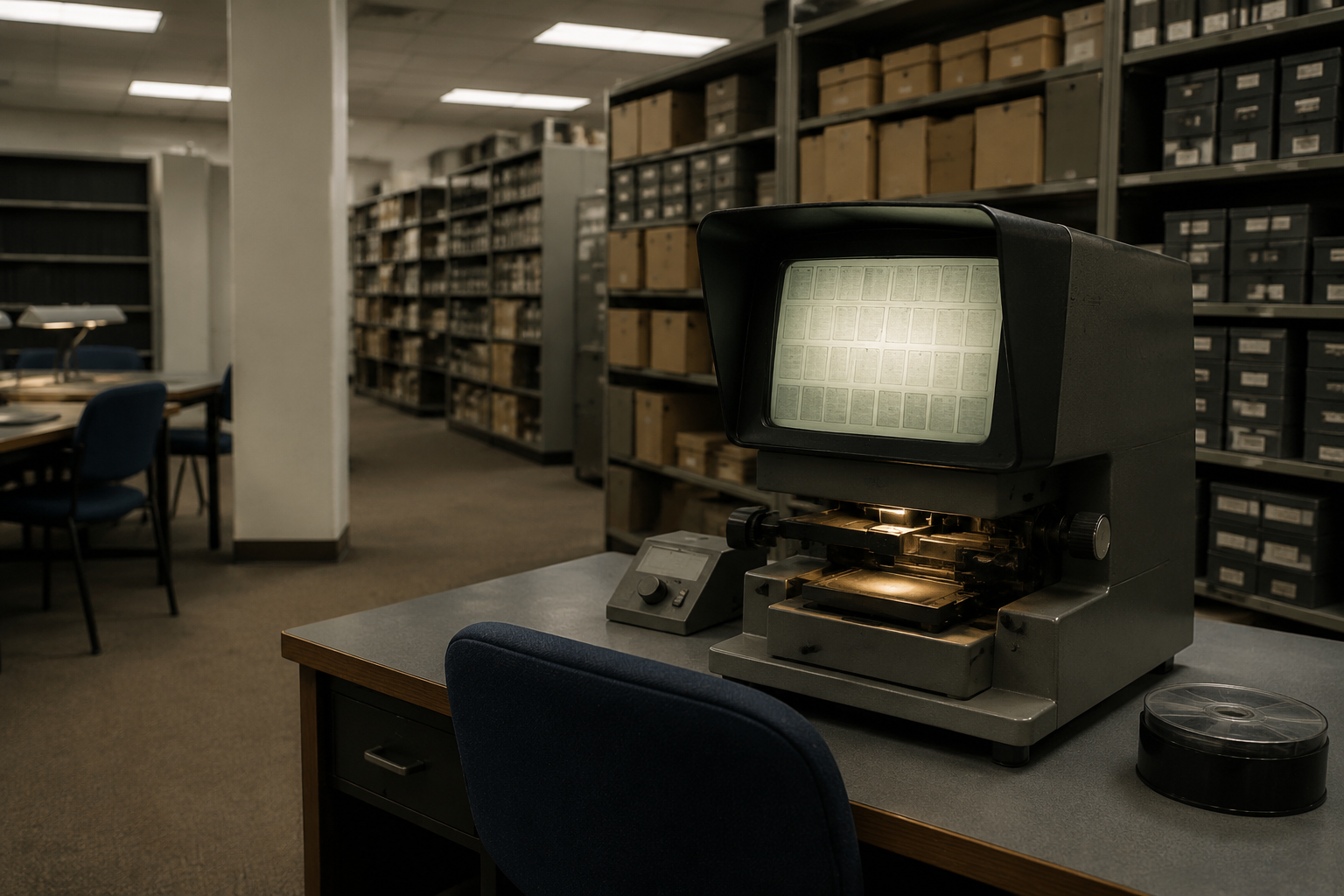
The microfilm reader was still warm when the librarian came back for her keys.
That is how the recreated scene usually begins, although the more important detail is not the warmth of the machine. It is what the gray reader glass appeared to show when the room lights were already being shut down.
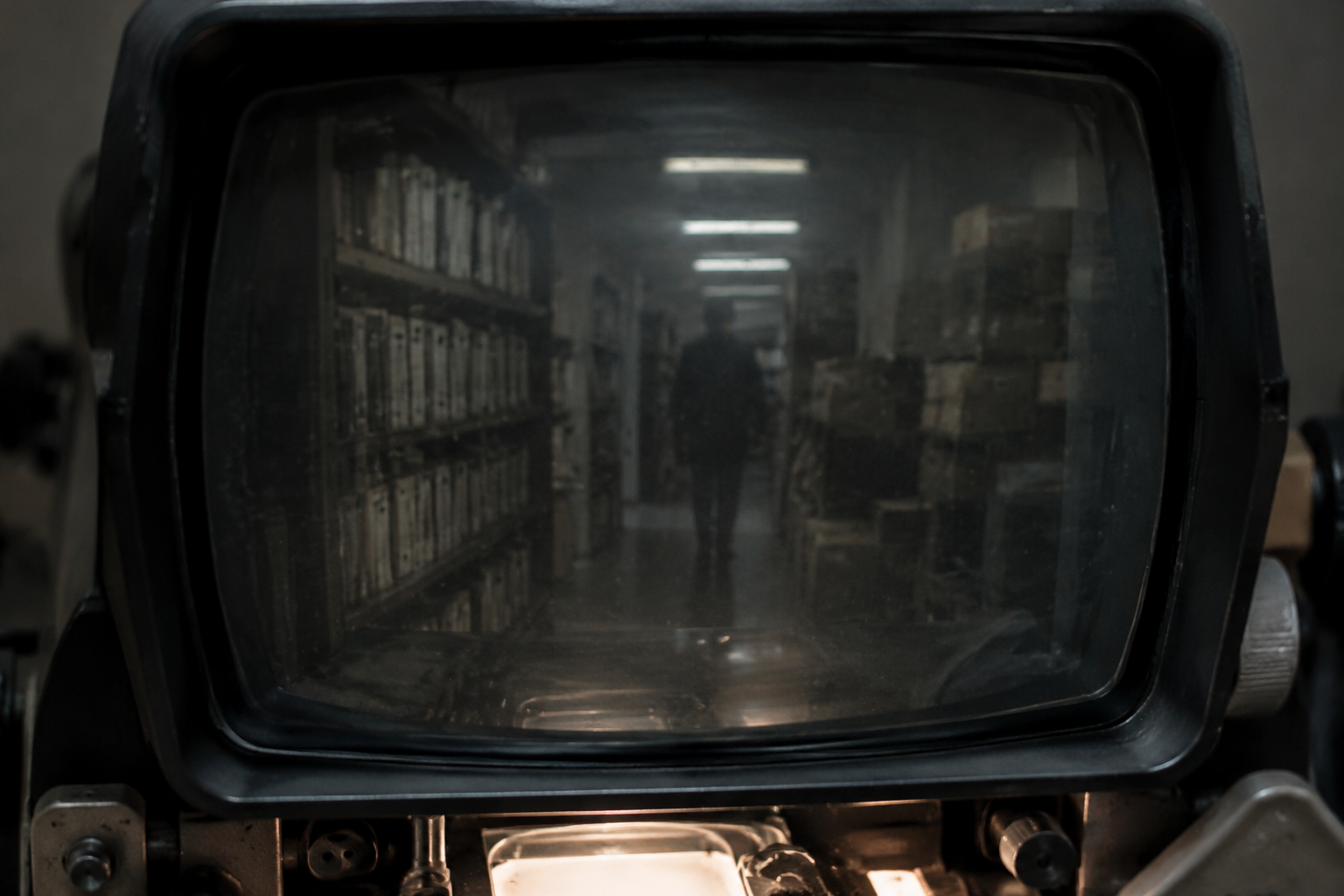
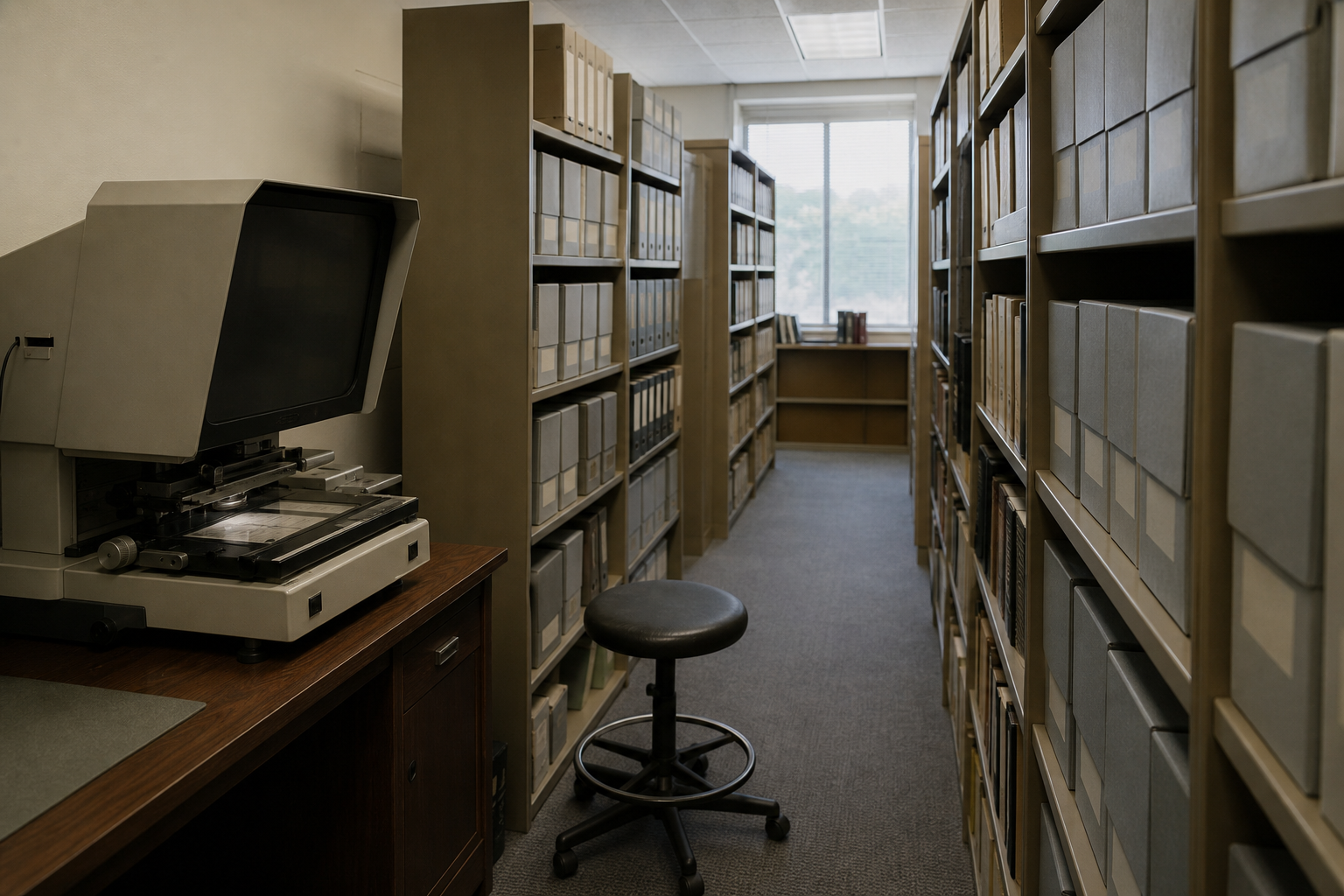
The public library was closed. The genealogy corner had been cleared. The archive shelves were locked behind the half door that separated staff storage from the public work tables. In one reported phone photo of the reader, a dark standing shape seemed to appear between two rows of archival boxes, reflected in the glass like someone waiting behind the chair.
The account is not a detail people read as a haunting. It is a small-town library story about a room full of records, a practical machine, and one image that looked occupied after everyone had supposedly left.
WHAT THE STORY SAYS WAS VISIBLE
- A closed public library microfilm room after public hours.
- One reader machine left on near the genealogy table.
- Archive shelves and film drawers reflected in the reader glass.
- A dark upright shape between two shelf rows.
- No clear face, clothing, or identifying detail.
- A later check that reportedly found the room empty.
The unsettling part is the setting. Libraries are full of shadows, but microfilm rooms are also full of memory. When a shape appears there, people are tempted to give it a story before they have given it a practical explanation.
1. The Room Was Already a Place for Looking Back
Microfilm rooms have a mood even when nothing unusual happens. The lights are usually flat. The machines hum. The drawers hold old newspapers, property notices, obituaries, school board arguments, wedding announcements, and weather reports from years when the town had different stores on Main Street.
That makes the reported figure feel staged, though nothing in the account requires staging. A person sitting at the reader is already looking into the past. If the screen reflects a dark form behind them, the mind does not read it as a random shadow. It reads it as someone from the same archive.
The library in the story was ordinary: public computers near the front, children’s section to one side, local history materials in the back. The microfilm reader sat where staff could supervise it during the day. After closing, that corner became one of the darker parts of the building.
A dark reflection there did not need much help to feel personal.
2. The Reader Glass Could Create a False Person
The best mundane explanation is glare.
Older microfilm readers have reflective glass, angled panels, plastic hoods, and pale screens that catch whatever light remains in a room. A storage shelf, a hanging lanyard, the edge of a rolling chair, or a dark gap between boxes can overlap in the reflection and become a person-shaped column.
This explanation is strong because the reported image was not a clean photograph of the aisle. It was a reflection in a machine.
Reflections are not reliable witnesses. They flatten space. They place objects beside each other that may be several feet apart. They also make dark areas look connected, especially when a phone camera adjusts exposure in low light.
So the reader itself may have built the figure. That possibility should remain the first answer.
3. Why the Shelf Gap Bothered People
The detail repeated in the library version is that the dark shape seemed to stand in a specific gap between archive shelves.
Not against the wall. Not in the open doorway. Not beside the chair.
Between the shelves.
That matters because archive rows are narrow. A real person standing there would have a particular height and width. A simple reflection of a chair or wall edge may look wrong once someone compares it to the aisle.
According to the story, a staff member returned to the room and looked down that same gap. No patron was there. No coat was hanging there. No cart had been left in the aisle.
That does not rule out a shadow. It only explains why the image kept bothering the people who saw it. The figure appeared where the room had depth, and where an ordinary object should have been easy to identify.
4. The Locked Half Door Adds Procedure, Not Proof
Many versions of public-building ghost stories lean heavily on a locked door. This one has a smaller detail: the half door to the staff archive area.
During open hours, patrons could request boxes or reels, but they were not supposed to wander into the storage side. After closing, that half door was reportedly latched. If the figure was truly between shelves in the staff area, then a person would have needed access or permission.
That sounds dramatic, but it is still not proof. Staff members forget latches. Volunteers have keys. Maintenance workers pass through areas that patrons do not see. A dark garment on a shelf end could remain unnoticed until morning.
What the latch adds is not certainty. It adds a sense of order. The room had rules, and the image seemed to ignore them.
5. A Library Has Many Human-Shaped Objects
Skepticism is especially important here because libraries collect vertical objects.
There are book carts, folded signs, poster tubes, coat trees, umbrella stands, rolling stools, tall boxes, end panels, and stacked document cases. In low light, almost all of them can become shoulders and a torso.
A black dust cover over a machine can look like a coat. A tall recycling bin can look like legs. A shelf label holder can catch a strip of light and suggest a face.
The reported shape had no clear eyes, hands, or motion. It was described as dark and present. That leaves a wide space for ordinary mistakes.
The story is stronger when it admits this. The question is not whether the photo defeats every explanation. It does not. The question is why one particular reflection felt less like clutter and more like a visitor.
6. The Archive Gave People a Ready-Made Folklore
Every local history room has names attached to it.
Researchers come in looking for grandparents, old addresses, court notices, vanished farms, and accidents that older residents still remember. Staff members learn which reels contain tragedies and which files are requested by families after funerals.
So when a dark figure appears in a microfilm room, the building supplies its own folklore. People wonder whether the shape belongs to a former librarian, a newspaper editor, a patron who spent years researching there, or someone whose name sits in the archive drawers.
Those guesses are natural, but they are still guesses. They can make a blurry image feel meaningful before the image earns that meaning.
A safer way to describe the account is simpler: a room devoted to preserved traces produced a trace of its own.
7. The Most Interesting Detail Is the Viewer’s Position
The image reportedly came from the seat where a patron would sit.
That perspective matters. If the dark shape had been photographed directly, it would have been either there or not there. Reflected in the reader glass, it occupies the space behind the viewer.
That is why the account works so well as a story. It turns a research machine into a rearview mirror.
Anyone who has worked alone in an archive knows that small feeling: the suspicion that the quiet behind you has changed. Usually it is the air conditioner, a settling shelf, or someone walking in another aisle. In this account, the reader seemed to give that feeling a shape.
Not a dramatic ghost. Not a floating face.
Just someone standing where the records were kept.
8. What Would Make the Case Stronger
The account would be much stronger with a full set of comparison images.
A daylight photo from the same chair would show the shelf gap clearly. A second photo with the reader off would reveal which reflections remain. A map of the room would show whether the shape aligns with a shelf end, cabinet, cart, or doorway.
The most useful evidence would not be a scarier image. It would be boring documentation.
That includes the time the photo was taken, who had keys, whether motion alarms covered the back room, what objects were stored in that aisle, and whether the reader screen had known reflection problems.
Without that, the story remains in the category where many recreated scary moments belong: memorable, plausible, and unresolved, but not conclusive.
9. Why the Image Still Travels
The microfilm room figure keeps its hold because it is quiet.
There is no chase, no scream, and no claim that the library proved the dead were walking between the shelves. The account depends on a single ordinary contradiction: the room was supposed to be empty, yet the reader seemed to show someone standing behind the person taking the photo.
Maybe it was glare. Maybe it was a cart, a shelf edge, a coat, or a phone camera turning darkness into a body.
Those are good explanations.
But for the people who know the sound of a microfilm machine in a closed library, the image offers a colder thought. In a room built to preserve what the town had almost forgotten, something appeared to be waiting in the aisle, close enough to be reflected, and dark enough to remain unnamed.
Reader Context
This Weird Witnessed story is an editorial reconstruction, written as eerie visual storytelling rather than a verified report. For more context, see Apparitions and Hauntings Guide and How WeirdWitnessed Creates Reconstructed Horror Stories.