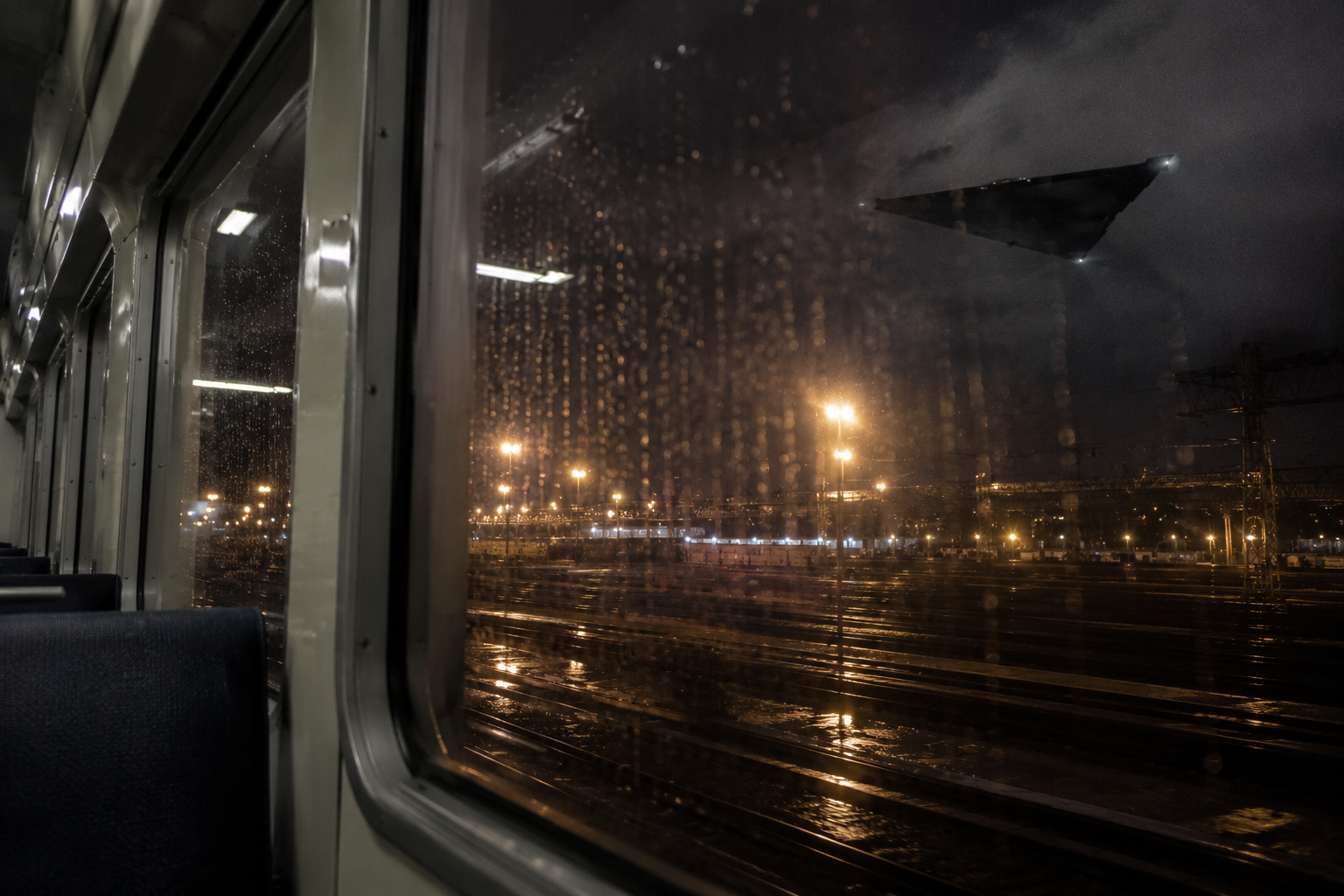
The train was late enough that the car had gone quiet in a particular commuter way. People were not asleep exactly. They were folded into coats, lit blue by phones, pretending the delay had not stolen the last useful part of the night.
Rain ran down the window beside one passenger in thin, nervous lines. Outside, the rail yard opened up between stations: tracks splitting and rejoining, signal masts glowing, parked cars sitting dark under industrial lamps.
The passenger took a picture of the window because the rain looked dramatic against the lights. That was all the moment was supposed to be.
Later, after getting home, the photo seemed to contain something else: a solid black triangle hanging over the yard.
A Late Train In Bad Weather
Late trains make ordinary places feel briefly abandoned. A rail yard that is busy in daylight becomes a field of metal after midnight, with machines parked like animals waiting for instructions.
The picture, as described in the post that spread with it, was taken from a seat on the right side of the train. The camera faced through wet glass toward a wide section of yard just before the line curved away.
There is nothing theatrical about the setting. No lonely desert highway. No remote mountain road. Just commuter infrastructure, rain, reflected phone glow, and the dull patience of delayed passengers.
That may be why the image feels uncomfortable. The strange part is not placed somewhere mythic. It is sitting above something practical.
The Photo Was Supposed To Be About Rain
The first thing the eye notices is the glass. Droplets cling to it in sharp beads. Longer trails slide diagonally, turning the rail lights into stretched yellow and white marks.
Anyone who has taken a bored train photo knows the look. The window becomes more interesting than the view. The outside world turns soft, and every light behind the rain becomes a small accident.
According to the passenger, they did not see anything alarming at the time. They were not watching the sky. They were trying to catch the texture of the rain before the train moved again.
That detail matters because it keeps the story small. There is no dramatic claim of a craft chasing the train. There is only a casual photograph that became stranger once it was examined.
The Shape Above The Yard
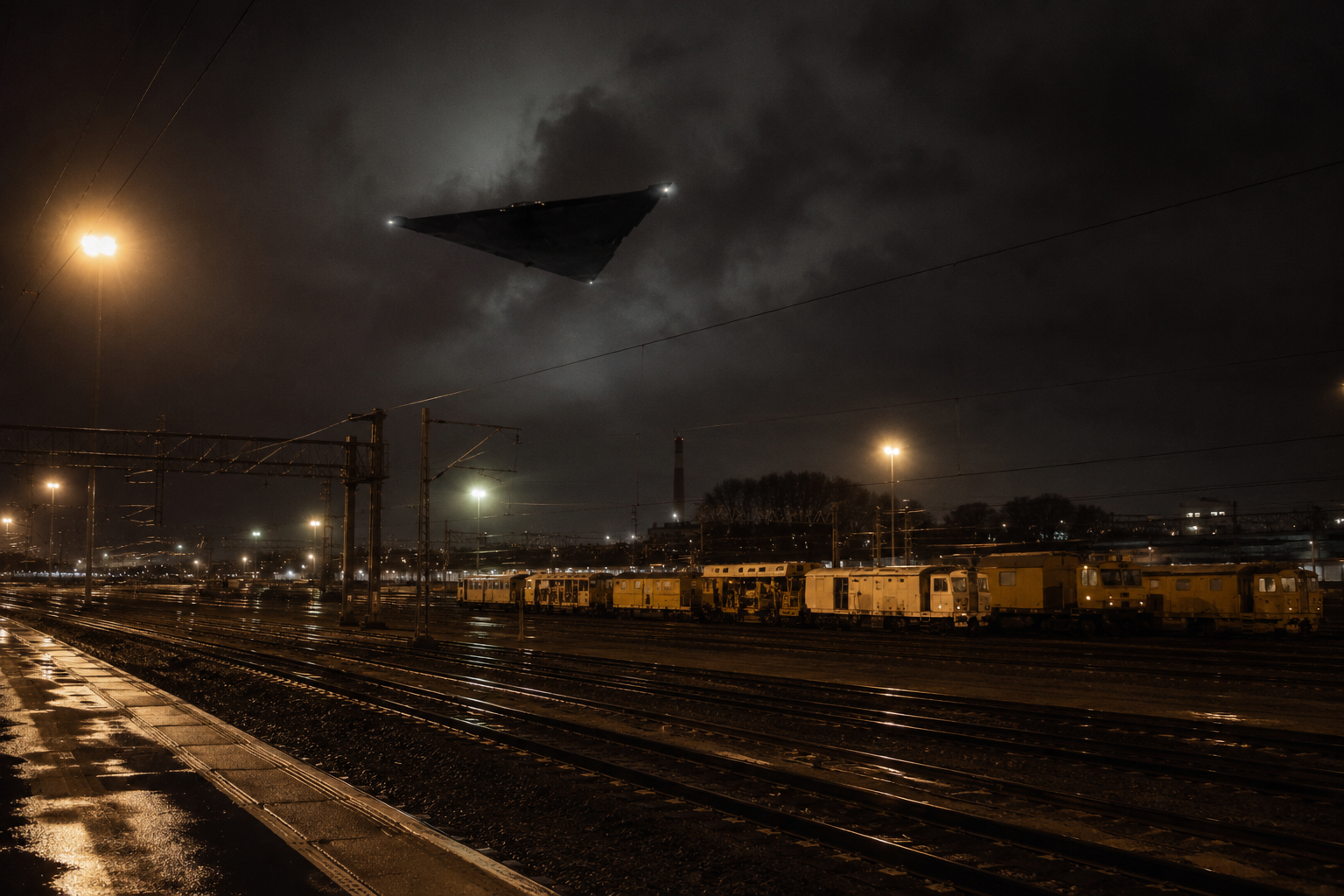
In the upper part of the image, beyond the rain and above the parked rail cars, there is a dark triangular form. It is not described as three lights arranged in a triangle. It appears as a black shape.
That distinction is the reason people linger on it. Many night sightings dissolve into navigation lights, reflections, or distant aircraft. This one is unsettling because the triangle seems to have a body.
The edges look firmer than the surrounding clouds. The underside appears darker than the sky behind it, as if it is blocking light rather than producing it.
It sits over the rail yard at a slight angle, broad at one end and narrowing toward another, with a flatness that makes it feel constructed. Not organic. Not like a torn cloud.
The passenger reportedly noticed it only while zooming in to crop the rain. The window picture stopped being a window picture.
Not Just A Cluster Of Lights
The easiest way to dismiss a triangular UFO photo is to reduce it to points. Three lights become an aircraft. Three reflections become a shape the mind invents between them.
This image is harder to file that way, at least emotionally, because the visible concern is the dark mass between and around the brighter areas. The triangle is defined by absence.
There are yard lights below it, a pale cloudy sky behind it, and then a patch that seems too evenly black. It is like a piece cut out of the weather.
That does not prove it is a craft. Night photographs through rain can create severe contrast, and our brains are eager to turn shadow into object.
Still, the fear in the picture comes from the possibility that the camera caught a surface, not merely an arrangement. The thing looks solid enough to cast a shadow inside the viewer's imagination.
The Window Makes Everything Unreliable
The rain is both the reason the photo exists and the reason it cannot be trusted completely. A train window at night is a complicated lens.
It reflects the inside of the car. It doubles lights. It bends bright points through droplets. It lets the camera focus on one plane while the mystery sits on another.
A dark jacket in the seat behind the photographer could become a floating patch outside. A triangular reflection from the ceiling, a luggage rack, or an advertisement panel could appear to hover over the tracks.
Even the phone may have contributed. Night mode can blend frames together while the train moves, preserving some shapes, smearing others, and inventing edges where contrast changes quickly.
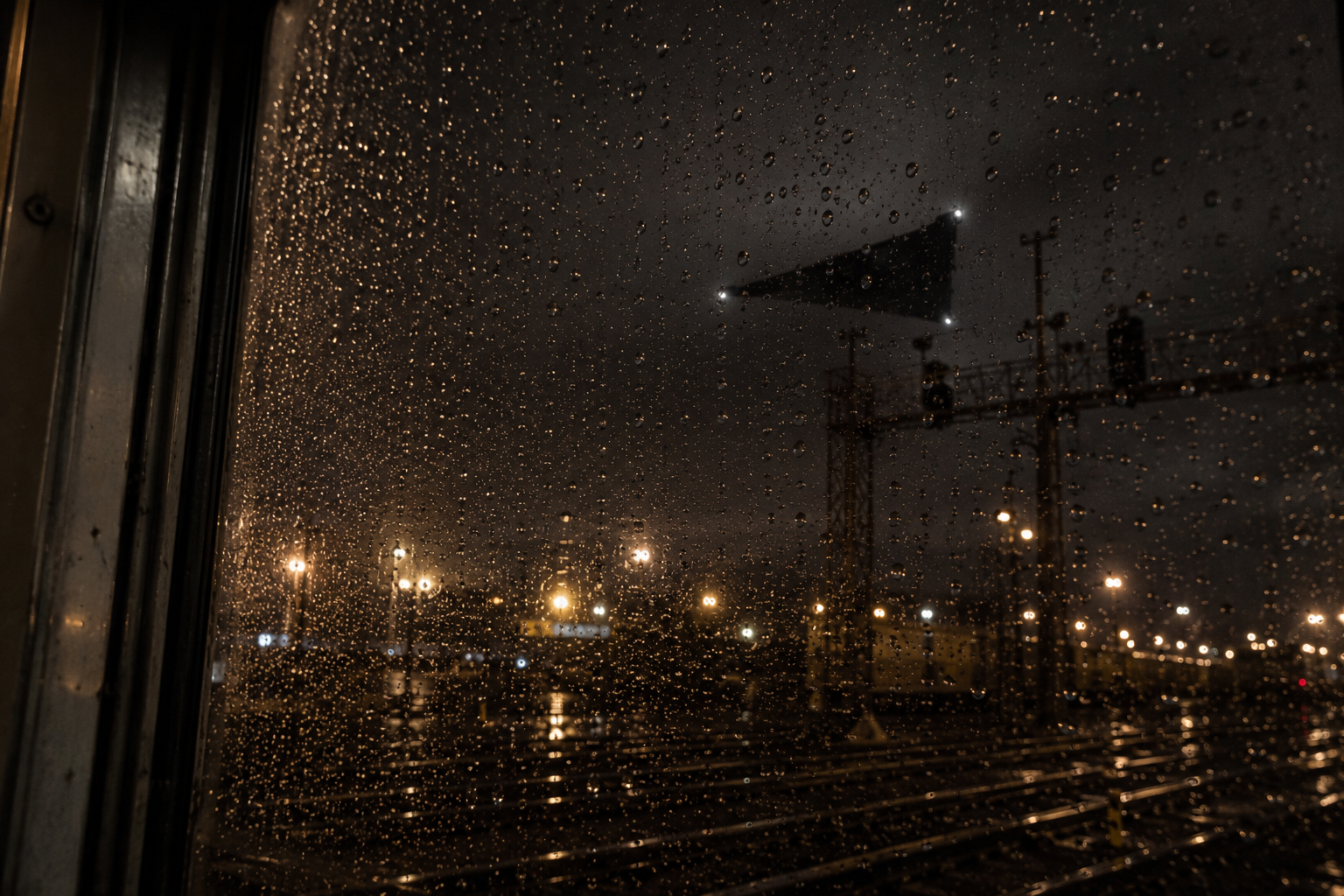
That is the responsible caution around the image. The glass is a suspect. The phone is a suspect. The rain is a suspect.
Ordinary Explanations In The Yard
There are also grounded possibilities outside the train. Rail yards are full of structures that can look strange from a moving passenger car.
A signal gantry, crane arm, maintenance canopy, or the dark roof of a parked service vehicle could align with the clouded sky and appear higher than it really is.
Overhead wires and support frames can slice a view into geometric shapes. When rain blurs the lower details, a normal structure may lose its supports and seem suspended.
Aircraft remain possible too. A plane banking in cloud could present a dark underside for a second, especially if the yard lights brightened the sky beneath it.
A bird close to the window is less likely if the shape is large and clean, but not impossible. A folded wing in motion can become a blunt triangle in a single still photograph.
None of these explanations require anything otherworldly. They require bad weather, industrial clutter, a reflective window, and one unlucky frame.
Why The Triangle Still Feels Wrong
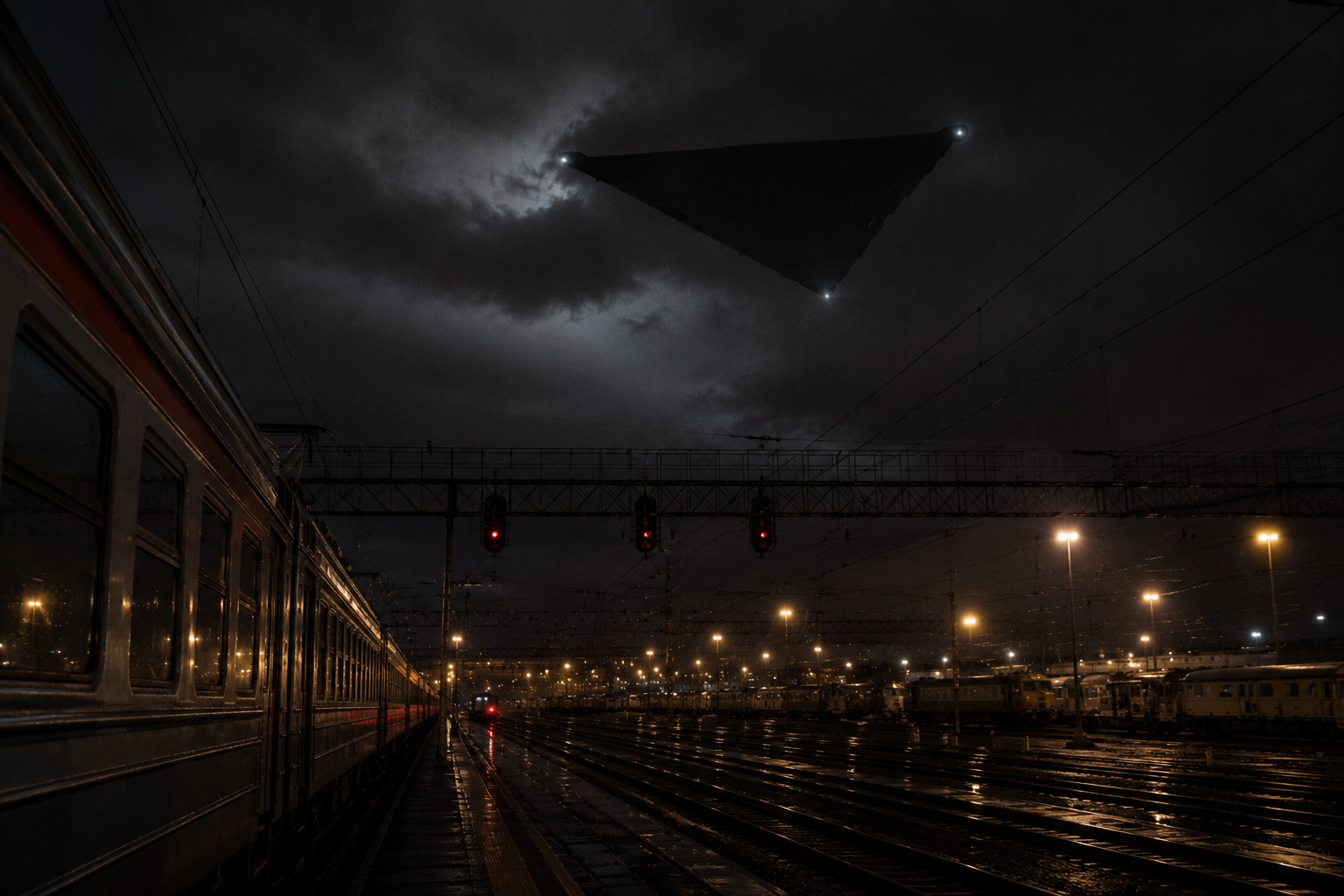
The unease survives because the triangle appears to occupy the one part of the scene that should have been empty. Above the yard, there is supposed to be only rain and low cloud.
Instead, the image seems to place a heavy shape there, darker than the background but not connected to anything visible. It does not read like a light reflection at first glance. It reads like an object waiting silently over the tracks.
There is something especially cold about a rail yard beneath it. Trains imply schedules, movement, and public routine. A black triangle over that ordered maze feels like an intrusion into a system that should be monitored from every angle.
If it was really there, someone else might have seen it: a dispatcher, a worker, another passenger in another car. Yet the story, as it usually happens online, narrows to one phone and one delayed ride home.
That isolation makes the photograph more frightening, not more convincing. It creates the sense of a thing that could be present above hundreds of people and still go mostly unnoticed.
The Moment After Zooming In
The most believable part of the story is the delay between taking the picture and becoming afraid of it. Strange photos often work that way. The body leaves the place before the mind realizes it may have stood near something unusual.
You can imagine the passenger sitting at home, warm at last, swiping through images that should have been disposable. Rain on glass. A platform sign. A blurred reflection of the aisle.
Then the rail yard photo opens larger. The triangle separates itself from the weather. The person pinches the screen wider and wider, trying to decide whether the shape belongs to the window or the sky.
That is where the image does its damage. Not in the train car, where nothing happened. Not in the yard, where nobody sounded an alarm. In the quiet afterward, when an ordinary commute changes retroactively.
The night has already passed. The train has already moved on. Whatever the camera caught, reflection or structure or something harder to name, is no longer available for a second look.
What Was Hanging Over The Tracks?
The safest reading is that the black triangle came from some combination of rain, glass, motion, and rail-yard equipment. That answer is not only possible. It may be the most likely one.
But the photograph remains memorable because it does not merely show lights in a pattern. It seems to show a dark physical shape in the sky over a place where many ordinary explanations should have left clearer clues.
Maybe it was a reflection from inside the commuter car. Maybe it was a gantry briefly isolated by rain and angle. Maybe a banking aircraft crossed the frame at exactly the wrong second.
Or maybe, for one quiet moment during a late ride home, something black and triangular hung above the tracks while the passengers looked at their phones.
The unsettling part is that nobody on the train had to notice it for the picture to exist. The rain noticed. The window noticed. The camera noticed.
Only later did the passenger notice too.