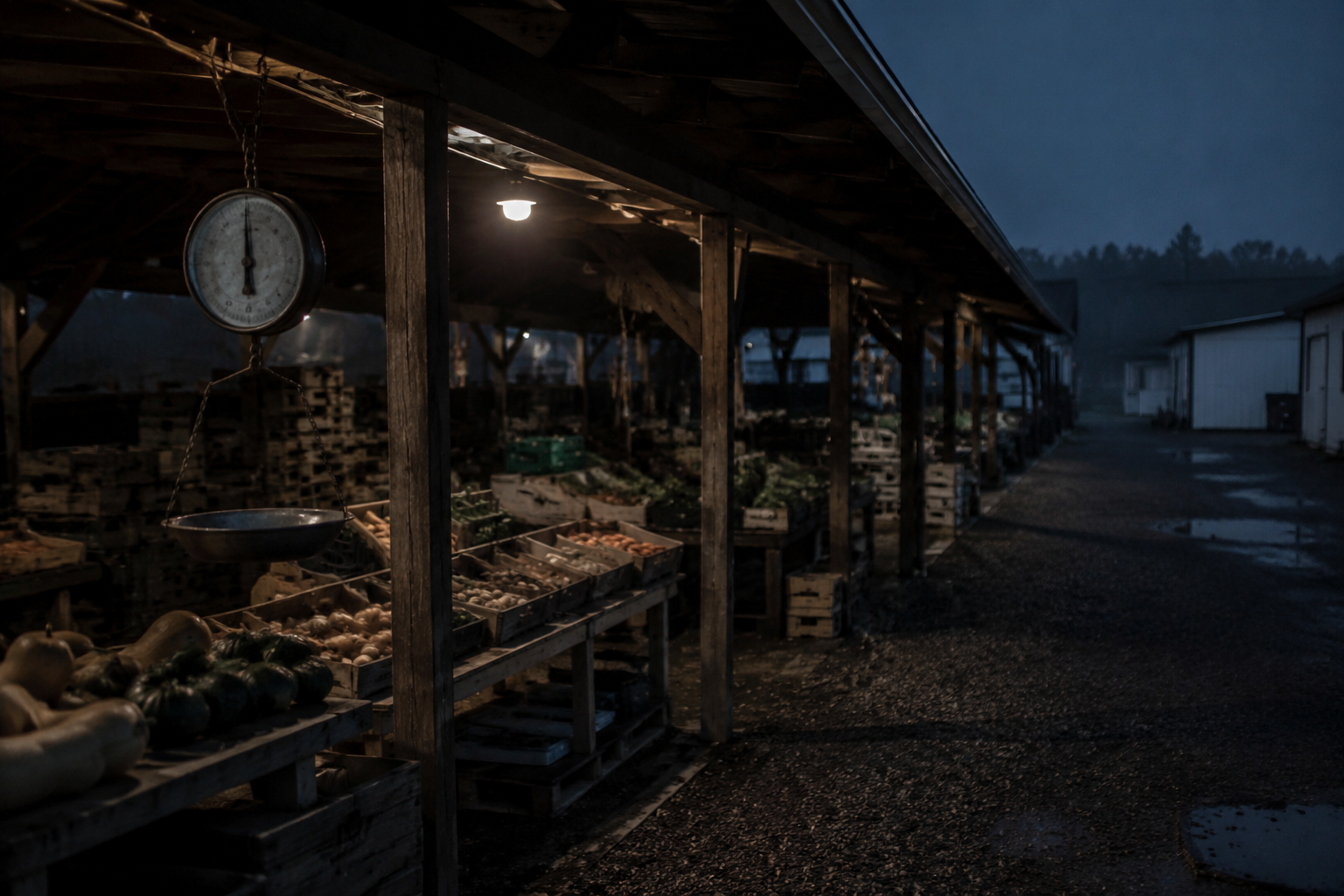
The detail people keep coming back to is not the shape. It is the scale.
According to the local version, the covered market had already closed for the evening. The cash box was gone. Crates were stacked for the next morning.
Under the roof, near the center aisle, an old hanging produce scale was still clipped to a beam.
That scale is what someone noticed later on the security camera images. The needle, which should have been sitting still, appeared to move after closing. Not spin. Not jump like a movie effect. Just a slow change that made people ask what had touched it.
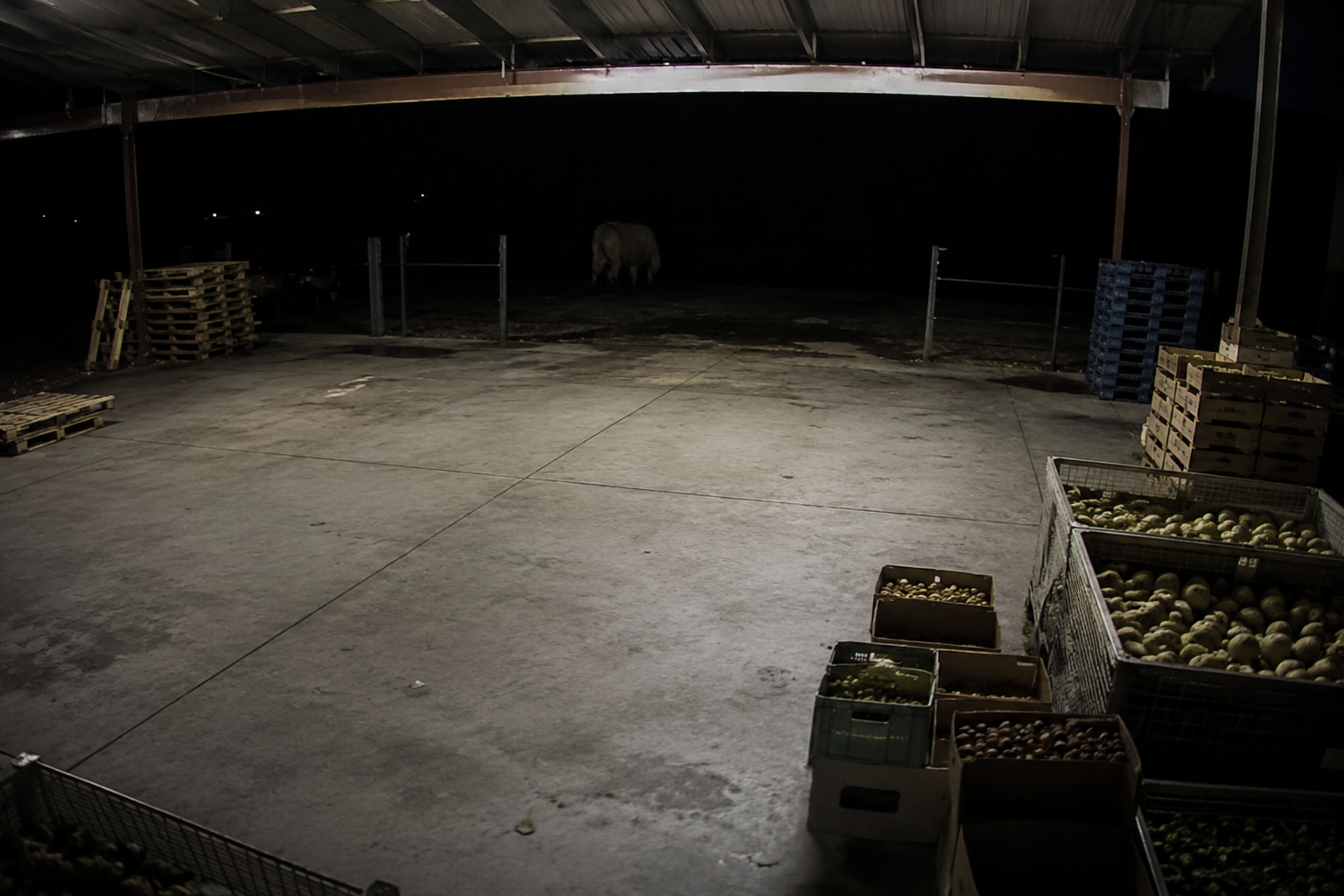
Then, in the background, a broad shape crossed behind the loading bay.
That is the part that moved the story into Bigfoot and Sasquatch territory. But the reason it has lasted is that everything around it looks painfully ordinary.
WHAT THE camera still IS SAID TO SHOW
- A rural covered produce market after closing.
- A hanging metal produce scale near the stalls.
- Stacked crates waiting for morning vendors.
- A quiet loading bay behind the market roof.
- The scale needle moving when no one is visible nearby.
- A wide, dark shape crossing behind the bay.
1. A Market After Closing Feels Different Than A Store
A covered produce market is not quite indoors and not quite outside. During the day, that makes it friendly. You hear trucks on the road, birds under the roof beams, people talking over tomatoes, and vendors calling out prices.
After closing, the same place changes.
The tables are still there. The smell of soil, cardboard, melon rind, and damp wood does not leave. But the human activity that explains all those objects is gone.
That is why the camera images bothers people. A grocery store after hours can feel locked and mechanical. A rural market after hours feels paused.
So when one object appears to move, viewers do not read it as random immediately. They read it as interruption.
2. The Produce Scale Gives The Story A Center
Most local mystery clips suffer from having no anchor. A shadow moves in darkness, and nobody can agree what part of the frame matters.
This story has an anchor: the scale.
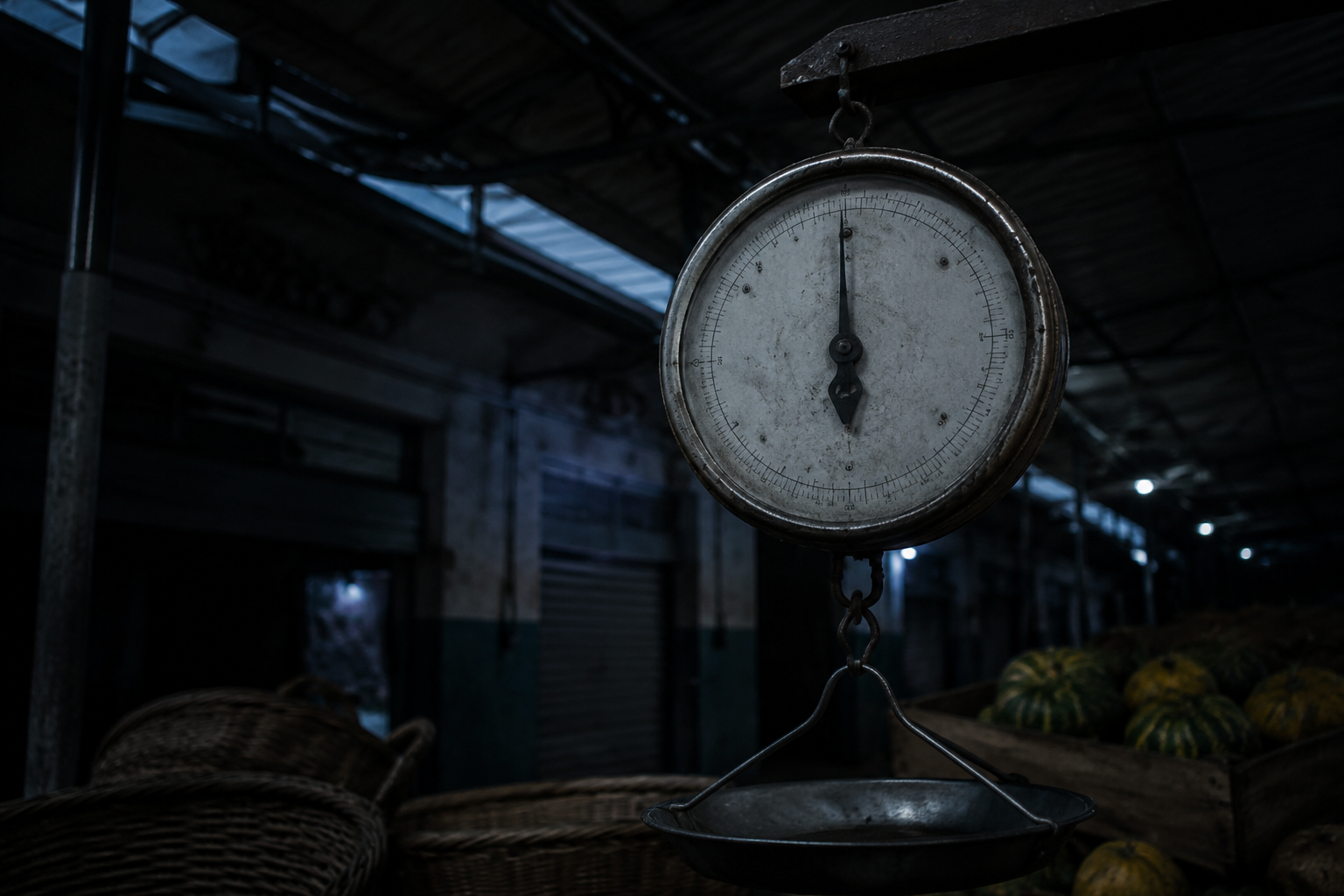
It was reportedly one of those metal hanging scales used for heavier produce, the kind with a round face, a hook below, and a needle that settles after weight is removed.
A scale is supposed to answer one simple question. How much does this weigh?
In the camera still, people say the scale seems to ask the question by itself.
The needle shifts without a visible basket on the hook. It does not give a dramatic reading that would let anyone calculate a monster. It only moves enough to make the viewer wonder whether the hook swayed, the beam shook, or something out of frame brushed it.
That smallness helps the story. A huge jump would feel staged. A slight movement feels like the camera caught the last second of something that did not know it was being watched.
3. There Are Normal Ways A Scale Can Move
A careful reading has to admit the obvious: a hanging scale can move for ordinary reasons.
Wind can travel through an open-sided market. A door closing elsewhere can push air under a roof. A passing truck can create vibration. A loose hook can settle.
If there were fans under the roof, even a weak current could nudge a hanging object. If a vendor removed a basket earlier, the camera might have caught a delayed swing.
None of those explanations require a creature.
That is part of why the story works better as a local mystery than a proof claim. The scale is not impossible. It is just strange enough, in that setting, at that time, to earn a second look.
4. The Loading Bay Is Where The Story Changes Tone
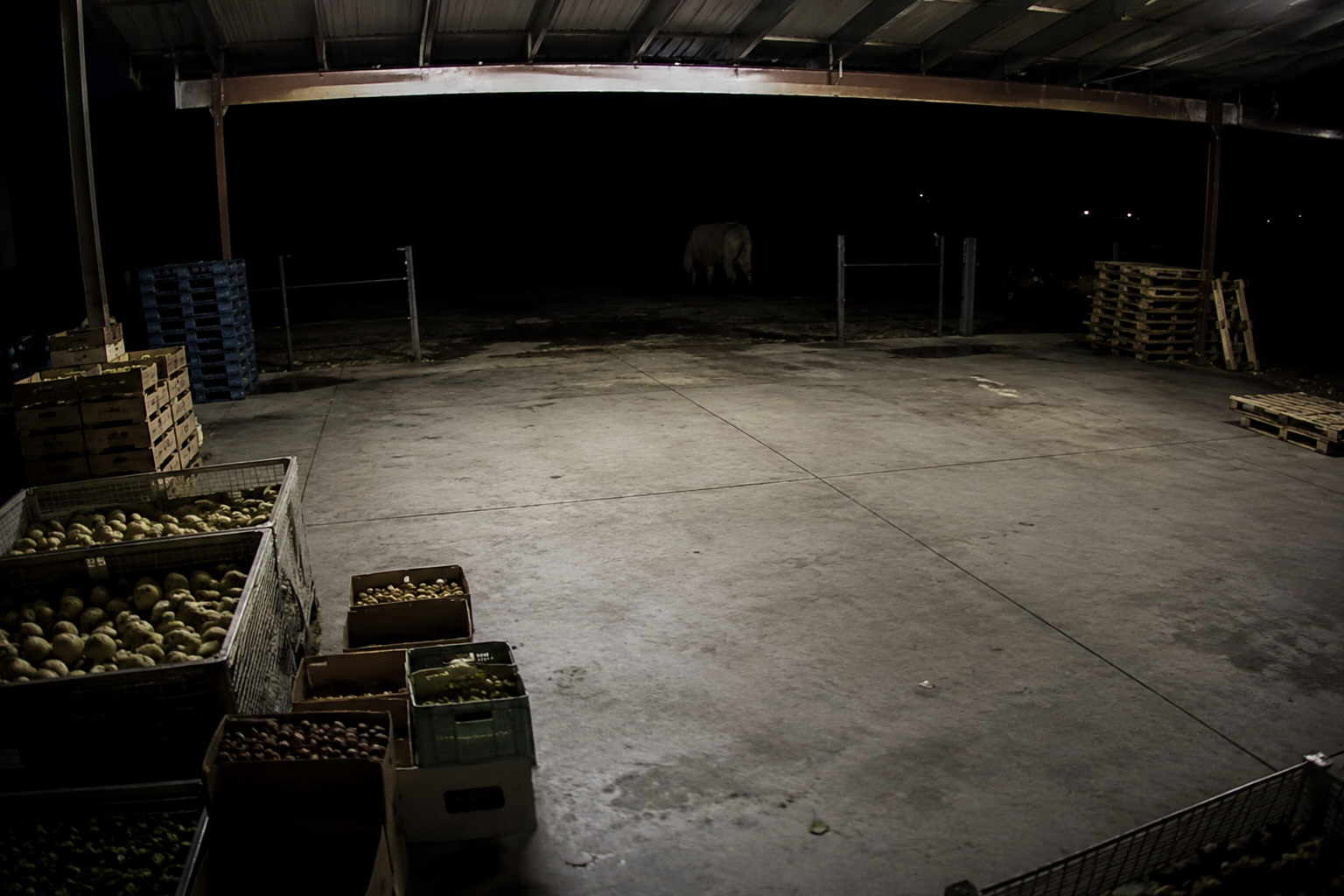
The loading bay sits behind the market in most retellings, partly open to a gravel drive and partly blocked by pallets, stacked bins, and posts. During the day, vendors back in, unload, sweep, complain about prices, and leave.
At night, it becomes a dark gap.
The reported shape does not enter the main market aisle. It does not stand under the light. It crosses behind the bay, wide and low in detail, there for only a short moment.
That is exactly the kind of movement that creates arguments.
A person in a coat could look broad. A tarp could shift. A deer close to the camera could distort. A bear could look taller than expected in bad light. A vehicle shadow could slide along the back wall.
Still, people who favor the Sasquatch interpretation focus on the proportions. They say it looked too wide through the shoulders, too smooth in its movement, and too uninterested in the market lights.
Those are impressions, not measurements. But impressions are often what keep scary reconstructed moments alive.
5. Rural Markets Sit On The Edge Of Human Routine
The Bigfoot angle is not random here. Covered produce markets are often built where human routine meets fields, brush, drainage cuts, and tree lines.
They are not deep wilderness. That matters.
Many Sasquatch stories come from edges: pastures, access roads, berry patches, creeks behind houses, and farm buildings where food smells collect.
A produce market is an edge location with a lot of scent.
Even after closing, there may be bruised apples, melon rinds, spilled corn, damp cardboard, and compost behind the stalls. To wildlife, that is information.
A believer hears that and says, “Exactly.”
A skeptic hears it and says, “Then there are many normal animals to consider first.”
Both reactions are reasonable. The setting does not prove a Sasquatch. It does explain why viewers connect the camera images to that category so quickly.
6. The Shape Was Broad, But Not Clear
The word broad does a lot of work in this story.
People use it when they cannot honestly say tall, hairy, upright, or unmistakable. Broad means the shape had width. It may also mean the camera angle widened whatever passed behind the bay.
That uncertainty should stay in the article.
Too many online retellings turn a dark crossing into a noted creature by the second paragraph. This one is more interesting unresolved. A broad shape behind a loading bay is not evidence strong enough to settle anything. It is a visual problem.
What was close to the camera? How bright was the security light? Was the bay open to the road? Did employees ever cut through after hours? Were there tarps, coats, or stacked black bins in that area?
Without those answers, the shape stays ambiguous.
But ambiguous does not mean boring. Sometimes it means the viewer has to keep building and unbuilding the scene in their head.
7. The Timing Makes The camera still Feel Like A Sequence
If the scale movement and the broad shape happened minutes apart, the story would probably be weaker. They would feel like separate oddities from one long night of camera images.
The version that circulates says the scale moved first, and the shape crossed behind the loading bay soon after.
That ordering matters.
It gives the camera still a beginning and a second beat. First, something in the market reacts. Then, something passes the back. The mind wants to connect those events, even if the connection is only coincidence.
Maybe a gust moved the scale. Maybe a passing vehicle caused both a vibration and a shadow. Maybe an animal brushed a post, then crossed the open gap.
The cautious answer is that timing can trick us.
The human answer is that timing is the whole reason people watched twice.
8. Why This One Feels Like A Cousin Story
Every family has a cousin who tells a story like this with too many practical details to dismiss quickly.
Not, “I saw a monster.”
More like, “You know that market by the county road? My friend’s uncle closes there sometimes. He said the scale moved after they locked up, and then something crossed behind the loading bay.”
That delivery is hard to categorize. It is not scientific evidence. It is not only a campfire legend either. It lives in the middle, where people remember the gravel, the scale on the beam, and the fact that nobody made a big speech about it.
The lack of drama can make it feel more believable, even when the actual evidence remains weak.
That is the Laurel-style pull of the story: ordinary objects arranged in a way that feels slightly wrong.
9. The Best Explanation May Still Be Mundane
The best explanation may be a draft, a settling hook, a person out of frame, or a shadow from something perfectly normal.
That should not be hidden. It is the responsible place to start.
But the reason the rural covered market story keeps resurfacing is not because it offers a clean answer. It is because it puts two suggestive things in one quiet place: a scale behaving as if weight changed, and a broad shape moving where the market meets the dark.
For Bigfoot and Sasquatch followers, that combination hints at something investigating food after humans left. For skeptics, it is a reminder that security camera images can turn air, vibration, distance, and shadow into a mystery.
Both readings can exist without forcing the camera still to become proof.
What remains is the image: a closed market roof, crates stacked for morning, a metal scale under the beam, and the loading bay behind it briefly occupied by something too unclear to name.
Not enough to prove a creature.
Enough to make people pause before turning off the lights.
Reader Context
This Weird Witnessed story is an editorial reconstruction, written as eerie visual storytelling rather than a verified report. For more context, see Bigfoot and Sasquatch Stories Guide and How WeirdWitnessed Creates Reconstructed Horror Stories.