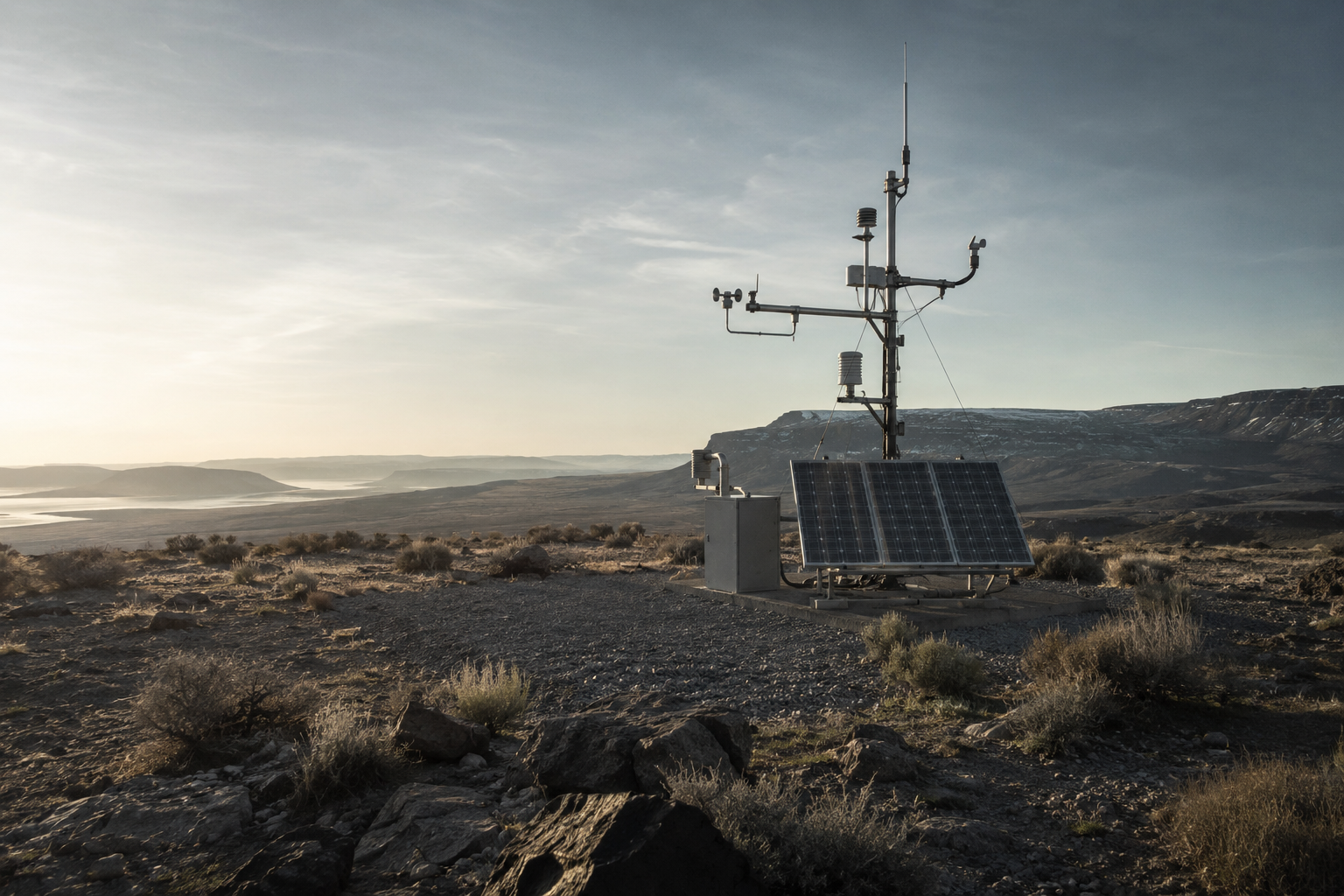
The Glass Mesa weather station was designed to remove mystery from the desert.
It recorded wind speed, temperature, pressure, humidity, solar radiation, and rainfall that almost never came. Its instruments were bolted to a gravel pad on a bare mesa where the horizon looked too far away and every shadow should have been easy to understand.
That is why the photographs taken during one maintenance visit became difficult to file away.
After a silent blue-white flash near the station, two thin shadows appeared in photos pointing opposite the sun. In another image, the dusty surface of a solar panel reflected a narrow upright shape that did not seem to be standing anywhere on the ground.
The case is not spectacular in the usual sense. Nothing lands. Nothing speaks. No witness describes a craft hovering overhead.
Instead, Glass Mesa offers a cleaner and stranger problem: if the sun was in one direction, why did two shadows point the other way?
A Station Built for Boring Data
Glass Mesa sat beyond a locked service road used by utility crews, range researchers, and the occasional maintenance contractor. The station itself was modest: an instrument mast, a rain gauge, a small enclosure, a battery box, and two angled solar panels.
The site was remote enough to discourage casual visitors but not unreachable. Tire tracks could persist for weeks. Footprints lasted until wind combed the gravel back into its usual hard crust.
The maintenance visit was routine. A technician and a driver came to replace a failing data logger, clean dust from the panel faces, check cable wear, and photograph the installation for the service record.
Those record photos are important. They were not framed as paranormal evidence. They were meant to show equipment condition.
The strange details appeared inside the kind of images people usually take quickly and forget.
The Flash No One Heard
The first odd event was described as a blue-white flash near the station, bright enough to make both crew members pause.
They did not report thunder. They did not feel a shock wave. No transformer blew, and no obvious burn mark was found on the mast, enclosure, gravel, or panels.
The flash was silent, brief, and local in the way lightning usually is not. One witness thought it came from above the instrument mast. The other thought it reflected from the panel array.
That disagreement matters because the event was too fast to locate with confidence. A flash can destroy distance. It turns every reflective surface into a suspect.
The crew waited, checked for electrical smell, then continued the job. Only later did the photographs make the flash seem like the beginning of something rather than an isolated nuisance.
The Shadows That Should Have Agreed
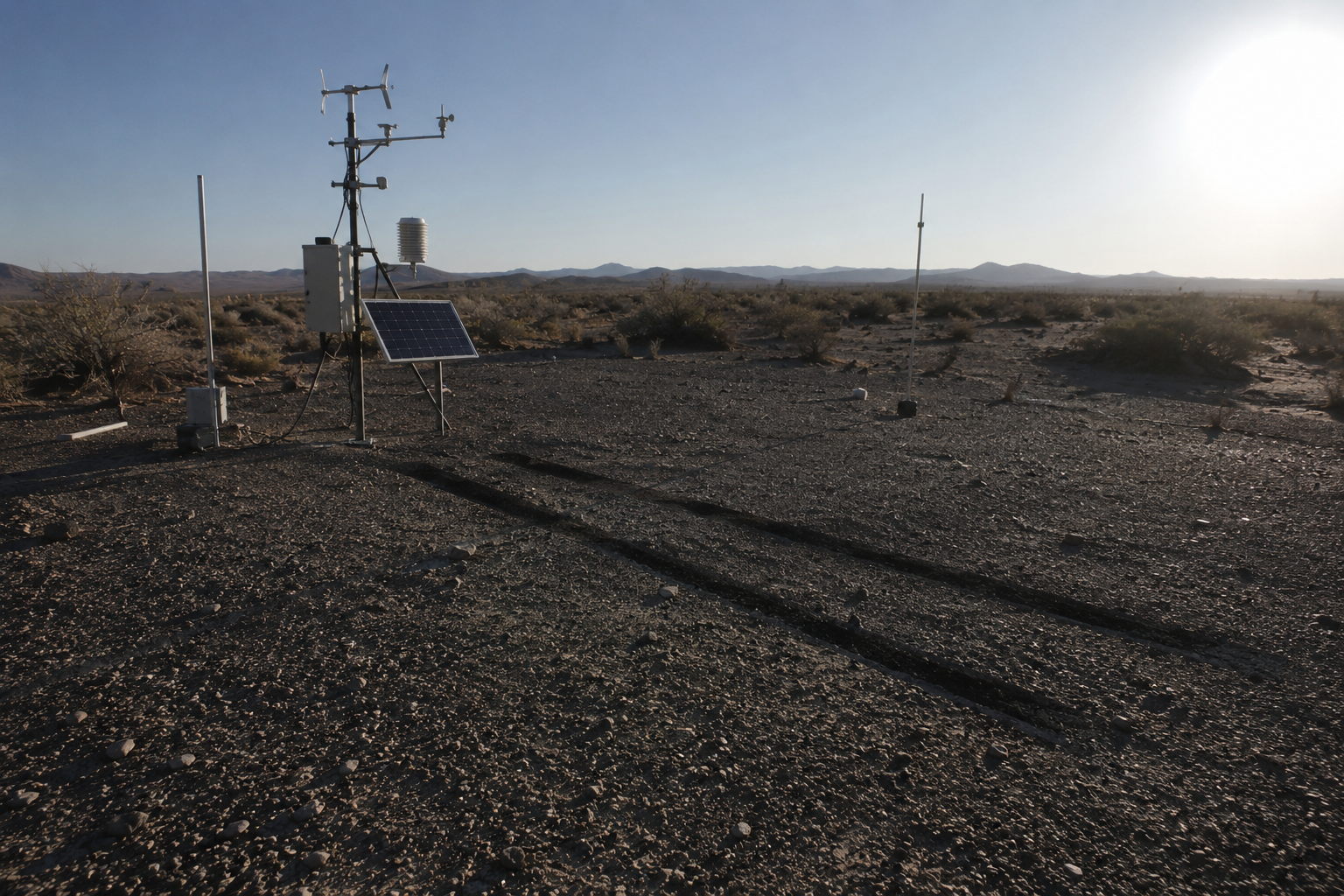
In the most discussed images, two thin shadows cross the pale gravel near the equipment pad.
They are narrow, upright, and oddly clean at the edges. They do not resemble the broader shadows thrown by the mast, the panel supports, or the crew members. More importantly, they angle in the wrong direction.
The sun position was not a mystery. It appears in the highlights on the instruments and in the known timestamp of the visit. Ordinary objects in the frame cast expected shadows consistent with the low desert light.
The two thin shadows do not follow that pattern. They point back toward the sun, as if their source were lit by something behind the camera or as if the ground briefly accepted a second geometry.
That phrase sounds dramatic, but the photos themselves are quiet. No glowing figure. No beam. Just two wrong lines on gravel.
The Reflection in the Solar Panel
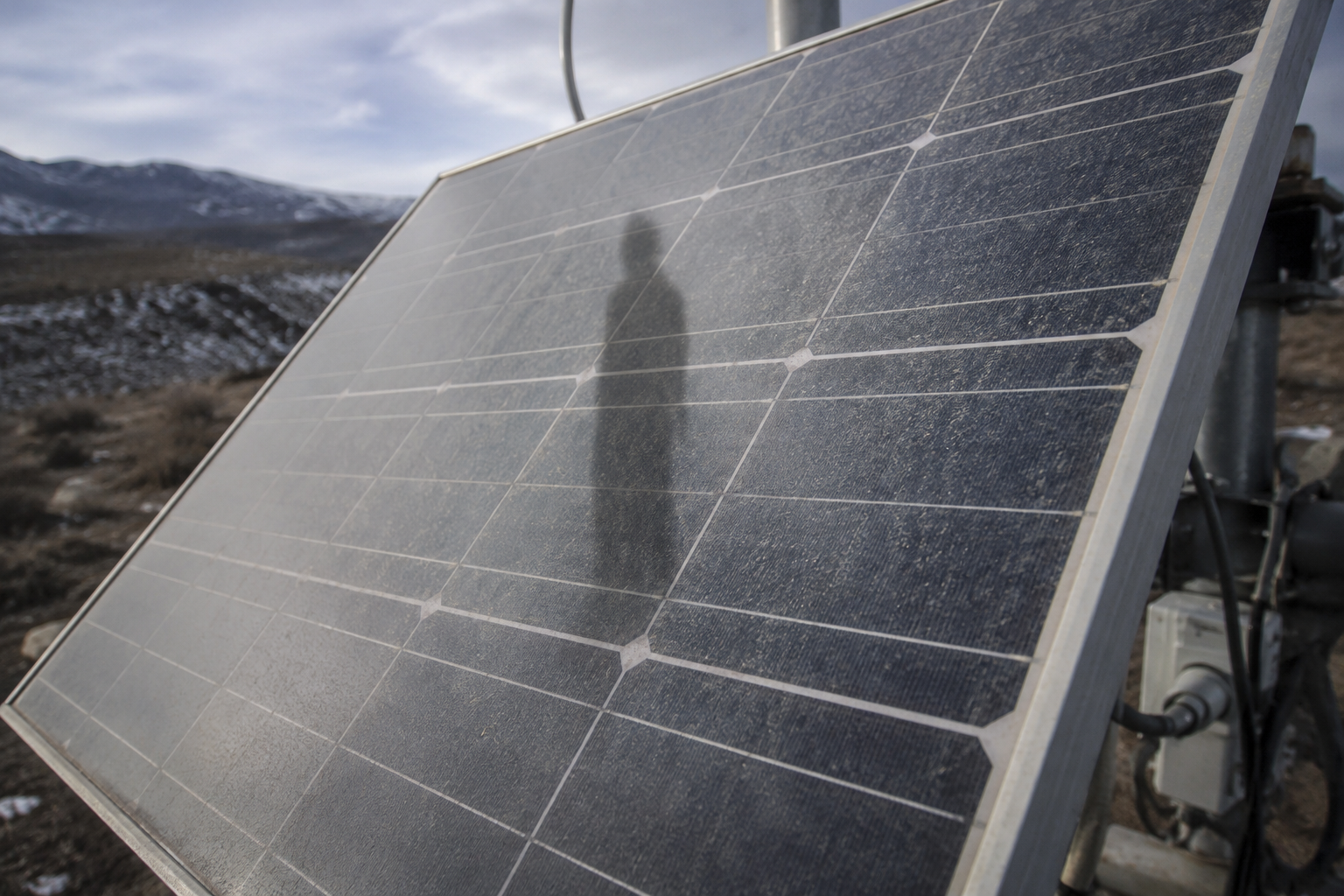
The image that pushed the story into unknown visitor territory is a closer panel photograph.
The technician had taken it to document dust accumulation and the condition of the mounting bracket. In the dark glass, between washed-out sky and the faint grid of cells, there appears to be a narrow upright form.
It is not detailed. There is no readable face, clothing, or equipment. The shape is slim, vertical, and slightly tapered, with the suggestion of a head or upper narrowing.
The troubling part is not that a reflection exists. Solar panels reflect. Dust and angle can turn a technician, tool, truck mirror, or mast into a strange figure.
The troubling part is placement. Based on the panel angle, the reflected shape should correspond to a position beside or behind the camera. The crew insisted no person was standing there, and no matching object appears in the wider scene.
That does not make the reflection alien. It makes it difficult.
Why This Became an Unknown Visitor Case
Most unknown visitor accounts depend on a witness seeing a figure directly. Glass Mesa is different.
No one claimed to watch a being cross the gravel. No one heard footsteps. No one found handprints on the enclosure or marks on the panels. The visitor, if that word is even fair, exists only as an effect inside images: shadows without an obvious caster and a reflection without an obvious body.
That restraint helped the case travel among people interested in evidence rather than spectacle. It also made the story easy to overstate.
Calling the solar panel form a visitor is an interpretation, not a fact. It could be a reflected technician distorted by glass, a tripod-like tool, a cable loop, or a shape produced by dust and compression.
Still, the combination of wrong-way shadows, silent flash, and reflected figure is unusual enough that the alien label attached itself quickly.
The Practical Explanations
There are several grounded explanations, and none should be skipped.
The blue-white flash could have been static discharge, a distant reflection from an aircraft, sunlight catching a vehicle mirror far down the road, or an electrical arc inside equipment that left no obvious mark.
The shadows might be artifacts of perspective. Gravel is uneven. Thin shadows from guy wires, tools, or antenna elements can look disconnected from their sources when photographed at a shallow angle.
A second light source is also possible. The maintenance truck’s windshield, chrome, or a reflective instrument face could have redirected sunlight across the pad and made shadows that contradicted the main sun angle.
The solar panel figure may be the photographer, the driver, or the open truck door stretched into a narrow form by the panel’s angle and dusty surface.
These explanations are not evasions. They are exactly where an investigation should begin.
Why the Debunk Is Not Simple
The reason Glass Mesa remains interesting is that the ordinary explanations do not align neatly with all the images.
If the wrong-way shadows came from reflected sunlight, the reflecting source should produce other visible clues: a bright flare, a matching highlight, or a consistent secondary shadow from nearby objects. The photos do not show an obvious one.
If the solar panel shape is a crew member, its reflected height and position seem awkward compared with where the crew remembered standing and where their shadows fall in adjacent frames.
Memory can be wrong. Timestamps can drift. Camera lenses distort. But the service photos were taken close together, and the ordinary shadows in them behave normally.
That contrast is what keeps the anomaly from dissolving at first touch. Most of the scene is legible. Only a few parts refuse the rules the rest of the frame follows.
What the Photos Can and Cannot Say
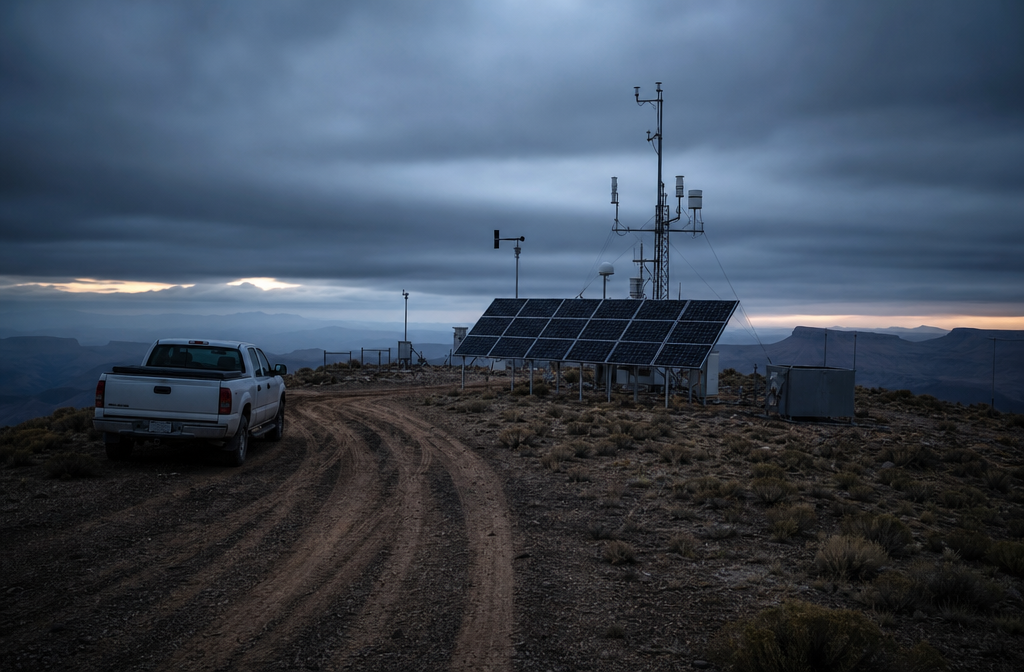
The photographs cannot prove an extraterrestrial visitor.
They cannot prove a body stood beside the panel, nor can they prove an intelligent source created the flash. They do not show a craft, a landing mark, or a clear entity.
What they can do is preserve a contradiction. In one set of frames, most shadows obey the sun while two thin ones do not. In another, a reflective surface shows something narrow and upright that the wider record does not easily place.
That is a modest kind of evidence, but modest evidence is sometimes the most persistent. It does not collapse because a dramatic claim fails. It survives as a technical question.
Where was the light? What cast the lines? What stood, or seemed to stand, in the panel?
Why Glass Mesa Still Feels Unsettled
The strongest version of the Glass Mesa case is not a story about aliens walking openly through a weather station.
It is a story about presence inferred from absence.
There should have been an object making those shadows. There should have been a person or tool corresponding to that reflection. There should have been a sound, mark, or equipment fault after the flash.
Instead, the file contains a clean station, a silent event, and photographs that disagree with the desert sun.
Maybe the answer is optical. Maybe it is a rare combination of reflections, timing, dust, and memory. That would be satisfying in the way good debunks often are: not less interesting, only less haunted.
But until the geometry is reconstructed convincingly, the Glass Mesa weather station remains a small, bright wound in an otherwise ordinary maintenance record.
The instruments kept logging weather after the crew left. Wind, heat, pressure, light.
None of them had a field for shadows pointing the wrong way.
Reader Context
This Weird Witnessed story is an editorial reconstruction, written as eerie visual storytelling rather than a verified report. For more context, see UFOs and Unknown Visitors Guide and How WeirdWitnessed Creates Reconstructed Horror Stories.