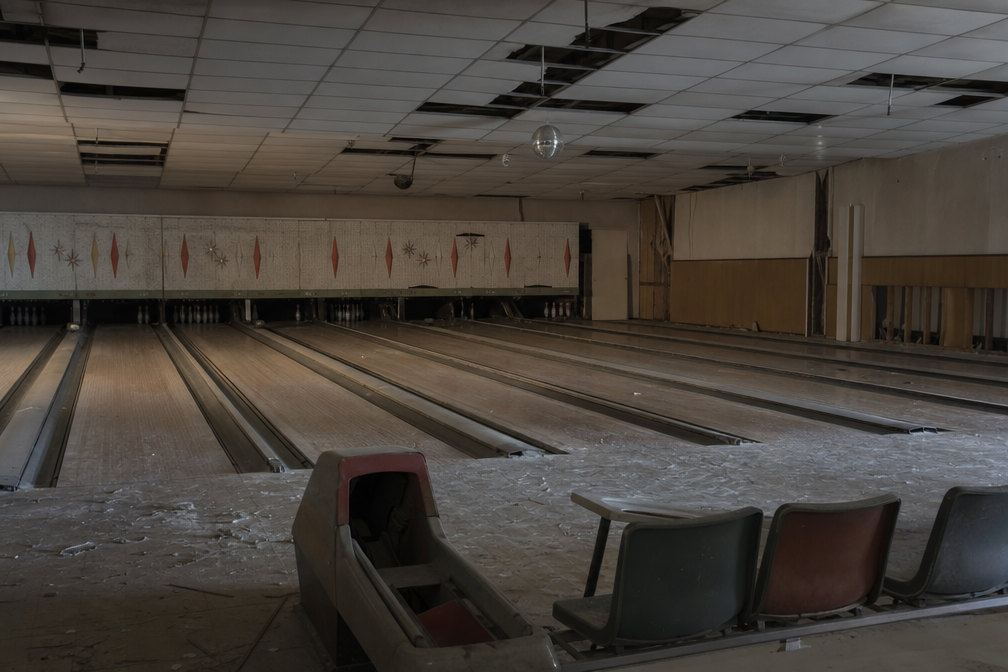
A camera in lane 7’s pinsetter room was not supposed to record anything after midnight.
The county bowling alley had already closed for good. The lanes were dark, the snack bar was empty, and the last maintenance walk-through had ended with the breaker panel tagged for shutoff.
That is why the short camera still, and the still image taken from it, made the story harder to treat as another abandoned-building rumor. In the camera record, several pins appear to reset in the pit area after the machine should have had no usable power. On the oil pattern beyond the foul line, there are fresh smears. In one frame, a dark human-shaped form seems partly hidden behind the pin elevator.
None of that proves a haunting. It does, however, create a case where the practical questions matter as much as the eerie ones: what still had power, what could move without it, and why did the camera catch the most unsettling detail in the one room almost nobody thought to check?
The Still Frame That Started the Lane 7 Story
The account begins with a maintenance camera, not a security camera aimed at customers.
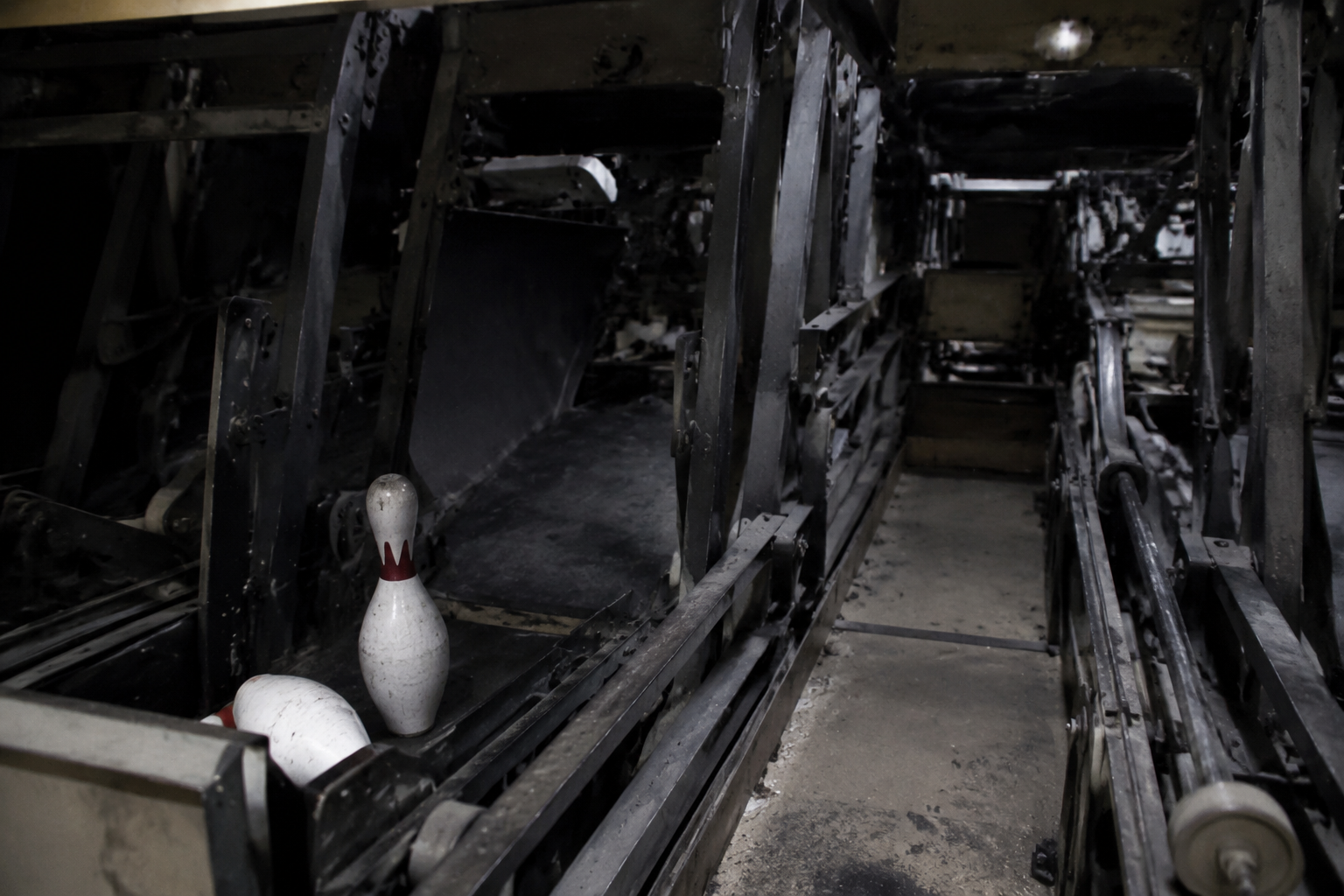
That distinction matters. A public-facing camera would have shown the concourse, the front doors, or the rows of lanes where trespassers might be expected. This one reportedly watched the pinsetter area for lane 7, a cramped mechanical room behind the masking unit where belts, lifts, pin wheels, and return tracks did the work bowlers never saw.
After the alley closed, a former employee reviewing stored camera images noticed a sequence that did not match the shutdown timeline. The image was dull and practical: gray machinery, scuffed kickbacks, dusty gutters, and the vertical shape of the pin elevator rising behind the deck.
Then the pins were no longer where they had been.
The unsettling part was not that the whole machine roared back to life. It was smaller. A cluster of pins appeared to shift into a reset position, as if some part of the old system had completed one last cycle.
Why a Closed Bowling Alley Changes the Question
Bowling alleys are full of sounds that imitate intention.
Even during normal operation, a pinsetter can clatter, pause, correct itself, and restart with a timing that feels almost aware. Springs release. Belts drag. Pins roll against guides. A loose part can sound like a hand working in the dark.
But a closed bowling alley is different from an active one. There are fewer normal explanations available because fewer systems are supposed to be running. According to the story, the building had entered the awkward period between business closure and final clearing: utilities being reduced, machines locked out, inventory removed, and fixtures left in place.
That period creates confusion. Some outlets may remain live for cameras or alarms. Emergency circuits may still work. A maintenance battery may preserve camera record for a short time. None of those details automatically make the camera images impossible.
They do make the question sharper. If the pinsetter’s primary power was off, what mechanism caused the visible reset?
The Pins, the Oil, and the Problem of Timing
The most ordinary part of the story may also be the most important: the lane oil.
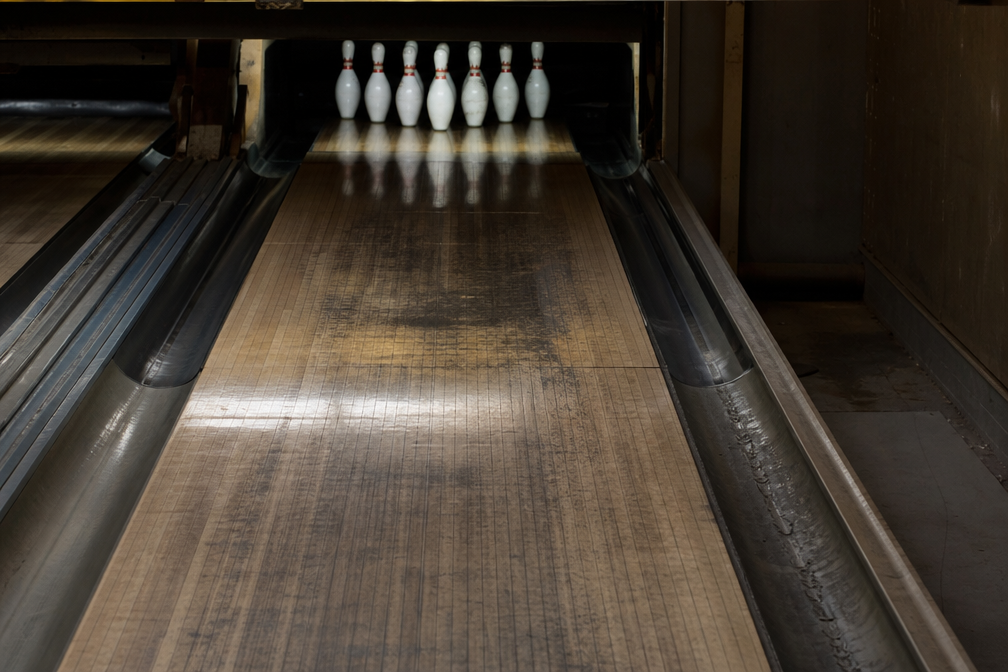
Lane oil is designed to be invisible from a distance, but under certain angles it can catch light as streaks, cloudy patches, or fresh-looking smears. In the lane 7 account, the oil pattern reportedly showed disturbances after the final service walk-through, including drag marks near the approach into the pin deck.
That detail does not require a ghost. A worker could have stepped too close. A tool cart could have crossed the lane. A leak, dust, or condensation could have changed how the surface reflected the camera’s light.
Still, the oil smears matter because they turn the event from a single odd camera moment into a sequence. First the building is shut down. Then the camera records activity near the pinsetter. Then the lane surface appears altered in a way that suggests contact, movement, or disturbance.
If the account is accurate, the camera images did not simply show an ambiguous shadow. It showed a physical system apparently responding to something in its space.
The Figure Behind the Pin Elevator
The still image became the part most people talked about, and also the part that deserves the most caution.
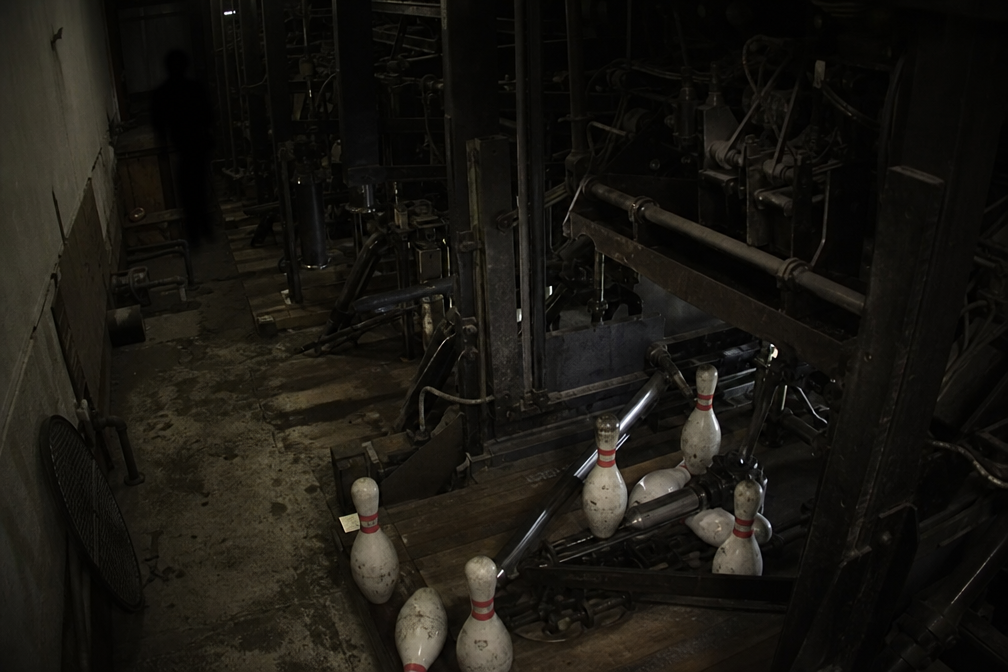
Behind the pin elevator, where the machinery creates overlapping vertical lines, there appears to be a human-shaped dark form. It is not centered. It is not dramatic. It does not have a visible face, hands, or clothing detail. It sits partly behind the equipment, easy to miss until someone points out the contour.
That is exactly what makes it effective as a story, but not necessarily as evidence.
Machines create false figures. Belts, shadows, housing panels, cable loops, and dust on a camera lens can combine into a shape the brain reads as a person. In a pinsetter room, almost every surface is interrupted by metal edges and dark gaps.
At the same time, the location of the form keeps the discussion alive. If the dark shape had appeared in the open lane, it could be treated as a trespasser, a reflection, or a camera artifact. Hidden behind the elevator, it seems connected to the machinery itself, as though something was standing where only a mechanic would normally stand.
The careful conclusion is not that the still shows an apparition. It is that the still gives the account its strongest visual anchor.
What the Practical Explanations Have to Cover
A good unexplained-camera images case should not be protected from ordinary explanations. It should be tested by them.
The first explanation is residual power. Some pinsetter components may remain energized through separate circuits, mislabelled breakers, or capacitors discharging after shutdown. If a component completed a delayed motion, the reset could look more purposeful than it was.
The second explanation is human access. Closed businesses are not sealed worlds. Former staff, contractors, owners, inspectors, vandals, or curious locals can enter buildings after hours, sometimes with keys and sometimes without them.
The third explanation is visual distortion. Low-light cameras often compress shadows, exaggerate contrast, and create motion artifacts from small changes in exposure. A smear on oil can look fresh. A belt can look like a shoulder. A pin rolling into place can seem like a reset.
Each explanation helps. None of them, by itself, addresses every part of the story cleanly.
Why Lane 7 Became the Focus
Stories like this often attach themselves to a specific number.
Lane 7 may not have been special before the camera images. It may have been just one machine among many, chosen by chance because its maintenance camera survived longer than the others. Once the camera still circulated, though, the number gave the account a center.
People remembered lane 7 because it sounded specific. They could picture it: the dark lane, the oil shine, the hidden machinery, the pin elevator rising like a narrow shaft in the back. Specificity makes a strange report feel less like folklore and more like a file someone could open.
The account also benefited from an unusually plain setting. A bowling alley is not a gothic mansion or a cemetery. It is a place of league nights, birthday parties, rental shoes, stale coffee, and fluorescent light. When something eerie appears there, it can feel more intrusive because the setting was never designed to be mysterious.
The Weaknesses That Should Stay in the Story
The lane 7 case is strongest when its weaknesses are not ignored.
We do not have a full public chain of custody for the camera images. We do not know exactly which circuits were live, how the camera was powered, whether the timestamp was synchronized, or how many people had access after closure. We do not know whether the oil pattern was photographed before and after under identical conditions.
Those gaps are not small.
They are the difference between a compelling recreated scary moment and a verified anomaly. Any responsible reading has to leave room for error, staging, misunderstanding, and the strange behavior of old equipment.
But uncertainty does not make the story worthless. It shows how easily a piece of camera images can sit between categories: mechanical incident, trespasser report, camera artifact, and possible figure sighting.
The case asks for patience rather than certainty.
What Makes the Pinsetter camera images Linger
The most memorable part of the story is not that a shadow appears in a closed building.
It is that the shadow appears in a room built for repetition. Pinsetters reset the same scene again and again: pins fall, pins rise, the deck clears, the lane waits. A machine like that already has a rhythm that can feel ghostly once the customers are gone.
If the camera images is ordinary, it is still a reminder of how abandoned places preserve movement after people leave. Machinery settles. Surfaces shift. Cameras keep watching. The building continues to behave as though the business has not fully ended.
If the camera images is not ordinary, then the still frame behind the pin elevator becomes more than a dark patch. It becomes the suggestion of a presence standing inside the last working memory of the alley.
Either way, the lane 7 account remains effective because it avoids an easy conclusion. It does not need a screaming witness or a dramatic apparition. It relies on a few pins, a smear in the oil, and a shape that may or may not have been watching from behind the machine.
That restraint is why the story has lasted.
It leaves just enough in the frame to make the empty alley feel occupied.
Reader Context
This Weird Witnessed story is an editorial reconstruction, written as eerie visual storytelling rather than a verified report. For more context, see Apparitions and Hauntings Guide and How WeirdWitnessed Creates Reconstructed Horror Stories.