The Evidence Is in the Before and After
The laundromat back-room camera became famous for what it does not show. There is no apparition walking past the dryers. No hand reaches from a doorway. No face appears in washer glass. The camera still is unsettling because it presents a practical problem: the room is normal, the camera skips forward, and the room is no longer normal.
That sounds like a technical failure, and maybe it is. But the details have kept the case alive.
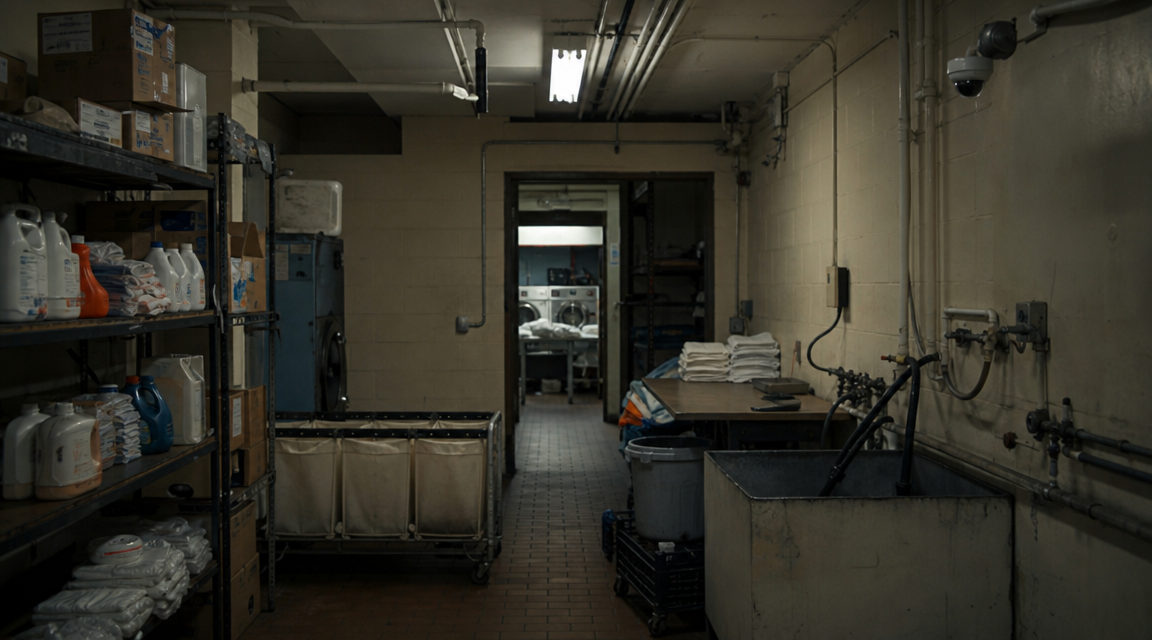
The back room belonged to a small neighborhood laundromat with long hours, coin machines, and a service area behind a staff-only door. The camera watched detergent boxes, dryer sheets, cleaning tools, and two wheeled laundry carts. It was installed after inventory kept going missing, not because anyone suspected anything paranormal.
On the morning in question, the owner found the back room disturbed. One cart sat in the middle of the room. A detergent box was open. Dryer sheets were scattered. Nothing expensive was gone.
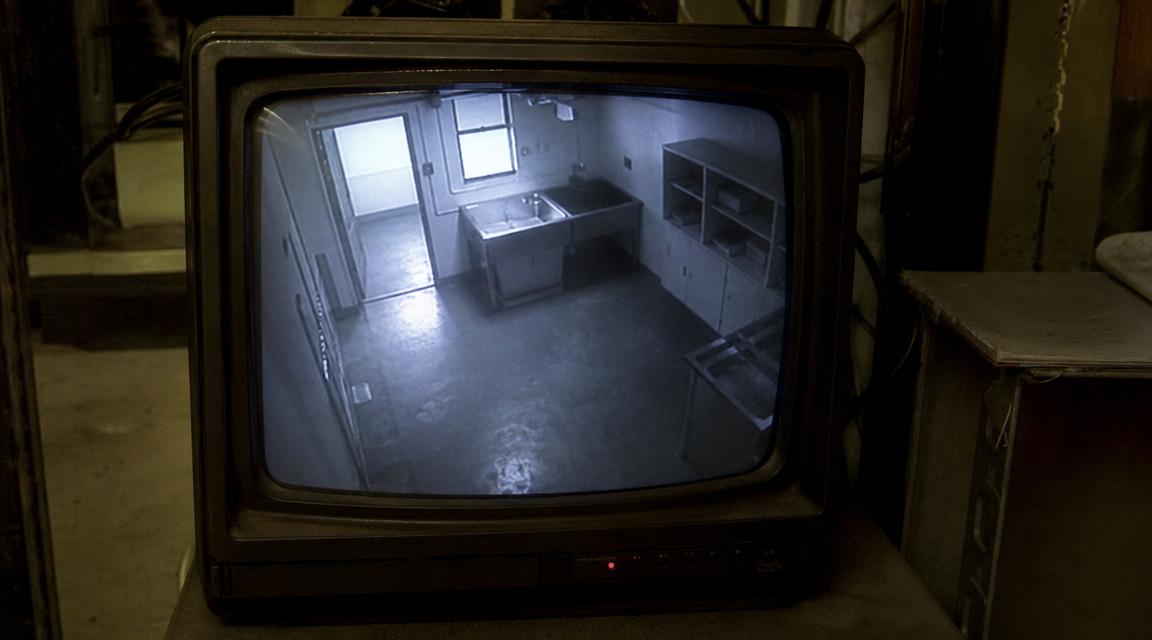
The camera should have explained it. Instead, it made the scene harder to understand.
The Room Was Ordinary Enough to Matter
This case works because the setting is so plain. Laundromat back rooms are cramped, bright, and full of objects with obvious uses. The walls are marked by humidity. The floor is concrete. The shelves hold bulk supplies. A service door connects to the main laundry area, and a rear exit opens to a narrow alley used for deliveries.
Because the room is functional, movement should be easy to interpret. If someone enters, there is a door. If a cart moves, there are wheels. If a box spills, gravity and handling explain the mess.
The camera angle covered most of the useful space: the main door, carts, supply shelves, and part of the sink. The rear exit was partly obscured, but opening it normally created a strip of outside light.
In the before image, the room is workroom-neat: carts against the wall, boxes stacked, sink clear. In the after image, the arrangement is plainly different.
The Timeline Did Not Behave Cleanly
The CCTV system recorded on motion detection. That is the first complication. It did not save every second of the night. It saved clips when the software decided something in the frame had changed. For a skeptic, that opens a wide door. The missing action could have happened between recordings.
That explanation would be satisfying if the rest of the system supported it.
According to the owner’s account, the camera recorded normal closing activity, then a brief empty-room camera still when the fluorescent fixture flickered. Hours after that, it recorded the disturbed room. The problem was the trigger. The later camera still began with the cart already in the center of the floor.
There was no saved segment showing the cart moving.
Motion systems miss things, especially in low light. But a cart rolling through the central frame should have been more noticeable than a flickering tube. A person opening the staff door should have changed much of the image. The software captured weaker events and missed the main event.
That inconsistency is the first reason the camera images became difficult to explain.
The Door Evidence Raised More Questions
The laundromat did not have a sophisticated security setup, but it had enough basic evidence to complicate a simple break-in theory. The front doors were locked after closing. The rear exit had a deadbolt and a contact sensor connected to the alarm panel. The staff door between the main floor and back room was visible from another camera near the coin machines.
The owner reportedly checked all three points.
The front camera did not show anyone entering after closing. The rear sensor did not log an opening during the time window when the room changed. The main-floor camera showed no person crossing toward the staff door.
None of this is perfect. Small businesses have blind spots. Sensors can fail. A staff member could have used a key and forgotten. A rear door can be opened carefully if the sensor is misaligned.
Still, the disturbance was physical. The cart moved. The supplies scattered. If a person did it, that person needed a route in and out. The available records do not supply one neatly.
The Cart Is the Hardest Object to Ignore
Small items can fall. Boxes can slump. Dryer sheets can scatter if a package has been left open near a vent. A plastic scoop can slide off a shelf. Individually, the mess is not mysterious.
The cart is different.
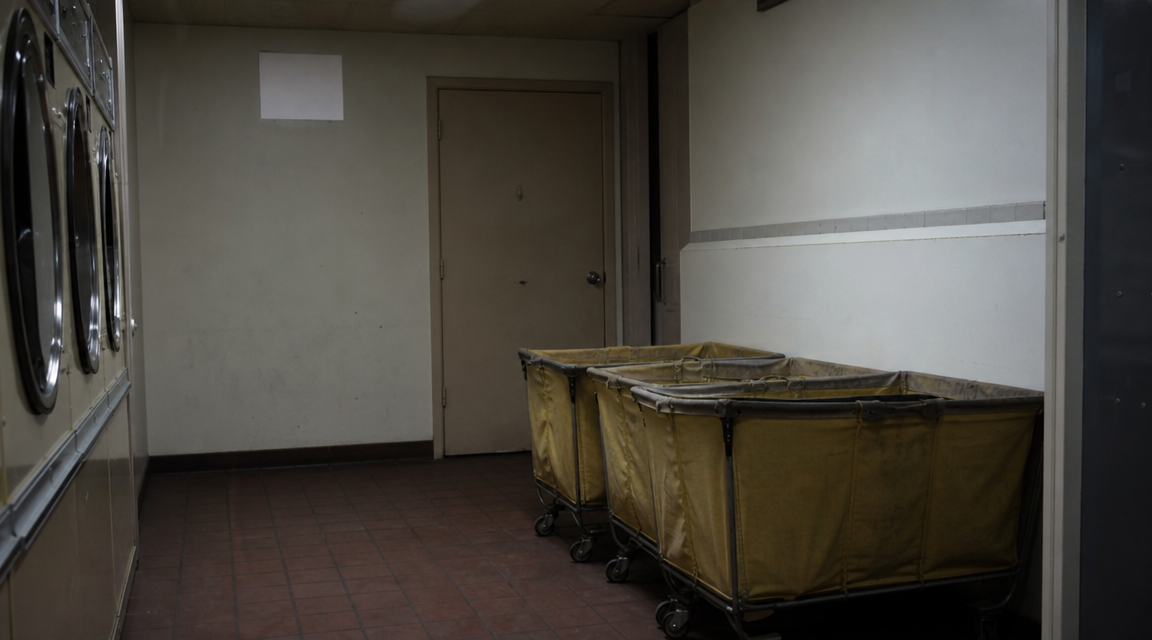
In the before frame, it sits against the left wall with its handle angled toward the sink. In the after frame, it is several feet away, turned slightly, with one wheel near the drain patch. The shift is not enormous, but it is deliberate-looking. It is not the kind of movement caused by a small vibration.
Laundry carts do roll. If the floor slopes or a wheel is sticky, one might drift. But employees said the cart usually had to be tugged over a lip in the floor near the wall.
A recreation reportedly showed that a cart could move from the wall to the center if pushed and released. It could not reproduce the same angle by simple drifting. The cart either needed contact, stronger force, or a different starting position.
For a before-and-after case, that is the key. The cart anchors the mystery in weight and distance.
The Mess Looks Random Until It Doesn’t
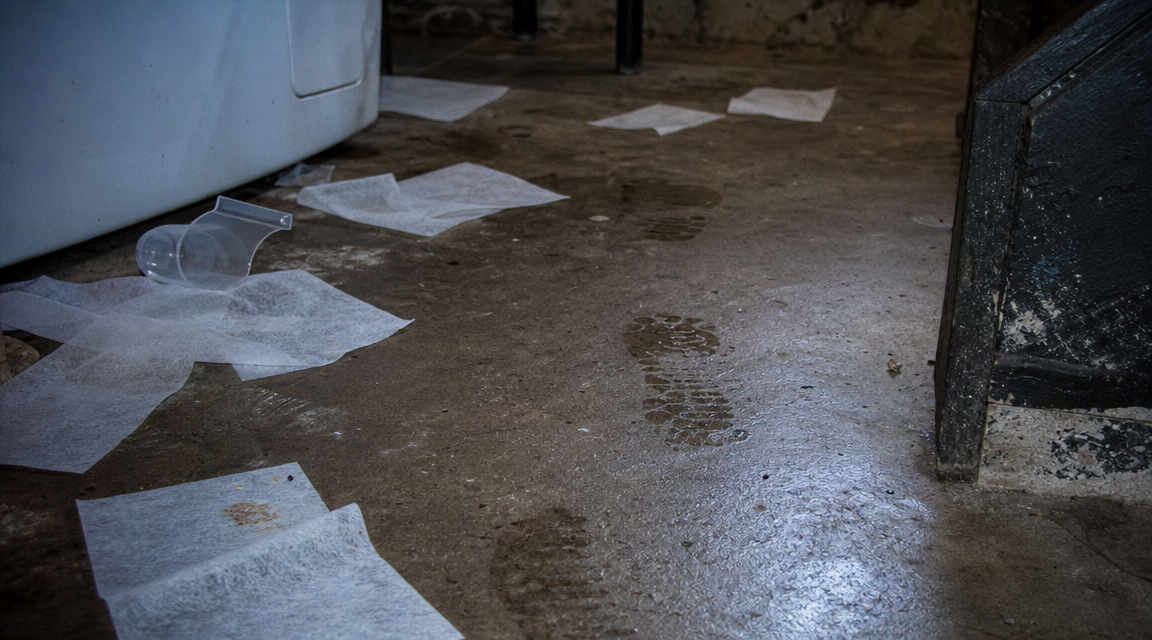
The scattered supplies are easier to dismiss, but they add texture. The dryer sheets were not spread evenly like something blown by a fan. They formed a loose trail between the shelf and the utility sink.
The open detergent box is also odd. If an animal had entered, that might make sense. Raccoons and stray cats can create chaotic scenes in utility rooms.
But animal explanations have problems. No animal appears on the camera. There were no reports of torn packaging, droppings, paw prints, or chewed material. A cat might slip through surprising spaces, but it would not easily move the cart.
The mess also appears distributed around the cart, not simply around the shelf. That makes it feel like an event happened in the center of the room, even though the camera never captured that event.
The CCTV Artifacts Cannot Be Ignored
Any honest discussion has to return to the camera. Motion-detection CCTV can be misleading. It can fail to record movement if the sensitivity is too low, if the light level changes gradually, or if the system is conserving storage. It can also make a room appear unchanged when a person enters briefly between clips.
The laundromat camera images was not a continuous movie. It was a set of fragments. That means the most important action may simply be absent.
There is another possibility: the before and after clips may not be as close together as people assume. Online versions often compress the timeline for drama, making a long gap feel sudden.
Without raw logs, exact timestamps, and system settings, nobody outside the investigation can calculate how likely a missed event would be.
But the owner had the local files, and the reported sequence still bothered him after reviewing them. The system caught flickers, empty-room changes, and normal employee movement. It did not catch the one disturbance that mattered.
The Best Normal Theories
There are several realistic explanations, and none should be thrown out too quickly.
The first is an unrecorded person. Someone with a key, or someone already inside, entered during a camera record gap and moved the objects. This is the simplest answer, because people are the best explanation for human-looking disorder.
The second is system failure. The camera may have missed the movement because of poor settings, low contrast, or a corrupted camera still. If the missing segment was never saved, the mystery becomes a technology problem rather than a room problem.
The third is employee error. The before frame might not represent the final state of the room before closing. Someone could have moved the cart after the last saved camera still, then forgotten.
The fourth is a combination: a cart parked badly, a box already loose, airflow from the HVAC, and a camera that failed to capture the shift.
These theories are stronger than any supernatural claim. They are also incomplete without a verified route, a captured person, or a recreation that matches the full scene.
Why It Became Hard to Explain
The laundromat back-room camera is not compelling because it shows the impossible. It is compelling because it shows the aftermath of something physical and then withholds the cause.
That is a different kind of fear. Apparition videos ask whether a shape is real. Before-and-after videos ask what happened while nobody was watching. In this case, the answer should have been easy. The room was small. The doors were monitored. The objects were ordinary. The camera existed for exactly this reason.
And still, the evidence lands awkwardly.
The cart moved farther than a casual drift should allow. Supplies scattered without a visible animal or person. The doors did not provide a clean entry point. The CCTV captured lesser changes but missed the main action.
Maybe someone entered and the system failed. Maybe the owner missed a practical detail in a tired review of late-night camera images. Maybe the story grew stranger in retelling.
But if you have ever opened a room you locked the night before and found it subtly rearranged, you understand why the camera file bothers people. The camera did not catch a monster. It caught the absence where an explanation should be.
Reader Context
This Weird Witnessed story is an editorial reconstruction, written as eerie visual storytelling rather than a verified report. For more context, see Camera Anomalies and Strange Images Guide and How WeirdWitnessed Creates Reconstructed Horror Stories.