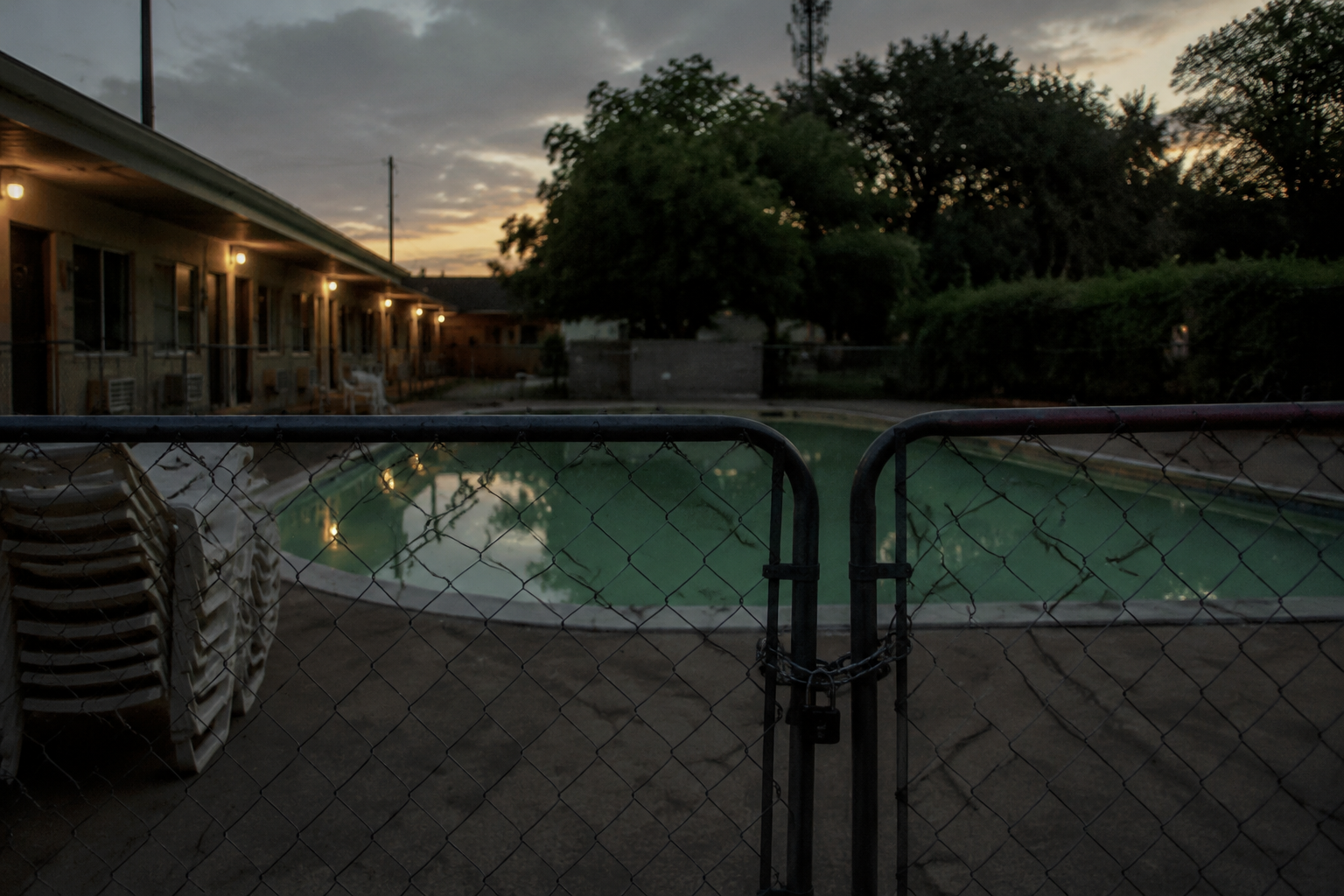
The first people who saw the locked motel pool photo did not start by talking about a ghost. They talked about how quiet the water looked.
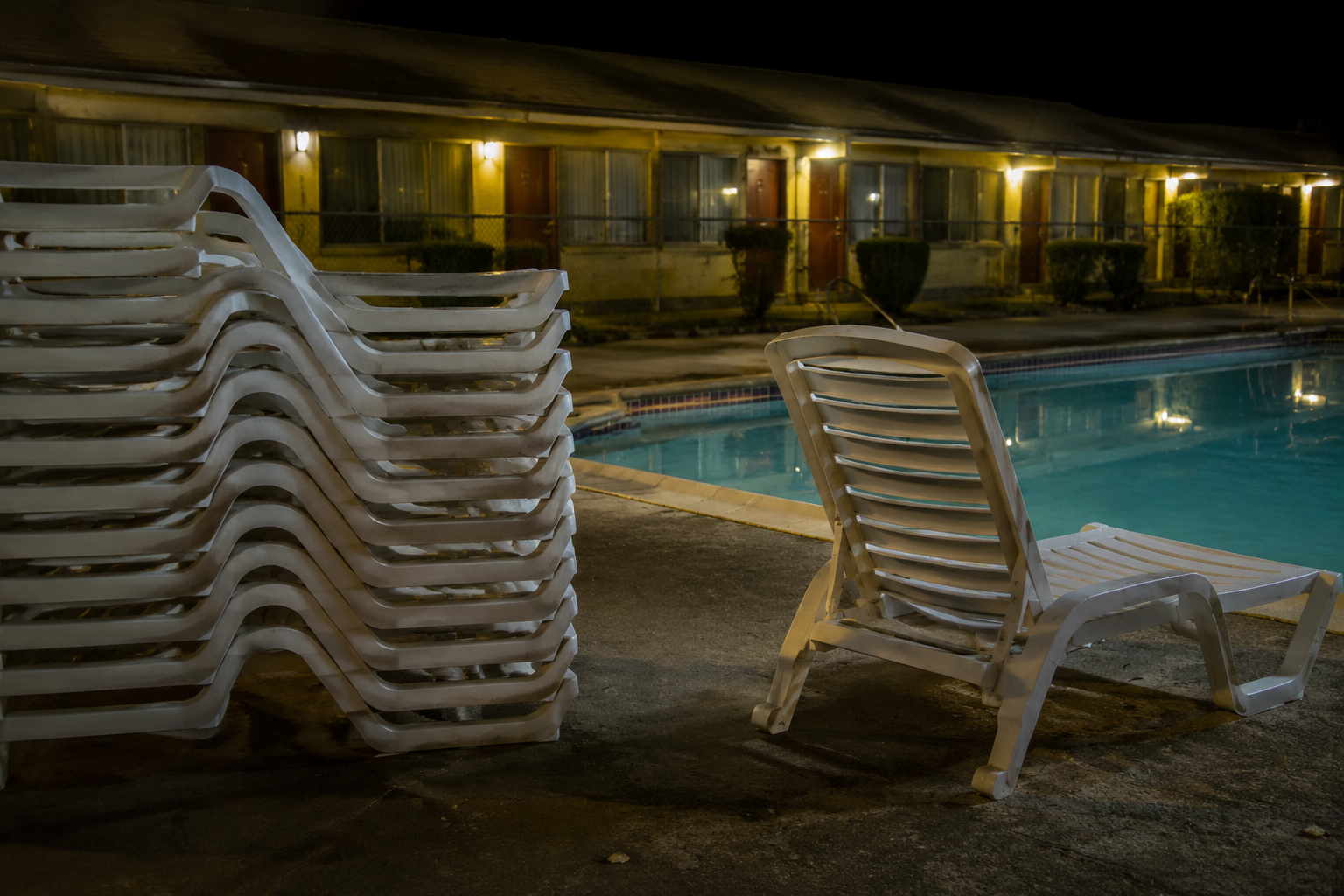
In the recreated version, the picture was taken at an older roadside motel after the pool had already been closed for the night. A family member, waiting near the courtyard while someone checked on a room key, snapped a quick photo through the chain-link gate because the old pool lights made the place look strangely blue.
The gate was locked. The chairs were stacked. The posted hours were over.
Only later did someone zoom in and notice a darker shape near the deep end, just inside the far wall. It looked vaguely human, but not enough to settle anything. No face, no hands, no clear outline.
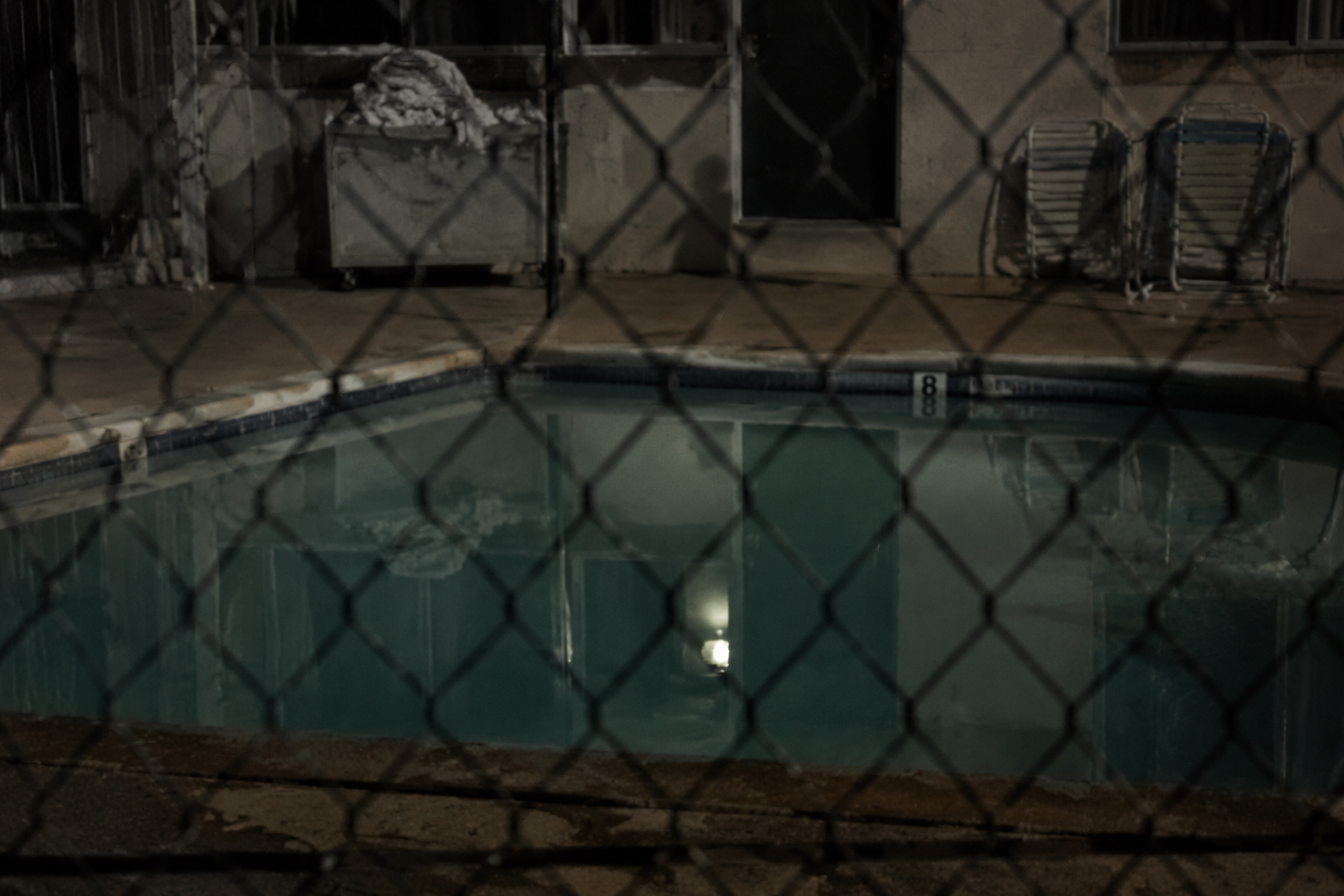
That is why the photo became interesting in the first place. The shadow was not a clean piece of proof. It was the last detail people noticed in a scene that already felt slightly wrong.
WHAT THE PHOTO IS SAID TO SHOW
- A closed motel pool photographed through a locked chain-link gate.
- Still water with one odd dark reflection near the deep end.
- Stacked pool chairs, with one chair turned slightly away from the others.
- Damp-looking concrete on a night when nobody was supposed to be inside.
- A faint human-like shadow that could be reflection, object, or something harder to place.
1. The Gate Was the First Detail That Changed the Mood
A locked gate matters because it gives the photo a boundary. Without it, the simplest explanation is that someone was standing near the pool after dark. A guest, employee, teenager, or late swimmer could have wandered in and been caught at a bad angle.
The account says the gate chain and padlock were visible in the foreground. That does not make entry impossible. Motel pool gates are not vault doors. Staff have keys. A determined person can sometimes climb a fence. A side access point may not be shown in the frame.
Still, the lock changes the way viewers read the image. The camera is outside. The strange detail is inside. That separation is why the photo feels staged by accident.
It also explains why the witness took the picture casually. They were not investigating a sound or following a rumor. They were just photographing a closed courtyard through a barrier, the way people photograph old neon signs or rain on pavement.
2. The Water Looked Too Still for a Recently Used Pool
People often point to the shadow first, but several locals reportedly mentioned the pool surface. It looked flat, almost sealed, with the motel lights sitting on top of it instead of breaking apart in ripples.
That can happen naturally. A closed pool on a windless night may look like glass. Courtyard walls block air. If the pump is off or running quietly, the surface can settle fast.
But in the photo, the stillness made the deep end feel empty in a way that was hard to ignore. If someone had just climbed out, crossed the deck, or disturbed the water, viewers expected some small movement to remain.
The point is not that still water proves anything. It is that the water trained people to look closer. The scene did not feel active. It felt paused.
3. The Shadow Sat Where a Reflection Should Have Been Messy
The shape near the deep end was described as a darker vertical patch, taller than the pool wall line but too soft to call a person. It appeared near a corner where the light from a room walkway, a pool lamp, and possibly a vending alcove could all meet.
That is exactly the kind of place where reflections misbehave. A pole, sign, tree, umbrella stand, or open doorway behind the photographer could stretch across water and become something upright in the final image.
Phones also do strange work in low light. They brighten shadows, smooth edges, and make separate objects seem connected. A dark pool ladder and a stain on the wall can become a torso. A loose towel can become a shoulder.
What bothered people was not that the shadow looked detailed. It did not. What bothered them was that it looked placed. It sat inside the scene with a quiet posture, not smeared across the whole pool surface like an obvious reflection.
4. One Chair Was Not Aligned With the Stack
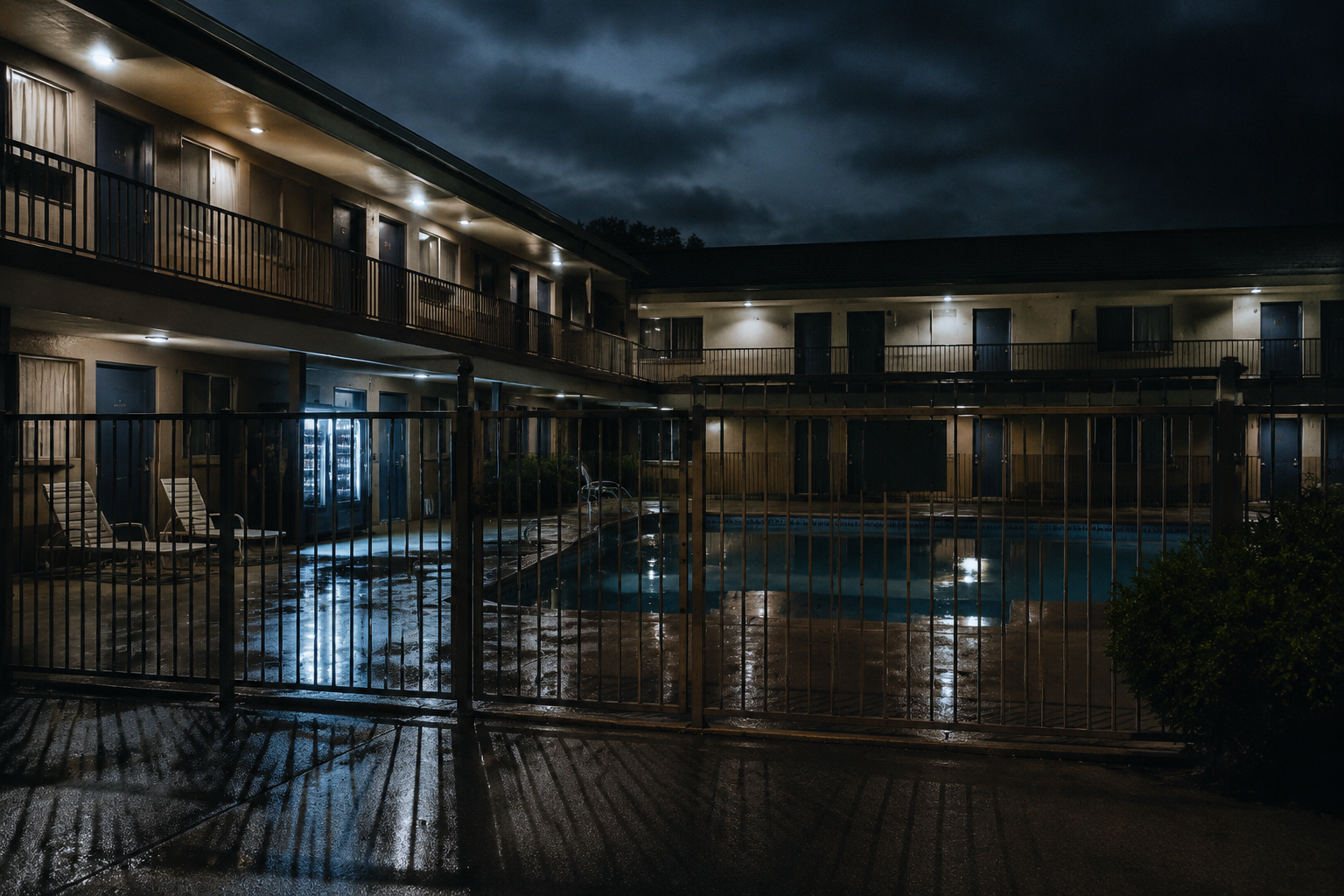
The chair detail is small, but it is the sort of thing that keeps a scary reconstructed moment alive. Most of the pool chairs were reportedly stacked in a neat row near the wall. One chair looked turned slightly away, as if it had been pulled out and then pushed back without care.
There are many ordinary reasons for that. Employees stack chairs quickly. Guests leave things crooked. Wind can shift lightweight plastic furniture. A chair at the end of a stack can turn when bumped by a cart or hose.
Still, once people noticed the shadow, the chair became part of the timeline they imagined. Someone had been there. Something had moved. The pool had not been as empty as the lock suggested.
But in a photo where no one expected a figure, small disorder draws attention. It gives the eye permission to believe the scene was recently occupied.
5. The Damp Concrete Added Another Question
Several versions of the account mention wet-looking concrete near the pool edge. Not flooded, not dramatic, just a darkened patch along the deck that seemed fresher than the rest of the walkway.
That may be the easiest detail to explain. Pools leave moisture everywhere. Hoses leak. Cleaning buckets spill. Humid nights darken old concrete in uneven patches. The camera may have increased contrast and made normal staining look wet.
If staff had closed the pool recently, they may have rinsed the deck before locking up. A small maintenance task can create the exact kind of clue that later looks mysterious.
Even so, the damp patch mattered because it appeared near the part of the pool where the shadow was seen. Viewers linked the two details because the human eye likes routes: from water to deck, from deck to chair, from chair to gate.
6. The Motel Setting Makes the Photo Feel Local, Not Legendary
There is nothing grand about a locked motel pool. That is part of the appeal. It is not a castle hallway or an abandoned hospital. It is a practical place with posted rules, vending machines, towel bins, and the smell of chlorine trapped in warm air.
Scary reconstructed moments often feel more believable when the setting is boring. People know these places. They remember being told not to run, seeing the gate chained at night, hearing the buzz of a light over the ice machine.
The photo reportedly came from that kind of place: a motel old enough to have faded depth markers and a pool small enough that one figure near the deep end could change the whole feeling of the courtyard.
7. The Best Normal Explanations Still Fit
A cautious reading has to give the ordinary explanations real space. The shadow could be a reflection from something outside the frame. It could be a staff member partly hidden by the pool wall. It could be a guest who entered through another access point.
It could be a combination of chair legs, a ladder rail, wall stains, and low-light processing. Many eerie photos are built from several dull facts stacked at the same time.
The locked gate may have been locked after the photo, or one side entrance may have been open. The wet concrete may have come from cleaning. The chair may have been crooked all day.
8. Why the Photo Felt Wrong Before the Shadow
The reason this account works is that the shadow does not carry the entire weight. The locked gate, glassy water, damp deck, and crooked chair all prepare the viewer before the dark shape is even named.
By the time someone says, look near the deep end, the scene already feels closed but not empty.
That is a powerful combination for an Apparition Evidence story. It does not prove a ghost. It does not need to. The photo sits in the uncomfortable middle ground where a normal place appears to have one extra presence inside it.
The most honest conclusion is also the most interesting one: the locked motel pool photo is not convincing because the shadow is clear. It is memorable because the setting seems to notice the shadow before the viewer does.
Maybe it was a reflection. Maybe it was a person. Maybe it was only a phone camera trying to make sense of bad light.
But for the people who saw it, the wrongness arrived first. The shadow only gave it a place to stand.
Reader Context
This Weird Witnessed story is an editorial reconstruction, written as eerie visual storytelling rather than a verified report. For more context, see Apparitions and Hauntings Guide and How WeirdWitnessed Creates Reconstructed Horror Stories.