A Blue Light Where No Light Belonged
The first report from Merrow did not sound like an alien story.
It sounded like a farm problem after rain.
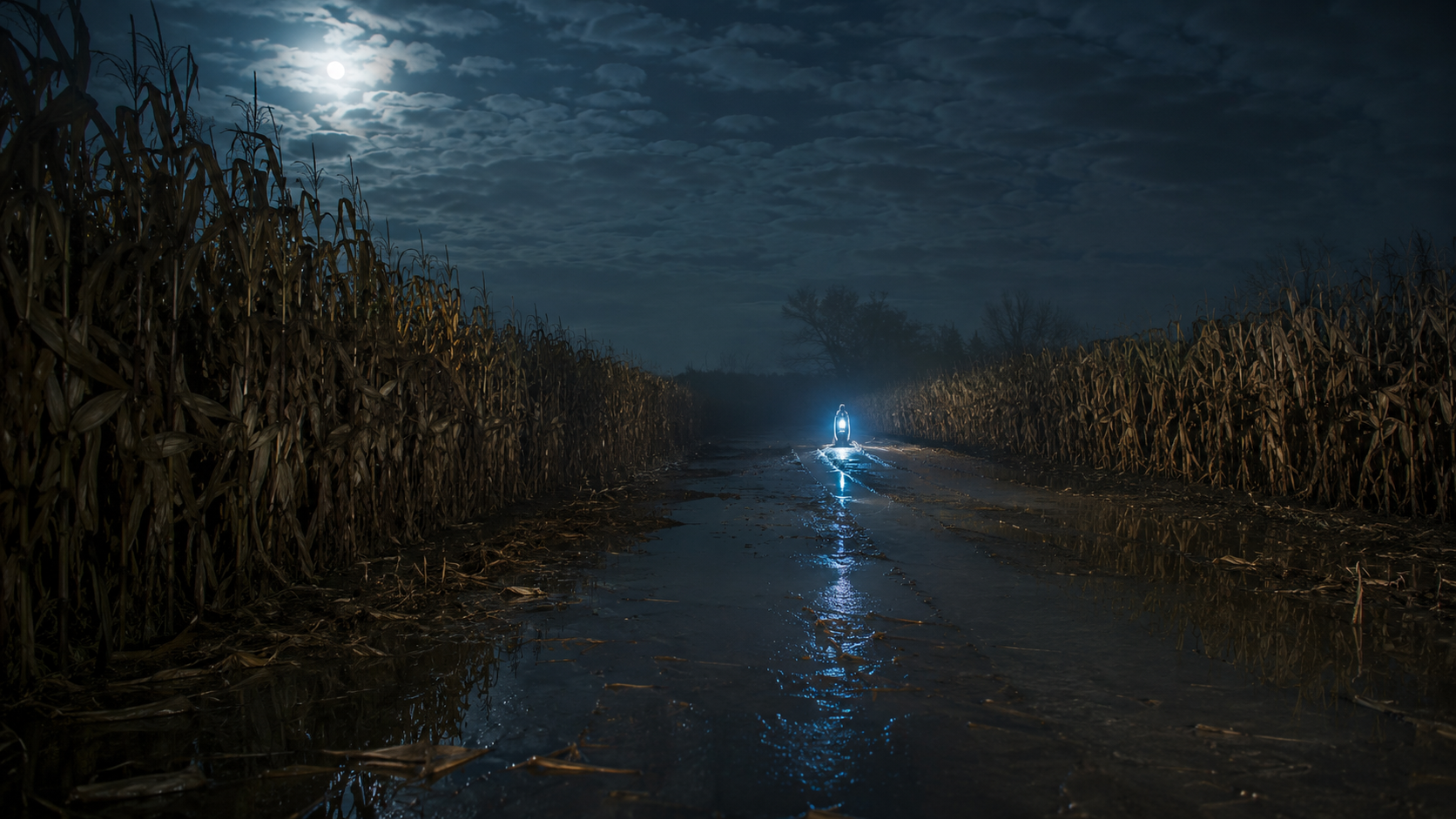
An irrigation lane between two corn blocks had collected several inches of standing water, enough to reflect the moon and hide the tire ruts beneath it. The pump house at the far end was locked. The fields were quiet. The nearest county road sat beyond a windbreak and a shallow ditch.
At about 11:40 p.m., a farmhand driving home along the service track saw what he first took for a lantern floating above the flooded lane.
It was blue, low, and steady.
Not a flashlight beam. Not a vehicle headlamp. Not the white blink of a drone. The light appeared about waist-high over the water, rounded at the top, and dimmer at the bottom, as if the air itself held a covered lamp.
That is the detail people in Merrow still repeat: it looked carried, but no carrier could be seen.
The Irrigation Lane
The location matters because it was not a public place.
The lane ran between standing corn that had already reached chest to shoulder height. It was used by tractors, sprayers, and the men who checked the pump during dry spells. After a hard rain, it became a narrow, reflective trench with thick rows pressing in from both sides.
A person walking there at night would have made noise. Corn leaves slap clothing. Boots pull at mud. Water moves around every step.
The witness said he stopped his truck before turning onto the lane because the color seemed wrong. Farm lights are usually white, amber, or red. Blue appears sometimes on equipment panels, emergency vehicles, or cheap battery lamps, but this glow did not splash outward like a normal lamp.
It made a small pool of blue on the water directly beneath it.
The corn around it stayed dark.
He watched for less than a minute. The light drifted down the lane toward the pump house, not fast, not bobbing much, and not crossing into the rows. Then it dimmed until the water reflected only sky again.
The Path Through The Rows
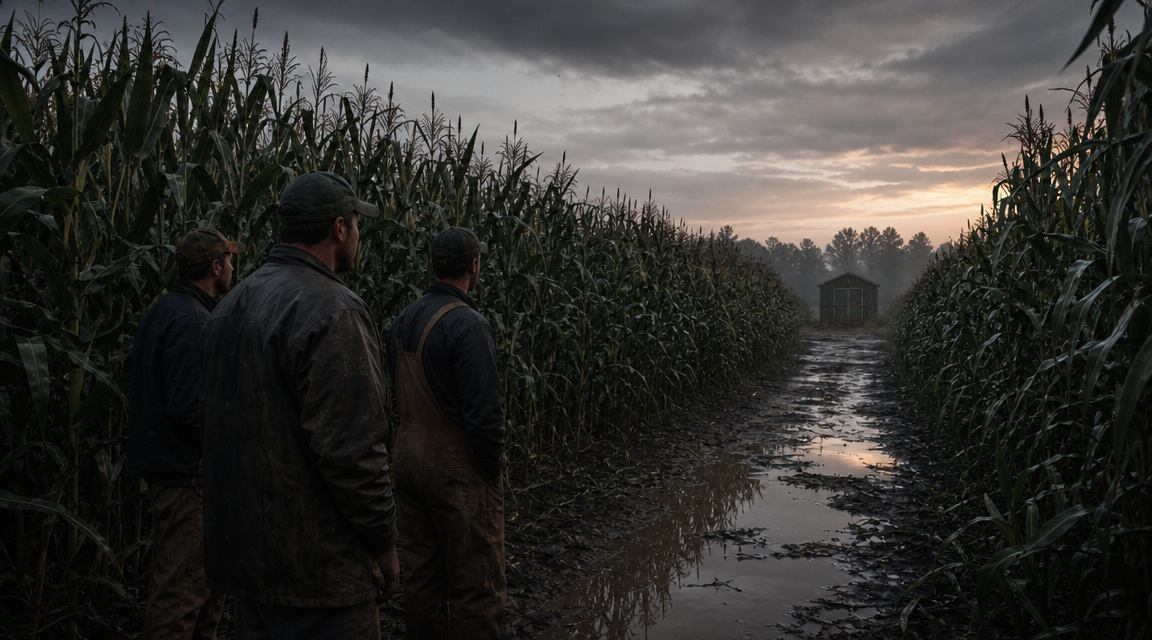
At first light, three people walked the lane.
They found the standing water, the same reflective stretch where the blue light had been seen. They found no fresh tire tracks entering from the gate. They found no beer cans, batteries, dropped tools, or cut wire.
Then one of them noticed the corn.
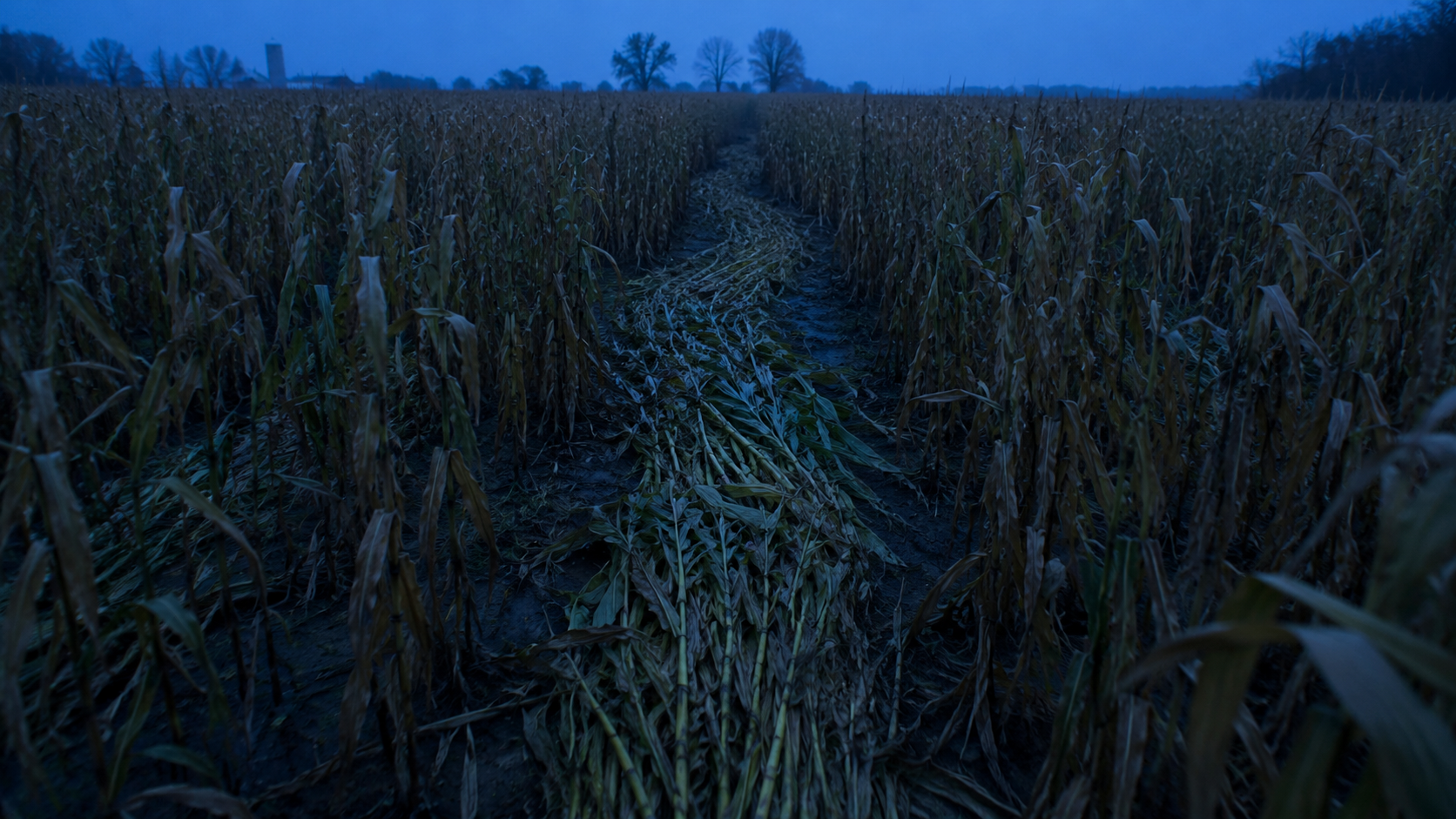
On the east side of the lane, several rows showed a narrow passage where leaves had been bent inward and stalks had tilted aside. It was not wide enough for a tractor, deer trail, or person carrying equipment comfortably. It looked closer to the width of one very thin body moving straight through.
The phrase “humanlike path” appears in later retellings, and it is useful only if handled carefully. It does not mean clear human footprints were found. It means the disturbance followed the spacing and height one might expect from something upright moving between rows.
The tops were not crushed. The lower leaves were not chewed. The stalks leaned, then resumed their position after a few yards, then leaned again.
The path did not wander.
It aimed directly toward the pump house.
The Locked Pump House
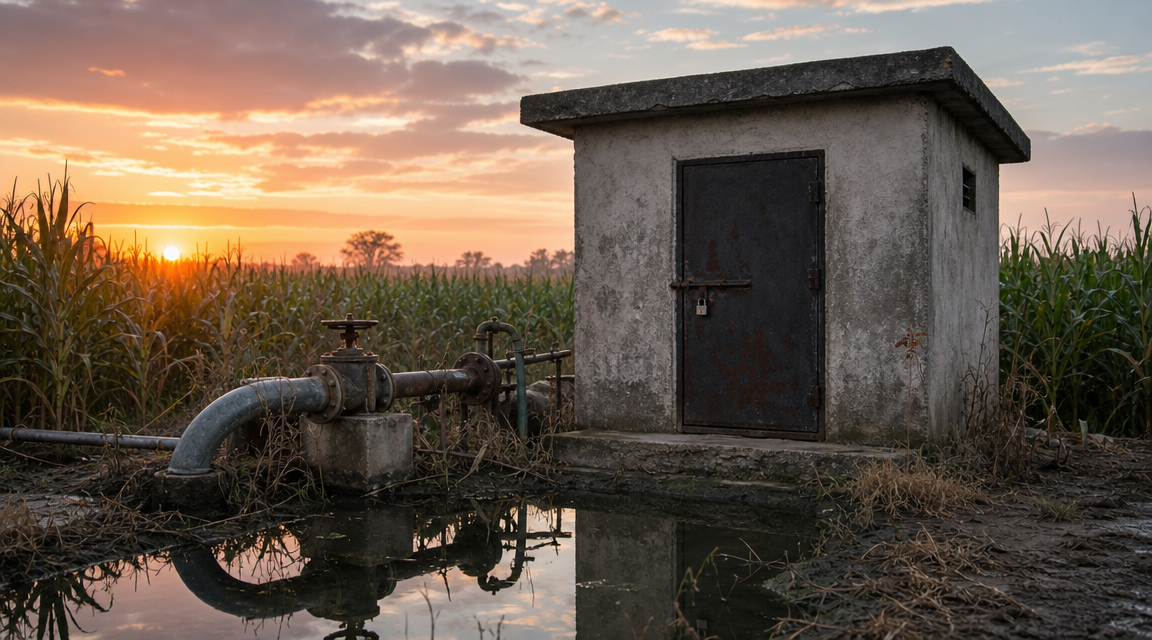
The pump house was a small cinderblock building with a metal door, a concrete step, and pipes running toward the irrigation line.
It was locked when they arrived.
That is the second detail that keeps the Merrow case alive. If the blue light belonged to a trespasser, that trespasser either never entered the building or entered without leaving the usual signs. The padlock was still seated. The hasp was not bent. The door frame showed no fresh pry marks.
Inside, after the owner opened it, nothing appeared stolen.
The pump controls were dry. The tool shelf was undisturbed. A coil of wire remained on a nail. Dust on a spare filter canister had not been wiped clean by handling. No animal nest had been disturbed. No one had slept there.
Yet the thin path through the corn ended at the concrete step as if the destination had been exact.
The water in front of the step held no useful footprints. It had been too shallow, too muddy, and too disturbed by the men arriving in daylight.
The case lost its chance at clean evidence almost immediately.
Ordinary Explanations First
A responsible reading starts with ordinary possibilities.
Someone may have been in the field with a blue lantern, an LED work light, or a phone screen inside a plastic cover. A trespasser could have stayed out of view behind corn while the light alone showed above the water. The narrow path might have been made earlier by a farmhand, a deer, or a dog.
Drones also enter the discussion quickly. A small drone with blue running lights could hover low and move smoothly along a lane. It would explain the lack of splashing and the strange steadiness.
But the drone theory has problems.
The witness described a broader, softer glow than the point lights on most hobby drones. He heard no propeller sound, though rain-softened fields and insects can mask small noises. The light stayed low in a lane crowded by corn, a risky place to fly at night unless the operator knew the field well.
A prank remains possible, but it requires a prankster willing to wade into a muddy irrigation lane, leave no obvious approach, create a narrow track that led exactly to a locked pump house, then vanish without being seen on the surrounding roads.
That is not impossible.
It is simply more work than the event seems to reward.
The Uncomfortable Unknown Visitor Reading
The unknown visitor interpretation does not depend on a spaceship, and it should not pretend to have one.
Nothing landed in the Merrow field. No craft was photographed. No creature stood in the headlights. The evidence is smaller and more frustrating: a blue light hovering where a carried lamp should have revealed a carrier, a path with a bodylike narrowness, and a destination that made sense only if something meant to reach the pump house.
That combination is why the case fits the Alien / Unknown Visitor Evidence category.
It suggests presence without identity.
The light behaved less like a random reflection and more like an object under control. The path suggested passage. The locked pump house suggested intent, or at least direction. None of that proves an extraterrestrial visitor. It does, however, place the story in the borderland where rural trespass, technology, and folklore begin borrowing each other’s clothes.
The most eerie version is not a gray figure walking through corn.
It is the idea that something small, careful, and unrecognized crossed the field with just enough light to see by, reached a human utility structure, and left no explanation behind.
Why The Blue Color Matters
Blue is a difficult witness color.
At night, people misread distance and brightness. Wet ground can amplify faint light. Moonlight on water can look cold and artificial. Some insects flash pale blue in peripheral vision. Some LED lamps shift color when batteries weaken.
Still, the witness insisted the light was not merely blue-white. It was blue enough to make the standing water look like ink.
That may be why the “lantern” label stuck. A lantern has a center. It implies a contained glow, something held or hung, not scattered reflection.
If someone was carrying it, their legs should have interrupted the reflection. If it was attached to a drone, its movement should have shown more mechanical correction. If it was a reflection from a distant vehicle, it should have shifted with the angle of the truck and the rippled water.
Instead, it moved along the lane as if it belonged there.
That impression is not proof. It is the heart of the witness account.
The Case That Ends At A Door
Many rural anomalies dissolve because the ending is vague. A light vanishes over trees. A shape crosses a road. A sound moves away into pasture.
The Merrow case has a more troubling ending.
The path ended at a locked door.
That gives the story a blunt physical shape. The unknown was not merely overhead or far off on the horizon. It came down into the practical world of pumps, mud, corn leaves, keys, padlocks, and morning inspection.
Nothing about the scene required belief in interstellar visitors. The safer conclusion is that someone or something ordinary moved through the field and left confusing traces under poor conditions.
But the case remains difficult because each ordinary answer has to borrow from another one. A trespasser explains intent but not the floating light. A drone explains hovering but not the crop path. A deer explains disturbed rows but not the blue glow. A reflection explains color but not direction.
That is where the Merrow blue lantern sits: not as proof, but as evidence of an encounter that refuses to become clean.
In the end, the most unsettling image is still the simplest one.
A flooded lane. A low blue light. Corn standing black on both sides. And in the morning, a narrow path pointing to a locked pump house as if the night had walked there and stopped.
Reader Context
This Weird Witnessed story is an editorial reconstruction, written as eerie visual storytelling rather than a verified report. For more context, see UFOs and Unknown Visitors Guide and How WeirdWitnessed Creates Reconstructed Horror Stories.