The Leak That Closed the Sky
Municipal planetariums are built to make a city feel larger than itself. A school bus arrives, the lights dim, and a round ceiling becomes winter, summer, Mars, Saturn, and the Milky Way. Even a small civic star theater makes the same promise: sit quietly in the dark, and the universe will arrive on schedule.
This one did not close because of scandal or disaster. It closed because water found the roof.
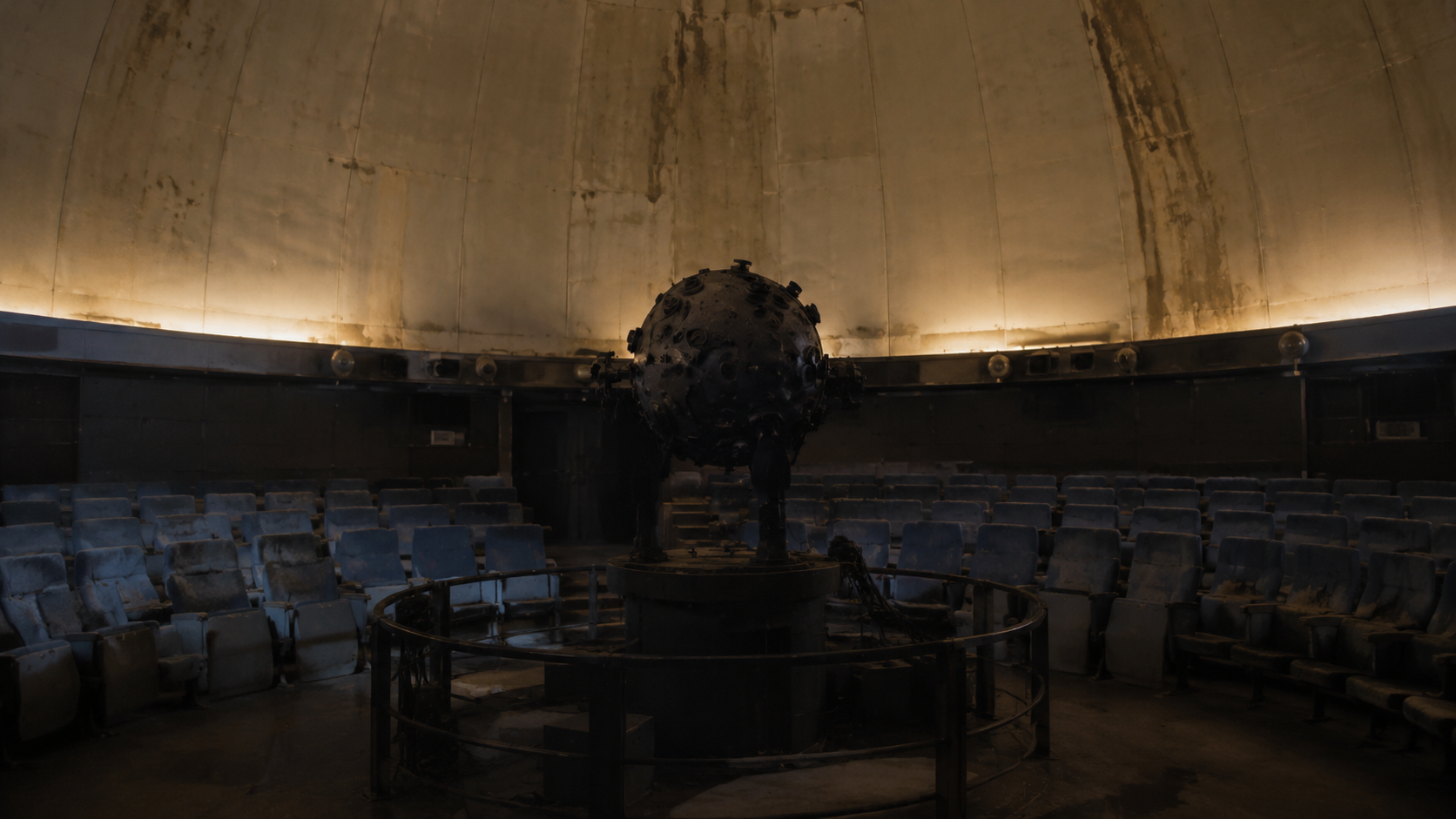
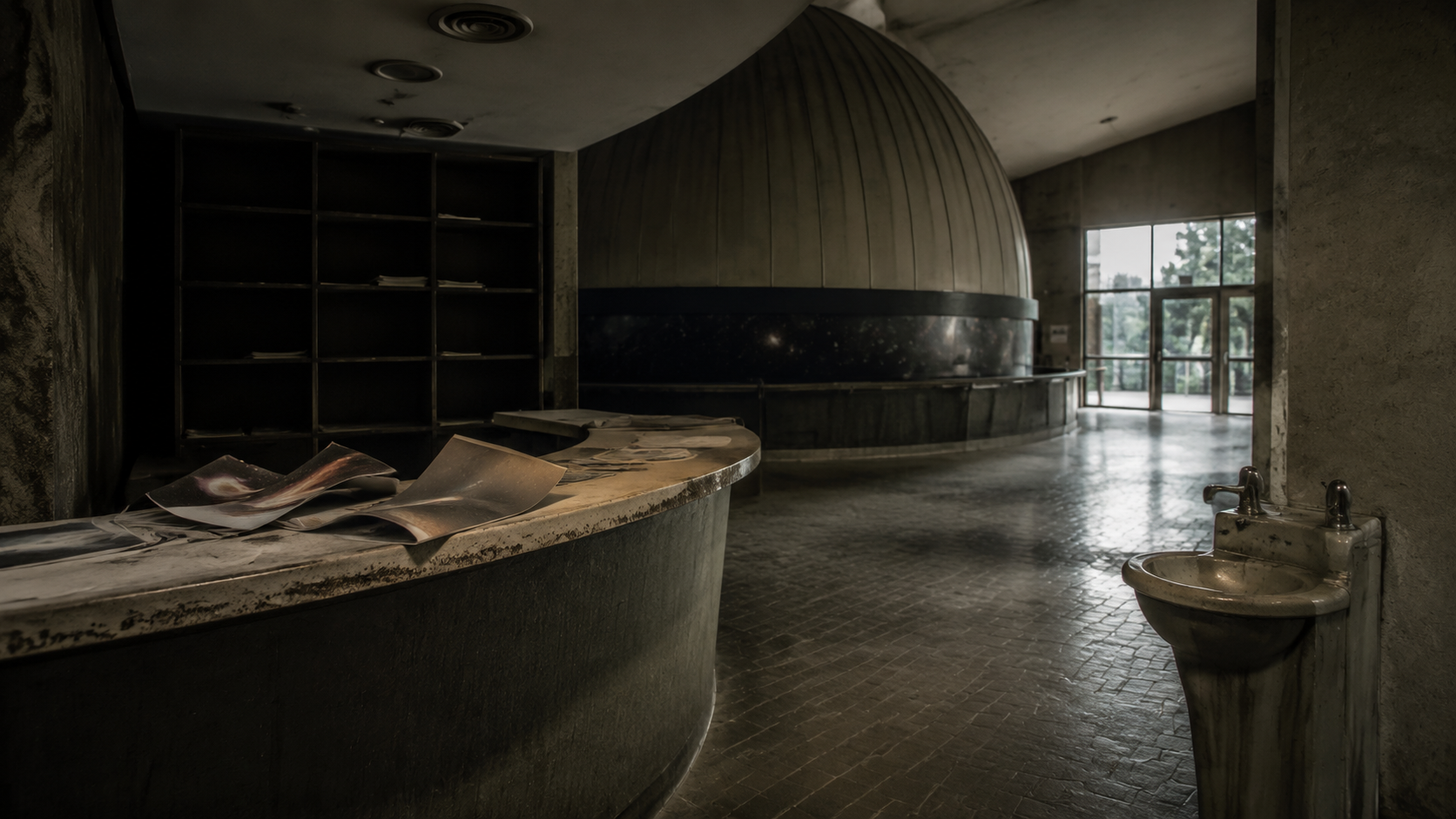
The planetarium had been attached to a public science center since the late 1960s, a low concrete drum behind the main building with a ticket window, narrow lobby, and dome theater seating just under one hundred people. Its last advertised program was a children’s show about spring constellations. After heavy rain, brown stains appeared along the dome seams. Staff covered seats with plastic, canceled shows, and stopped giving reopening dates.
The science center eventually moved across town. The planetarium remained locked, technically maintained, and too expensive to empty properly. The old star projector stayed in the middle of the room.
Years later, a maintenance team entered to assess the building for demolition. They expected mold, dust, and wet insulation. They found those things. They also found the projector facing the seats, as if it had just finished addressing an audience that had not bought tickets in years.
The Room Under the Dome
Former staff described the theater as modest, not grand. The seats were dark blue. The aisle lights were tiny amber dots. The projector stood at the center like a mechanical insect, its lenses arranged around a metal body, its arms reaching toward the curve of the dome.
During shows, the machine made a layered sound: fans, motors, shutters, the faint click of slides. A presenter sat near the rear console and spoke into a microphone while stars faded in overhead.
After closure, the room was preserved without purpose. The lobby still held curled brochures. A plastic sign asked visitors not to bring food inside. The empty gift rack stood near a stained water fountain.
Inside, dust had settled across armrests, cushions, floor edges, and the backs of most chairs. Ceiling debris powdered the aisle. Old leaks had left pale streaks down the dome like washed-out comets.
Nothing suggested a busy trespass spot. No graffiti, cans, sleeping bags, or obvious forced entry appeared in the common versions of the story. The strange disturbance was smaller and harder to dismiss.
The Clean Chair Backs
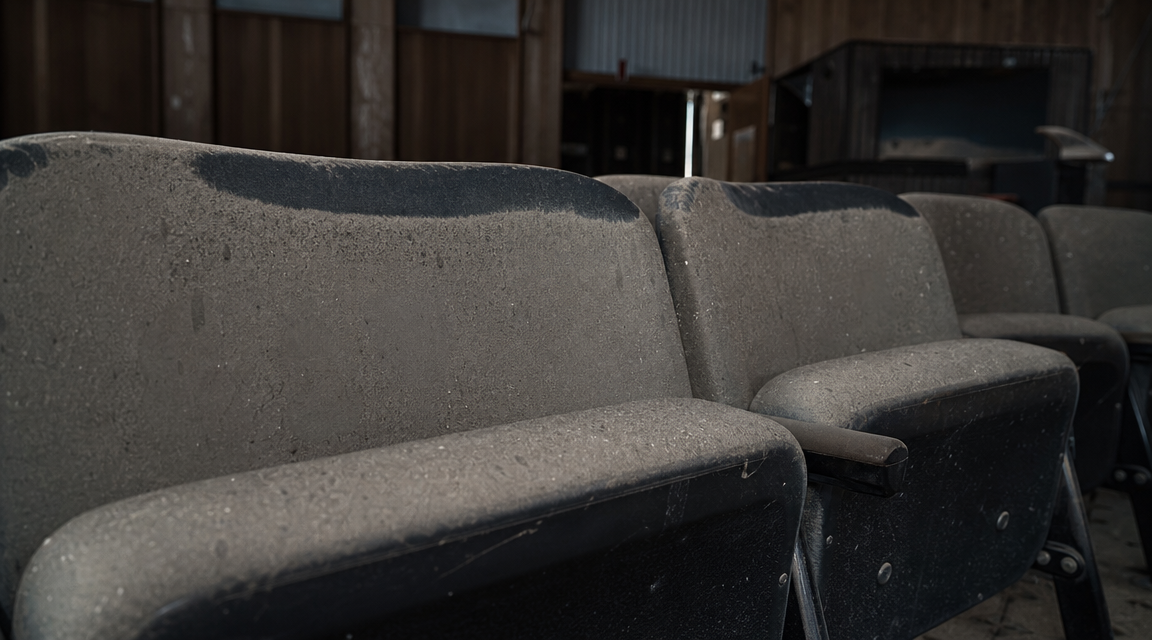
Most of the chairs were dusty in the same ordinary way, as if time had been brushed evenly over them. But several chair backs in the rear third of the theater were clean across their upper edges. Not scrubbed. Not polished. Just cleared by contact.
The pattern resembled what happens when people sit through a program and lean back, shoulders and coats wiping dust from fabric. Accounts differ, but the number is usually given as four to seven seats. They were not arranged neatly. They formed a loose cluster, spaced like late arrivals choosing places with a good view.
The cushions below were reportedly still dusty. That detail is why the story lingers. It looked less like people had sat down and more like something had occupied the space above the seats, touching only the backs.
One worker supposedly joked that the last audience had stayed for the encore. Another did not laugh. In one brief retelling, a crew member mentioned a dark human-shaped figure near the back row before the work lights fully warmed, but that line appears only once.
The chair backs are stronger. They ask a quieter question: who had been leaning back in a closed planetarium?
The Projector Facing the Audience
Old optical star projectors do not feel neutral when abandoned. In daylight they can look awkward, all knobs and glass eyes. In darkness they become ceremonial. Every lens suggests a star waiting to appear.
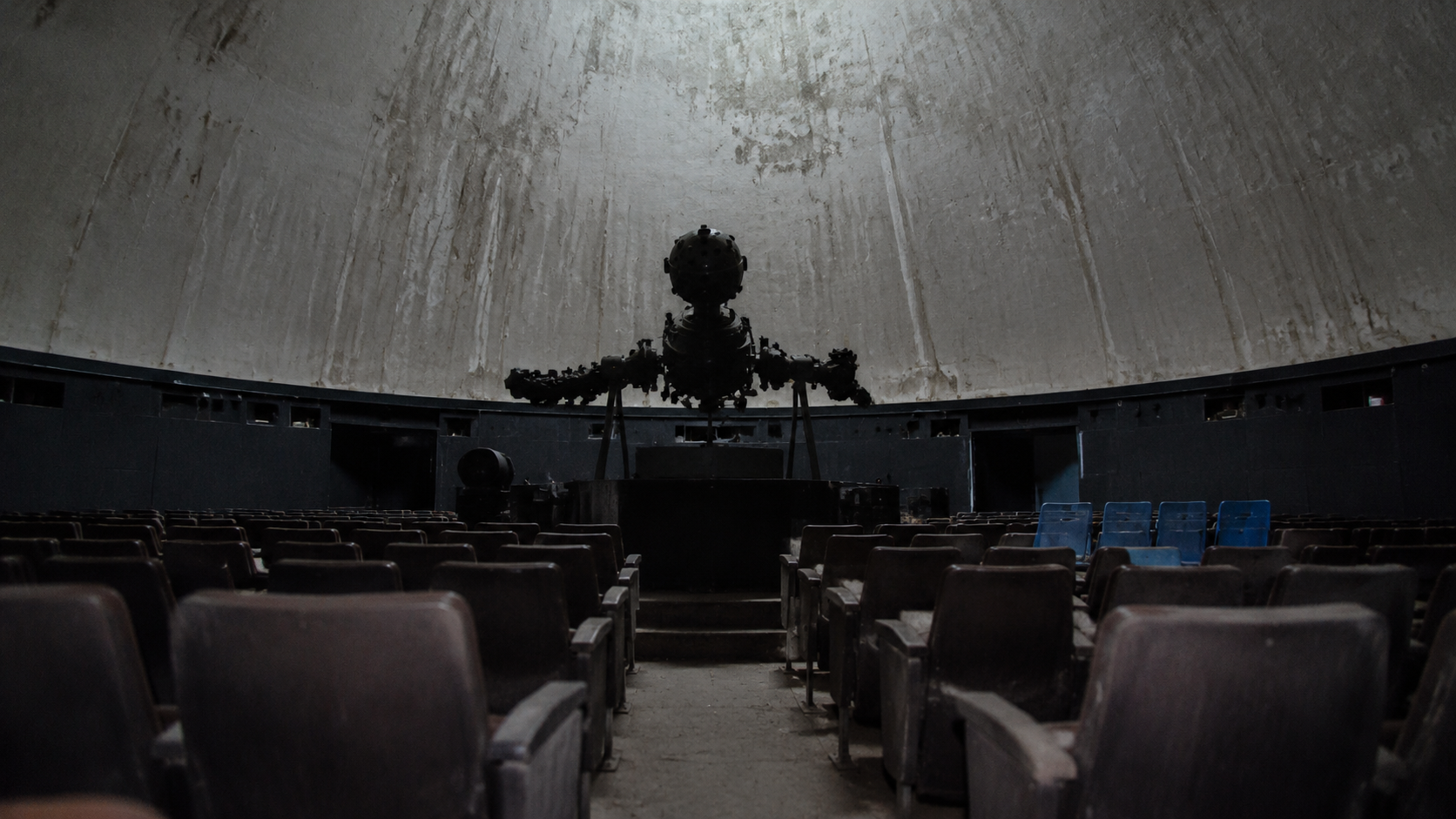
The maintenance crew reportedly found the projector oriented toward the seats rather than left in some obvious service position. Perhaps the final operator simply shut it down after the last show and never returned to reset anything. Still, witnesses described it as “aimed” at the clean chair backs, which gave the discovery a staged quality.
A planetarium reverses the usual relationship between room and viewer. The audience sits still while the heavens move. Stars rise. Planets drift. The ceiling becomes time. If the machine had been left in its final configuration, the abandoned room preserved a posture: projector addressing seats, seats facing a manufactured cosmos, the city outside moving on.
Ordinary places become haunted when they retain a gesture after their function ends. Desks face a missing teacher. Curtains open onto an empty theater. Hymn numbers remain posted in a silent church. The planetarium was not just empty. It was ready.
What Could Explain It
There are practical explanations. Workers may have entered earlier than remembered and brushed the chairs while checking the dome. Dust can exaggerate small contact. Fabric may hold powder unevenly when humidity changes. A leaking roof can create odd air movement.
Animals are possible, though imperfect. Birds, raccoons, or cats can enter municipal buildings through roof gaps and service spaces. They disturb dust in strange ways. But the reported marks were broad and human-height, not clawed, nested, or tracked.
Trespassers may be the simplest answer. A locked public building is rarely as sealed as officials claim. Urban explorers or curious former employees could have found a way in, stood in the dark, leaned on seats, and left. Yet that explanation must account for the lack of other disturbance and for cushions that supposedly remained dusty.
The least romantic answer is that the story improved in the telling. A maintenance note became a staff anecdote. A few brushed chairs became an audience. The projector’s position became intentional. The back-row figure may have been shadow plus nerves.
Even so, none of those explanations fully erases the image.
Why Planetariums Make Good Hauntings
A haunted house depends on domestic memory: footsteps upstairs, a door opening, a bed shaped by a body. A haunted planetarium works differently. It is a public room built for simulated infinity. It trains people to sit together in darkness and believe in a sky that is not there.
That creates a special residue. Generations of visitors looked upward in the same posture. School groups whispered under artificial night. Retirees attended eclipse lectures. Parents pointed out the North Star to children who could not yet find it outside.
The building collected repeated focus. Everyone entered, sat down, became quiet, and looked at the same false heavens.
When such a room closes, the absence is unusually visible. Empty seats in an auditorium suggest a canceled event. Empty seats in a planetarium suggest an unwitnessed sky. If the projector remains, the room still has a performer. If the seats remain, it still has places for witnesses. The only missing part is the crowd.
The clean chair backs seem to supply that missing part.
The Last Show Problem
The phrase “last show” sounds final, but institutions rarely end cleanly. There is an advertised final date, then a private inspection, then a canceled school group, then a staff member retrieving supplies, then a contractor with a flashlight. A building can have many last human moments.
For this planetarium, the last official show was probably ordinary. Children filed in. Someone warned them not to kick the seats. The presenter dimmed the lights and asked what they had noticed in the sky. The projector brightened. Spring constellations filled the dome. Then everyone left without realizing they had attended a closing ritual.
Years later, the maintenance discovery created a different last show in local imagination. In that version, an audience returned after closure. They gathered near the back, not quite sitting, while the old machine faced them. No narration played. No ticket taker waited in the lobby. Roof stains widened overhead like weather crossing a dead universe.
This imagined show has no beginning. Did something revisit the room repeatedly? Did the theater replay its purpose once, briefly, for whoever still belonged there? Or did the marks simply wait for someone to notice and complete the scene?
A haunting does not always need motion. Sometimes arrangement is enough.
What Still Feels Occupied
The planetarium is usually described in past tense now, whether sealed, demolished, or folded into redevelopment plans. The paperwork matters less than the entry moment: workers opening a damp civic building and finding the audience area not uniformly empty.
There is no famous photograph, no viral clip, no named ghost. That helps the story. It stays small enough to feel municipal, the kind of oddity passed between former employees, contractors, and adults who once visited on field trips.
Maybe living people leaned on those chairs. Maybe the projector was simply left as it was after the final program. Maybe the single reported figure was a coat, a shadow, or a nervous brain assembling a person from poor light.
But the abandoned planetarium still feels occupied because it was designed around occupation. Its purpose was to gather bodies in darkness and make them look up. When the city stopped coming, the room kept the shape of the ritual.
The clean chair backs are the legend’s quiet signature. Not a detail people read as ghosts, exactly. Proof only that the room did not look as empty as it should have.
In a place built to manufacture stars, that may be enough to make absence feel like an audience.
Reader Context
This Weird Witnessed story is an editorial reconstruction, written as eerie visual storytelling rather than a verified report. For more context, see Apparitions and Hauntings Guide and How WeirdWitnessed Creates Reconstructed Horror Stories.