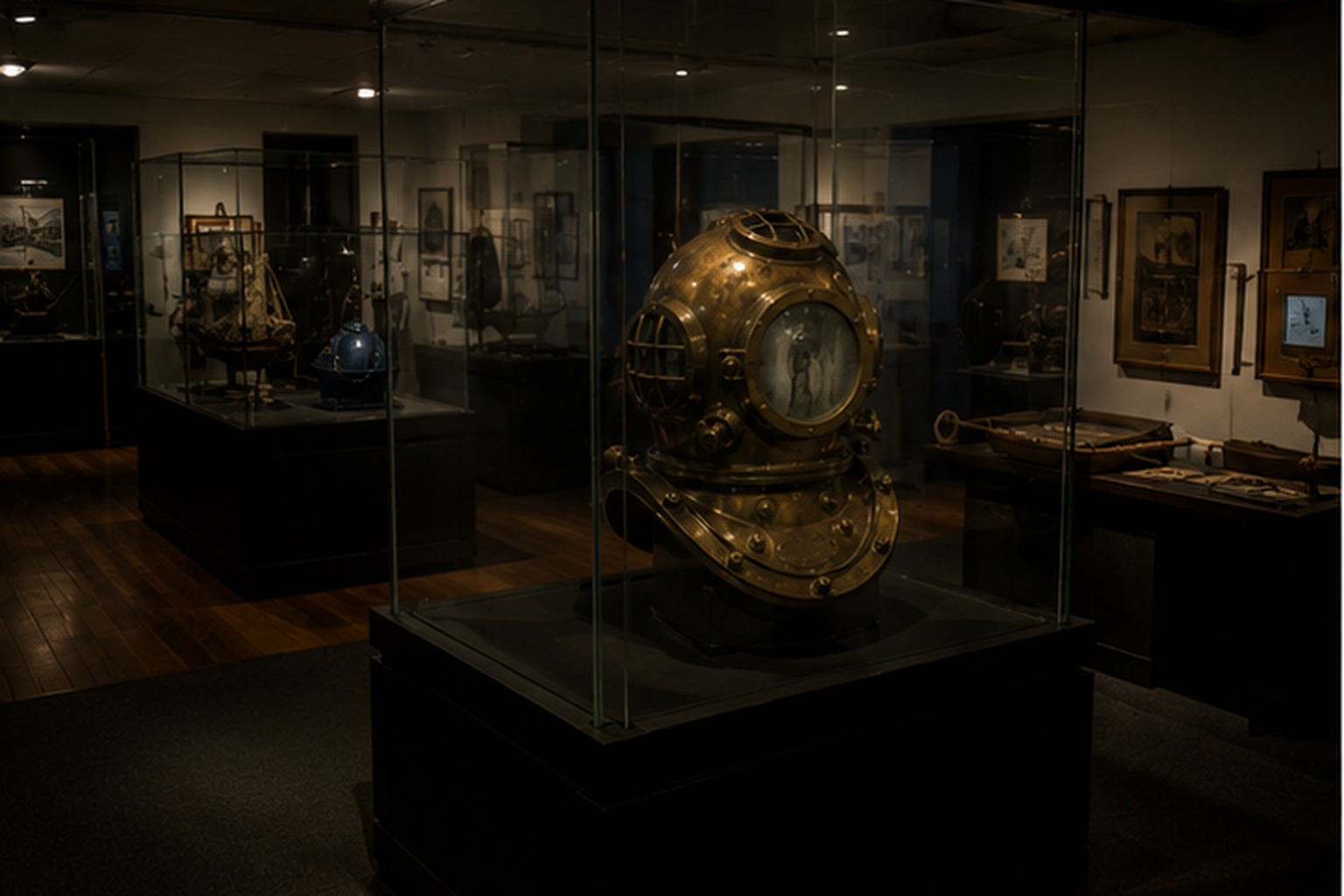
The diving helmet had been sitting in the same locked display case for years before its glass fogged from the inside.
That was the detail people kept repeating.
Not dust on the outside. Not condensation on the case. Not a visitor's handprint on the front glass. The clouding appeared inside the helmet's own viewing ports, as if someone had leaned into the brass shell and breathed out.
This reconstruction rests on four unsettling details:
- the helmet was inside a locked display case;
- the room humidity sensor reportedly stayed normal;
- overnight footage showed the gallery empty;
- by morning, the old faceplate looked freshly fogged from within.
Small museums are unsettling enough after closing. They are full of objects removed from their original purpose, placed under labels, and left to wait in rooms where footsteps sound too loud.
The Helmet Was Not The Famous Exhibit
The old diving helmet was not the museum's centerpiece.
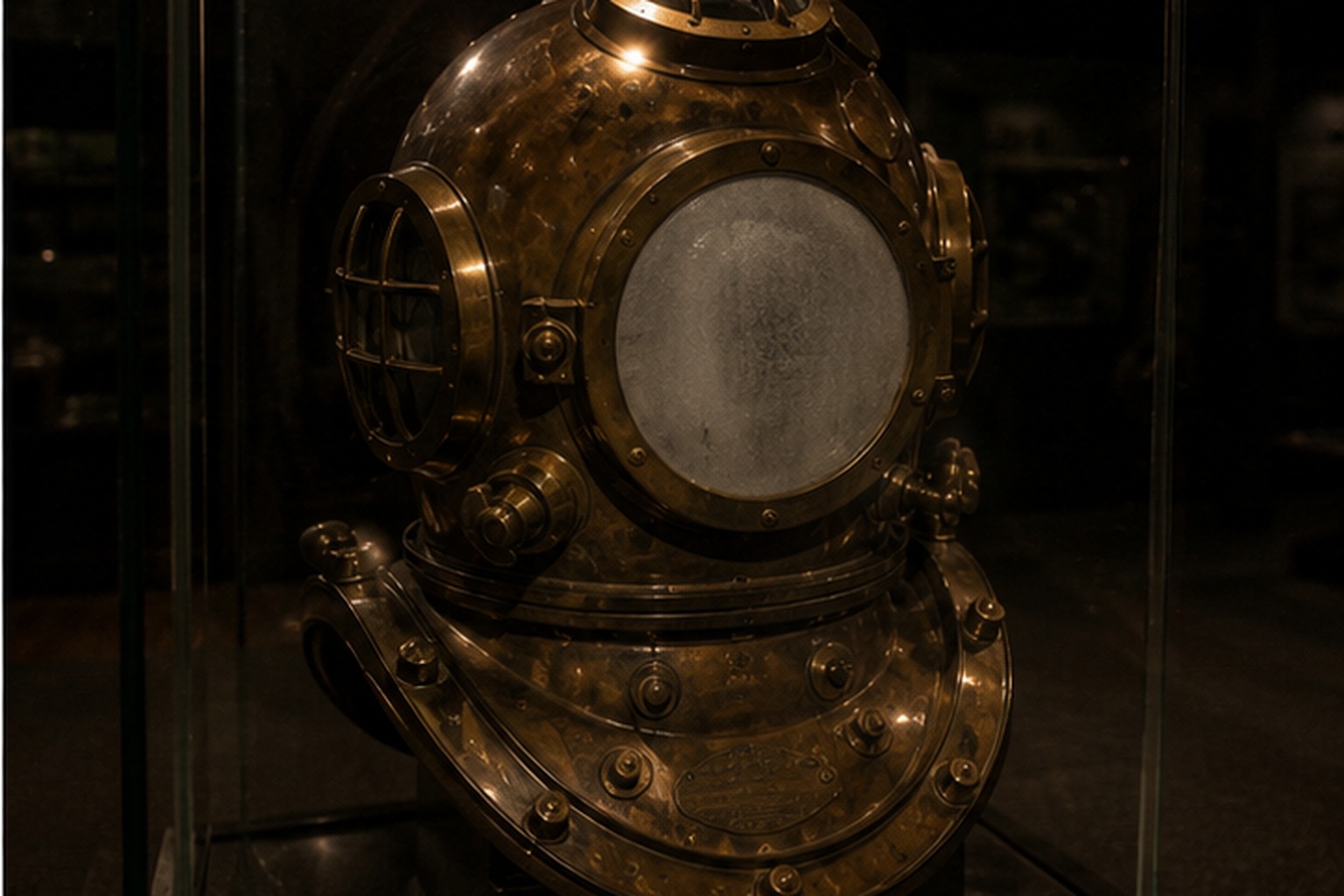
It sat in a maritime corner between a case of ship tools and a faded photograph of men standing on a dock in wool coats. The helmet was brass or brass-colored, heavy-looking, with a rounded top and thick circular windows that made it resemble a face without expression.
Children liked it because it looked like a moon suit from the bottom of the sea. Adults glanced at the label, nodded, and moved on.
The staff treated it like any other object that needed stable conditions and occasional dusting. It had been donated years earlier, cataloged, photographed, and sealed behind glass. The display case had a lock. The room had a basic environmental monitor. Nothing about the helmet suggested trouble.
A strange event around a modest diving helmet in a local museum feels like something accidentally noticed.
The Morning Opening Started Normally
The first person in the gallery was doing the kind of work visitors rarely think about.
Lights came up in sections. A sign was straightened. A brochure rack was refilled. The temperature log was checked. Nothing dramatic happened at first.
Then the staff member saw the helmet's front port.
The circular glass was cloudy.
At a distance, it looked like a smudge on the outside of the case. That would have been simple. Museums collect fingerprints the way beaches collect sand. Even behind ropes and signs, someone always touches glass.
But when the staff member wiped the outside of the display case, the cloudy patch remained exactly where it was.
They leaned closer and realized the fog was not on the case at all.
It was on the helmet.
More specifically, it appeared behind the case glass, on or just inside the helmet's own viewing window.
The Case Was Still Locked
The display case lock had not been forced.
No tool marks were obvious. The door sat flush. The small gap along the frame looked normal. The key was where it was supposed to be.
The museum did not leap to ghosts. Small institutions cannot afford to treat every oddity as a legend. They worry first about leaks, pests, failing seals, bad climate control, and expensive repairs.
So the first concern was conservation.
Moisture inside a case can damage metal, paper, fabric, and labels. Condensation can indicate a microclimate problem or a hidden water source. If the helmet was fogging, something physical might be wrong.
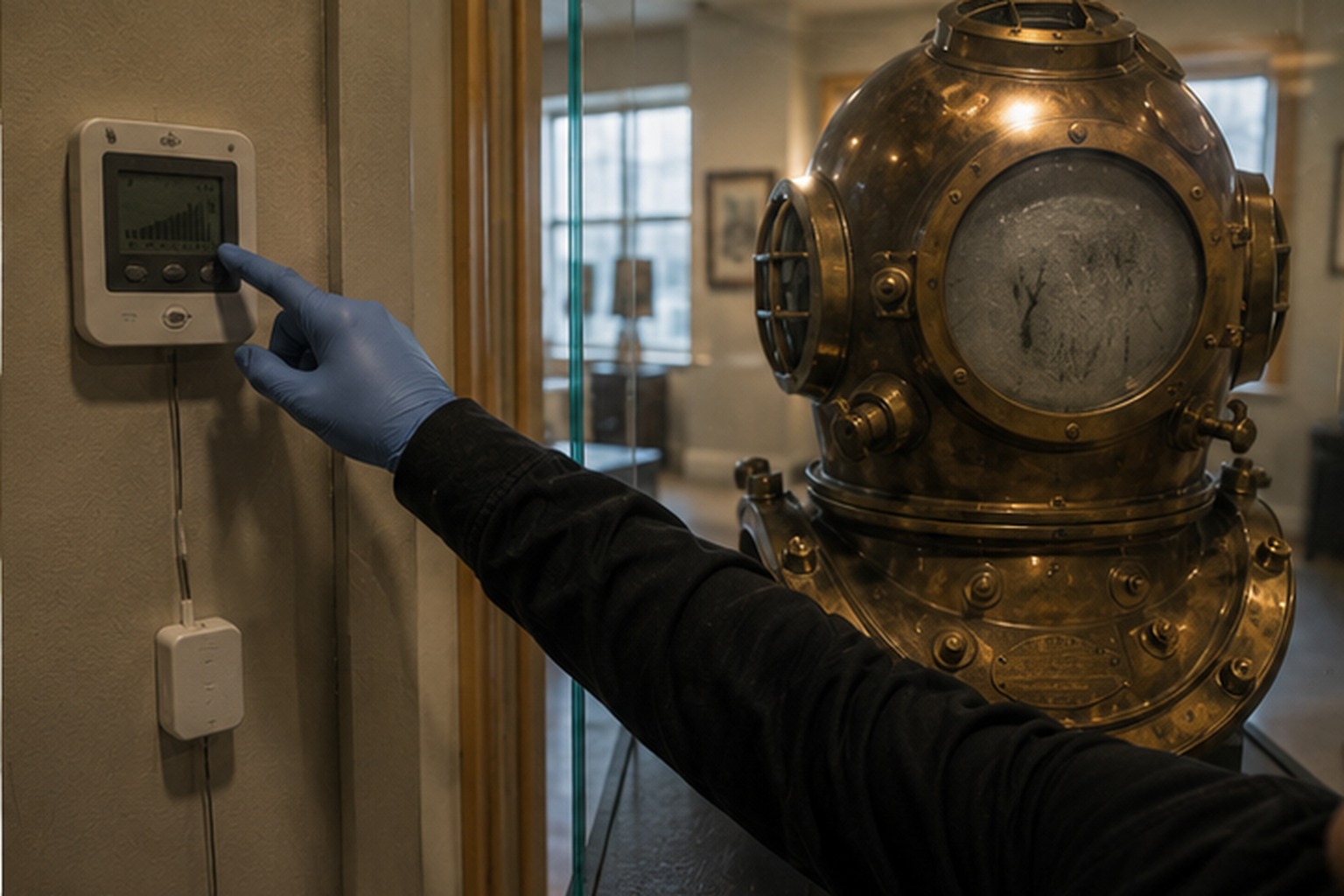
The staff checked the room monitor.
The humidity reading was normal.
Not unusually low. Not spiking. Not the kind of jump that would explain sudden moisture appearing on one object while neighboring displays looked untouched.
That did not make the event impossible. It made it irritating in the specific way museum problems become irritating.
The Fog Looked Too Fresh
According to the story, the clouding was not a dry stain or a permanent haze.
It looked fresh.
Fresh fog on glass has a particular softness. It blooms at the center, thins at the edges, and suggests breath.
On the helmet's front port, the fogging seemed strongest where a face would have been closest if someone were wearing it.
The side port had a weaker haze. The inside of the helmet remained dark, impossible to read through the curved glass.
Nobody saw a face. Nobody reported a hand moving inside the case. The unsettling part was subtler than that. The object looked as if it had just been occupied and then abandoned before anyone entered the room.
For a museum piece designed to separate a human head from deep water, that suggestion was enough.
The Footage Was Boring Until It Wasn't
The security camera in the gallery was not placed for cinematic effect.
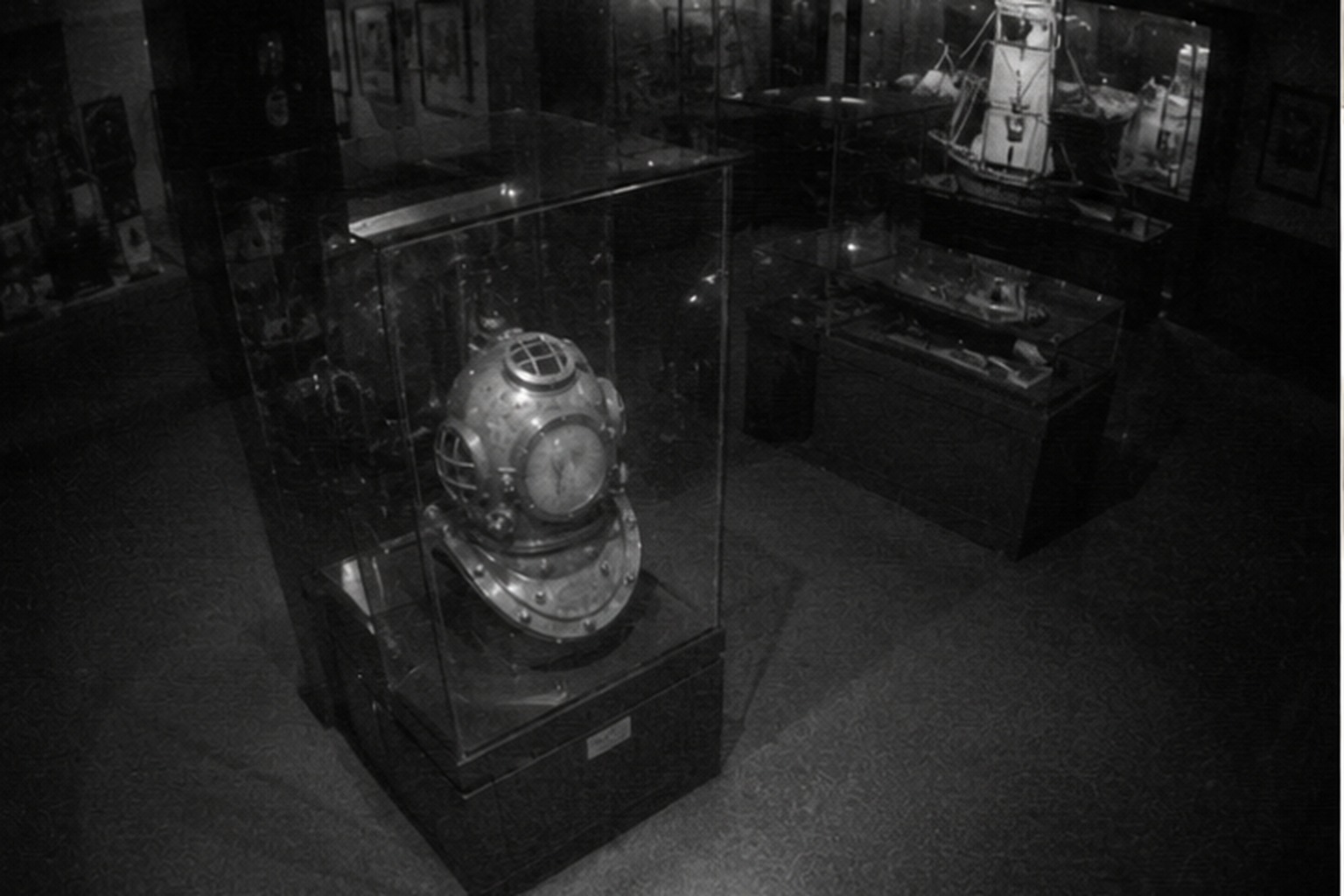
It watched the room from high in a corner. It saw the tops of cases, the center walkway, and part of the maritime display.
Most of the night showed nothing.
That is what makes after-hours museum footage feel different from a horror scene. The camera does not know what to emphasize. It simply records a chair, a wall, a case, and emergency light.
No visitor entered. No staff member crossed the room. No obvious mist filled the gallery.
But when the footage was scrubbed forward, the helmet's front window appeared to pale gradually between one stretch of time and the next. It was not a dramatic burst. It was a slow change, the kind a person might miss if they were not comparing frames.
The case glass did not show the same clouding.
Neither did the neighboring display.
The Mundane Explanation Matters
There are sensible explanations, and any fair version of the story has to include them.
A locked display case is not necessarily airtight. Small differences in temperature can create condensation on one surface and not another. The helmet's metal could have cooled or warmed at a different rate than the room. Residue from cleaning products might haze under certain light. The humidity sensor measured the room, not every pocket of air inside every artifact.
All of that is plausible.
The fog may not have been breathlike at all. It may have been an ordinary conservation issue given a frightening shape by timing, lighting, and the human tendency to connect objects with their original use. A diving helmet is a machine built around breathing. If moisture appears on its faceplate, the mind supplies lungs before vapor pressure.
The staff reportedly treated the situation as a preservation problem first. They documented the display, checked the case, and avoided unnecessary handling until they knew whether the artifact was at risk.
The Sensor Was The Detail That Stuck
The normal humidity reading became the story's anchor.
People do not remember every measurement. They remember the contradiction. A room can feel normal while one object behaves as if it has its own weather.
If the whole gallery had been damp, nobody would have told the story this way. A leak, a failing air conditioner, or a door left open would have explained the mood immediately.
Instead, the museum seemed ordinary.
The labels were dry. The neighboring glass was clear. The old tools in the next case looked unchanged. Visitors arriving later would have seen a quiet exhibit room with no reason to pause.
By then, the fog had begun to thin.
Permanent stains become maintenance. Temporary fog becomes an event.
The Object Already Looked Like Someone Waiting
Some artifacts are eerie because they resemble people while being completely empty.
The diving helmet belonged to that category. Its round ports suggested eyes. The front window suggested a face. The neck ring suggested a body that was missing below it.
In daylight, it was historical equipment. At night, it could look less like an object and more like a head placed on a shelf.
That does not mean anything supernatural happened.
It explains why the story spread.
The Facebook image practically writes itself: a brass helmet behind glass, the case locked, the room still, the faceplate clouded as if the last person inside had just exhaled.
The strongest scary images are often almost normal.
They ask for one impossible adjustment.
What Was Left After It Cleared
By later that day, the fog had reportedly faded.
That made the staff's photos more important than the object itself. Once the glass cleared, the helmet returned to being a historical display. Visitors could stand in front of it and see only brass, labels, and old engineering.
The mystery did not announce itself again in the same way.
There were no nightly messages on the glass. No case doors swinging open. The story stayed small, which may be why it feels more believable as a strange reconstruction.
The most reasonable answer is probably environmental: a small pocket of moisture, a temperature difference, a material inside the helmet releasing vapor, or an imperfect case seal. The object did not need to be haunted for the result to look uncanny.
But reason does not erase the image.
A museum exists to hold the past still. It places old tools behind glass and asks them to remain quiet while the living pass by. When one of those objects appears to breathe, even by accident, the room changes.
For a few morning minutes, the helmet did not look displayed.
It looked occupied.