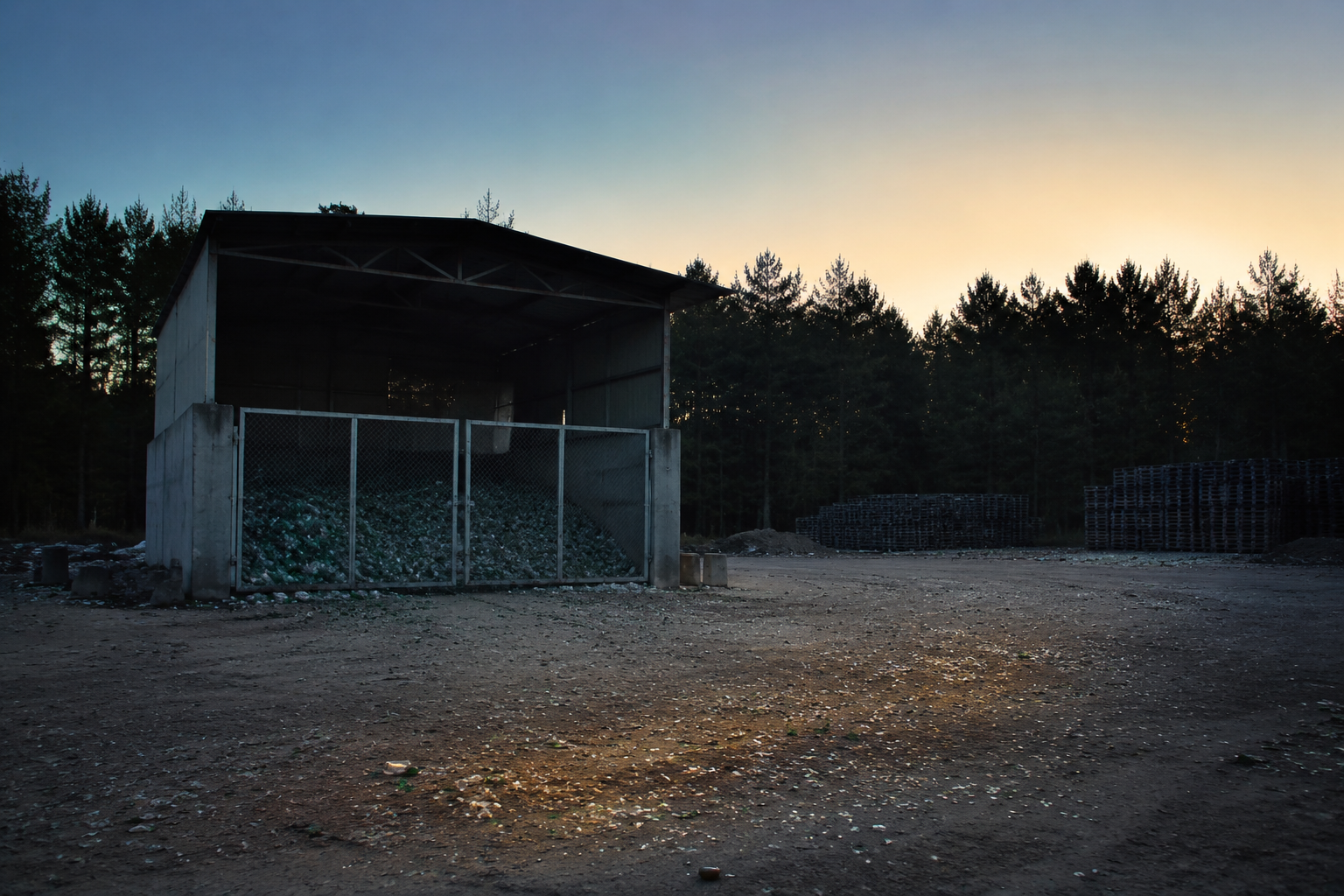
At the county recycling transfer station, the first clue was not the camera still. It was the glass.
In the recreated version, staff arrived before opening and found crushed green and brown bottle fragments outside the locked glass-crusher bay, where loose glass was not supposed to be. A long sorting rake leaned nearby with its metal teeth bent sideways.
Then someone checked the trail camera pointed toward the tree line.
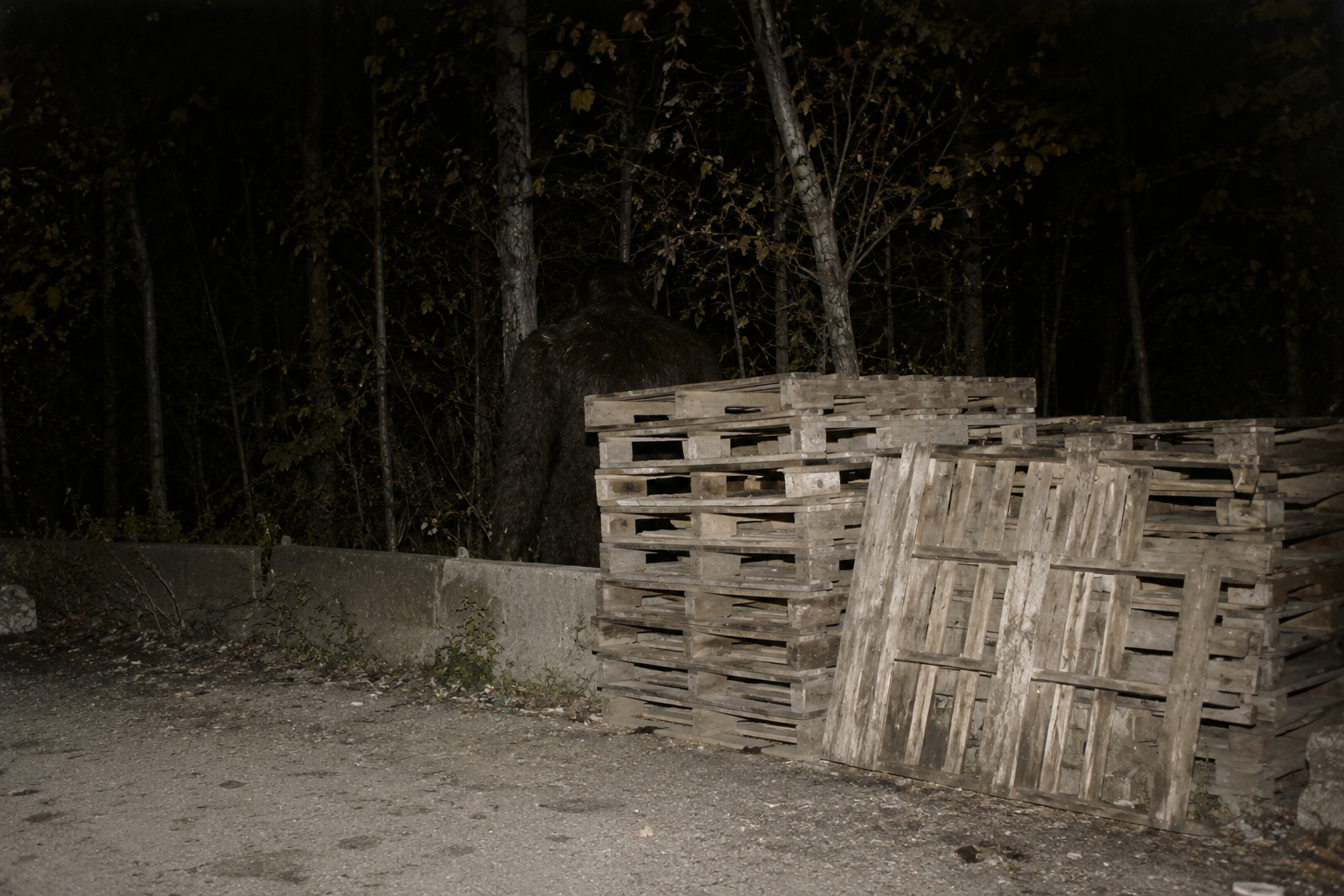
One still, reportedly taken during the quietest part of the night, seemed to show a broad opaque dark shape partly hidden behind stacked pallets near the woods.
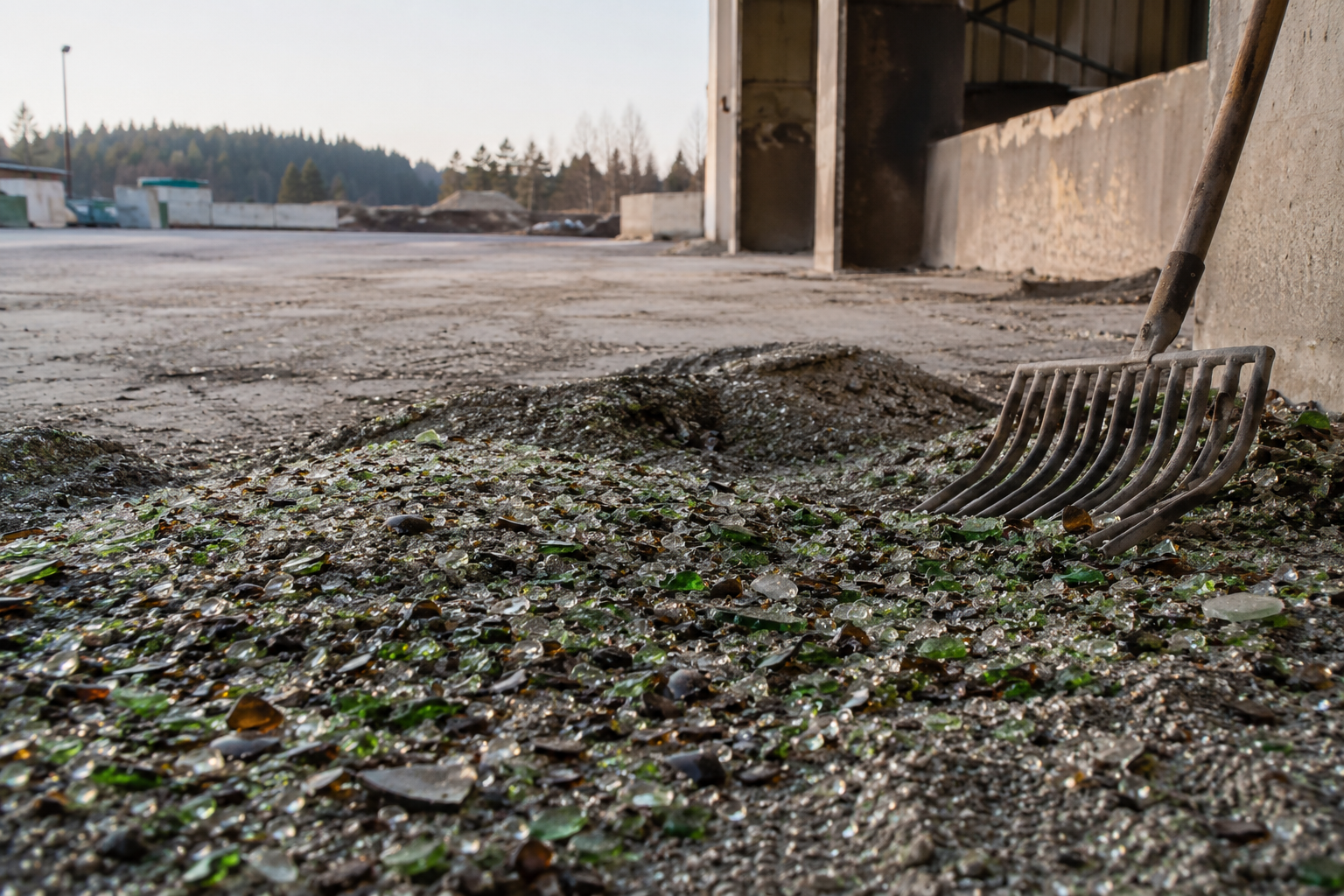
That is why this recycling-yard story keeps circulating: not because it confirms anything, but because the mess, the locked bay, and the image do not line up neatly.
WHAT THE CAMERA SHOWS – A dark, wide shape behind pallets at the edge of the transfer-station lot – No clear face, eyes, or readable body detail – A position close to the tree line, not inside the glass bay – A single still rather than a clean sequence – Enough ambiguity for locals to argue shadow, animal, trespasser, or something stranger
1. The Glass Was Outside the Locked Bay
Most rural transfer stations have a rhythm. Residents sort bags, cardboard, cans, and glass. Staff sweep the bays before closing. Gates are locked because a public works yard can become dangerous after dark.
That is why the glass outside the bay mattered.
The account describes fragments scattered where the path bends between the glass area and the pallet stack. Not a dramatic trail, just enough broken pieces to make staff stop and ask who had been there.
A simple explanation exists. Someone could have dropped a bin near closing. A bag could have split. Wind, animals, or a tire could have spread fragments farther than anyone noticed.
But the detail people repeated was location. The pieces were said to be outside the locked section, while the crusher bay itself was secured.
That does not make the story supernatural. It only creates the first mismatch.
A transfer station is full of mismatches: shifted scrap, loose bags, things blown against fences, raccoons that learn the schedule better than people. Still, local mysteries rarely begin with a monster-shaped clue. They begin with something out of place.
Here, it began with glass where glass did not belong.
2. The Sorting Rake Looked Bent, Not Dropped
The second detail was the rake.
Workers use long-handled sorting rakes to pull containers forward, clear jams, and keep hands away from sharp debris. They get abused. They bend. They are not delicate tools.
That is why this part of the account should be treated carefully.
A bent rake does not require a Sasquatch. It can be damaged by machinery, caught under a tire, wedged in a bin, or left leaning where something heavy slides into it.
What made people talk, according to the story, was the way the teeth were angled. They were described as bent sideways, as if the tool had been pulled against resistance rather than simply stepped on.
That may be interpretation added later. Memory hardens quickly around strange mornings. By lunchtime, “the rake was bent” can become “the rake was bent by something strong.”
Still, the rake became the second anchor because it gave the glass scene a sense of force.
Not violence. Not certainty. Force.
If the account is accurate, something disturbed the area between closing and opening. The question is whether that something was a person, equipment, wildlife, weather, or an unknown visitor moving along the tree line.
3. The Shape Stayed Behind the Pallets
The camera still is the part most people would click for, but it is also the least certain.
Trail cameras are blunt instruments. They turn darkness, rain, insects, low batteries, and moving branches into strange shapes. A single frame can make ordinary things look heavy, upright, and deliberate.
In this account, the still reportedly showed a broad opaque dark shape behind stacked pallets near the edge of the woods.
That matters because the shape was not standing in the open like a clean sighting. It was partly blocked. The pallets interrupted the outline. The tree line behind it made the dark area harder to separate from shadow.
For a skeptical reader, that is exactly why the image is weak.
For locals who retold it, that is exactly why it felt wrong.
A person might appear narrow unless bundled in dark clothing or turned sideways while carrying something. A bear could appear broad, especially if rising behind debris. A shadow from equipment could look solid if the camera exposed for a brighter patch of yard.
Yet the account says the shape appeared where staff did not expect anyone to be: behind the pallets, facing the lot from the woods rather than approaching the gate.
That posture, or the impression of posture, is what pushed the story into Bigfoot territory.
Not because the still settles the matter. It does not. But Bigfoot stories often hinge on a specific kind of presence: something large at the margin of a human work area, close enough to affect objects, far enough to remain unclear.
4. The Tree Line Changed the Whole Setting
By daylight, a transfer station can feel almost aggressively ordinary.
At night, the same place changes.
That setting does not make an account true. It explains why the story found an audience.
The most reasonable wildlife candidates are not mysterious. Raccoons, coyotes, foxes, feral dogs, deer, black bears in the right region, and scavenging birds can all leave confusing signs around waste sites.
A bear is especially worth mentioning if the county has them. Bears can bend objects, scatter debris, and look very strange on trail cameras.
5. The Timeline Leaves Room for Argument
The strongest version of the story depends on timing.
If staff closed the bay, cleaned the area, locked the gate, and then found fresh glass outside the bay before public access resumed, the mystery tightens. If any of those steps are uncertain, the mystery loosens.
That is why transfer-station accounts are tricky.
A site can be “locked” but still have gaps in fencing, low gates, drainage paths, or shared access for public works crews. A camera can miss key minutes. A staff member can remember a clean area that was actually only mostly clean.
There may also have been legal human activity: a late municipal drop-off, a contractor, a deputy checking the gate, or an employee retrieving something after hours.
None of that is as exciting as an unknown shape behind pallets. It is also how many strange accounts resolve.
The problem is that the local version apparently did not come with a tidy resolution. No one matched the shape to a tarp, a pallet shadow, or a piece of equipment with total confidence.
So the timeline became the fifth detail.
A single dark shape can be dismissed. Broken glass can be dismissed. A bent rake can be dismissed. Together, within a narrow overnight window, they become harder for the community to forget.
The Most Boring Explanation May Still Be Best
The cautious explanation is that several ordinary causes overlapped.
Someone may have left glass near the bay before closing. An animal may have moved through and scattered it. The rake may have been damaged earlier. The camera may have caught a shadow, bear, bundled person, or stacked material that looked more solid than it was.
That chain is possible enough that no responsible account should skip it.
The trouble is emotional, not scientific.
People who work the same grounds every week know the normal messes. They know what raccoons do. They know what the wind does. They know how a rake looks after a truck backs over it.
When those people say a morning felt off, the feeling is not evidence by itself. But it is part of why the story travels.
Local mysteries survive in the gap between “probably explainable” and “not explained to the people who found it.”
This one sits squarely in that gap.
The Detail That Keeps the Story From Closing
For me, the lingering detail is not the silhouette.
It is the distance between the locked bay and the tree line.
If the glass was outside the bay and the shape was at the pallets, the account describes two separate zones: the place where something was disturbed and the place where something was seen. That separation leaves room for several theories.
Maybe the camera caught an animal after the glass was already scattered. Maybe a trespasser moved through the lot and ducked behind the pallets. Maybe the shape was not connected to the glass at all.
Or maybe, as some locals reportedly wondered, the still caught the edge of whatever had been investigating the site before retreating into the trees.
The honest answer is that the available account cannot decide between those possibilities.
That is why it works as a WeirdWitnessed case. The story is not a clean answer. It is a cluster of clues from a place people rarely think about until something feels wrong there.
The glass could be mundane. The rake could be old damage. The still could be shadow.
But if all three belonged to the same night, what moved through the recycling yard after the gate was locked?
And why did it stop, or seem to stop, behind the pallets at the edge of the woods?
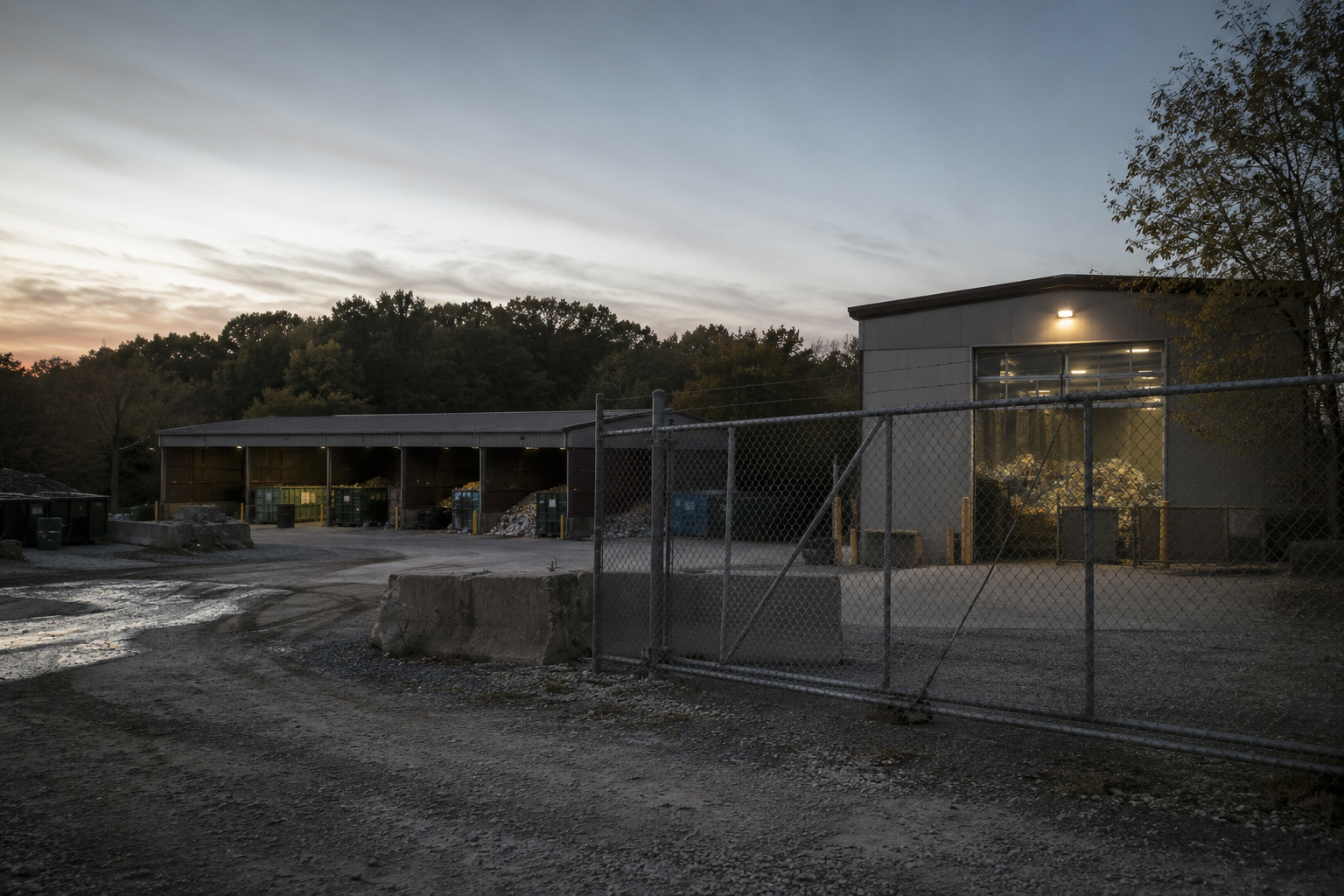
For now, the transfer station story stays in the uncomfortable space between a routine overnight mess and a trail-camera still that locals could not file away neatly.
Reader Context
This Weird Witnessed story is an editorial reconstruction, written as eerie visual storytelling rather than a verified report. For more context, see Bigfoot and Sasquatch Stories Guide and How WeirdWitnessed Creates Reconstructed Horror Stories.